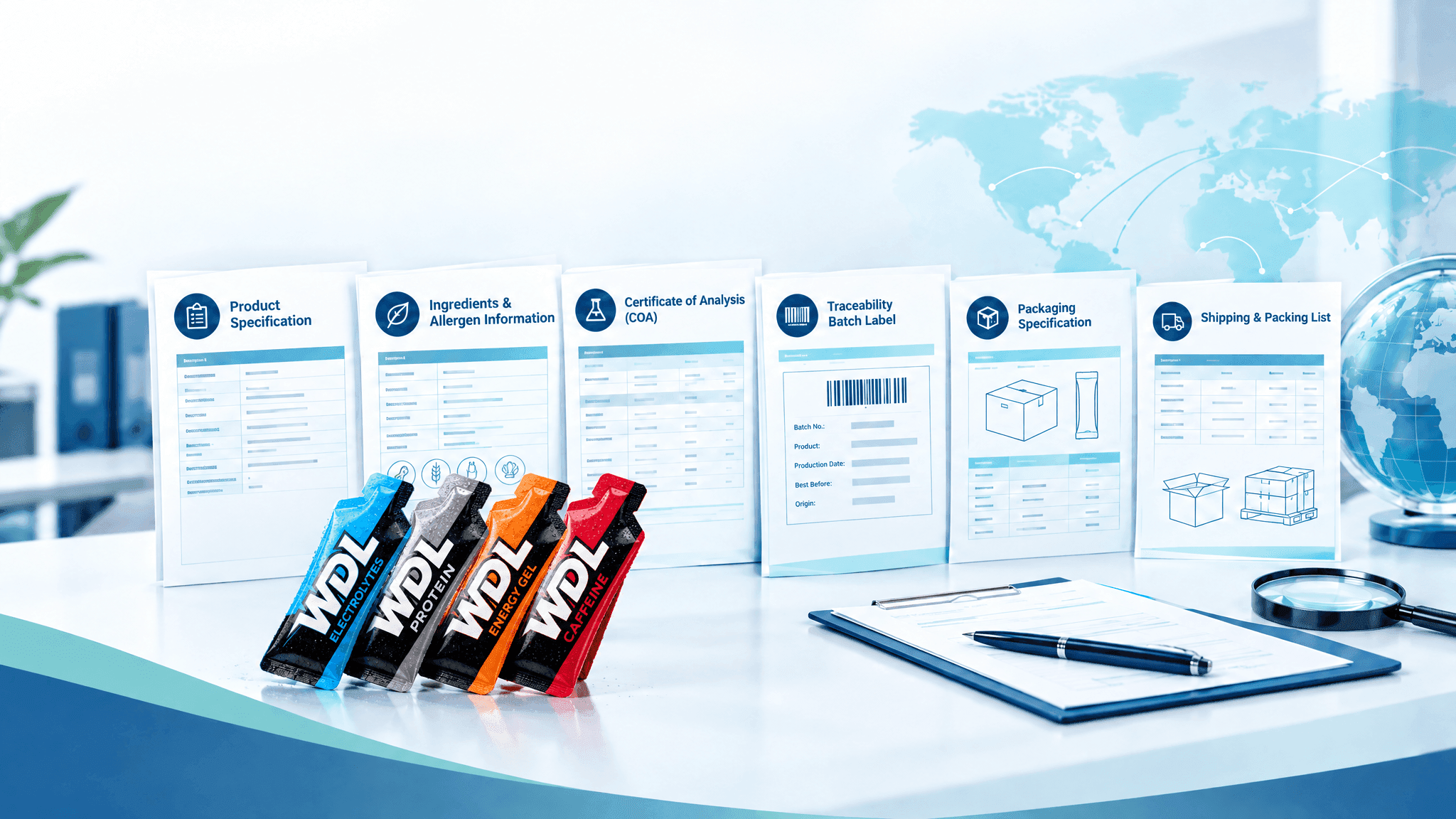
What Documents Should Importers Request From a Functional Jelly Manufacturer
A supplier quotation does not show whether a functional jelly project is ready for import and retail. This guide explains the product, food-safety, testing, traceability, shelf-life, packaging and commercial documents buyers should review before placing an order.
What Documents Should Importers Request From a Functional Jelly Manufacturer
A product sample can answer an important question: does the jelly look, taste and feel right?
It cannot answer every question an importer needs to resolve before ordering.
Before a private-label functional jelly enters production, the buyer may also need to understand what the product is, how it is controlled, how each lot can be traced, what evidence supports its shelf life, what information is available for label review and which responsibilities remain with the importer.
That requires documents.
The goal is not to collect the largest possible folder. A generic certificate pack can create the appearance of diligence without confirming whether the documents apply to the exact product, factory, market and order under review.
The better question is:
Which document helps us make which decision?
For importers, distributors and private-label brands, a useful document review should connect five areas:
Product identity + Food safety + Market requirements + Traceability + Commercial execution
The exact list varies by product and destination market, but the following framework gives buyers a practical starting point.
1 Start With a Product Specification Sheet
The product specification sheet is one of the most useful documents in an OEM project because it defines what is actually being purchased.
Depending on the project, it may cover:
- product name and product type
- serving format and net content
- ingredient list
- key physical or sensory characteristics
- functional ingredient targets where applicable
- packaging format
- storage conditions
- shelf-life target
- microbiological or chemical limits
- coding and traceability information
- destination-market version
A specification should be specific enough for the buyer, manufacturer and quality teams to recognize the same product.
That distinction matters when a supplier offers several related platforms. A 25 g beauty jelly stick, an 80 ml fiber pouch and an electrolyte freezer pop may all use hydrocolloid technology, but they are not the same commercial or technical product.
Importers should confirm that the specification matches the approved sample and final quotation. If the formula, serving size, packaging or market changes, the document may need to change as well.
2 Review the Ingredient and Allergen Information
The ingredient list is not only a marketing input. It supports label development, allergen review, customs classification discussions and market-specific compliance work.
Buyers should ask for the ingredient information in a form that clearly identifies the finished-product formulation rather than only presenting a sales summary.
Questions may include:
- Are compound ingredients broken down sufficiently for the intended market?
- Are flavors, colors, sweeteners and preservatives identified appropriately?
- Are functional ingredients listed by their correct commercial or regulatory names?
- Is allergen information available for the finished product and relevant production environment?
- Has the ingredient list been updated after the final sample revision?
The manufacturer can provide formulation information, but the final legal label should still be reviewed for the destination market. A term accepted in one market may require different wording or treatment in another.
This is especially important for functional products because the front-of-pack concept may use simple language while the ingredient declaration requires much greater precision.
3 Ask for Nutrition and Label Development Inputs
Nutrition information should be treated as part of product development, not as a decorative panel added after the formula is finished.
The buyer may need inputs such as:
- nutrition data for the final formulation
- serving size and servings per package
- net quantity information
- preparation or consumption instructions
- storage statements
- allergen statements
- manufacturer or responsible-party details
- country-of-origin information
- lot and date-code format
Not every value is produced in the same way. Depending on the project and market, nutrition information may be calculated, supported by ingredient data, laboratory tested or developed through another accepted method.
The buyer should therefore ask how the information was generated and whether it applies to the exact finished product.
Claims require separate attention. The presence of collagen, fiber, vitamins, electrolytes or botanicals does not automatically authorize every benefit statement a brand may want to use. Formula targets, finished-product data, serving size and local claim rules must be evaluated together.
4 Verify Food Safety Certificates and Their Scope
Certificates can be useful supplier-screening documents, but only when the buyer checks what they actually cover.
For each relevant certificate, review:
- the legal company and factory name
- the manufacturing-site address
- the certification standard
- the product or process scope
- the issuing or certification body
- issue and expiry dates
- certificate status
A valid-looking document for another facility or an unrelated product scope may not answer the buyer's question.
Importers should also distinguish between a management-system certificate, a product test report, a registration document and a shipment document. They serve different purposes and should not be treated as substitutes for one another.
Where a buyer's supplier-verification program requires additional evidence, the importer may need audit information, food-safety records or other documentation appropriate to the product risk and applicable law.
5 Define Certificate of Analysis and Testing Expectations
The phrase test report is too broad to be useful by itself.
Buyers should define what they need to know, for which product and at which stage.
Depending on the formula and market, the discussion may include:
- microbiological testing
- relevant chemical or contaminant testing
- functional ingredient verification
- nutrition verification
- packaging integrity
- fill weight or net content controls
- pH or soluble-solids targets where relevant
- sensory or physical checks
A Certificate of Analysis, or COA, may summarize selected results for a specific product or lot. Buyers should confirm the parameters, methods or references, acceptance limits, sample identity, date and issuing laboratory or quality function.
One historical report can help explain the product, but it may not replace batch-specific or shipment-specific documentation when that is required.
The right testing plan depends on the product, ingredients, destination market, customer requirements and risk assessment. It should be agreed before production whenever possible.
6 Confirm Traceability and Lot Coding
Traceability allows a finished product to be connected with production and distribution records.
Before ordering, buyers should understand:
- where the lot code will appear
- how the production date and expiry or best-before date are shown
- whether inner packs, retail packs and master cartons can be connected
- what records identify the production batch
- how ingredient and packaging lots are recorded
- how retained samples or complaint investigations are handled
The importer does not necessarily need every internal factory record in advance. It does need confidence that the manufacturer has a traceability system and can retrieve appropriate information when required.
This becomes especially important when the same product is sold in several flavors, pack sizes or destination-market versions. Clear coding reduces the risk of confusing one commercial version with another.
7 Request Shelf Life and Storage Support
Shelf life should not be treated as a number copied from a similar product.
Functional ingredients, acidity, sweetness, hydrocolloid system, processing, barrier properties, package seal and storage conditions can all affect product stability.
Useful shelf-life documentation may include:
- the stated shelf life of the finished product
- required storage conditions
- the basis used to establish or support the shelf life
- relevant stability or retention observations
- packaging configuration used in the assessment
- instructions after opening where applicable
For products designed to freeze at home, buyers should also separate ambient storage before freezing from the consumer's frozen consumption experience. The supply-chain condition and the use condition are not the same.
If a formula or package changes materially, the buyer should ask whether the existing shelf-life support still applies.
8 Review Packaging and Shipping Specifications
Packaging documents connect the product with manufacturing, logistics and retail execution.
The buyer may need specifications for:
- primary packaging material and dimensions
- seal or closure format
- retail carton
- master carton
- units per carton
- carton dimensions and gross weight
- pallet configuration where applicable
- barcode placement
- artwork version
- storage and transport conditions
For direct-food-contact packaging, the project may also require relevant supplier declarations, compliance information or testing appropriate to the destination market and packaging material.
Packaging review should occur before artwork is released and before freight planning is finalized. A small change to pouch size, carton count or pallet pattern can affect unit economics, warehouse handling and retail presentation.
9 Separate Manufacturer Documents From Importer Responsibilities
A supplier can provide important product and factory information, but it cannot automatically assume every responsibility of the importer, brand owner or local regulatory representative.
For the United States, importers subject to the Foreign Supplier Verification Programs rule generally need a program appropriate to the food and supplier. FDA guidance explains that applicable records may include hazard analysis, supplier-performance evaluation, approval procedures, verification activities, corrective actions and reevaluation.
For the European Union, traceability and import controls apply within a broader food-law framework, while specific documentary and border requirements depend on the product category and risk.
This means a buyer should not ask only:
Can the factory send export documents?
The buyer should also ask:
What must our importing entity, broker, distributor, label reviewer or local authority complete for this product?
Responsibilities should be assigned clearly. Otherwise, both parties may assume the other is handling the same requirement.
10 Add Commercial and Production Documents
Compliance documents do not replace commercial clarity.
Before the purchase order is finalized, the project should also align on documents such as:
final quotation
- approved product specification
- approved packaging specification
- artwork approval
- sample approval record
- purchase order
- production and delivery schedule
- inspection arrangement where applicable
- packing list and invoice requirements
- shipping marks
agreed shipment documents
These records reduce ambiguity about what was approved, what will be produced and what will travel with the shipment.
For customized products, version control matters. File names such as final artwork new 2 do not provide a reliable approval history. Each party should be able to identify the current formula, specification and artwork version.
11 Watch for Common Document Review Problems
A document pack deserves further questions when:
- the product name does not match the quotation or sample
- the factory address differs across certificates without explanation
- documents are expired or difficult to verify
- the certificate scope does not cover the relevant activity
- test reports do not identify the tested sample clearly
- ingredient or nutrition information changes between versions
- shelf-life claims are unsupported or copied from another format
- packaging details do not match the shipping quotation
- the supplier sends marketing brochures instead of requested records
None of these points automatically proves that a supplier is unsuitable. They do indicate that the buyer needs clarification before relying on the document.
A professional supplier discussion should make it possible to separate unavailable information, information still under development and information that can be provided after a batch is produced.
12 Use a Stage Based Document Checklist
Requesting every possible document in the first email can slow the project and produce a folder that nobody reviews.
A more useful sequence is:
Supplier Screening
Review company identity, manufacturing location, relevant certification scope, product capability and initial quality information.
Product Development
Align the formulation brief, ingredient information, serving size, specification targets, packaging concept and destination market.
Sample Approval
Confirm the approved sample, current formula direction, sensory targets and any testing or data still required.
Preproduction
Approve the final product specification, artwork, packaging specification, testing plan, coding format and purchase order.
Shipment
Collect the agreed batch, inspection, packing, invoice, traceability and shipment documents.
This approach makes document collection part of project management rather than a last-minute customs exercise.
A Practical Buyer Request List
Before placing an order, an importer can ask the manufacturer to confirm the availability and timing of:
1.Company and manufacturing-site information
2.Relevant food-safety certificates with scope and validity
3.Finished-product specification
4.Ingredient and allergen information
5.Nutrition and label-development inputs
6.Testing plan and available reports
7.COA format or batch-release documentation where applicable
8.Shelf-life and storage support
9.Lot-coding and traceability information
10.Primary and secondary packaging specifications
11.Carton and logistics data
12.Final commercial and shipment documents
The buyer should identify which items are needed for supplier approval, label development, production release or shipment. Not every document exists at the same stage.
Developing Document Ready Functional Jelly Projects With Victory Foods
Victory Foods China develops OEM and ODM hydrocolloid-based products across functional wellness, konjac jelly, squeeze jelly, freezer pops, popping boba and sports nutrition formats.
For a document-ready inquiry, buyers should provide:
Destination market + Product format + Consumer + Functional targets + Serving size + Flavor + Packaging + Claims direction + Order estimate + Target shelf date
That information helps the manufacturer identify which existing documents are relevant and which product-specific records must be created during development.
The objective is not to promise that one document pack fits every country.
It is to build a project in which the product, evidence, label, packaging and shipment records describe the same finished item.
FAQ
What is the first document I should request from a functional jelly manufacturer
Start with a finished-product specification or a clear preliminary specification. It helps define the product, serving format, ingredients, packaging, storage and quality targets that other documents should support.
Is a food safety certificate enough to approve a supplier
No. A certificate can support supplier screening, but buyers should review its company name, site, scope, issuing body and validity, then evaluate product-specific specifications, controls, testing, traceability and market requirements.
Should every shipment include a Certificate of Analysis
That depends on the product, contract, customer requirements and destination market. Buyers should agree in advance whether a COA is required, which parameters it covers and whether the document is batch specific.
When should packaging documents be approved
Primary-pack and carton specifications should be aligned before final artwork, commercial production and freight planning. Packaging changes can affect labeling, sealing, case counts, pallet configuration and logistics cost.
Can the manufacturer handle all importer compliance responsibilities
The manufacturer can provide product, factory and shipment information, but the importer or local responsible party may retain separate legal duties. Responsibilities should be confirmed for the specific product and destination market.