Private Label Functional Jelly: What Buyers Should Prepare Before Requesting Samples
Planning a private label functional jelly? Learn what information brands should prepare before requesting samples—from product format and functional ingredients to flavor, texture, packaging and target market—so your OEM/ODM development process can start more efficiently.
Private Label Functional Jelly: What Buyers Should Prepare Before Requesting Samples
A successful private label functional jelly project starts long before the first sample is produced.
For brands, importers and distributors, requesting samples may feel like the first step. In practice, however, the quality of the initial product brief can significantly affect how efficiently an OEM/ODM manufacturer understands the concept, evaluates feasibility and begins formulation work.
The clearer your brief, the easier it is for the manufacturer to translate an idea such as “a healthy jelly for active consumers” into specific decisions about format, ingredients, texture, flavor, packaging and processing.
If you are planning a private label functional jelly, here are the key points worth preparing before contacting a manufacturer.
1. Define the Product Concept Before the Formula
Start with the bigger picture.
Instead of beginning with a long ingredient list, explain what the product is supposed to do, who it is for and when consumers are expected to use it.
For example:
- Is it designed for sports nutrition, hydration, beauty, daily wellness or convenient snacking?
- Who is the primary consumer?
- Where will they consume it—at the gym, at work, outdoors, while traveling or at home?
- Will it be positioned as a food, snack or another type of product in your target market?
A concept such as “portable hydration for endurance athletes” gives an R&D team a very different starting point from “zero-sugar beauty jelly for everyday wellness.”
The concept helps determine the appropriate serving format, ingredient system, flavor direction and texture.
2. Choose the Product Format
Functional jelly is not a single format.
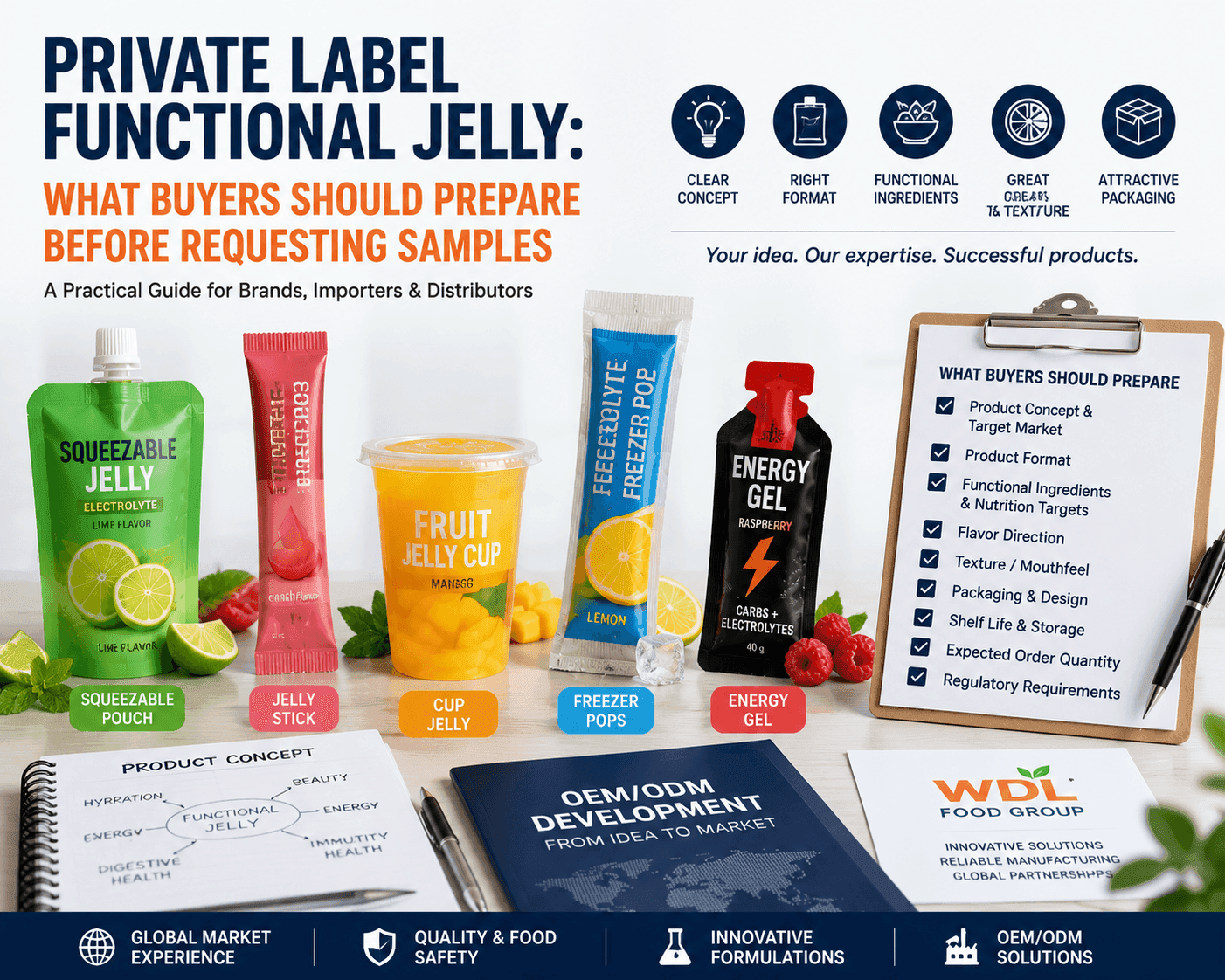
Depending on the target market and consumption occasion, brands can explore different delivery formats.
A spouted pouch can work well for drinkable or squeezable jelly products and offers a relatively large surface for branding.
Jelly Stick
Compact stick packaging creates a portable, portion-controlled format suitable for functional snacking and daily wellness concepts.
Cup Jelly
Cups can provide a more traditional snack experience and may suit retail multipacks or family-oriented products.
Freezer Pop
Some formulas can be designed for ambient distribution and frozen before consumption, creating a different experience for summer or hydration concepts.
Energy Gel
For sports nutrition projects, a compact gel pouch can provide a convenient format for carbohydrates, electrolytes or other permitted ingredients depending on the intended formula and market.
The format should be selected around the consumer experience—not simply because a particular package looks attractive.
3. Prepare Your Functional Ingredient Targets
One of the most useful things a buyer can provide is a clear nutritional objective.
Instead of writing:
“Please make a healthy jelly with lots of functional ingredients.”
Try to define:
- Which functional ingredients are important?
- Do you have a target amount per serving?
- Are there ingredients you must include?
- Are there ingredients you want to avoid?
- Do you require sugar-free, reduced-sugar or another sweetness direction?
- Are there relevant dietary or allergen requirements?
Depending on the project, brands may explore ingredients associated with categories such as dietary fiber, electrolytes, vitamins, collagen, carbohydrates or other permitted functional ingredients.
However, more is not always better.
Higher active-ingredient levels can influence taste, acidity, sweetness, viscosity, gel structure and processing behavior. Some ingredients may also interact with each other or require special consideration during production.
This is why a target nutrition profile is often more useful to the manufacturer than an extremely long ingredient wish list.
The R&D team can then evaluate how close the desired nutritional profile can reasonably come to the intended eating experience.
4. Define Your Flavor Direction
Flavor becomes especially important in functional foods because active ingredients can influence the final taste.
Some minerals may introduce salty or bitter notes. Certain plant ingredients may have distinctive aromas. High levels of fiber can affect both mouthfeel and flavor perception.
When preparing your brief, consider providing:
- preferred fruit or flavor profiles;
- desired flavor intensity;
- whether you prefer a light, refreshing or richer profile;
- benchmark products you like;
- flavors or aftertastes you specifically want to avoid.
For many projects, flavor development and functional formulation should happen together rather than as separate steps.
A technically impressive nutrition panel is unlikely to build repeat purchase if consumers do not enjoy eating the product.
5. Describe the Texture You Want
Texture is one of the most important—and often overlooked—parts of functional jelly development.
“Jelly” can describe very different experiences.
A product might be:
- light and drinkable;
- smooth and squeezable;
- soft-bite;
- firm and chewy;
- elastic;
- pudding-like;
- or designed with inclusions such as fruit pieces or popping boba.
Hydrocolloid systems such as konjac gum, carrageenan, pectin, gellan gum and locust bean gum can be used in different combinations depending on the desired product structure and formulation.
Rather than simply asking for “good texture,” give the manufacturer a sensory reference.
For example:
- “We want a light jelly that can be consumed directly from a spouted pouch without feeling too thick.”
is much more useful than:
- “We want premium texture.”
If you already have a benchmark product, sharing it or describing its texture can significantly improve communication during development.
6. Define the Target Market Early
Where will the product be sold?
This question should be answered before the final formula and packaging are confirmed.
Different markets can have different requirements concerning ingredients, nutrition labeling, claims, allergens and packaging information.
A formula developed for one country should not automatically be assumed to meet the requirements of another.
Tell your manufacturing partner which market or markets you intend to enter so regulatory and labeling requirements can be considered during development.
For brands planning multi-market launches, identifying the priority market first can also simplify the initial development process.
7. Think About Shelf Life and Storage Conditions
Shelf life is not just a number printed on the package.
Brands should tell the manufacturer how the product is expected to travel through the supply chain.
Consider:
- Will it be stored at ambient temperature?
- Will consumers refrigerate or freeze it?
- Will the product be shipped through hot climates?
- How long does your distribution model require the product to remain saleable?
- Will the product be sold through supermarkets, pharmacies, convenience stores, e-commerce or another channel?
Processing, formulation, packaging and storage conditions all influence product stability.
The final shelf-life specification should therefore be established through the appropriate product-development and validation process rather than assumed at the concept stage.
8. Prepare Your Packaging and Branding Direction
Packaging is part of the product development process—not something that should only be considered after the formula is finished.
Before requesting samples, it is useful to know whether you are considering:
- a stick sachet;
- spouted pouch;
- cup;
- freezer-pop sleeve;
- multipack;
- display box;
- or another configuration.
You do not necessarily need finished artwork.
However, sharing approximate pack size, serving size, target retail channel and branding direction helps the manufacturer understand the commercial product you are trying to build.
Packaging dimensions can also affect filling equipment, product weight and production feasibility.
9. Be Open About Expected Order Quantity
MOQ is an important part of private label food manufacturing because customized printed packaging, ingredients and production setup all have minimum economic quantities.
Buyers sometimes request a very small trial quantity while also requiring fully customized packaging and formula development.
Those objectives may conflict.
A more productive approach is to tell the manufacturer:
- your expected first order quantity;
- your estimated annual demand if available;
- whether you plan to launch one SKU or several;
- whether custom printed packaging is required from the first order.
The manufacturer can then recommend a development and packaging route that better fits the project.
10. Use Samples to Refine the Product, Not Just Approve It
The first prototype does not always need to be the final product.
Sampling is an opportunity to evaluate the relationship between function and sensory experience.
When reviewing samples, provide specific feedback.
Instead of:
- “The taste isn't right.”
try:
- “The sweetness is suitable, but the citrus acidity is too strong and we would like a lighter texture.”
Useful feedback may cover:
- sweetness;
- acidity;
- aroma;
- aftertaste;
- thickness;
- chewiness;
- color;
- serving size;
- packaging usability.
Specific sensory feedback helps R&D teams make more targeted adjustments in the next development round.
A Better Product Brief Creates a Better Starting Point
Private label functional jelly development works best as a collaboration between the brand and the manufacturer.
The brand understands its consumers, positioning and commercial goals.
The manufacturer understands formulation, hydrocolloid behavior, processing and production constraints.
A strong initial brief connects those two areas.
Before requesting your next sample, prepare five essentials:
Target Consumer + Product Function + Format + Nutrition Target + Sensory Direction.
Everything else can then become progressively more detailed during development.
Developing Private Label Functional Jelly with Victory Foods
Victory Foods develops hydrocolloid-based products across categories including squeezable jelly drinks, konjac jelly, functional wellness jelly and sports nutrition formats. Our product portfolio also supports OEM/ODM development for international brands and distributors.
For a new project, providing the target market, product concept, desired format, functional ingredient targets, flavor direction and packaging requirements gives our development team a much stronger starting point.
The goal is not simply to make a sample.
It is to develop a product concept that can realistically move from R&D to commercial production.
FAQ
What information should I send a functional jelly manufacturer before requesting samples?
At minimum, prepare your target market, intended consumer, product function, desired format, ingredient or nutrition targets, flavor direction, preferred texture and packaging concept.
Can functional jelly formulas be customized?
Yes, OEM/ODM projects can typically involve customization of ingredients, sweetness, flavor, texture and packaging, subject to formulation feasibility, manufacturing requirements and the regulations of the destination market.
Can I request zero-sugar functional jelly?
Zero-sugar concepts are possible for certain products, but the formulation and final labeling claim should be evaluated according to the ingredients, nutrition profile and regulations of the target market.
Why does a manufacturer need to know my target country?
Ingredient permissions, labeling rules and nutrition or health claims can differ between markets. Knowing the destination market early helps the development process account for those requirements.
Should I send a benchmark product?
If available, yes. A benchmark can help communicate flavor, texture, sweetness and packaging expectations much more precisely than descriptive words alone.