Why Hydration Is Moving Beyond Sports Drinks: 5 Product Formats Brands Can Build in 2026
Hydration is moving beyond traditional sports drinks. Explore five functional hydration formats brands can develop in 2026, from electrolyte jellies to freezer pops and energy gels.
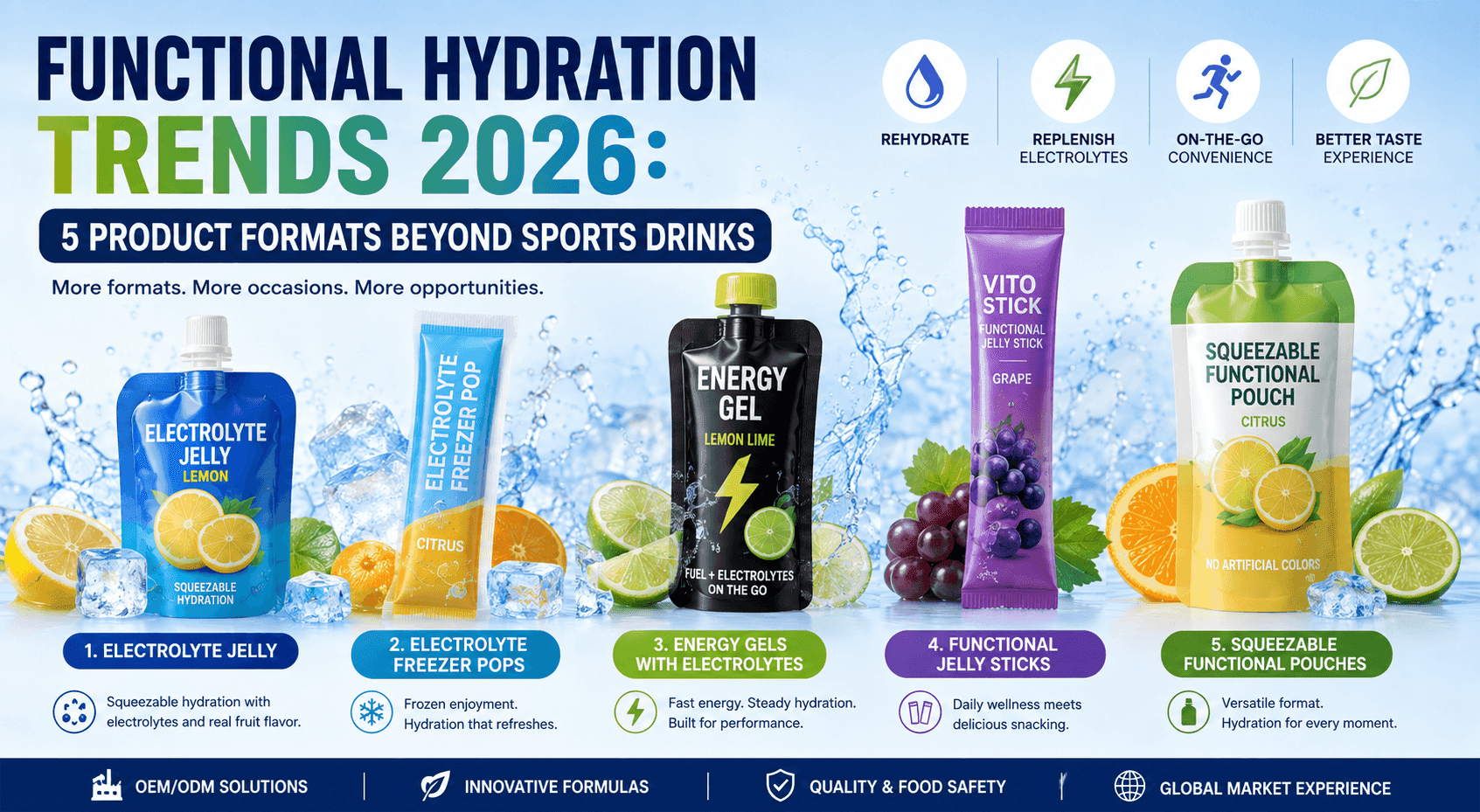
# Functional Hydration Trends 2026: 5 Product Formats Beyond Sports Drinks
For decades, hydration products were easy to recognize: a bottle of sports drink, usually positioned around exercise, sweating, or recovery.
In 2026, that definition is becoming much broader.
Hydration is increasingly moving into the wider functional food and beverage market, where consumers expect products to fit different moments of the day, different lifestyles, and different consumption preferences. That shift creates an important opportunity for brands: the next hydration product does not necessarily need to be another bottled sports drink.
Electrolytes can now be delivered through functional jellies, freezer pops, energy gels, squeezable pouches, and other portable formats.
For brands, importers, distributors, and retailers developing new functional products, format may therefore become just as important as formulation.
Why Is Functional Hydration Growing Beyond Sports Nutrition?
Hydration remains fundamental to sports nutrition, but the commercial opportunity is expanding beyond athletes.
Consumers increasingly encounter electrolyte products positioned around travel, outdoor activities, hot weather, work, festivals, wellness routines, and everyday convenience.
This is part of a broader shift in functional foods and beverages: consumers are not simply choosing a flavor or refreshment anymore. They are increasingly looking for products designed around a specific occasion or function.
That changes the product-development question.
Instead of asking:
“How do we launch another sports drink?”
Brands can ask:
“What is the most convenient and enjoyable way for our target consumer to use a hydration product?”
The answer may be a drink—but it could also be a jelly, frozen snack, gel, or squeezable pouch.
Here are five formats worth considering.
1. Electrolyte Jelly: Hydration in a Squeezable Format
An electrolyte jelly combines a soft or drinkable jelly texture with a formulation designed to contain selected electrolytes.
Unlike a conventional beverage, the product can be packed in a compact pouch and consumed by squeezing directly from the package.
This creates several interesting positioning possibilities.
A brand might develop an electrolyte jelly for:
- outdoor activities
- travel
- sports and fitness
- summer retail
- convenience stores
- functional snack ranges
Texture is particularly important in this format.
A hydration jelly should generally feel light and easy to consume rather than excessively thick or gummy. Electrolyte levels, sweetness, acidity, flavor and hydrocolloid structure therefore need to be developed together rather than independently.
For private-label projects, brands should discuss the desired nutritional target and eating experience with the manufacturer before finalizing the formula.
2. Electrolyte Freezer Pops: Ambient Logistics, Frozen Consumption
Freezer pops offer a very different hydration experience.
The product can be manufactured and distributed as an ambient liquid product and frozen by the retailer or consumer before consumption, depending on the formulation and packaging design.
That distinction can be commercially important.
Traditional frozen products require continuous temperature-controlled logistics. An ambient-to-freeze product can potentially simplify transportation and warehousing because the product does not necessarily need to remain frozen throughout the supply chain.
For distributors operating across large territories or hot-weather markets, this can create an interesting combination:
functional positioning + frozen consumption experience + potentially simpler logistics.
Flavor also becomes especially important after freezing because cold temperatures can change how sweetness and acidity are perceived.
For that reason, a formula intended to be consumed frozen should be developed specifically for that consumption condition rather than simply copying a room-temperature beverage formula.
3. Energy Gels with Electrolytes: Hydration Meets Sports Fuel
Energy gels remain one of the most established portable formats in endurance sports.
But modern sports nutrition products do not have to focus on carbohydrates alone.
Depending on the intended market and regulatory requirements, brands may explore formulations combining carbohydrate sources with selected electrolytes and other permitted functional ingredients.
This creates a more concentrated product designed for specific consumption occasions such as:
- running
- cycling
- hiking
- endurance events
- training
- outdoor sports
The key difference between an energy gel and an electrolyte jelly is product purpose.
An **energy gel** is typically developed primarily around portable sports fueling.
An **electrolyte jelly** may be positioned more broadly around hydration, refreshment or functional snacking.
That distinction should influence everything from formulation and texture to serving size and packaging communication.
4. Functional Jelly Sticks: Turning Hydration Into a Daily Wellness Format
Not every electrolyte product needs to look like sports nutrition.
Jelly sticks offer another direction: combining functional ingredients with a snack-like experience.
This is particularly relevant as functional nutrition moves into everyday consumption.
A brand could develop different concepts around a stick-format product, such as a summer electrolyte jelly, a vitamin-and-electrolyte jelly, or another market-specific wellness concept where permitted.
The advantage is psychological as much as technical.
Consumers may perceive a colorful jelly stick differently from a traditional sports drink or supplement. It can sit closer to the intersection of **snacking, convenience and functional nutrition**.
That gives brands more freedom in areas such as:
- flavor
- packaging design
- target demographic
- consumption occasion
- multipack configuration
- brand storytelling
For retailers, it can also create merchandising opportunities outside the traditional sports nutrition aisle.
## 5. Squeezable Functional Pouches: A Flexible Platform for New Concepts
The squeezable pouch may be one of the most flexible platforms for functional product development.
Depending on formulation and local regulatory requirements, brands can explore products with different textures—from relatively fluid beverages to thicker drinkable jellies.
This flexibility makes the format suitable for concepts built around hydration as well as other functional categories.
It also gives brands significant freedom in package design.
Spouted pouches can provide a large printable surface for branding while remaining portable and easy to consume. For children's products, sports concepts, wellness products or convenience-focused ranges, packaging shape and graphics can become part of the product experience itself.
## Which Hydration Format Is Best for a New Brand?
There is no single best format.
The correct choice depends on the target consumer, retail channel, formulation and intended consumption occasion.
| Product Format | Potential Positioning | Consumption Experience |
|---|---|---|
| Electrolyte Jelly | Everyday or active hydration | Soft / squeezable |
| Freezer Pop | Summer and frozen hydration | Frozen |
| Energy Gel | Endurance sports | Concentrated / portable |
| Functional Jelly Stick | Wellness and functional snacking | Snack-like |
| Squeezable Pouch | Broad functional concepts | Drinkable / squeezable |
A sports nutrition company may prefer an energy gel.
A supermarket brand preparing a summer promotion may see more potential in freezer pops.
A youth-oriented wellness brand might choose a colorful jelly stick.
A distributor looking for an unusual functional product may explore electrolyte jelly.
Product development should begin with the consumer occasion, not simply the ingredient list.
- What Should Brands Tell an OEM/ODM Manufacturer?
Before requesting samples, brands should prepare a basic product brief.
Useful information includes:
### Target market
Where will the product be sold?
Regulatory requirements, permitted ingredients and labeling rules differ between countries.
- Target consumer
Is the product intended for athletes, families, children, travelers, general wellness consumers or another audience?
- Desired format
For example:
- stick pack
- spouted pouch
- freezer pop
- jelly sachet
- gel pouch
- Nutrition targets
Instead of simply requesting “high electrolytes,” provide measurable targets where possible.
The manufacturer can then evaluate formulation feasibility, flavor impact and texture.
- Flavor direction
Electrolytes can influence taste, so flavor development is an important part of functional hydration formulation.
Citrus-style profiles such as lemon, lime, grapefruit and yuzu can be useful starting directions, but the best flavor depends on the complete formulation and target market.
- Sweetness strategy
Brands should also define whether they want conventional sugar, reduced sugar, no added sugar, or another sweetness system where legally permitted.
These decisions affect much more than the nutrition panel—they influence flavor, mouthfeel and overall consumer acceptance.
## From Beverage Category to Hydration Platform
The most important hydration trend may not be a single new ingredient.
It is the expansion of hydration into **more formats and more consumption occasions**.
For product developers, that creates a larger innovation space.
Electrolytes no longer have to live exclusively inside a bottle marketed to athletes. They can become part of frozen treats, squeezable jellies, portable sports gels and functional snacks.
For brands entering the category, the opportunity is therefore not simply to copy an existing hydration product.
It is to determine **where hydration fits into the consumer's day—and then design the format around that moment.**
## Developing Functional Hydration Products with Victory Foods
Victory Foods China develops and manufactures hydrocolloid-based foods and functional products for international markets, including functional jellies, sports nutrition formats, freezer pops and squeezable products.
OEM/ODM projects can be developed around different flavors, textures, packaging formats and functional concepts according to project requirements and the regulations of the destination market.
For brands exploring an electrolyte jelly, functional freezer pop, sports gel or another hydration concept, the development process should begin with the target market, nutritional objectives, desired texture and packaging format.
That gives the R&D team a much clearer starting point for evaluating formulation feasibility and developing samples.
---
## Frequently Asked Questions
### Can electrolytes be added to jelly products?
Electrolytes can be incorporated into certain jelly formulations, but the appropriate ingredients and levels depend on the formulation, serving size, flavor profile, target market and applicable regulations. Higher mineral levels can also affect taste, so formulation and flavor development should be considered together.
### What is the difference between an electrolyte jelly and an energy gel?
An electrolyte jelly is generally built around a jelly-based hydration or functional-snacking concept, while an energy gel is usually designed primarily for portable sports fueling. Exact formulations vary by brand and market.
### Can functional freezer pops be shipped without frozen logistics?
Some freezer-pop products are designed for ambient transportation and storage before being frozen for consumption. Whether this is possible depends on the specific formulation, processing, packaging, shelf-life validation and destination-market requirements.
### Can a private-label brand customize the electrolyte formula?
OEM/ODM manufacturers can develop formulas toward a customer's requested nutritional targets, but feasibility must be evaluated against taste, texture, ingredient compatibility, processing requirements and local regulations.
### What information should I prepare before requesting functional jelly samples?
A useful development brief should include the target country, target consumer, serving size, desired format, nutritional targets, preferred flavors, sweetness requirements, packaging concept and any benchmark products.