
Fiber Is Moving Into Everyday Snacks: What It Means for Functional Jelly Brands
Fiber is moving beyond powders and traditional supplements into convenient everyday snacks. Explore why functional jelly offers brands an interesting format for fiber-forward product development—and what formulation, texture, flavor and positioning decisions matter before launching.
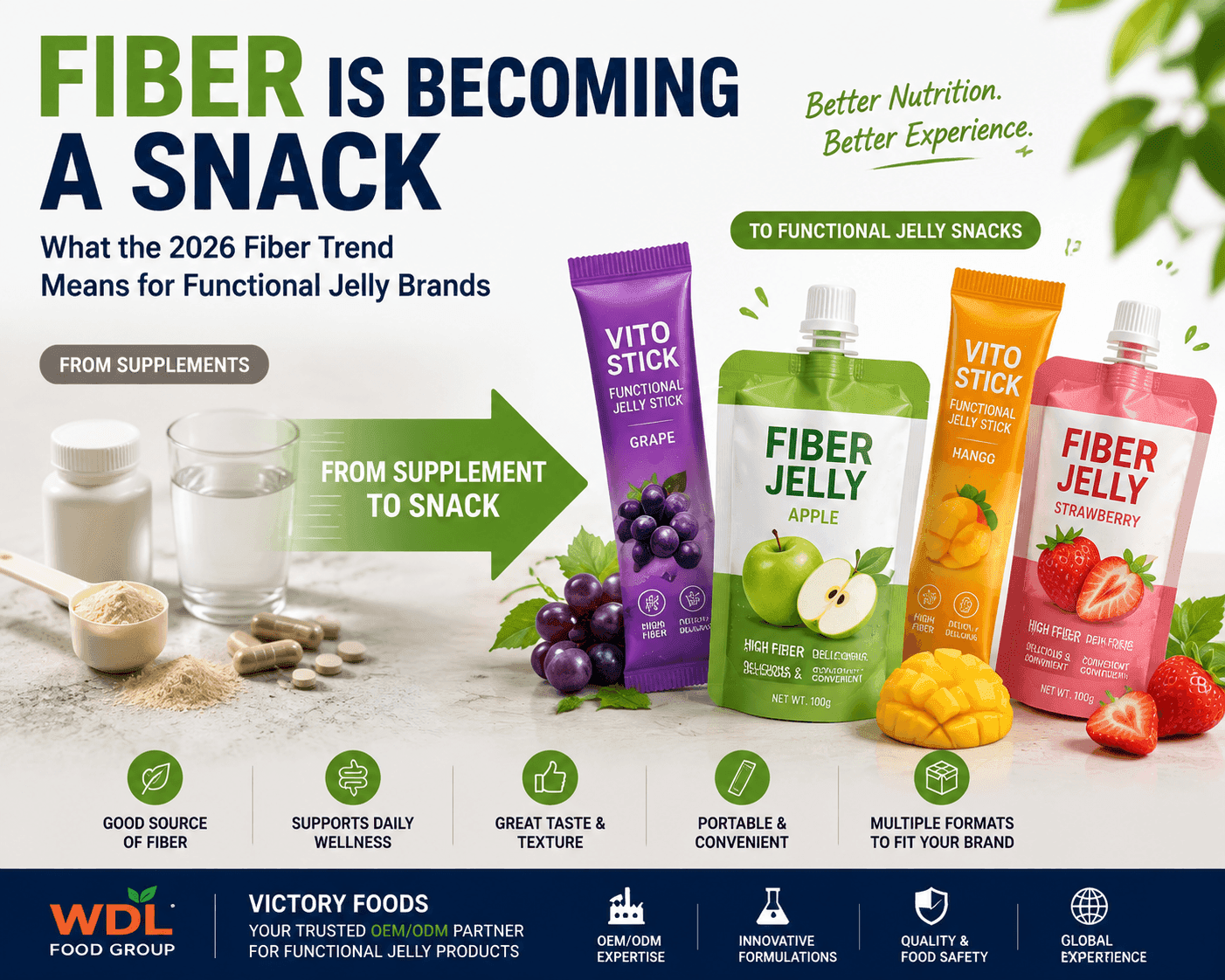
For years, consumers mainly encountered dietary fiber through cereals, powders, capsules and nutrition bars.
That is changing.
In 2026, fiber is increasingly appearing in products that look and feel like ordinary snacks—from fruit bars and gummies to beverages and other convenient formats. For food brands, this signals an important shift: functional nutrition is moving closer to everyday snacking.
For functional jelly brands, the opportunity is especially interesting.
Jelly is portable, highly customizable in texture and flavor, and compatible with multiple packaging formats. This gives product developers the ability to explore fiber-forward concepts without automatically creating a product that looks like a traditional supplement.
But developing a successful fiber functional jelly requires more than simply adding dietary fiber to an existing jelly formula.
Brands need to consider the fiber source, serving target, texture, flavor, sweetness, packaging and destination-market requirements together.
Why Is Fiber Becoming a Bigger Functional Snack Opportunity?
Protein has dominated functional food development for years, but fiber is gaining more attention across food and beverage categories.
Recent product innovation illustrates the shift. Recent 2026 snack launches and industry coverage show fiber appearing in fruit bars, gummies and other familiar snack formats.
Fiber is appearing in fruit snacks, gummies, beverages and other familiar formats. This matters because consumers do not always want nutrition to feel like taking a supplement.
A snack can provide a more familiar consumption experience.
That creates a useful product-development question for brands:
Instead of asking how to make consumers take more supplements, can functional ingredients become part of products they already enjoy eating?
Functional jelly is one possible answer.
What Is a Fiber Functional Jelly?
A fiber functional jelly is a jelly-format food formulated with a source or combination of dietary fibers.
The exact formulation can vary significantly.
Depending on the product concept and applicable regulations, a brand might explore soluble fiber ingredients, konjac-derived ingredients or other suitable fiber systems.
The product could then be developed in formats such as:
- jelly sticks;
- squeezable pouches;
- small jelly cups;
- drinkable jelly;
- portion-controlled sachets.
The goal is not simply to maximize the number of grams printed on the nutrition panel.
A commercially successful product also needs an acceptable taste, texture and eating experience.
1. Start With the Consumer, Not the Fiber Number
A common product-development mistake is beginning with:
- “We want the highest possible fiber.”
A better starting point is:
- “Who is going to eat this product, and why?”
A daily wellness jelly aimed at adults may require a different serving size and texture from a playful functional snack positioned for younger consumers.
Similarly, a compact jelly stick designed for daily routines creates a different experience from a 100 ml squeezable pouch.
Before choosing a fiber target, define:
- target consumer;
- consumption occasion;
- serving size;
- desired product format;
- target retail channel;
- intended market.
Once those decisions are clear, an R&D team can evaluate an appropriate formulation direction.
2. Fiber Source Can Change the Eating Experience
Not all dietary fibers behave the same way in food formulations.
Different fiber ingredients can influence:
- viscosity;
- gel structure;
- sweetness perception;
- mouthfeel;
- appearance;
- flavor release;
- processing.
Some fiber systems may integrate relatively smoothly into a product, while others can create thickness, graininess or other sensory challenges at higher levels.
This is particularly important for jelly.
Consumers expect jelly products to have an intentional texture. A product that becomes excessively thick, gritty or difficult to squeeze may meet a nutritional target while delivering a poor consumer experience.
For this reason, the fiber system and hydrocolloid system should be developed together.
3. Texture Can Become a Competitive Advantage
Texture is one of the biggest opportunities for functional jelly.
Traditional supplements tend to offer limited sensory experiences: swallow a capsule, mix a powder or chew a tablet.
Jelly allows brands to design a more distinctive experience.
A product can be:
- soft and squeezable;
- elastic and chewy;
- light and refreshing;
- or more dessert-like.
Hydrocolloid systems can be adjusted to create different structures depending on the ingredients and desired format.
For brands, this means texture should be part of the product brief—not an afterthought.
Instead of asking an OEM manufacturer for “good texture,” describe the intended experience.
For example:
- “We want a smooth, soft jelly that consumers can easily squeeze from a stick without a heavy or grainy mouthfeel.”
That provides a much clearer R&D target.
4. High Fiber Still Has to Taste Good
Function does not eliminate the importance of flavor.
In fact, as functional snacks move closer to mainstream snacking, taste becomes even more important.
Consumers may try a product because of its functional positioning, but repeat purchase depends heavily on the overall eating experience.
Fiber ingredients can influence sweetness, aroma and mouthfeel, so flavor development should happen alongside formulation.
Fruit profiles can be particularly useful for jelly because acidity, aroma and sweetness can be adjusted to create a refreshing experience.
Possible directions might include:
- apple;
- citrus;
- berry;
- peach;
- mango;
- passion fruit;
- grape;
- yuzu.
The best flavor is not universal. It depends on the fiber system, sweetness strategy, target consumer and destination market.
5. Should a Fiber Jelly Be Sugar-Free?
Not necessarily.
“Fiber” and “zero sugar” answer different consumer needs.
Some brands may want a zero-sugar or no-added-sugar positioning. Others may prioritize natural fruit taste, a specific texture or a different nutritional profile.
Reducing sugar can also change sweetness, body and flavor perception.
Therefore, brands should not automatically stack every trending claim into one product.
A better product-development approach is to establish a clear hierarchy:
What is the primary reason the consumer should buy this product?
If fiber is the hero benefit, other formulation decisions should support that positioning rather than make the concept unnecessarily complicated.
6. Functional Snacking Changes Packaging Strategy
Moving from supplements into snacks also changes how a product should look.
A clinical-looking package may communicate efficacy, but it can also make an everyday snack feel medicinal.
Functional jelly allows brands to explore a broader visual language.
For example, a brand might use:
Jelly sticks
For portable daily routines and multipacks.
Squeezable pouches
For a larger serving and more branding space.
Jelly cups
For a familiar snack experience suitable for retail displays.
Packaging should reflect the target consumer and consumption occasion while still communicating the product's functional positioning clearly and responsibly.
7. Avoid Turning the Front of Pack Into an Ingredient List
As functional products become more sophisticated, brands are tempted to add more ingredients and more claims.
Fiber + vitamins + collagen + electrolytes + probiotics + botanicals may sound powerful on paper.
But consumers still need to understand the product quickly.
For many concepts, one clear primary function supported by a simple secondary story can be stronger than an overloaded formula.
This also helps product development.
Every additional functional ingredient may affect flavor, stability, processing, cost or regulatory considerations.
A focused concept is often easier to formulate, explain and market.
8. Fiber Claims Depend on the Destination Market
Brands should be careful with terms such as “high fiber,” “good source of fiber,” “prebiotic” or digestive-health claims.
Definitions and permitted claims vary between markets.
The amount and type of fiber used in a formulation does not automatically authorize a particular front-of-pack claim.
Before commercial launch, the final formulation, nutrition information, ingredient declaration and claims should be evaluated according to the requirements of the destination market.
This is another reason to tell an OEM/ODM manufacturer the intended sales market early in development.
9. What Should Brands Prepare Before Developing a Fiber Jelly?
A useful product brief should include:
Target market:
Where will the product be sold?
Target consumer:
Who is expected to buy it?
Fiber objective:
Do you have a specific fiber source or target amount in mind?
Format:
Stick, pouch, cup or another format?
Serving size:
How much product should consumers eat at one time?
Texture:
Drinkable, squeezable, soft, elastic or chewy?
Flavor:
What flavor family fits the brand?
Sweetness strategy:
Conventional, reduced sugar, no added sugar or another approach?
Packaging:
Single serve, multipack, retail display or e-commerce?
Giving an R&D team this information is much more useful than simply requesting a “high-fiber jelly sample.”
From Supplement to Snack
The rise of fiber-forward snacks reflects a broader change in functional nutrition.
Consumers increasingly expect functional products to fit naturally into daily life.
That means brands have an opportunity to rethink not only what functional ingredients they use, but also how those ingredients are delivered.
For dietary fiber, jelly offers an interesting platform because formulation, texture, flavor and packaging can all be customized around a specific consumer experience.
The opportunity is not to create a supplement disguised as candy.
It is to develop a functional snack where nutrition and enjoyment are designed together from the beginning.
Developing Fiber Functional Jelly with Victory Foods
Victory Foods develops hydrocolloid-based jelly products across multiple formats, including functional jelly sticks, squeezable jelly products, konjac jelly and wellness-oriented products.
For OEM/ODM projects, the development process can begin with the target market, desired fiber objective, serving format, texture, flavor and packaging direction.
From there, formulation feasibility can be evaluated alongside sensory experience and manufacturing requirements.
For brands exploring the growing functional-snacking category, fiber jelly provides one possible bridge between traditional functional nutrition and convenient everyday snacking.
FAQ
Can dietary fiber be added to functional jelly?
Certain dietary fibers can be incorporated into jelly products. The appropriate type and level depend on the desired texture, serving size, flavor, processing conditions and destination-market requirements.
Does more fiber always make a better functional jelly?
No. Higher levels can influence texture, viscosity and taste. Product development should balance the nutritional objective with consumer experience.
Can a fiber jelly also be zero sugar?
A zero-sugar concept may be possible depending on the formulation and target market, but sweetness, texture, labeling requirements and ingredient compatibility should be evaluated together.
What packaging works for fiber functional jelly?
Common concepts include jelly sticks, squeezable pouches and portion-controlled cups. The best format depends on serving size, target consumer, retail channel and desired eating experience.
Can an OEM manufacturer customize the fiber level?
An OEM/ODM manufacturer can evaluate formulations toward a requested nutritional target, subject to ingredient compatibility, sensory quality, processing feasibility and applicable regulations.