
Zero-Sugar Functional Jelly: Why Sweetener Choice Is Only Half the Formulation
Developing a zero-sugar functional jelly is more complex than replacing sugar with a sweetener. Learn how sweetness, texture, flavor, hydrocolloids and functional ingredients must work together to create a better product.
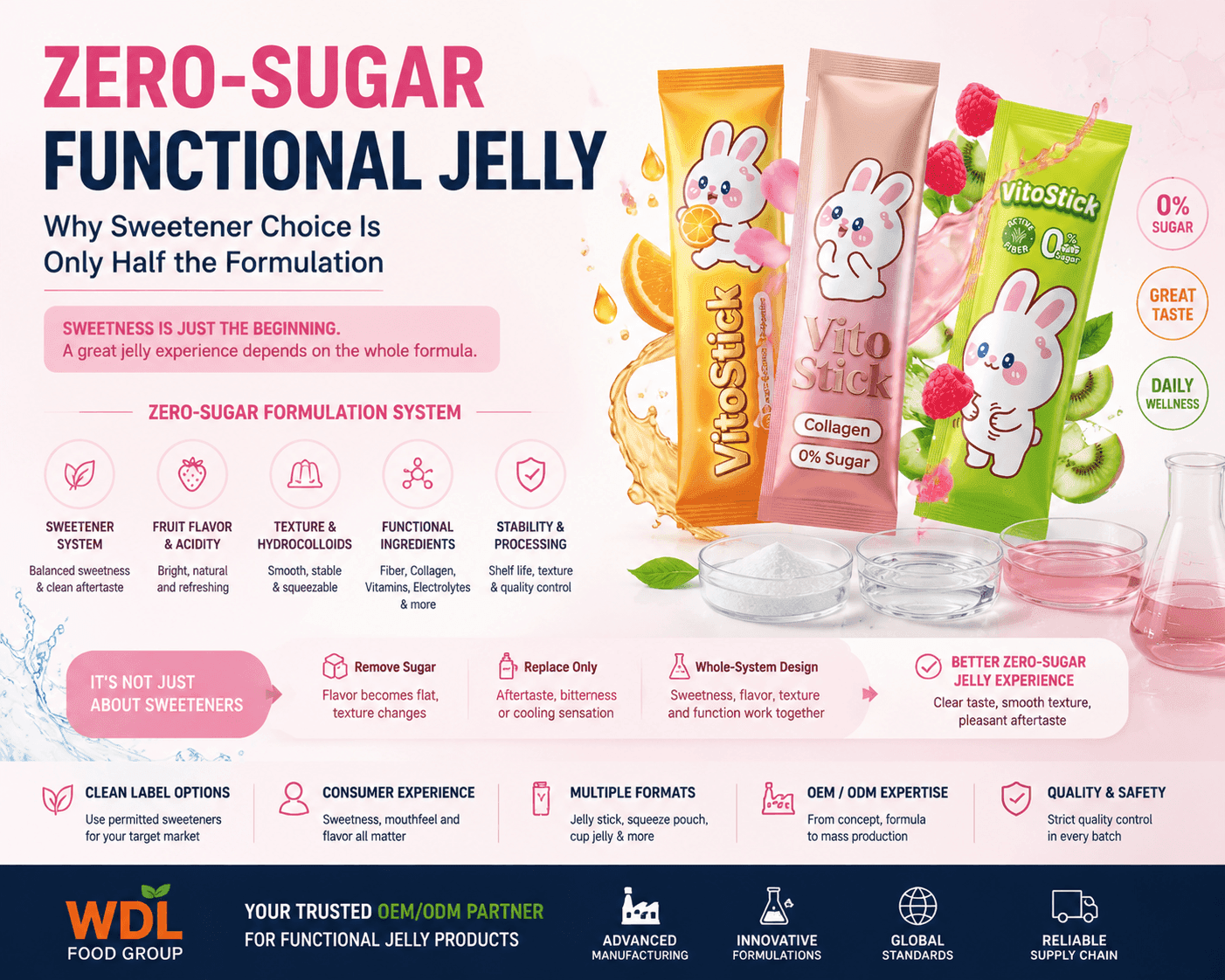
When a brand asks an OEM manufacturer to develop a zero-sugar functional jelly, one of the first questions is often:
“Which sweetener should we use?”
It is an important question—but it is not the whole formulation.
Removing or significantly reducing sugar changes more than sweetness. Sugar can also contribute to body, mouthfeel, flavor balance and other characteristics of a food system. As a result, developing a successful zero-sugar jelly requires the manufacturer to consider the complete formulation rather than simply replacing sugar with another sweetener.
For functional jelly brands, this becomes even more important because the product may also contain dietary fiber, electrolytes, vitamins, collagen or other functional ingredients that can influence taste and texture.
The real formulation challenge is therefore:
How do you create the desired sweetness while maintaining an enjoyable jelly experience?
1. Zero Sugar Is a Formulation System, Not a Single Ingredient
It is tempting to think of sugar reduction as a simple substitution.
Remove sugar. Add another sweetener. Finish the formula.
In practice, food formulation is more interconnected.
Sweetness affects how consumers perceive acidity, fruit flavor, bitterness and even texture. Meanwhile, removing ingredients that contribute solids or body can change how the product feels in the mouth.
This is why modern sugar-reduction strategies increasingly use a system approach.
A product developer may need to balance:
- sweetener selection;
- sweetness intensity;
- sweetness timing;
- acidity;
- fruit flavor;
- hydrocolloid structure;
- functional ingredients;
- serving temperature;
- mouthfeel.
Changing one element can influence several others.
For an OEM/ODM project, the best starting point is therefore not simply:
- “Which sweetener is cheapest?”
but:
- “What sensory experience are we trying to create?”
2. Different Sweeteners Create Different Sweetness Profiles
Sweeteners do not all taste identical.
Even when two formulations reach a similar perceived sweetness level, the way sweetness develops and disappears can feel different.
Depending on the formulation, developers may explore different permitted sweetening approaches for the destination market.
The important point is that sweetener selection should be evaluated within the complete product.
Questions may include:
- How quickly does the sweetness appear?
- Does it remain too long after swallowing?
- Does it expose bitterness from functional ingredients?
- Does it work with the selected fruit flavor?
- Does the target consumer expect a very sweet product or a lighter profile?
For example, a refreshing citrus jelly may require a different sweetness-acidity balance from a mango or grape wellness jelly.
There is no universally “best” sweetener system for every functional jelly.
3. Fruit Flavor Becomes More Important When Sugar Is Reduced
Sugar does more than make fruit products sweet.
It also influences how consumers perceive fruit character and acidity.
When sweetness is reduced or changed, a familiar fruit flavor can suddenly seem:
- more acidic;
- less rounded;
- weaker;
- more bitter;
- or less juicy.
This means flavor development should happen together with sugar reduction.
Instead of developing the jelly first and adding flavor at the end, an R&D team can evaluate sweetness, acidity and aroma as a combined sensory system.
This is especially relevant for functional products because active ingredients may introduce additional flavor challenges.
A successful zero-sugar functional jelly should therefore not merely taste “sweet enough.”
It should taste intentionally designed.
4. Functional Ingredients Add Another Layer of Complexity
A conventional fruit jelly and a functional jelly can behave very differently.
Consider several common product concepts.
Electrolyte Jelly
Minerals used in electrolyte formulations can affect taste, creating salty, bitter or mineral-like notes depending on the ingredients and levels used.
Fiber Jelly
Higher levels of certain fiber ingredients may influence viscosity and mouthfeel.
Beauty Jelly
Ingredients selected for beauty or wellness concepts can introduce their own flavor, color or formulation considerations.
Sports Nutrition Jelly
Carbohydrates, electrolytes, caffeine or other permitted ingredients can significantly change the sensory profile.
When these ingredients are combined with a zero-sugar requirement, the formulation becomes a balancing exercise.
The sweetener system has to work with the functional ingredients—not simply cover them.
5. Texture Matters as Much as Sweetness
One of the most common mistakes in zero-sugar product development is focusing almost entirely on sweetness.
But consumers experience texture before they finish evaluating flavor.
A functional jelly might be designed to be:
- soft and squeezable;
- light and drinkable;
- elastic and chewy;
- smooth and pudding-like;
- or firm enough to hold a defined shape.
These textures require different formulation approaches.
Hydrocolloids such as konjac gum, carrageenan, pectin, gellan gum and locust bean gum can contribute different gelling, thickening and stabilizing properties depending on the formulation and processing conditions.
The goal is not to use as many hydrocolloids as possible.
It is to build the texture that fits the product concept.
A sports jelly intended for quick consumption should not necessarily have the same structure as a dessert jelly or a children's snack.
6. Why Hydrocolloid Design Matters in Zero-Sugar Jelly
This is where jelly formulation differs significantly from simply developing a sweetened beverage.
Hydrocolloids interact with water and can be used to influence viscosity, gel structure and stability. Industry ingredient suppliers describe hydrocolloids such as carrageenan and pectin as tools for functions including thickening, gelling and stabilization. 嘉吉
For a zero-sugar jelly, texture design becomes especially important because the product still needs to deliver a satisfying eating experience after the sweetness system changes.
The manufacturer may need to evaluate:
- gel strength;
- elasticity;
- water release;
- squeezability;
- viscosity;
- processing behavior;
- stability over the intended shelf life.
This is why two zero-sugar jellies using similar sweeteners can still feel completely different.
The hydrocolloid system helps define the product experience.
7. Do Not Stack Every Trend Into One Formula
A common development brief might sound like this:
- “We want zero sugar, high fiber, collagen, vitamins, electrolytes, probiotics and natural fruit flavor.”
Every individual idea may be commercially interesting.
Together, however, they can create a difficult formulation and an unclear product story.
Every additional ingredient can potentially influence:
- flavor;
- color;
- texture;
- stability;
- cost;
- processing;
- regulatory requirements.
A stronger strategy is often to define one hero benefit first.
For example:
Zero-Sugar Beauty Jelly
Primary story: beauty-oriented functional snacking.
Zero-Sugar Fiber Jelly
Primary story: fiber-forward everyday wellness.
Zero-Sugar Electrolyte Jelly
Primary story: convenient hydration.
Additional ingredients can then support the central concept rather than compete with it.
8. “Zero Sugar” Is Also a Regulatory Question
Brands should not assume that removing conventional sugar automatically allows a product to carry a “zero sugar” or similar claim.
Definitions, thresholds, ingredient requirements and labeling rules vary by market.
The final product should be evaluated according to the regulations of the country or region where it will be sold.
This is why destination market should be included in the product brief before formulation is finalized.
An OEM/ODM manufacturer can develop toward a nutritional target, but the commercial label and claims should ultimately match the applicable local requirements.
9. What Should Brands Tell Their Manufacturer?
If you are developing a zero-sugar functional jelly, provide more information than:
- “Please make it zero sugar.”
A useful brief should include:
Target Market
Where will the product be sold?
Target Consumer
Who will buy and consume it?
Product Function
Beauty, fiber, hydration, sports nutrition or another concept?
Format
Jelly stick, squeezable pouch, cup or another package?
Sweetness Preference
Light, medium or similar to a specific benchmark?
Functional Ingredients
Which ingredients and target levels are required?
Flavor Direction
Which fruit or flavor profiles should be explored?
Texture Direction
Drinkable, soft, squeezable, elastic or chewy?
Benchmark Product
Is there an existing product whose taste or texture you like?
This information gives the R&D team a much clearer starting point.
10. Sample Development Should Compare Complete Experiences
When reviewing prototypes, brands should avoid evaluating only one dimension.
Instead of asking:
“Is it sweet enough?”
evaluate:
- initial sweetness;
- aftertaste;
- fruit character;
- acidity;
- bitterness;
- mouthfeel;
- gel strength;
- squeezability;
- overall enjoyment.
A prototype with the “right” sweetener can still fail if the texture feels wrong.
Likewise, a technically perfect gel can fail if the flavor does not encourage another bite.
Successful development requires the entire sensory experience to work together.
Zero Sugar Without Sacrificing the Product Experience
The direction of sugar reduction in food and beverage is becoming increasingly sophisticated. Industry formulation discussions in 2026 emphasize that removing sugar is not simply a one-for-one ingredient replacement because sweetness, texture and mouthfeel are interconnected. Kline + Company
For functional jelly brands, this creates both a challenge and an opportunity.
The challenge is that the formula must balance multiple variables.
The opportunity is that brands can create products where sweetness, function, texture and flavor are intentionally designed as one system.
That is much more difficult to copy than simply choosing a trending sweetener.
Developing Zero-Sugar Functional Jelly with Victory Foods
Victory Foods develops multiple hydrocolloid-based product formats, including zero-sugar konjac products, functional jelly sticks, squeezable jelly and wellness-oriented jelly concepts. 胜利食品
For OEM/ODM development, brands can begin by defining the target market, functional concept, desired sweetness, texture, flavor and packaging format.
The objective is not simply to remove sugar.
It is to build a commercially viable functional jelly that delivers the intended nutrition positioning and an enjoyable consumer experience.
FAQ
Is zero-sugar jelly simply made by replacing sugar with a sweetener?
Not necessarily. Sugar can influence sweetness, body, flavor balance and other formulation characteristics, so removing it may require broader adjustments to the product system.
Which sweetener is best for functional jelly?
There is no universal best option. Sweetener selection depends on the target market, desired sweetness profile, functional ingredients, flavor, texture and applicable regulations.
Can zero-sugar jelly also contain dietary fiber?
Depending on formulation feasibility and local regulations, brands may explore concepts combining sugar reduction with dietary fiber. The fiber system can also influence viscosity and mouthfeel.
Does zero sugar change jelly texture?
Changing the sugar system can affect the overall formulation and sensory experience. Hydrocolloid selection and formulation balance therefore remain important during development.
Can Victory Foods develop private-label zero-sugar jelly?
Victory Foods supports OEM/ODM development across several jelly formats. Project feasibility depends on the requested formula, packaging, destination market and production requirements.