
Jelly Stick vs. Squeezable Pouch: Which Format Fits Your Functional Food Brand?
Jelly stick or squeezable pouch? Compare portability, serving size, texture, branding space, consumption occasions and OEM considerations to choose the right format for your functional jelly product.
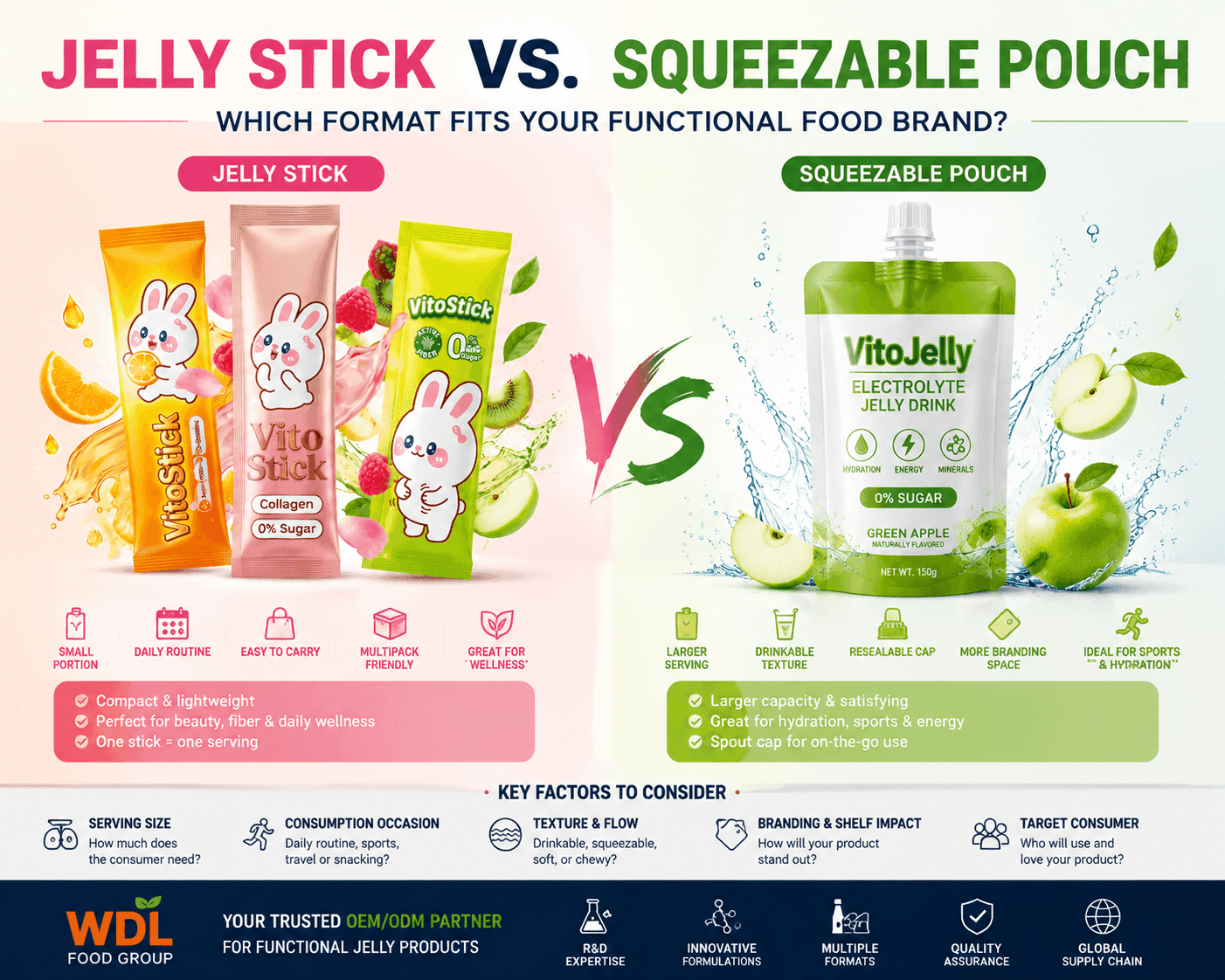
For most functional food brands, the choice between a jelly stick and a squeezable pouch should depend on serving size, consumption occasion, texture and brand positioning—not simply packaging appearance.
Jelly sticks are compact, portion-controlled and well suited to daily routines or multipacks. Squeezable pouches provide more capacity, more branding space and greater flexibility for drinkable or larger-serving products.
Neither format is universally better.
The right choice begins with one question:
How do you want the consumer to use the product?
For brands developing functional jelly, sports nutrition or wellness products, answering that question before formulation can make product development much more efficient.
Jelly Stick vs. Squeezable Pouch: A Quick Comparison
Choosing between a jelly stick and a squeezable pouch depends on how consumers will use the product, how much they need per serving and what experience the brand wants to create.
Both formats can work well for functional jelly products, but they support different product strategies.
Jelly Stick: Compact, Convenient and Routine-Friendly
A jelly stick is designed around individual servings and daily consumption habits.
Its main advantages include:
- Easy portability for travel, work, gym or outdoor activities;
- Clear portion control for consumers;
- Suitable for multipack retail formats;
- Convenient for daily wellness routines.
This format is often considered for products such as:
- Beauty jelly;
- Fiber jelly;
- Vitamin jelly;
- Daily wellness products.
For brands building a “one serving per day” concept, a jelly stick can create a simple and repeatable consumer habit.
However, the smaller package size may limit the total product volume and the amount of certain functional ingredients delivered per serving.
Squeezable Pouch: Larger Serving and More Product Flexibility
A squeezable pouch provides more space for product volume and branding communication.
Its advantages include:
- Larger serving possibilities;
- Suitable for drinkable or squeezable textures;
- More surface area for branding and product information;
- Strong suitability for sports nutrition and hydration concepts.
This format is often considered for:
- Electrolyte jelly;
- Sports nutrition products;
- Energy jelly;
- Larger wellness servings;
- Children's functional snacks.
For products where consumers expect a refreshing or more substantial experience, a squeezable pouch may provide more flexibility.
The Right Choice Depends on the Product Concept
Neither format is automatically better.
The better question is:
What problem is this product solving for the consumer?
If the product is designed for:
Daily habit and convenience → Jelly Stick may be the better choice.
Examples:
- Morning beauty routine;
- Daily fiber intake;
- Portable wellness supplement.
If the product is designed for:
Larger consumption moments → Squeezable Pouch may be the better choice.
Examples:
- Sports hydration;
- Outdoor activities;
- Functional refreshment.
The packaging should support the consumer experience, not simply follow a trend.
1. What Is a Functional Jelly Stick?
A jelly stick is an individually packed, narrow sachet designed for direct consumption.
Consumers typically tear the top and squeeze or slurp the product from the package.
Its greatest advantage is simplicity.
The format can fit easily into:
- handbags;
- gym bags;
- desk drawers;
- travel kits;
- daily supplement routines;
- retail multipacks.
For functional brands, this creates a useful behavior:
one stick can represent one consumption occasion.
A brand developing a beauty-oriented jelly, fiber jelly or vitamin concept may find this particularly useful because consumers can easily incorporate an individual stick into a daily routine.
The compact package also works well for cartons containing multiple servings.
2. What Is a Squeezable Jelly Pouch?
A squeezable pouch generally provides more package volume and can support a wider range of jelly viscosities.
Depending on the product concept, it may use a spout and cap so consumers can open, squeeze and potentially reseal the package.
This makes the format particularly interesting for:
- drinkable jelly;
- electrolyte products;
- sports nutrition;
- children's products;
- larger snack portions;
- hydration concepts.
The larger package also gives brands more physical space for graphics, instructions and product communication.
For emerging brands competing on crowded retail shelves, that additional branding area can be commercially valuable.
3. Which Format Is More Portable?
Both formats are portable, but they create different types of convenience.
Jelly Stick: Minimal and Lightweight
A stick is extremely compact.
Consumers can carry several servings without taking up much space. This makes it suitable for products designed around repeated daily use or routines.
The trade-off is capacity.
A very small package naturally limits how much product—and therefore how much of certain functional ingredients—can be delivered per serving.
Squeezable Pouch: Portable With More Capacity
A pouch remains portable but can accommodate a larger serving.
That can be useful when the product concept requires more water, carbohydrate, jelly base or other formulation components.
For brands, the question is not simply:
“Which package is smaller?”
It is:
“How much product does the consumer need for this particular occasion?”
4. Serving Size Can Determine the Packaging Decision
Serving size should be discussed early because it connects packaging with formulation.
Imagine two different concepts.
Concept A: Daily Beauty Jelly
The consumer takes one compact serving every morning.
A jelly stick may fit the routine naturally.
Concept B: Electrolyte Jelly for Outdoor Activities
The consumer expects a more substantial, refreshing serving.
A larger squeezable pouch may provide a better experience.
Trying to force both products into the same package simply because the packaging looks attractive can create unnecessary formulation compromises.
Start with the intended serving. Then choose the package.
5. Texture Should Match the Opening
Packaging and texture are closely connected.
A jelly stick needs a formulation that consumers can comfortably consume through a relatively narrow opening.
If the product is too firm, consumption can become awkward.
A spouted pouch may offer more flexibility for products designed to be drinkable or squeezable.
Therefore, an OEM manufacturer should evaluate packaging and hydrocolloid formulation together.
Factors may include:
- viscosity;
- gel strength;
- flow behavior;
- squeezability;
- inclusions;
- serving temperature.
For example, a smooth wellness jelly and a thick sports gel may both use flexible packaging while requiring very different texture systems.
6. Which Format Gives Brands More Packaging Space?
Here the squeezable pouch usually has an obvious advantage.
A larger front and back surface can provide more room for:
- brand identity;
- product name;
- flavor communication;
- preparation or consumption instructions;
- nutrition information;
- required labeling.
That does not mean jelly sticks are weak branding tools.
In fact, their narrow vertical shape can create a recognizable visual identity, particularly when multiple colorful sticks are displayed together in a carton.
The difference is strategic.
A pouch can act as a mini billboard.
A stick can become a recognizable ritual object.
Brands should decide which role matters more.
7. Which Is Better for Functional Ingredients?
Neither.
The packaging itself does not automatically make a product more functional.
The appropriate format depends on the formula and desired amount per serving.
For example, if a product requires a relatively large quantity of an ingredient, a larger serving may provide more formulation flexibility.
For a concentrated concept using smaller target amounts, a stick may be sufficient.
Brands should provide the OEM manufacturer with measurable nutritional targets rather than choosing packaging first and trying to force the formula into it later.
Useful information includes:
- target ingredient;
- target amount per serving;
- desired serving weight;
- sweetness direction;
- texture;
- target market.
The R&D team can then evaluate whether the desired concept fits the intended package.
8. Jelly Stick vs. Pouch for Different Product Concepts
Beauty & Wellness Jelly
Often worth considering: Jelly Stick
Why?
The compact format can fit daily routines and multipack boxes well.
However, a pouch may still be appropriate for a larger drinkable beauty product.
Fiber Functional Jelly
Possible formats: Both
A stick can support daily portioning, while a pouch can provide a larger snack-like experience.
Fiber level and texture may influence the decision.
Electrolyte Jelly
Often worth considering: Squeezable Pouch
A larger serving can fit hydration-oriented positioning and provide a more substantial consumption experience.
Energy Gel
Possible formats: Stick/Sachet or Pouch
The best choice depends on serving size, viscosity and intended sports use.
Children's Functional Jelly
Possible formats: Both
Convenience, package opening, portion size and applicable packaging requirements should all be considered carefully.
9. Packaging Is Now Part of the Product Experience
Food packaging is increasingly expected to do more than protect the product.
Consumers interact with the package before they taste what is inside.
Recent 2026 packaging discussions emphasize convenience, portability and visual design as important parts of food and functional-nutrition innovation. Food & Wine
For functional jelly, this is particularly relevant because the package determines how the consumer physically interacts with the product.
Tear.
Squeeze.
Sip.
Carry.
Reseal.
Share.
These actions become part of the brand experience.
This means packaging selection should happen during product concept development—not after the formula is finished.
10. What Should You Tell Your OEM Manufacturer?
Before requesting samples, provide:
Target Consumer
Who will use the product?
Consumption Occasion
Morning routine, gym, outdoor sports, school, travel or general snacking?
Serving Size
How much product should one package contain?
Functional Target
Which ingredients and amounts are important?
Texture
Drinkable, squeezable, soft or thick?
Packaging Preference
Stick, sachet, spouted pouch or open to recommendation?
Retail Channel
Supermarket, pharmacy, convenience store, e-commerce or sports channel?
Target Market
Where will the finished product be sold?
With this information, the manufacturer can evaluate the package as part of the complete product system.
So, Which Format Should Your Brand Choose?
Choose a jelly stick when the concept benefits from:
- compact single servings;
- daily routines;
- multipacks;
- lightweight portability;
- portion control.
Choose a squeezable pouch when the concept benefits from:
- larger serving sizes;
- drinkable or squeezable textures;
- stronger front-of-pack branding;
- hydration or sports occasions;
- potentially resealable consumption.
But do not make the final decision from this checklist alone.
The best packaging format is the one that aligns:
Consumer + Occasion + Formula + Texture + Serving Size + Brand Positioning.
Developing Functional Jelly Formats with Victory Foods
Victory Foods develops hydrocolloid-based products across formats including jelly sticks, squeezable jelly drinks, konjac jelly, sports nutrition and wellness-oriented products. The company's current product catalog includes dedicated Squeeze Jelly Drink, Beauty & Wellness, Keto / Zero Sugar Konjac and Sports Nutrition categories.
For an OEM/ODM project, brands can begin with the product concept rather than committing to packaging immediately.
By evaluating the target consumer, serving size, functional ingredients, texture and distribution market together, the development team can determine which format provides the stronger commercial starting point.
The package should not simply contain the product. It should help make the product make sense.
FAQ
Is a jelly stick cheaper than a squeezable pouch?
Packaging cost depends on package specification, material, printing, order quantity, filling requirements and other project details. Format alone is not enough to determine final cost.
Can the same jelly formula be used in a stick and a spouted pouch?
Not always. Package opening, serving size and desired consumption experience can require adjustments to viscosity, gel structure or other formulation characteristics.
Which format is better for private-label functional jelly?
Neither format is universally better. Jelly sticks often suit compact daily-use concepts, while squeezable pouches can suit larger, drinkable or hydration-oriented products.
Can functional ingredients be customized in both formats?
OEM/ODM formulations can be developed toward different functional targets, subject to ingredient compatibility, processing feasibility, sensory quality and destination-market requirements.
Should packaging be selected before sample development?
The preferred format should be discussed early, but formulation and packaging are best evaluated together rather than as completely separate decisions.