Planning Electrolyte Freezer Pops for Summer 2027: When Should Brands Start OEM Development?
Summer products need to be developed before summer arrives. This B2B guide explains how brands, importers and retailers can work backward from a Spring/Summer 2027 shelf date when developing private-label electrolyte freezer pops.
Planning Electrolyte Freezer Pops for Summer 2027: When Should Brands Start OEM Development?
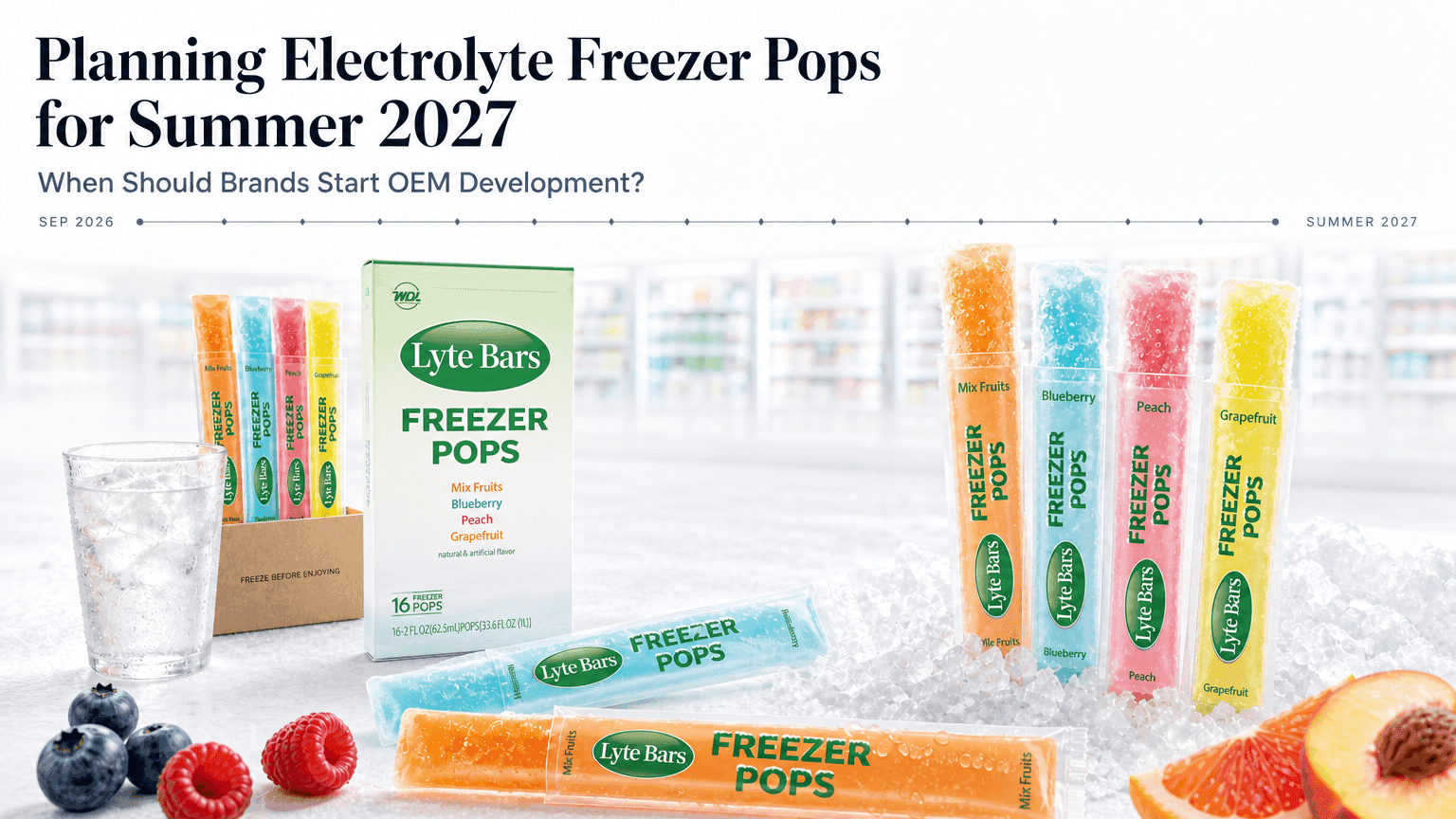
If a brand wants private-label electrolyte freezer pops on shelf for Spring or Summer 2027, product development should begin months before the first hot day. Formulation, sampling, packaging, production planning and international logistics all happen before retail launch—so September 2026 is a reasonable time to start building the project rather than waiting until Spring 2027.
Seasonal products create a strange planning problem.
Consumers think about freezer pops when temperatures rise.
Retail buyers cannot.
By the time consumers start searching for cooling products, the brand may already need finished inventory in a warehouse or distribution center.
That is why the most useful question for a private-label buyer is not:
When will consumers want electrolyte freezer pops?
It is:
How far backward do we need to work from the intended shelf date?
For a 2027 summer program, that planning can begin now.
Why Functional Freezer Pops Are Worth Watching
Freezer pops are not a new format.
What is changing is the function brands are building into them.
In August 2026, Freezeez launched nationally at Walmart with a formulation combining electrolytes, vitamins and minerals. The product is positioned for active children and families and uses the familiar freezer-pop experience as the delivery format.
Earlier in 2026, JonnyPops also announced No Sugar Added Mini Pops with Electrolytes, explicitly connecting frozen treats with sports days, heat and hydration occasions.
These products sit inside a broader hydration shift.
Recent 2026 hydration analysis describes growing consumer interest in products that combine hydration with additional functional positioning rather than relying on electrolytes alone.
For buyers, the interesting point is not that freezer pops will replace sports drinks.
It is that:
hydration now has more possible formats.
Freezer Pops Create a Different Hydration Occasion
Traditional sports drinks are consumed as beverages.
Powders require mixing.
Tablets require water.
Energy gels are associated more strongly with fueling and endurance.
A freezer pop creates another experience:
cold + portioned + familiar + refreshing.
That can make the format relevant to different consumer groups and channels.
Possible concepts include:
- family hydration;
- children's summer products;
- sports and outdoor activity;
- workplace heat programs;
- convenience retail;
- wellness and pharmacy channels.
The formulation and claims would need to match the intended market and consumer, but the format itself creates a different consumption occasion.
That is why product development should begin with:
Who will use it, where, and why?
—not simply with an electrolyte ingredient list.
What Makes a Shelf-Stable Freezer Pop Different?
There is an important distinction between a conventional frozen product and a shelf-stable freeze-at-home format.
Victory Foods' current Electrolyte Freezer Pop product is designed to be stored in liquid form at ambient temperature and frozen before consumption.
For international B2B projects, that architecture can change the logistics conversation.
A product that does not require frozen transportation before the consumer or retailer freezes it may avoid some of the distribution constraints associated with conventional frozen desserts.
But buyers should verify the actual storage conditions, shelf-life specification and shipping requirements for their specific formula and destination market.
“Freezer pop” does not automatically mean every product has the same logistics model.
Start With the Shelf Date and Work Backward
Suppose the commercial target is:
Retail availability: April–May 2027
Do not begin by asking:
When should production start?
Production is only one stage.
Instead, work backward through the complete project.
A practical development sequence may include:
Concept → Formula Brief → Prototype → Sample Feedback → Formula Refinement → Packaging → Validation → Production → Freight → Warehouse → Retail
The duration of each stage varies by project.
A simple existing formula with standard packaging may move differently from a custom electrolyte system with new printed packaging and market-specific requirements.
That is why the timeline should be built around project complexity rather than a universal promise such as “launch in 30 days.”
Stage 1: September–October 2026 — Define the Product
The first stage should answer the commercial questions.
Who is the consumer?
Children?
Families?
Athletes?
Outdoor workers?
General wellness consumers?
What is the product supposed to do?
Is it primarily:
a frozen treat with electrolytes
or:
a hydration product delivered as a freezer pop?
Those two concepts may sound similar, but the positioning can lead to different formulation and communication decisions.
What is the serving format?
The buyer should define:
- approximate serving size;
- number of pops per retail pack;
- flavor direction;
- sweetness strategy;
- functional ingredient targets;
- intended market.
At this stage, perfect artwork is not necessary.
A clear brief is.
Stage 2: October–December 2026 — Develop and Test Samples
Once the product brief is clear, R&D can begin evaluating the formulation.
For an electrolyte freezer pop, development may involve balancing:
electrolytes + sweetness + acidity + flavor + texture + freezing experience.
Adding more electrolytes is not simply a marketing decision.
Minerals can influence taste.
Sweetener changes can alter flavor perception.
The product also needs to be evaluated in the way consumers will actually use it.
That means a freezer pop should not only be tasted as room-temperature liquid.
The frozen sensory experience matters.
Brands should therefore leave room for sample feedback and adjustment rather than assuming Prototype 1 will automatically become the commercial formula.
Stage 3: Late 2026 to Early 2027 — Finalize Packaging
Packaging often looks like the easy part.
It can become a scheduling bottleneck.
The brand may need to confirm:
- primary pouch artwork;
- retail box design;
- ingredient declaration;
- nutrition information;
- barcode;
- product name;
- consumption instructions;
- storage instructions;
- market-appropriate claims.
If the product is shipped ambient and frozen before use, the consumer should also understand that behavior clearly.
The package may need to communicate something as simple as:
Freeze Before Enjoying
without creating confusion about how the product should be stored before and after freezing.
Artwork should therefore be treated as part of product development—not decoration added at the end.
Stage 4: Early 2027 — Commercial Validation and Production Planning
Before commercial production, the buyer and manufacturer should confirm the final product specification.
Depending on the project and destination market, this may involve appropriate product, packaging and documentation checks.
At the same time, commercial planning becomes more important:
How many SKUs?
How many flavors?
What quantity per SKU?
What carton configuration?
When must goods leave the factory?
This is also where overly complicated launch plans can become expensive.
Four flavors may sound more impressive than two.
But four flavors also mean more artwork, inventory allocation, forecasting and production planning.
For a new seasonal concept, a focused launch can sometimes be easier to manage.
Stage 5: Build Logistics Around the Required Arrival Date
International buyers should plan from:
required warehouse arrival
rather than:
factory completion.
Those are not the same date.
After production, goods may still need:
- export preparation;
- booking;
- port handling;
- ocean transit;
- import clearance;
- domestic transport;
- warehouse receiving;
- retailer distribution.
The exact timeline depends heavily on origin, destination, freight method and seasonal shipping conditions.
That is why a manufacturer should not invent one universal freight lead time.
The safer B2B approach is:
Set the required arrival date first, then confirm the logistics schedule with the responsible freight partners.
For a seasonal product, buffer matters.
Being early creates storage considerations.
Being late can miss the selling season.
Why September Is Not “Too Early” for Summer 2027
From a consumer perspective, September feels far away from next summer.
From a product-development perspective, it is not.
A custom functional product may need decisions across:
formula + flavor + package + compliance + production + international logistics.
Starting earlier creates room for iteration.
It also gives the brand time to answer important questions before inventory is committed.
For example:
Does the frozen texture work?
Is the electrolyte profile too salty for the intended consumer?
Does the flavor remain appealing after freezing?
Should the first launch have two flavors or four?
Does the package clearly explain freeze-before-use?
Those are better questions to answer during development than after production.
What Should Retail Buyers Ask a Freezer Pop Manufacturer?
A useful sourcing conversation should cover more than price.
Ask:
Is the product shipped frozen or ambient?
This affects logistics and storage planning.
What can be customized?
Formula, electrolyte profile, flavor, sweetness, serving size and packaging may have different customization constraints.
How should samples be evaluated?
The manufacturer should explain the intended preparation and consumption condition.
What are the packaging minimums?
Printed film, cartons and other materials may have their own commercial requirements.
What information is needed for the destination market?
Labeling and regulatory requirements vary by country.
What is the realistic project timeline?
Ask the supplier to separate:
sampling, packaging, production and logistics
rather than giving one vague lead-time number.
Should the Product Be for Kids, Sports or General Hydration?
This decision should happen early.
A family-focused freezer pop and an endurance-sports hydration product should not automatically use the same formula or communication.
The current market already demonstrates different directions.
Freezeez uses the format for active children and families.
Commercial electrolyte freeze pops are also sold for workplace heat and outdoor environments, while established products such as Pedialyte Freezer Pops demonstrate the long-standing use of frozen electrolyte formats for fluid-replacement occasions.
The opportunity is therefore not one product.
It is a format that can support different product strategies.
Avoid Turning Every Hydration Trend Into One Formula
2026 hydration trends include energy, beauty, digestive-health and other functional extensions.
That does not mean one freezer pop should contain everything.
A product with:
electrolytes + collagen + fiber + vitamins + botanicals + energy ingredients
may sound differentiated on a presentation slide.
It may also create formulation, sensory, positioning and regulatory complexity.
For many brands, a clearer product architecture is stronger:
one primary job + supporting benefits.
For example:
Family hydration first, vitamins second.
or:
Sports hydration first, refreshing frozen format second.
The consumer should be able to understand the product quickly.
The Best Time to Develop a Summer Product Is Before Summer
Seasonal sourcing rewards backward planning.
If Summer 2027 is the commercial target, the product brief, samples and packaging should not still be unresolved when temperatures begin rising.
The exact OEM timeline depends on the project.
But the principle is universal:
Shelf Date → Warehouse Date → Freight → Production → Packaging → Validation → Samples → Product Brief
Work backward.
Then add buffer.
That is much safer than starting with:
“How quickly can you manufacture it?”
Developing Private-Label Electrolyte Freezer Pops With Victory Foods
Victory Foods China (https://www.victoryfoodscn.com/?utm_source=chatgpt.com) currently lists Freezer Pops and Sports Nutrition within its OEM/ODM product portfolio. Its Electrolyte Freezer Pop platform is designed around ambient storage before freezing, with flavor and private-label customization available.
For brands planning a 2027 launch, a useful first brief should include:
Target Market + Consumer + Intended Function + Ingredient Targets + Serving Size + Flavor + Sweetness + Retail Pack + Target Shelf Date
That gives the manufacturer something much more useful than:
“Please send your freezer pop price.”
Because for seasonal products, the launch date is part of the product-development brief.
FAQ
When should I start developing electrolyte freezer pops for Summer 2027?
If the target is Spring or Summer 2027 retail availability, beginning the development conversation in late 2026 provides more room for formulation, samples, packaging, commercial production and international logistics. The exact timeline depends on customization and destination market.
Can electrolyte freezer pops be shipped without frozen transportation?
Some freeze-at-home products are designed for ambient storage before freezing. Victory Foods' current Electrolyte Freezer Pop is presented this way, but buyers should confirm storage, shelf-life and logistics requirements for the final formula.
Are electrolyte freezer pops only for children?
No. Current products span family hydration, sports, heat and other use occasions. The formula and positioning should be designed around the intended consumer rather than assuming one universal product.
Can I customize the electrolyte formula and flavor?
Customization depends on the manufacturer's technical capabilities and the specific project. Flavor, sweetness, electrolyte targets, serving size and packaging should be discussed together because changing one variable can affect the complete product.
What should I send an OEM manufacturer first?
Send the target country, consumer, intended function, ingredient or electrolyte targets, serving size, preferred flavors, sugar strategy, packaging concept, estimated quantity and desired shelf date.