
How to Market Konjac Jelly in a New Market: A Guide for Brands & Retailers
Konjac jelly can be a familiar everyday snack in parts of Asia but an unfamiliar format elsewhere. This guide explains how brands, importers and retailers can introduce the category through familiar flavors, clear consumption cues, functional positioning, sampling and focused SKU strategies.
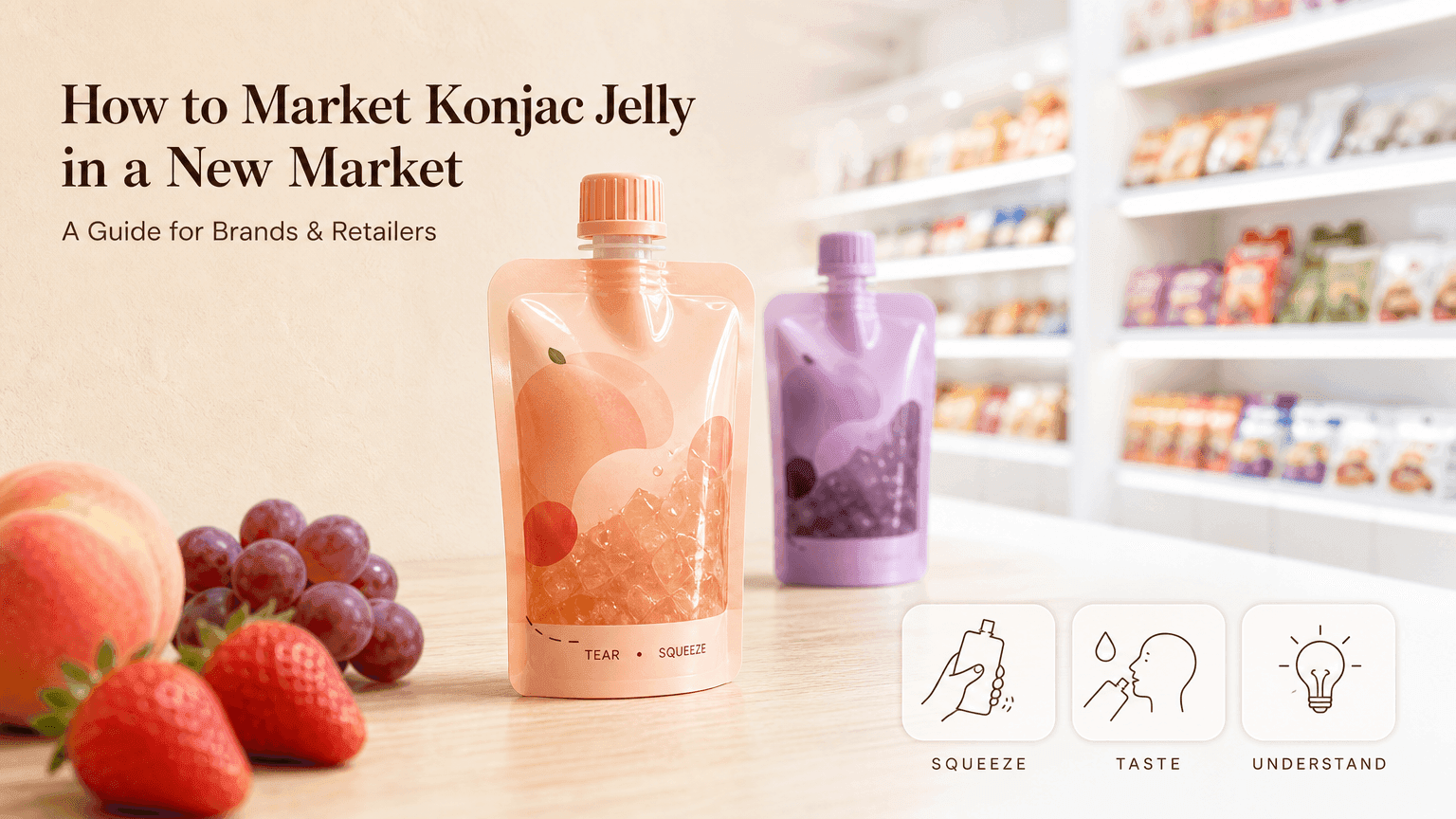
How to Market Konjac Jelly in a New Market: A Guide for Brands & Retailers
When consumers do not already understand konjac jelly, the launch strategy should make the product easier—not harder—to understand. Start with a familiar consumer need, recognizable flavor and clear consumption occasion, then introduce the unfamiliar format through packaging, sampling and simple product education.
This matters because konjac jelly has an unusual market position.
In parts of Asia, jelly pouches and konjac-based snacks can feel completely normal.
In another market, the same consumer may look at a pouch and ask:
Is this a drink?
Is it a snack?
Do I chew it?
Is it a supplement?
When am I supposed to eat it?
Those questions are not necessarily a weakness.
They are a sign that the brand is introducing a new product behavior.
The commercial challenge is therefore not simply:
How do we sell konjac jelly?
It is:
How do we make an unfamiliar format feel easy enough to try?
Why Konjac Jelly Is Becoming Relevant Outside Asia
Konjac is increasingly appearing beyond its traditional Asian applications.
Recent food-industry coverage has highlighted konjac across noodles, rice alternatives, functional foods, drinks and “inner beauty” concepts, with growing visibility among health-focused consumers.
A particularly relevant example arrived in the United States in August 2026.
Beauty entrepreneur Priscilla Tsai and creator Ava Lee launched Mimitime, a collagen-infused konjac jelly brand positioned around beauty and wellness. Coverage of the launch explicitly noted that many American consumers still do not know what konjac jelly or Korean jelly snacks are.
That creates an interesting lesson for private-label brands:
Category unfamiliarity does not automatically mean lack of opportunity.
But it does mean product education becomes part of the launch.
1. Lead With the Consumer Benefit, Not the Ingredient Name
Imagine seeing this product for the first time:
KONJAC GLUCOMANNAN HYDROCOLLOID JELLY
Technically descriptive.
Commercially difficult.
Now compare it with:
Peach Beauty Jelly
or:
On-the-Go Fiber Jelly
The consumer understands the second type of language much faster.
For a new market, “konjac” does not always need to be the first thing the shopper understands.
The first message may instead communicate:
what it is for + what it tastes like + how it fits into everyday life.
Konjac can then support the product story.
This creates a useful hierarchy:
Consumer Need → Product Experience → Flavor → Ingredient Story
rather than:
Ingredient → Technical Explanation → Consumer Benefit.
For B2B buyers, this distinction is important when developing front-of-pack communication.
2. Use Familiar Flavors to Introduce an Unfamiliar Format
If the format is new, flavor does not also need to be difficult.
This is one reason familiar fruit flavors can be useful during category introduction.
The recent Mimitime launch, for example, uses Strawberry, Peach, Grape and Apple rather than building the entire first range around highly unfamiliar flavor combinations.
That is strategically interesting.
The consumer may not understand:
konjac jelly.
But they understand:
peach.
A brand can therefore reduce one layer of uncertainty.
This follows a simple product-development principle:
Unfamiliar Format + Familiar Flavor
can make trial easier than:
Unfamiliar Format + Unfamiliar Flavor + Unfamiliar Function.
Once the category becomes understood, more adventurous flavors can follow.
3. Give Consumers a Clear Consumption Occasion
One of the biggest mistakes when introducing a new food format is failing to explain when it belongs in the consumer's life.
Should konjac jelly be eaten:
in the morning?
after lunch?
at the gym?
during travel?
as an afternoon snack?
as part of a beauty routine?
There is no universal answer.
But the brand should have one.
Consider how differently these products feel:
Daily Collagen Jelly
Afternoon Fiber Snack
Post-Workout Electrolyte Jelly
Low-Sugar Fruit Jelly Snack
The physical format may be similar.
The consumption occasion is completely different.
A clear occasion gives retailers and consumers a mental category for the product.
Without it, the pouch is simply “something unusual.”
4. Packaging Needs to Explain How the Product Is Used
Packaging has another job when the product format is unfamiliar.
It needs to teach behavior.
For a squeezable jelly pouch, simple communication can clarify:
tear → squeeze → enjoy
or
open → squeeze directly from pouch
depending on the actual packaging design.
This may sound obvious to manufacturers familiar with jelly products.
It may not be obvious to the shopper seeing one for the first time.
The package can also use visual cues to communicate texture.
Fruit imagery alone tells the consumer the flavor.
It does not necessarily explain:
soft jelly + squeezable + ready to eat.
Photography or illustrations showing the actual jelly texture can therefore be valuable.
The packaging should reduce questions at shelf.
5. Sampling Matters More When Texture Is the Innovation
Konjac jelly is difficult to communicate through words alone.
Terms such as:
soft
smooth
squeezable
jelly-like
describe the product.
They do not recreate the experience.
That is why sampling can be particularly valuable when introducing texture-led products.
At trade shows, retailer meetings, distributor presentations or consumer events, the moment someone actually squeezes and tastes the product can explain more than a paragraph of marketing copy.
For importers and distributors, this also affects B2B selling.
A buyer deck should explain the concept.
A physical sample should explain the texture.
Both matter.
6. Functional Positioning Can Give the Format a Reason to Exist
If consumers already have hundreds of snack options, why should they learn a new one?
Function can provide an answer.
Current functional-food trends continue to move toward more specific consumer needs, including gut health, women's wellness, fiber, protein and convenient everyday nutrition. Expo West 2026 reporting, for example, highlighted gut support, fiber products, women's wellness and functional beverages among major innovation areas.
This creates space for jelly concepts such as:
Beauty Jelly
Fiber Jelly
Vitamin Jelly
Electrolyte Jelly
Low-Sugar Wellness Jelly
But brands need to be careful.
Functional positioning should be based on the actual finished formulation and applicable market regulations.
The package should not imply a health outcome that the product cannot legally or scientifically support.
Function should create relevance.
It should not become exaggerated medical language.
7. Beauty-from-Within Is a Particularly Natural Entry Point
Beauty nutrition is especially interesting because the consumer already understands the concept of a daily ritual.
Skincare has:
morning routines;
night routines;
serums;
masks;
supplements.
A single-serve jelly can fit naturally into that behavioral structure.
That may help explain why collagen is increasingly moving beyond traditional supplement formats into foods and drinks. Recent industry coverage has highlighted collagen appearing across snacks and other food formats rather than remaining confined to powders or capsules.
A beauty jelly can therefore be communicated not simply as:
“a strange Asian jelly.”
but as:
“a convenient daily beauty snack.”
The format becomes part of the ritual.
8. Do Not Launch Too Many SKUs Before the Category Is Understood
New categories create uncertainty.
More SKUs create more uncertainty.
If a distributor is already trying to understand:
What is this product?
asking them to choose between eight flavors, four functions and three package sizes can make the first conversation harder.
A focused launch can be easier.
For example:
Hero SKU: Peach Collagen Jelly
Second SKU: Strawberry Collagen Jelly
Then expand once the brand learns:
- who buys it;
- where it sells;
- which flavor performs;
- what consumers ask;
- what retailers understand.
The objective of the first launch is not always portfolio completeness.
Sometimes it is:
category education.
9. Retail Placement Can Change How Consumers Interpret the Product
Where the product appears can influence what consumers think it is.
Place a jelly beside candy and it may be interpreted as confectionery.
Place it beside supplements and it may be interpreted as nutrition.
Place it in a beauty-wellness section and it may become part of an ingestible beauty routine.
Place it in convenience snacking and it may become an on-the-go snack.
For brands and distributors, this means retail placement should be discussed early.
Ask:
What product should sit next to us?
That question can be more useful than:
What category are we technically classified under?
The regulatory classification still matters, of course.
But consumer interpretation happens visually at shelf.
10. Use Social Content to Demonstrate the Format
Texture-led foods have one important marketing advantage:
they can be visually demonstrated.
A short video can show:
tear → squeeze → texture → reaction
in seconds.
That makes jelly particularly compatible with creator content and social product demonstrations.
For brands entering markets where konjac jelly is unfamiliar, content should therefore do more than show packaging.
Show the actual product.
Show the texture.
Show how it is consumed.
Show the portion.
Show the occasion.
The goal is to turn:
“What is that?”
into:
“I understand how that works.”
11. Localize the Product—Do Not Simply Export the Asian Version
A product successful in one market should not automatically be copied exactly into another.
Brands should evaluate:
flavor preferences;
sweetness expectations;
serving size;
package communication;
permitted ingredients;
labeling requirements;
functional claims;
retail price;
channel strategy.
The product can retain its Asian or Korean-inspired identity without assuming every part of the original format transfers directly.
There is an important difference between:
authenticity
and
lack of localization.
A strong market-entry product can preserve what makes konjac jelly distinctive while adapting the parts that create unnecessary friction.
12. What Should Importers Ask Before Launching Konjac Jelly?
Before requesting samples, a buyer should be able to answer:
Who is the target consumer?
What familiar need does the product solve?
Is it primarily a snack, wellness product or functional format?
What is the hero flavor?
What texture should consumers experience?
How will the package explain consumption?
Where should the product sit at retail?
Which market will it enter?
What claims are appropriate for that market?
These questions help transform:
“We want to import konjac jelly.”
into an actual product strategy.
The Goal Is Not to Teach Consumers Everything About Konjac
A new category does require education.
But education should not become homework.
Consumers do not need a hydrocolloid lesson before trying a peach jelly pouch.
The strongest launch usually makes the first experience intuitive:
Recognizable Need + Familiar Flavor + Clear Format + Easy Consumption + Distinctive Texture
Then the ingredient story can deepen over time.
That is how an unfamiliar format begins to become a familiar category.
Developing Private-Label Konjac Jelly With Victory Foods
Victory Foods China (https://www.victoryfoodscn.com/?utm_source=chatgpt.com) currently develops konjac and functional jelly products across Keto / Zero Sugar Konjac, Beauty & Wellness, Squeeze Jelly Drink and other OEM/ODM categories. Its existing product architecture gives overseas brands different starting points for functional, snack-led and squeezable jelly concepts.
For a new-market project, a useful development brief can begin with:
Target Market + Consumer + Product Positioning + Function + Flavor + Texture + Serving Size + Packaging + Retail Channel
rather than simply:
“Please quote your konjac jelly.”
Because when the category itself is new, the product and the market-entry strategy need to be designed together.
FAQ
What is the best way to introduce konjac jelly to a new market?
Start with a clear consumer need, familiar flavor and simple consumption occasion. Packaging and sampling should make the unfamiliar texture and eating method easy to understand.
Should konjac jelly be marketed as a snack or supplement?
That depends on the actual formulation, regulatory classification, positioning and target channel. Brands should determine the intended product role before developing packaging and claims.
What flavors are good for a first konjac jelly launch?
Familiar fruit profiles such as peach, strawberry, apple, grape, mango or citrus can reduce consumer uncertainty. More distinctive combinations can be introduced as the category becomes familiar.
Is collagen konjac jelly suitable for beauty brands?
Konjac jelly can be explored as a delivery format for beauty-oriented products, including collagen concepts, provided the ingredient system, formulation, labeling and claims are appropriate for the destination market.
What should an importer tell a konjac jelly OEM manufacturer?
Provide the target market, consumer, product positioning, functional ingredients, serving size, flavor, sweetness, texture, packaging, retail channel and expected order volume.