
How to Choose Flavors for Functional Jelly: Familiar, Tropical or Trend-Led?
Functional jelly flavor selection should begin with the consumer and formula—not a trend list. Learn when familiar fruit flavors, tropical profiles, citrus, berries and more distinctive combinations make sense for private-label functional jelly development.
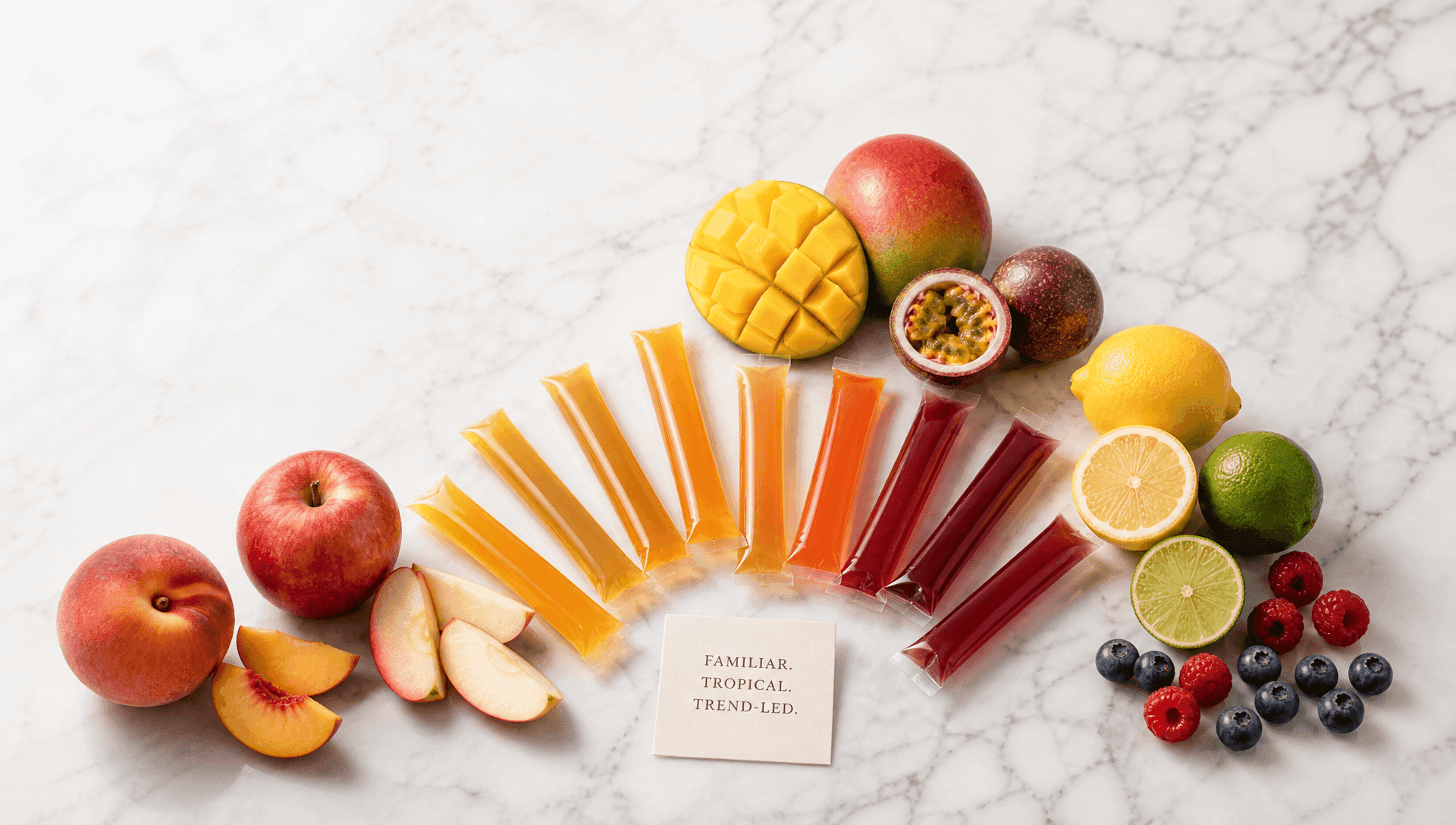
How to Choose Flavors for Functional Jelly: Familiar, Tropical or Trend-Led?
The best flavor for a functional jelly is not necessarily the most fashionable flavor. It is the flavor that fits the target consumer, functional ingredients, sweetness and acidity system, consumption occasion and market positioning while remaining enjoyable after the complete formula is built.
For private-label brands, flavor selection often begins with a list:
Mango.
Strawberry.
Peach.
Yuzu.
Lychee.
Passion fruit.
Then someone asks:
Which flavor is trending right now?
That is a useful question—but it should not be the first one.
A flavor that performs well in a sparkling beverage may not behave the same way in a concentrated functional jelly.
A flavor that feels exciting in one country may feel unfamiliar in another.
And a flavor that works beautifully in a simple fruit jelly may need adjustment once fiber, minerals, vitamins or other functional ingredients enter the formulation.
The better starting question is:
What job does the flavor need to do in this product?
Why Flavor Matters More in Functional Foods
In conventional confectionery, flavor is primarily part of enjoyment.
In functional food, it may have another job:
helping the formula remain enjoyable despite the sensory characteristics of functional ingredients.
Depending on the ingredient and quantity, a functional formula may introduce bitterness, mineral notes, plant-like aromas, acidity, powdery sensations or lingering aftertaste.
Flavor development therefore needs to work with:
Functional Ingredients + Sweetness + Acidity + Texture + Aroma
rather than being added at the end.
This is one reason current functional beverage development is increasingly focused on delivering more complex benefits without sacrificing taste. Recent industry coverage has highlighted precisely this challenge: consumers want more functionality, but the finished product still needs to deliver an appealing sensory experience.
For functional jelly, the same principle applies.
1. Familiar Flavors Reduce the Amount of Consumer Education
Strawberry, orange, grape, peach, apple and mango are not exciting simply because they are familiar.
Their advantage is that consumers already know approximately what to expect.
That can be valuable when the format itself is unfamiliar.
Imagine launching a functional jelly stick into a market where consumers are already familiar with vitamin gummies but less familiar with squeeze-to-eat wellness jelly.
If both the format and flavor are unusual, the consumer has to process two new ideas at once.
A familiar flavor can reduce that friction.
This leads to a useful product-development principle:
New Format + Familiar Flavor
can sometimes be safer than:
New Format + New Flavor + New Functional Concept
for a first launch.
Familiar does not have to mean boring.
A recognizable flavor can still be developed with more sophisticated acidity, aroma or fruit combinations.
2. Tropical Flavors Offer Familiarity With More Differentiation
Tropical profiles occupy an interesting middle ground.
Mango, passion fruit, pineapple and guava are recognizable in many international markets, but they can still feel more distinctive than basic apple or strawberry.
Recent 2026 flavor reporting continues to identify tropical profiles as important across beverage innovation. FoodNavigator's 2027 U.S. beverage outlook, for example, lists mango, passion fruit, guava, pineapple and dragon fruit among established modern tropical directions, with combinations such as passion fruit-orange and guava blends providing additional differentiation.
For functional jelly, tropical fruits can be useful because many naturally suggest:
brightness + juiciness + acidity + refreshment.
That sensory direction can fit products such as:
- beauty jelly;
- vitamin jelly;
- hydration jelly;
- fiber-forward jelly;
- squeeze jelly drinks.
But “tropical” is not one flavor strategy.
Mango is very different from yuzu.
Guava is different from passion fruit.
Dragon fruit creates a different consumer expectation from pineapple.
Brands should choose according to the complete product positioning.
3. Citrus Can Help When a Formula Needs Brightness
Citrus deserves its own category.
Orange and lemon provide familiarity.
Yuzu, calamansi, blood orange and grapefruit can provide a more premium or globally inspired direction.
Recent flavor forecasts have continued to highlight more specific citrus varieties such as yuzu, calamansi and blood orange as brands move beyond generic “citrus” profiles.
From a formulation perspective, citrus-style flavors can also work naturally with products designed around a sharper, more refreshing sensory profile.
That does not mean citrus automatically masks every difficult functional ingredient.
Flavor masking needs to be evaluated against the actual formula.
But where acidity is already part of the desired experience, citrus can create a coherent product story.
For example:
Yuzu Electrolyte Jelly
feels very different from:
Vanilla Electrolyte Jelly.
The first combination naturally communicates refreshment.
The second would require a much more deliberate product concept.
4. Berry Flavors Can Bridge Wellness and Familiarity
Berry profiles are another useful option because they can sit between mainstream and premium.
Strawberry is extremely familiar.
Blueberry feels more wellness-oriented in some product contexts.
Blackberry, blackcurrant, black raspberry and dark cherry can create a deeper, more sophisticated flavor identity.
Current flavor forecasting is also giving increased attention to dark red and purple fruits, including black cherry, blackberry, pomegranate, acai and blackcurrant, as brands seek richer flavor and visual experiences.
For a beauty or wellness jelly, this creates interesting possibilities.
Instead of simply:
Berry Flavor
a brand could consider:
Strawberry + Pomegranate
Blueberry + Lemon
Black Cherry + Berry
Raspberry + Hibiscus
The second flavor can add distinction without making the entire product unfamiliar.
5. Flavor Pairing Can Be More Useful Than Chasing One Trend
A common mistake is searching for:
“the next mango.”
That may be the wrong goal.
Many successful product concepts are not built around a completely new flavor.
They are built around a familiar anchor plus a more distinctive secondary note.
For example:
Mango + Passion Fruit
Peach + Yuzu
Strawberry + Lychee
Berry + Hibiscus
Pineapple + Lime
This structure creates a useful balance:
Familiarity + Discovery
Industry flavor development is moving in this direction. Beverage R&D coverage in 2026 describes familiar profiles being reimagined through global, botanical and cross-cultural influences rather than simply discarded for novelty.
For a first private-label launch, that can be more commercially practical than choosing an extremely niche flavor purely because it appears on a trend report.
6. The Functional Ingredient Should Influence the Flavor Choice
Flavor cannot be selected independently from the functional formula.
Suppose a product contains an ingredient system that introduces noticeable bitterness.
A delicate pear flavor may not provide the same sensory environment as a stronger citrus or tropical profile.
Likewise, ingredients with earthy or botanical characteristics may pair differently with berry, tea, citrus or floral notes.
The correct process is therefore not:
Choose Flavor → Add Functional Ingredients
but:
Define Functional Formula → Understand Sensory Challenges → Build Flavor Around the Complete Product
This is particularly important when ingredient targets are relatively high.
The higher the sensory contribution of the functional ingredients, the more deliberate the flavor system may need to become.
7. Zero-Sugar Products Need Their Own Flavor Strategy
Sugar reduction makes flavor development more complicated.
Sweetness affects how consumers perceive fruit flavor, acidity and aftertaste.
A flavor that feels balanced in a conventional sugar-containing jelly may feel sharper, thinner or different when the sweetening system changes.
That is why zero-sugar product development should evaluate:
Sweetener + Flavor + Acid + Hydrocolloid + Functional Ingredients
together.
Victory Foods already discusses this relationship in its existing guide to zero-sugar functional jelly formulation.
For buyers, the practical takeaway is simple:
Do not approve a flavor in isolation and assume it will taste identical after the final zero-sugar formula is completed.
8. Beauty Jelly and Sports Nutrition May Need Different Flavor Logic
The product occasion matters.
A beauty jelly consumed once per day at home can support a different sensory profile from an energy gel consumed during endurance exercise.
Beauty and wellness products may have room for:
lychee, peach, berry, yuzu, floral-fruit or premium tropical profiles.
Sports nutrition often benefits from flavors that feel:
clear, refreshing and easy to consume repeatedly.
The correct answer depends on the product.
Victory Foods currently separates Beauty & Wellness and Sports Nutrition within its product architecture, reflecting the fact that these categories can require different formulation and consumption strategies.
Flavor should reinforce that distinction.
9. Trend-Led Flavors Work Best When the Brand Has a Reason to Use Them
Dragon fruit is trending.
Yuzu is visible.
Matcha continues to expand.
Botanical combinations are receiving attention.
That does not mean every brand should launch them.
A trend-led flavor makes more sense when at least one of these is true:
The target consumer already understands it.
The flavor fits the product function or occasion.
The brand identity supports experimentation.
The retailer needs novelty.
The product is intended as a limited edition.
If none of those conditions apply, the flavor may simply make the product harder to explain.
Trend data should inform product development.
It should not replace product strategy.
10. How Many Flavors Should a New Brand Launch?
More flavors do not automatically create a stronger launch.
Every additional SKU can create more:
- sampling;
- artwork;
- packaging;
- inventory;
- forecasting;
- production planning;
- retailer decisions.
For a new concept, a focused flavor architecture can be easier to manage.
One practical approach is:
Hero Flavor
The safest expression of the product.
Differentiation Flavor
A more distinctive option that demonstrates the brand personality.
Future / Limited Edition Flavor
Held for later expansion.
For example, a beauty jelly range might begin with:
Peach
and
Lychee + Yuzu
rather than launching six unrelated flavors immediately.
The goal is to learn which flavor direction consumers actually respond to.
A Practical Flavor Brief for OEM Development
Before requesting samples, brands should provide more than flavor names.
A useful brief can include:
Target Consumer: Who is buying it?
Destination Market: Where will it be sold?
Product Function: Beauty, fiber, hydration, sports or general wellness?
Functional Ingredients: What ingredients and target amounts are planned?
Sugar Positioning: Conventional, reduced sugar or zero sugar?
Flavor Direction: Familiar, tropical, citrus, berry, botanical or experimental?
Sweetness Preference: Light, mainstream or indulgent?
Acidity Preference: Soft, balanced or sharp?
Benchmark: Is there an existing product whose sensory direction you like?
This gives R&D enough context to interpret a request such as “mango.”
Because one brand's mango may mean:
ripe + sweet + creamy
while another wants:
fresh + tart + tropical + refreshing.
The flavor name alone does not define the product.
Choose Flavor Around the Product, Not the Trend List
Current flavor trends are useful.
They show where consumer curiosity may be moving.
In 2026, industry reporting continues to highlight tropical fruit, more specific citrus varieties, dark berries, global influences, botanicals and updated familiar flavors.
But functional jelly development requires another layer of thinking.
The best flavor needs to work with:
Consumer + Function + Ingredients + Sweetness + Acidity + Texture + Market + Occasion
A familiar peach flavor can be the right strategic choice.
So can yuzu.
So can passion fruit.
The answer depends on what the product is trying to become.
Developing Custom Functional Jelly Flavors With Victory Foods
Victory Foods China (https://www.victoryfoodscn.com/?utm_source=chatgpt.com) develops OEM/ODM jelly products across Beauty & Wellness, Keto / Zero Sugar Konjac and Sports Nutrition, alongside other jelly and beverage formats.
A useful flavor-development conversation should therefore begin with:
Product Function + Functional Ingredients + Serving Size + Sweetness + Texture + Target Market + Flavor Direction
rather than simply asking for the flavor currently receiving the most attention online.
Because in functional food development:
Trend gets attention. Fit creates a product.
FAQ
What are the best flavors for functional jelly?
There is no universal best flavor. Familiar fruits such as peach, strawberry, orange and mango can reduce consumer friction, while tropical, citrus, berry and botanical combinations can create greater differentiation. The best choice depends on the formula and target market.
What flavors work well for beauty jelly?
Fruit-forward profiles such as peach, berry, lychee, citrus and tropical combinations can provide useful starting points, but the final choice should fit the functional ingredients, sweetness level and intended brand positioning.
Can flavor help mask functional ingredients?
Flavor, sweetness and acidity can help manage some undesirable sensory characteristics, but masking performance depends on the specific ingredient and concentration. It should be tested in the complete formula.
Should a new functional jelly brand launch several flavors?
Not necessarily. A smaller launch range can simplify sampling, packaging, inventory and market validation. Brands can expand once they understand which flavor directions consumers prefer.
Should I choose a trending flavor for my functional jelly?
Only when the trend fits the target consumer, function, market and brand identity. Trend data is best used as an input to product strategy rather than the sole reason for choosing a flavor.