Planning a 2027 Functional Food Launch: When Should Brands Start OEM Development?
Planning a 2027 functional food launch? Learn how to work backward from your target market date and build a realistic OEM development timeline covering product briefs, sampling, packaging, validation, production and logistics.
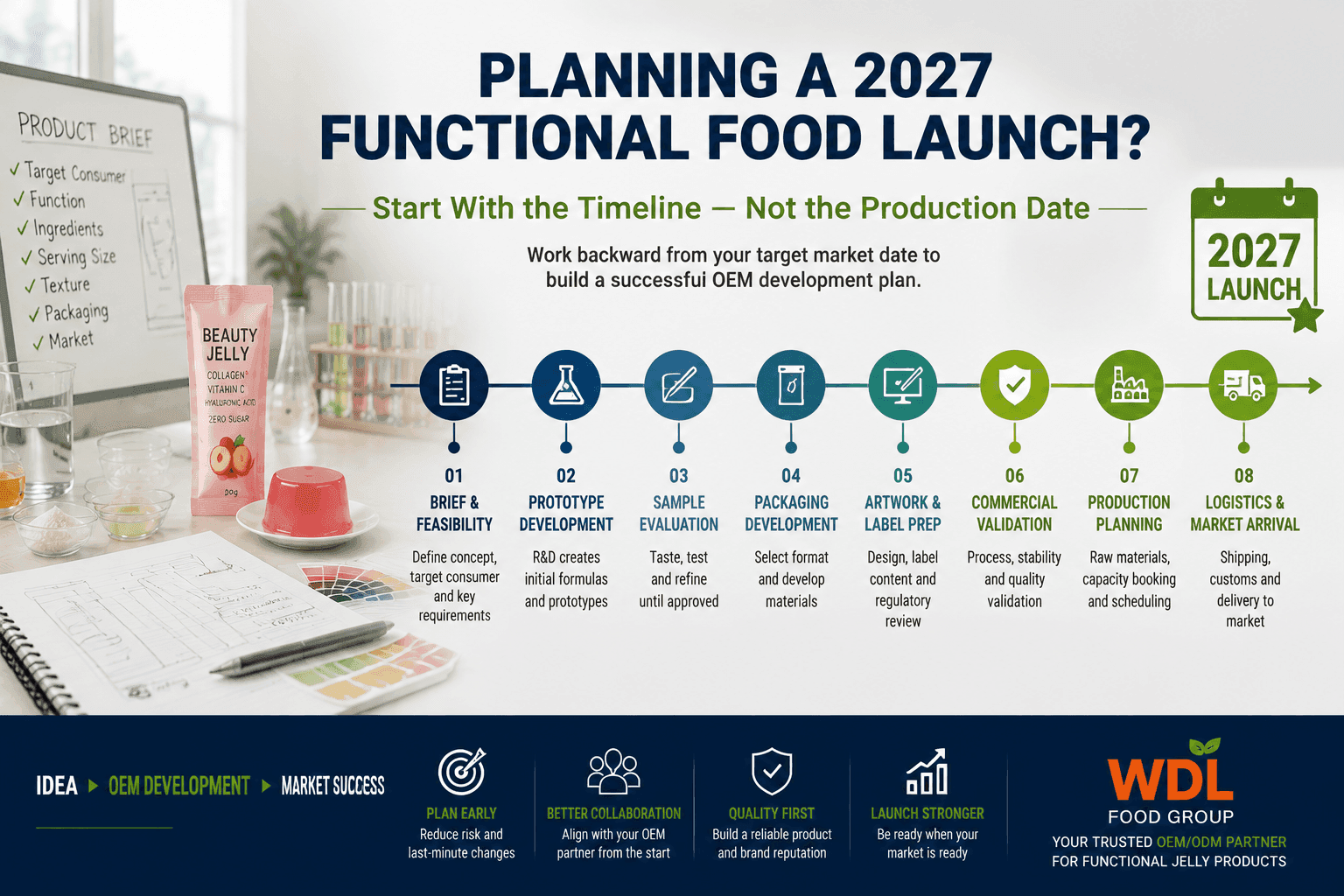
If a brand wants to launch a private-label functional food in 2027, OEM development should begin well before the intended retail launch—not when inventory is already needed.
A functional jelly project can involve product definition, formulation, sampling, revisions, packaging development, artwork, validation, production planning and logistics. Each stage can affect the next.
There is therefore no universal rule such as “start exactly three months before launch.”
A better approach is:
Choose the desired market-launch date first, then plan backward through every development stage.
This is particularly important for brands developing functional jelly, energy gels, electrolyte products, beauty jelly or other customized functional foods.
Why Launch Planning Should Begin Before Sampling
Many first-time buyers treat sampling as the beginning of a project.
In reality, important decisions should happen before the first prototype is made.
A manufacturer needs to understand questions such as:
- Who is the target consumer?
- What is the primary product function?
- Which functional ingredients are required?
- What is the target serving size?
- What texture is expected?
- Which packaging format is preferred?
- Which market will the product enter?
If these questions remain unresolved, the first sample may simply create more questions.
For example, a buyer may initially request a 20 g jelly stick and later discover that the desired functional ingredient dosage creates a better product in a larger serving.
Or the brand may develop a formula first and only later realize that the preferred packaging format creates different requirements for viscosity and squeezability.
Early product definition reduces downstream changes.
Stage 1: Product Brief and Feasibility
The first development stage should turn the business idea into a usable product brief.
Instead of:
- “We want a healthy jelly for women.”
a stronger brief might say:
- “We want a daily beauty-oriented jelly stick for women aged 20–35, with a refreshing fruit profile, a soft squeezable texture and specific functional ingredients. The initial market will be the United States.”
The second brief gives an OEM manufacturer much more useful information.
At this stage, the manufacturer can begin evaluating whether the desired:
function + dosage + serving size + texture + packaging
can realistically work together.
This is also the right time to identify major formulation questions before investing heavily in packaging or branding.
Stage 2: Prototype Development
Once the direction is feasible, the project moves into prototype development.
This is where the concept becomes a physical product.
For functional jelly, R&D may need to balance:
- functional ingredients;
- sweetness;
- acidity;
- flavor;
- hydrocolloid structure;
- viscosity;
- color;
- serving size.
A high-fiber jelly, for example, should not be developed only around the number of grams of fiber.
The formula still needs an appropriate eating experience.
Likewise, a zero-sugar product cannot be designed simply by removing sugar and selecting another sweetener.
Every formulation decision can influence another part of the system.
Stage 3: Sample Evaluation and Revision
Brands should expect sample evaluation to be a development process rather than a ceremonial approval step.
A first prototype gives the buyer something concrete to evaluate.
Useful feedback should be specific:
- Reduce sweetness.
- Increase acidity slightly.
- Make the texture softer.
- Reduce the aftertaste.
- Make the product easier to squeeze.
This type of feedback is far more useful than:
- “Please make it more premium.”
The number of revisions varies by project.
A concept based on an established manufacturing platform may move differently from a highly customized formulation with unusual ingredients or demanding nutrition targets.
This is one reason launch plans should include development flexibility.
Stage 4: Packaging Direction
Packaging should be discussed early even if the final artwork is not ready.
Different formats create different product requirements.
A jelly stick may suit a compact daily serving.
A spouted pouch may allow a larger serving and more branding space.
An energy gel sachet may prioritize portability during sport.
Packaging decisions can also involve:
- filling volume;
- material structure;
- print requirements;
- closures;
- carton configuration;
- shipping efficiency;
- consumer opening experience.
The formula and package should ultimately work as one commercial system.
Stage 5: Artwork and Label Preparation
Once the product direction becomes stable, brands can move more confidently into final packaging artwork.
This stage can take longer than expected.
The brand may need to coordinate:
- product name;
- ingredient information;
- nutrition information;
- net content;
- flavor description;
- preparation or consumption instructions;
- importer or distributor information;
- barcodes;
- market-specific statements;
- permitted claims.
Requirements vary by destination market.
For that reason, regulatory and label review should not be left until finished packaging is already being printed.
A beautiful package that requires major compliance changes can create unnecessary cost and delay.
Stage 6: Commercial Validation
A good laboratory sample is an important milestone.
It is not automatically the same thing as a commercially ready product.
Before mass production, the manufacturer may need to conduct appropriate confirmation, testing or production validation according to the product and project.
Considerations may include:
- manufacturing behavior;
- filling performance;
- packaging compatibility;
- sensory consistency;
- product specifications;
- relevant food-safety requirements;
- stability expectations.
The exact process depends on the product.
The important distinction is:
Prototype development proves the concept. Commercial validation helps confirm that the concept can move into manufacturing.
Stage 7: Production Planning
Once the formula, packaging and relevant commercial requirements are confirmed, production planning can begin.
But this does not mean finished goods appear immediately.
Commercial manufacturing depends on the availability and coordination of:
- raw materials;
- functional ingredients;
- printed packaging;
- cartons;
- production capacity;
- quality-control activities.
Customized packaging is particularly important because packaging materials may need to be prepared specifically for the project.
Brands should therefore avoid treating the production lead time as the entire project timeline.
Development time and production time are two different things.
Stage 8: Logistics and Market Arrival
The final planning stage is not simply “ship the goods.”
Brands should plan for when inventory actually needs to arrive in the destination market.
Depending on the project, this may involve:
- export preparation;
- international freight;
- customs procedures;
- importer requirements;
- warehouse receiving;
- distributor scheduling;
- retailer delivery windows.
A launch date should therefore be based on market-ready inventory, not factory completion alone.
If a retailer needs stock available by a specific date, the production schedule needs to work backward from that requirement.
Should Brands Start Earlier for a Custom Product?
Generally, more customization creates more variables that need to be resolved.
A project may require additional planning when it involves:
- a new functional formula;
- multiple active ingredients;
- demanding nutrition targets;
- unusual flavors;
- custom packaging;
- multiple SKUs;
- new ingredient sourcing;
- market-specific testing or documentation.
By contrast, a concept using an existing product platform with limited customization may have fewer development variables.
This does not mean custom products are undesirable.
Customization is often exactly what creates differentiation.
It simply means brands should give customized development enough time.
Why 2027 Planning Matters Now
Private-label food is becoming more competitive on more than price.
In August 2026, Reuters reported that Target plans to introduce approximately 600 new private-label food and beverage products as the retailer expands its grocery strategy.
At the same time, specialty-food trend analysis continues to emphasize new formats, sensory experiences and convenient consumption.
For emerging brands, this creates both opportunity and competition.
A functional food launch increasingly needs more than an interesting ingredient.
It needs:
a clear consumer need, differentiated format, strong sensory experience, appropriate packaging and reliable manufacturing execution.
Starting OEM discussions earlier gives the brand more room to make those decisions deliberately.
A Better Way to Plan: Work Backward From Launch
Instead of asking:
- “How quickly can the factory make my product?”
start with:
- “When does my product need to be available for sale?”
Then work backward through:
Market Arrival → Logistics → Production → Packaging → Validation → Sample Approval → Prototype Development → Product Brief
This approach makes delays easier to identify before they become launch problems.
It also creates a better conversation with the manufacturer because both parties understand the commercial objective.
Developing a 2027 Functional Food Project With Victory Foods
Victory Foods develops hydrocolloid-based products across multiple categories, including functional jelly, konjac jelly, squeezable jelly products, beauty and wellness concepts, freezer pops and sports nutrition products.
For an OEM/ODM project, brands can begin by defining:
Target Consumer + Function + Ingredients + Serving Size + Flavor + Texture + Packaging + Destination Market
From there, the project can move through feasibility review, prototype development, sample refinement, packaging alignment and commercial production preparation.
The most useful question is therefore not:
“How fast can we make this?”
It is:
“What needs to happen between today and the date consumers need to see this product on the shelf?”
That is the foundation of better functional food launch planning.
FAQ
How early should I contact a functional jelly manufacturer?
There is no universal lead time. Brands should contact manufacturers early enough to allow for product definition, formulation, sample revisions, packaging, validation, production and logistics. More customized projects generally involve more development variables.
Should I design the packaging before requesting samples?
You can establish the packaging direction early, but final artwork is usually better completed after the product direction is sufficiently stable. Formula, serving size and package format can influence one another.
What usually causes delays in private-label functional food development?
Common causes include unclear product requirements, repeated sample revisions, changing functional targets, custom packaging, artwork changes, ingredient sourcing and market-specific testing or documentation.
Can I launch faster by using an existing formula?
Using an established product platform with limited customization may reduce some development variables. However, the actual timeline still depends on packaging, market requirements, production planning and logistics.
What should I prepare before contacting an OEM manufacturer?
Prepare the target consumer, product function, functional ingredients or nutrition targets, serving size, flavor, texture, packaging preference, destination market and expected commercial quantity.