
How Many Functional Ingredients Should a Wellness Jelly Have? A Practical Guide for Private Label Brands
More functional ingredients do not automatically make a better wellness jelly. This guide explains how private-label brands can balance consumer purpose, ingredient targets, serving size, taste, texture and product positioning when developing a functional jelly.
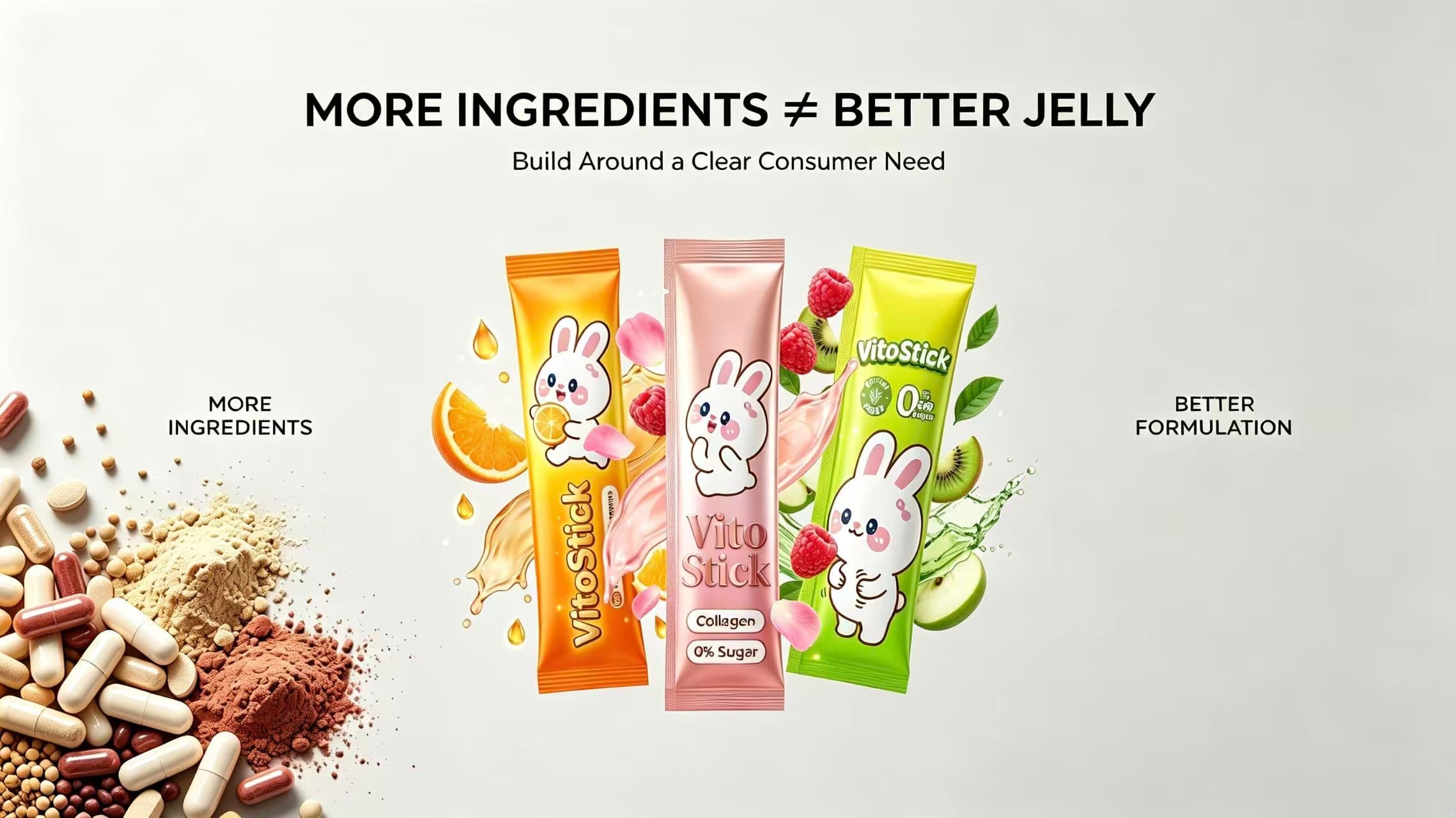
How Many Functional Ingredients Should a Wellness Jelly Have?
A wellness jelly should contain as many functional ingredients as the product can meaningfully support—not as many as the ingredient list can physically accommodate.
For private-label brands, adding collagen, fiber, vitamins, minerals, electrolytes, botanical ingredients and other functional components into one product may sound commercially attractive.
More ingredients can appear to mean more benefits.
But functional food development rarely works that simply.
Every additional ingredient can affect formulation, flavor, texture, serving size, cost, labeling and the clarity of the product story.
The better question is therefore not:
“How many functional ingredients can we add?”
It is:
“Which ingredients are necessary to deliver the product concept consumers are supposed to understand?”
That distinction can make the difference between a focused wellness product and an overloaded formula.
Why Are Brands Adding More Functions to Everyday Foods?
Functional nutrition is increasingly moving beyond traditional tablets, capsules and powders.
Consumers now encounter functional ingredients in drinks, snacks, bars, gummies, jellies and other convenient formats.
Recent industry coverage illustrates the direction.
In August 2026, Nutritional Outlook reported that growing demand for functional beverages is pushing brands toward increasingly complex formulations while still requiring strong taste and consumer experience. FoodNavigator has also highlighted how major food and beverage companies are combining traditional reformulation—such as lower sugar—with positive nutrition attributes including fiber and protein.
For functional jelly brands, this creates opportunity.
But it also creates a formulation trap:
If one ingredient is good, are five ingredients automatically better?
Not necessarily.
1. Start With One Primary Consumer Need
Before selecting ingredients, define what the product is primarily supposed to do.
A beauty-oriented jelly might be built around a different consumer expectation from a fiber-focused jelly.
A sports product has different requirements from an everyday wellness snack.
A useful product-development sequence is:
Consumer → Need → Product Function → Ingredient Strategy → Format
not:
Trending Ingredients → Formula → Find a Marketing Story Later
For example, a brand could begin with:
Daily beauty support for young adult consumers.
That gives the R&D and marketing teams a clear filter for ingredient decisions.
Another concept might begin with:
Convenient fiber-forward snacking for consumers looking to add fiber to their daily routine.
Again, the purpose is understandable.
When a product tries to communicate beauty, digestion, energy, hydration, immunity, sleep and focus simultaneously, the consumer proposition can become difficult to understand.
2. Separate the Hero Ingredient From Supporting Ingredients
One useful way to structure a functional jelly concept is to distinguish between:
Hero Ingredient
and
Supporting Ingredients.
The hero ingredient is closely associated with the primary product proposition.
Supporting ingredients complement that concept rather than competing with it.
For example, a beauty-positioned jelly might be developed around one central ingredient or ingredient system, with selected vitamins or other permitted components playing supporting roles.
A fiber-oriented product may instead make dietary fiber the central nutritional story.
This structure helps buyers ask a better R&D question:
What does each ingredient contribute to the product concept?
If there is no clear answer, the ingredient may not need to be included.
3. Serving Size Creates a Physical Limit
Functional foods are not capsules.
The ingredients have to exist inside an actual food matrix that consumers will eat.
A 15–25 g jelly stick creates a different formulation environment from a 100 ml squeezable pouch.
If a brand wants meaningful quantities of several ingredients in a very small serving, the formulation can become increasingly challenging.
Depending on the ingredients involved, higher solids or functional ingredient loads may affect:
- viscosity;
- gel structure;
- sweetness;
- acidity;
- bitterness;
- aftertaste;
- color;
- aroma;
- squeezability.
This is why serving size should be discussed at the same time as functional targets.
The question should not only be:
“Can this ingredient go into jelly?”
It should be:
“Can the intended amount of this ingredient work in this serving size while maintaining the desired product experience?”
4. Taste Still Determines Whether Consumers Want a Second Serving
Functional positioning may persuade someone to try a product.
Taste influences whether they want it again.
This is especially important for everyday wellness products.
Some functional ingredients can introduce bitterness, mineral notes, earthy flavors, acidity or other sensory characteristics that need to be considered during formulation.
Adding multiple functional components can make flavor masking more difficult.
Brands therefore need to balance:
Functional Target + Flavor + Sweetness + Acidity + Texture
as one system.
A technically impressive ingredient panel does not compensate for a product consumers do not enjoy eating.
That is one reason the current functional beverage conversation is increasingly focused on delivering function without compromising taste.
The same principle applies to functional jelly.
5. Texture Is Part of Functional Product Design
Jelly is not simply a container for active ingredients.
Its texture is part of the product experience.
A beauty jelly may benefit from a smooth, premium eating experience.
A fiber jelly may require careful texture management as the fiber system changes the formula.
A sports gel may prioritize rapid squeezing and easy consumption.
A larger wellness pouch may be designed with a softer or more drinkable structure.
This means the hydrocolloid system, functional ingredients and serving format should be developed together.
Adding another ingredient can change more than the nutrition panel.
It can change how the product behaves.
6. More Ingredients Can Create More Labeling Questions
Every ingredient added to a commercial product also becomes part of the regulatory and labeling conversation.
Brands need to consider the requirements of the destination market, including appropriate ingredient declarations, nutrition information and any claims they intend to make.
The presence of an ingredient does not automatically permit every associated marketing claim.
This is especially important when products use wellness language around areas such as beauty, digestion, energy or other physiological functions.
Brands should therefore distinguish between:
what the formula contains
and
what the label is legally permitted to say about it.
Regulatory requirements vary by product and destination market, so label and claim review should be handled according to the specific commercial project.
7. Ingredient Count Also Affects Commercial Complexity
A functional formula is also a supply-chain system.
Each specialized ingredient may involve:
- sourcing;
- supplier documentation;
- minimum purchasing quantities;
- specifications;
- storage;
- production handling;
- testing or verification requirements;
- cost.
A ten-ingredient functional system may therefore be commercially different from a focused two- or three-component concept even before packaging and marketing are considered.
For private-label buyers, the best formulation is not necessarily the formula with the longest specification sheet.
It is the formula that can realistically support the intended:
consumer + positioning + sensory experience + price point + manufacturing model.
8. When Does a Multi-Functional Jelly Make Sense?
Multi-functional products can absolutely make sense.
The key is whether the functions naturally belong together.
For example, ingredients may share:
- the same consumer;
- the same consumption occasion;
- compatible serving requirements;
- complementary positioning.
A product designed for one clear daily routine can sometimes support several carefully selected components without confusing the consumer.
The problem begins when the formula becomes a collection of unrelated trending ingredients.
A useful test is:
Can the product proposition still be explained in one sentence?
If not, the concept may need simplification.
9. Build a Product Family Instead of One “Everything Jelly”
Brands do not always need to put every function into one SKU.
Sometimes a portfolio creates a clearer strategy.
For example:
Beauty Jelly
Built around a beauty-oriented ingredient concept.
Fiber Jelly
Built around dietary fiber and everyday snacking.
Active Jelly
Designed around hydration or active-lifestyle positioning.
Each product can have a clear reason to exist while sharing common packaging architecture and brand identity.
This approach can also make future product extensions easier to understand.
Instead of asking consumers to decode one extremely complicated product, the brand creates a functional system.
10. What Should Brands Give an OEM Manufacturer?
Before requesting a functional jelly sample, brands should provide measurable priorities.
A useful brief includes:
Primary Function
What is the main consumer purpose?
Hero Ingredient
Which ingredient or system defines the concept?
Target Amounts
Are specific nutritional or ingredient targets required?
Serving Size
Stick, sachet or larger squeezable pouch?
Texture
Firm jelly, soft jelly, smooth squeeze or drinkable?
Flavor Direction
Fruit-forward, refreshing, mild, dessert-inspired or another profile?
Sugar Positioning For zero-sugar concepts, sweetener selection should be evaluated together with texture, flavor and the complete formulation system.
Conventional, reduced sugar, no added sugar or another target?
Destination Market
Where will the finished product be sold?
Target Price Position
Mass market, premium wellness or another commercial tier?
These details give an R&D team much more useful information than:
“Please put as many healthy ingredients as possible into the jelly.”
The Better Formula Is the Formula Consumers Understand
Functional food innovation is becoming more sophisticated.
But sophistication does not have to mean complexity.
A strong functional jelly concept aligns:
Consumer Need + Hero Function + Ingredient System + Serving Size + Taste + Texture + Packaging
When these elements reinforce one another, the product becomes easier to develop, position and explain.
When they conflict, adding another ingredient usually does not solve the problem.
For private-label brands, the goal should therefore not be to create the longest ingredient list.
It should be to create the clearest product.
Developing Functional and Wellness Jelly With Victory Foods
Victory Foods develops jelly-based products across categories including beauty and wellness, zero-sugar konjac products, squeezable jelly and sports nutrition formats. The company’s current product architecture gives brands multiple serving and positioning options when developing private-label concepts.
An OEM/ODM project can begin with:
Consumer + Function + Ingredient Targets + Serving Size + Texture + Flavor + Packaging + Destination Market
The formulation can then be evaluated as a complete product system rather than a list of ingredients.
Because in functional food development, more is not always better.
Better aligned is better.
FAQ
How many functional ingredients can be added to a jelly?
There is no universal number. Feasibility depends on the specific ingredients, intended amounts, serving size, flavor, texture, processing requirements and destination market.
Can collagen, vitamins and fiber be combined in one functional jelly?
Multiple functional ingredients may be combined where the formulation is technically and commercially appropriate, but compatibility, sensory quality, target amounts and labeling requirements should be evaluated during development.
Is a larger pouch better for high-dose functional ingredients?
A larger serving can provide a different formulation environment than a small jelly stick, but the best format depends on ingredient targets, texture, consumer occasion and positioning.
Should a functional jelly have one hero ingredient?
Not necessarily, but a clear primary function or ingredient story can make the product easier for consumers to understand and for brands to position.
What should I send a functional jelly manufacturer before requesting samples?
Provide the target consumer, primary function, ingredient targets, serving size, flavor, texture, sugar positioning, packaging preference, destination market and commercial positioning.