What Should Buyers Ask a Functional Jelly Manufacturer About Quality Control?
Quality control should be evaluated before price becomes the only supplier-selection factor. Here are 10 practical questions brands, importers and distributors can ask when evaluating a functional jelly OEM/ODM manufacturer.
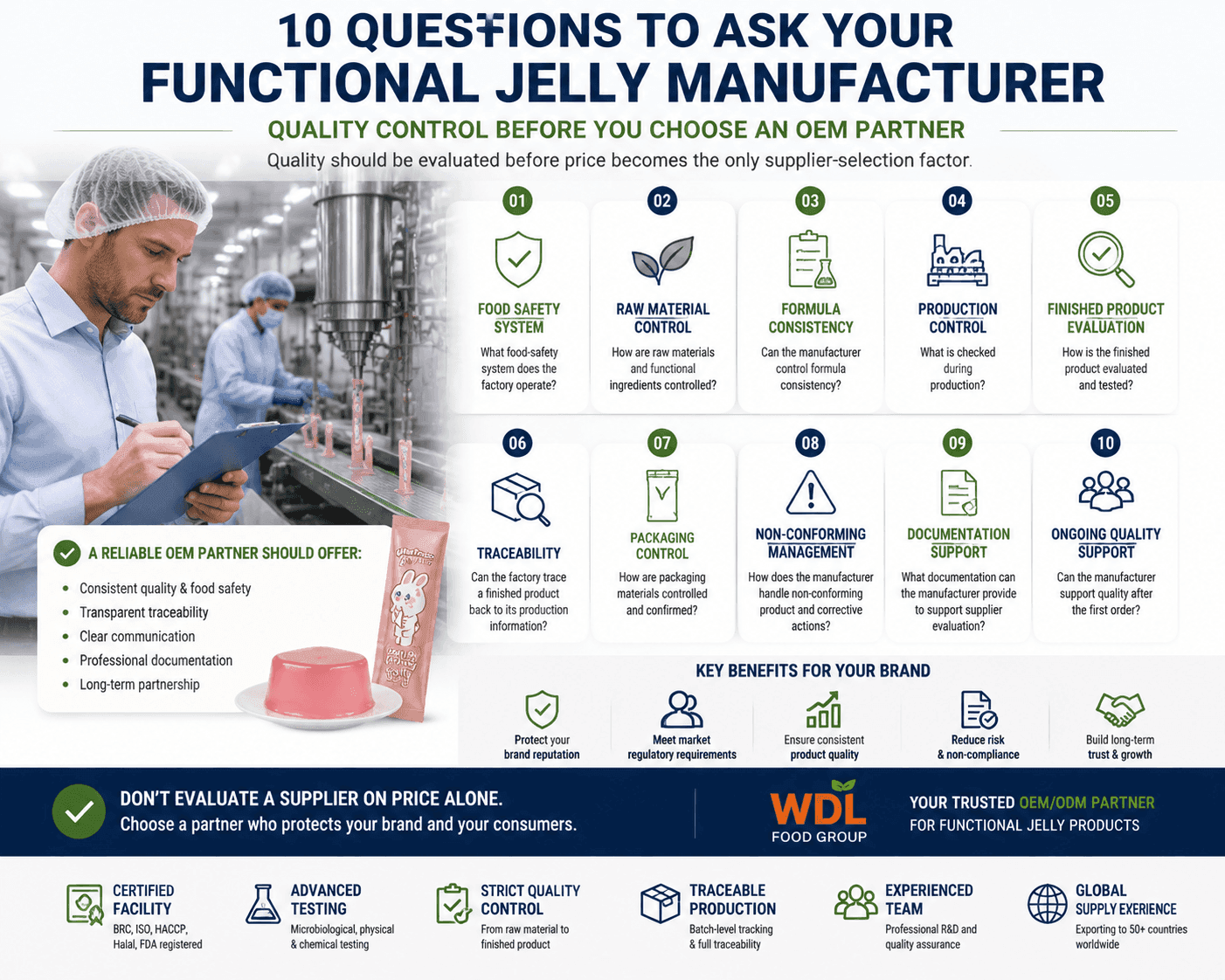
Before choosing a functional jelly manufacturer, buyers should evaluate more than certifications and price. A useful supplier review should examine food-safety systems, raw-material controls, formulation records, production controls, testing, traceability, packaging management, corrective actions and the manufacturer’s ability to provide relevant documentation.
For private-label brands, importers and distributors, selecting an OEM manufacturer is one of the most important decisions in product development.
A sample may taste excellent.
The packaging may look attractive.
The quotation may fit the target.
But commercial manufacturing introduces another question:
Can the supplier produce the defined product consistently and support the quality requirements of the destination market?
This matters for conventional foods, and it becomes particularly important for functional jelly products that may combine hydrocolloids, flavors, sweeteners, vitamins, minerals, fibers, electrolytes or other ingredients in one formulation.
Quality control is therefore not a single inspection at the end of the production line.
It is a system.
Here are ten questions buyers can use when evaluating a functional jelly OEM/ODM manufacturer.
1. What Food-Safety System Does the Factory Operate?
The first question should not simply be:
- “Do you have certificates?”
Ask instead:
What food-safety management system operates inside the factory, and how does it affect daily production?
Certifications can provide useful third-party evidence, but buyers should understand what sits behind the certificate.
Depending on the supplier and destination market, useful discussions may include:
- good manufacturing practices;
- hazard analysis;
- preventive controls;
- sanitation procedures;
- allergen management where applicable;
- employee hygiene;
- pest control;
- production records;
- corrective-action procedures.
For U.S.-bound foods, FDA’s preventive-controls framework requires covered food facilities to consider known or reasonably foreseeable biological, chemical and physical hazards and implement appropriate controls where required.
The practical lesson for buyers is simple:
A certificate is useful evidence, but a functioning food-safety system is the real objective.
2. How Are Raw Materials and Functional Ingredients Controlled?
Functional jelly can contain more than fruit flavor and a gelling system.
Depending on the product concept, a formulation may include ingredients such as:
- dietary fiber;
- collagen;
- vitamins;
- minerals;
- electrolytes;
- sweeteners;
- botanical ingredients;
- fruit concentrates;
- acids;
- hydrocolloids.
Each additional ingredient introduces another supply-chain consideration.
Buyers should ask how the manufacturer manages raw-material suppliers and what documentation is available for ingredients relevant to their project.
Questions may include:
How are suppliers approved?
Are incoming materials checked against specifications?
How are ingredient lots identified?
How are changes in suppliers or specifications managed?
The exact controls should be appropriate to the ingredient and product.
For a functional food brand, ingredient sourcing is not separate from finished-product quality.
It is where quality begins.
3. Can the Manufacturer Control Formula Consistency?
A functional jelly formula is a system.
Changing the amount of one component may affect:
- sweetness;
- acidity;
- viscosity;
- gel strength;
- flavor;
- nutritional composition;
- processing behavior.
That makes formulation control important during commercial manufacturing.
Buyers should understand how approved formulations are transferred into production and how unauthorized or accidental formula changes are prevented.
Useful questions include:
Is there a controlled production specification?
How are ingredient quantities recorded?
How are formula revisions managed?
How does production know which version is approved?
This becomes especially important after several rounds of R&D samples.
The product that reaches mass production should correspond to the commercial specification that the buyer approved.
4. What Is Checked During Production?
Quality control should not begin only after cartons are sealed.
Depending on the product and manufacturing process, manufacturers may monitor relevant parameters during production.
The appropriate checks vary, but buyers can ask:
What parameters are monitored during my product’s production?
At which stages are checks performed?
What happens if a result falls outside the defined specification?
For jelly products, process control may relate to characteristics such as formulation preparation, filling, sealing, weight or other product-specific parameters.
The important point is not to demand an arbitrary list of tests.
It is to understand whether the manufacturer has defined controls for the actual product being produced.
5. How Is Finished Product Evaluated?
Before discussing testing, buyers should distinguish between two concepts:
product specification
and
testing.
Testing without a defined specification does not tell the buyer enough.
A useful conversation begins with:
What characteristics define an acceptable finished product?
Depending on the project, finished-product evaluation may involve relevant:
- sensory characteristics;
- net content or weight;
- packaging integrity;
- microbiological criteria;
- physical or chemical parameters;
- nutrition-related verification where appropriate.
Not every product requires the same test plan.
A conventional fruit jelly and a functional sports gel may have different specifications.
The manufacturer and buyer should therefore agree on what matters for the specific commercial product.
6. Can the Factory Trace a Finished Product Back to Its Production Information?
Traceability is one of the most useful supplier-evaluation questions because it connects multiple parts of the quality system.
Ask:
If I give you a finished-product lot number, what information can you trace?
A traceability system may connect relevant records involving:
- production date;
- production batch;
- ingredients or material lots;
- packaging materials;
- production records;
- inspection or testing records.
The exact system differs between manufacturers.
The buyer’s objective is to understand whether the supplier can investigate a specific commercial batch if a problem occurs.
Traceability becomes particularly important when products move across borders and through distributors, warehouses and retailers.
7. How Are Packaging Materials Controlled?
For private-label projects, packaging is part of product quality.
A perfectly formulated jelly can still become a commercial problem if the packaging does not perform as intended.
Depending on the format, buyers may need to discuss:
- film or pouch specifications;
- seals;
- closures;
- printing;
- artwork versions;
- filling compatibility;
- carton configuration.
This is particularly relevant for functional jelly because the category can use very different formats, including jelly sticks, sachets, cups and squeezable pouches.
A good supplier discussion therefore asks:
How do you confirm that the packaging being used matches the approved specification and artwork?
Packaging control is both a quality issue and a brand-protection issue.
8. How Does the Manufacturer Handle Non-Conforming Product?
No serious quality system should be built around the assumption that nothing will ever go wrong.
A more useful question is:
What happens when something does not meet specification?
Buyers can ask how the manufacturer handles:
- non-conforming raw materials;
- production deviations;
- packaging problems;
- failed inspection results;
- customer complaints.
The important concept is control and corrective action.
Can affected material be identified?
Can it be separated from acceptable product?
Can the cause be investigated?
Can corrective action be documented where appropriate?
A manufacturer’s response to a problem can reveal more about its quality culture than a perfect showroom presentation.
9. What Documentation Can the Manufacturer Provide to Support Supplier Evaluation?
International buyers increasingly need documentation, not only verbal reassurance.
For U.S. importers subject to the Foreign Supplier Verification Programs rule, FDA states that supplier verification is risk-based and may include activities such as on-site audits, sampling and testing, and review of relevant food-safety records depending on the circumstances. U.S. Food and Drug Administration
That does not mean every buyer needs exactly the same document package.
It does mean buyers should discuss documentation early.
Depending on the project, buyers may request relevant:
- company information;
- food-safety certificates;
- product specifications;
- ingredient information;
- test documentation;
- traceability information;
- manufacturing records or other appropriate quality documents.
Requirements vary by product, market and importer.
For U.S. projects specifically, brands and importers should determine which regulatory obligations apply to their own situation rather than assuming that a factory certificate alone satisfies every import requirement.
10. Can the Manufacturer Support Quality After the First Order?
Supplier evaluation should not stop when the first container ships.
A private-label product may continue for years.
During that time:
- ingredients can change;
- packaging can change;
- regulations can change;
- formulations can be revised;
- consumer expectations can evolve.
Brands should therefore consider whether the manufacturer can support an ongoing quality relationship.
Ask:
How are specification changes communicated?
How are complaints investigated?
Can production records be reviewed when necessary?
How are repeat orders kept aligned with the approved product?
The strongest OEM relationships are not simply transactional.
They create continuity between product development, manufacturing and future production.
Quality Control Should Be Evaluated Before the Purchase Order
Many buyers begin supplier discussions with four questions:
What is the MOQ?
What is the price?
How fast can you make samples?
What is the lead time?
These questions matter.
But they do not tell you whether the supplier is suitable for a long-term functional food project.
Quality questions should begin during supplier evaluation—not after a problem occurs.
A practical buyer sequence is:
Product Fit → Manufacturing Capability → Quality System → Documentation → Commercial Terms
rather than evaluating a manufacturer on quotation alone.
A Note for U.S. Importers
For buyers importing food into the United States, supplier evaluation can also have a regulatory dimension.
FDA states that food imported into the U.S. must meet applicable U.S. requirements, and the FSVP rule requires covered importers to conduct risk-based activities to verify foreign suppliers. These responsibilities can include hazard analysis, evaluation of food risk and supplier performance, appropriate verification activities, corrective actions and recordkeeping. U.S. Food and Drug Administration
FDA also provides dedicated firm and supplier evaluation resources for importers and manufacturers. U.S. Food and Drug Administration
This article is not regulatory advice, and requirements vary according to the food, importer and circumstances.
The important commercial point is:
Supplier verification should be planned before import—not treated as paperwork after production.
Evaluating Victory Foods as a Functional Jelly Manufacturing Partner
Victory Foods manufactures hydrocolloid-based products across categories including konjac jelly, functional jelly, squeezable jelly products, beauty and wellness formats and sports nutrition.
Our public website provides information about our manufacturing capabilities and food-safety certifications for buyers conducting an initial supplier review.
For an OEM/ODM project, quality discussions should then become product-specific.
A useful starting point is to define:
Product + Ingredients + Target Specification + Packaging + Destination Market + Required Documentation
This allows quality requirements to develop alongside the formula rather than being added at the end of the project.
Because for a private-label brand, the objective is not merely receiving one good sample.
It is being able to produce the approved product consistently at commercial scale.
FAQ
What should I check before choosing a functional jelly manufacturer?
Evaluate product-development capability, food-safety systems, raw-material controls, production controls, traceability, packaging management, relevant testing and documentation in addition to price, MOQ and lead time.
Are food-safety certificates enough to approve an OEM manufacturer?
Certificates can be useful evidence, but supplier evaluation should also consider the specific product, manufacturing controls, supplier performance and documentation required by the buyer or destination market.
What quality documents should I request from a jelly manufacturer?
The appropriate documents depend on the product and market. Buyers may need relevant food-safety certificates, product specifications, ingredient information, test records or other documentation supporting their supplier-verification process.
Why is traceability important in private-label food manufacturing?
Traceability helps connect a finished-product batch with relevant production, ingredient, packaging and quality information, making investigation and corrective action more effective if a problem occurs.
Does a U.S. importer need to verify a foreign food supplier?
Importers covered by FDA's FSVP rule have risk-based foreign-supplier verification responsibilities. Applicability and required activities depend on the specific circumstances, so importers should review current FDA requirements for their product and business.
https://www.fda.gov/food/food-safety-modernization-act-fsma/fsma-final-rule-foreign-supplier-verification-programs-fsvp-importers-food-humans-and-animals?utm_source=chatgpt.com
https://www.fda.gov/food/food-safety-modernization-act-fsma/firmsupplier-evaluation-resources-fsma-rules?utm_source=chatgpt.com