Alcohol Jelly Cup Seal Integrity What Buyers Should Validate Before Launch
A sealed cup must do more than look closed. This buyer guide explains how visual inspection, mechanical seal strength, leak detection, production controls and shelf-life evidence work together when evaluating individually sealed alcohol jelly cups.
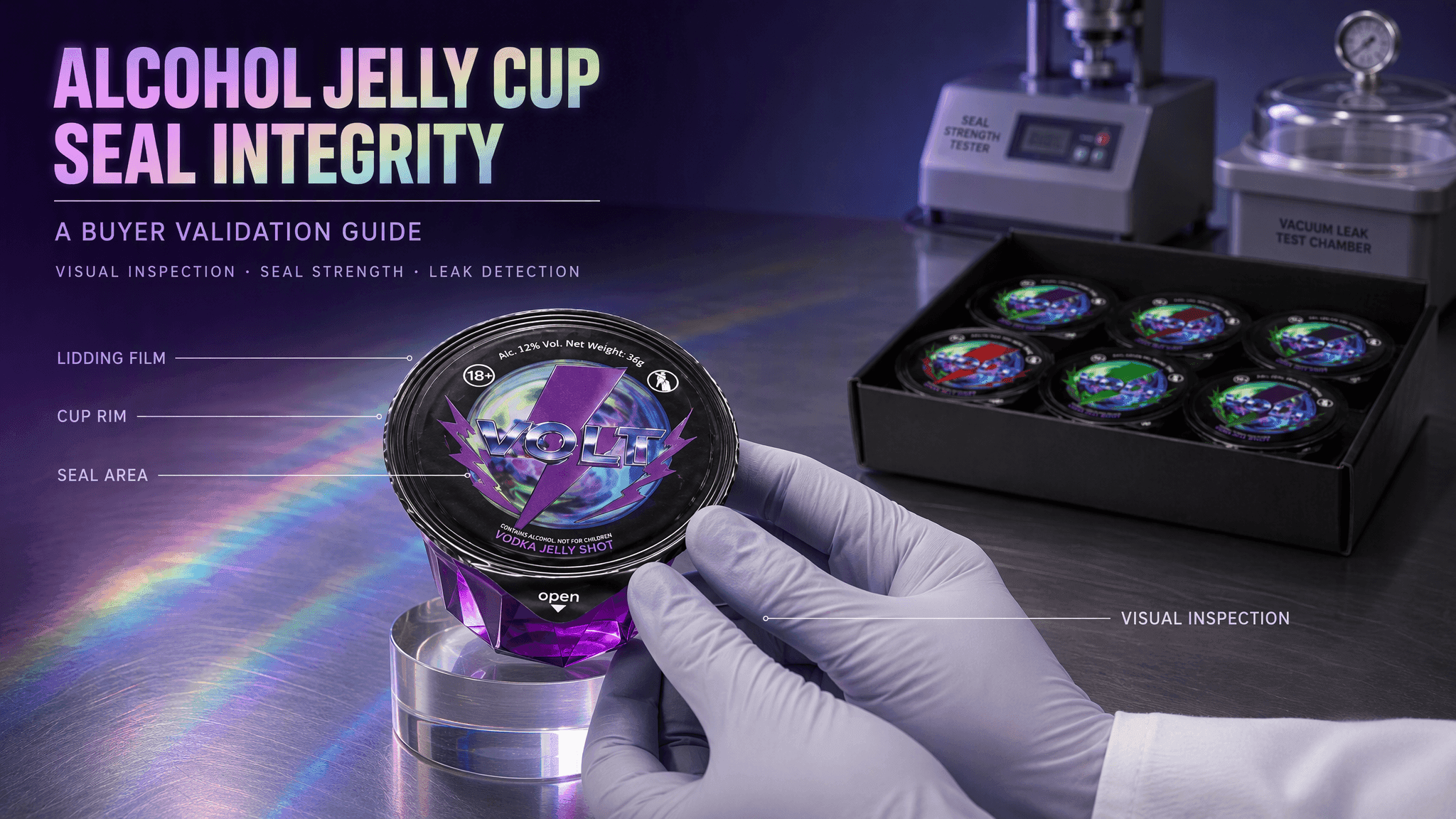
Alcohol Jelly Cup Seal Integrity What Buyers Should Validate Before Launch
Every VOLT retail box contains six individually sealed alcohol infused jelly cups. The seal on each cup is a small part of the package, but it affects handling, transport, product identification and the condition of the jelly when an adult opens it.
A lid that looks attached is not enough evidence by itself. Buyers need to understand what seal integrity means, which checks answer different questions and how the package is connected to the approved 18-month ambient shelf-life statement.
This article describes a practical validation framework. It does not publish confidential sealing parameters or set a universal pass value for every cup and lidding system.
Define Seal Integrity Before Choosing a Test
Seal integrity means the closed package performs as intended under the conditions defined for the product.
For an individually sealed jelly cup, that usually requires a continuous seal around the rim, suitable bonding between the cup and lidding material, resistance to expected handling and an opening experience that does not require excessive force.
Different checks measure different properties. A visual inspection can find obvious contamination, wrinkles or incomplete areas. A mechanical test can measure the force needed to separate a seal. A leak test can look for a path through which gas or liquid may move. Shelf-life work evaluates the finished product and package over time.
None of those results should be used as a substitute for all the others. A strong seal may still contain a local defect, while a package that passes a leak check may still be difficult for the consumer to open.
Treat the Cup and Lid as One Packaging System
The seal is created where the flexible lid meets the rim of the cup. Its performance depends on the complete system rather than one material in isolation.
Buyers should confirm that the cup, lidding material, product and sealing process were evaluated together. A material change that appears minor may alter the sealing window, opening force, leak performance or behavior during storage.
The alcohol-containing jelly also needs to remain compatible with the approved food-contact package throughout the stated shelf life. Compatibility should be supported by supplier declarations, applicable migration or compliance documents and finished-product evidence required for the destination market.
Public sales copy does not need to identify confidential material structures. The technical file should still make clear which approved cup and lid versions belong to the product specification.
Control the Rim Before the Lid Is Applied
The cup rim is the surface that receives the lid. A stable process begins before sealing.
Product on the rim can interrupt contact between the surfaces. A deformed cup, uneven flange or damaged rim can also make a continuous seal harder to achieve. Filling and cup handling therefore belong in the seal-control discussion, even though they occur before the sealing station.
A buyer reviewing a production trial should ask how the factory keeps the rim clean, how damaged cups are removed and how the line detects visible sealing defects. The answer should describe an actual control method rather than rely only on final random inspection.
The same review should cover changeovers. Different cup or lid lots, line settings and start-up conditions may require checks before routine production continues.
Understand the Sealing Window
Heat sealing commonly depends on a controlled combination of temperature, contact time and pressure. The acceptable combination is a process window, not a single setting copied from another package.
If the conditions are too low for the selected materials, the seal may be incomplete or weak. If conditions are too aggressive, the lid, rim or opening behavior may be damaged. Actual limits must be established for the approved package and equipment.
Line speed, equipment condition, cup position and surface cleanliness can influence results. That is why a laboratory material data sheet cannot replace a production trial on the intended line.
The buyer does not need the supplier to publish proprietary settings online. The supplier should be able to show that sealing parameters are defined, monitored and connected to acceptance checks in the production record.
Start With Visual Inspection
Visual inspection is fast and useful, but its scope should be clear.
Inspectors can look for a lid that is out of position, a visibly open area, folds crossing the seal, product contamination on the rim, damaged cup edges, punctures or print defects that interfere with required information.
The inspection method should define what area is examined, under what lighting and which defects cause rejection. Reference photographs can help production and quality teams classify the same defect consistently.
Visual inspection cannot prove that every microscopic leak or bond weakness is absent. It is one layer of control and should be combined with other evidence selected for the package risk.
Separate Seal Strength From Leak Detection
Seal strength and leak detection answer related but different questions.
ASTM F88 and F88M describes a method for measuring the force required to separate a seal in flexible barrier materials. It can support process development and comparison when the method is suitable for the package and the specimen is prepared consistently.
The result should not be treated as a universal target. Test width, peel angle, equipment, conditioning and package geometry can affect the measurement. The approved specification should state the method and acceptance basis used for the actual cup system.
Leak detection focuses on whether a pathway exists through the package or seal. ASTM F2338 describes vacuum-decay testing for several package types, including cups and rigid or flexible nonporous packages. Suitability, sensitivity and acceptance criteria still need to be established for the product and test equipment.
A buyer should therefore ask two separate questions: how is seal strength controlled, and how are leaks detected. One result does not automatically answer both.
Build Validation Around the Real Production Process
Validation should use cups made on the intended commercial process, not only hand-prepared laboratory seals.
The plan should identify the approved materials, equipment, line range, sampling points, test methods and failure rules. Samples may need to represent start-up, stable running conditions, changeovers and the end of a production run, depending on the risk assessment.
The team should also decide how to respond when a result falls outside the acceptance criteria. A useful plan defines product hold, investigation, additional sampling, disposition and approval responsibilities before a deviation occurs.
Importers do not need access to every proprietary machine setting. They do need enough evidence to understand that the finished package was made under a controlled and repeatable process.
Check the Package After Handling and Distribution
A cup can leave the sealing station in good condition and still be damaged later.
The secondary box, shipping case and pallet pattern should protect the cups from compression, abrasion, puncture and movement expected in the distribution route. Handling checks should use the actual retail and shipping configuration planned for the project.
After distribution testing or a controlled shipment, the team should inspect seals again and review any leakage, lid movement, cup deformation or damage caused by contact between units.
The shipping review should also include temperature conditions relevant to the route. Ambient shelf storage does not mean the package can tolerate unlimited heat, freezing or direct sunlight. The current VOLT version should be stored according to the approved instructions and protected from direct sunlight.
Connect Seal Evidence to Shelf Life
The current VOLT version has an 18-month ambient shelf life under its approved storage conditions. That claim belongs to the confirmed formula and package combination.
Seal inspection at production release does not prove the entire shelf life. Shelf-life evidence should examine finished packages over the required period using the approved product, cup, lid and storage plan.
If the formula, alcohol level, cup, lid, sealing process or secondary packaging changes, the team should evaluate whether existing evidence still applies. A change-control record should state the assessment and any additional work required.
Buyers should compare the shelf-life report, packaging specification, production controls and label statement. The documents should describe the same product version without conflicting storage or date-marking information.
Review Finished Samples as a Buyer
Finished samples let the importer connect documents to the physical package.
- Confirm that all six cups are individually sealed and remain clean inside the retail box.
- Examine the full seal perimeter for obvious folds, contamination, open areas or damaged rims.
- Check whether the lid opens in a controlled way without tearing the cup or creating an unsafe edge.
- Confirm that batch and date information remain legible after normal handling.
- Compare the sample cup and lid with the approved packaging specification and artwork.
- Ask which visual, strength and leak checks support release of the commercial version.
- Confirm how results are recorded and how nonconforming product is controlled.
This review does not replace laboratory or factory evidence. It helps the buyer identify gaps between the approved specification, the production record and the sample received.
Ask for Evidence Without Asking for Trade Secrets
A buyer can evaluate seal control without requesting confidential process recipes.
Useful evidence includes the approved cup and lid specification, the inspection plan, the named test methods, acceptance criteria, summary results, deviation handling, change-control rules and the shelf-life evidence linked to the same package version.
The buyer should also ask who approves a packaging change and whether a change triggers a new production trial, transport review or shelf-life assessment.
The objective is traceability. Each commercial lot should be connected to an approved packaging version and a defined set of controls.
Request a Finished VOLT Sample Set
Qualified importers, distributors and retail buyers can request a finished VOLT sample set to review the six individually sealed cups, opening experience and packaging presentation.
Please include the destination market and intended channel so the required package documents and local compliance questions can be identified before launch.
Frequently Asked Questions
What does seal integrity mean for an alcohol jelly cup
It means the finished cup and lid remain closed and perform as intended under the approved manufacturing, handling, storage and use conditions.
Is a visual inspection enough to approve the seal
No. Visual inspection can identify obvious defects, but it may not detect every leak or bond weakness. The validation plan should combine methods appropriate to the package risk.
Is seal strength the same as leak tightness
No. Seal strength measures resistance to separation under a defined method. Leak testing looks for a pathway through the package or seal. Both may be relevant.
Does ASTM F88 set the required seal strength for VOLT
No. ASTM F88 and F88M describes a measurement method. The acceptance criteria must be established for the approved cup, lid, process and intended use.
Does Victory Foods use vacuum decay testing on every cup
This article does not claim a specific routine test frequency. Buyers should review the approved quality plan for the commercial project. ASTM F2338 is provided only as a general technical reference.
Does an intact seal prove an 18-month shelf life
No. Seal integrity is part of the package evidence, but shelf life must be supported by finished-product data for the approved formula and packaging system.
Should packaging changes trigger a new review
Yes. A change to the cup, lid, supplier, sealing process or related specification should be assessed through change control to determine which validation work must be repeated.
Can buyers request finished product samples
Yes. Qualified importers, distributors and retail buyers can request a finished sample set for packaging and market-fit evaluation.