
How to Plan Shelf Life Validation for Functional Jelly Products
Shelf life should be supported by the final formula, package and intended supply chain, not copied from a similar product. This buyer guide explains how to define a functional jelly validation plan before artwork and mass production are approved.
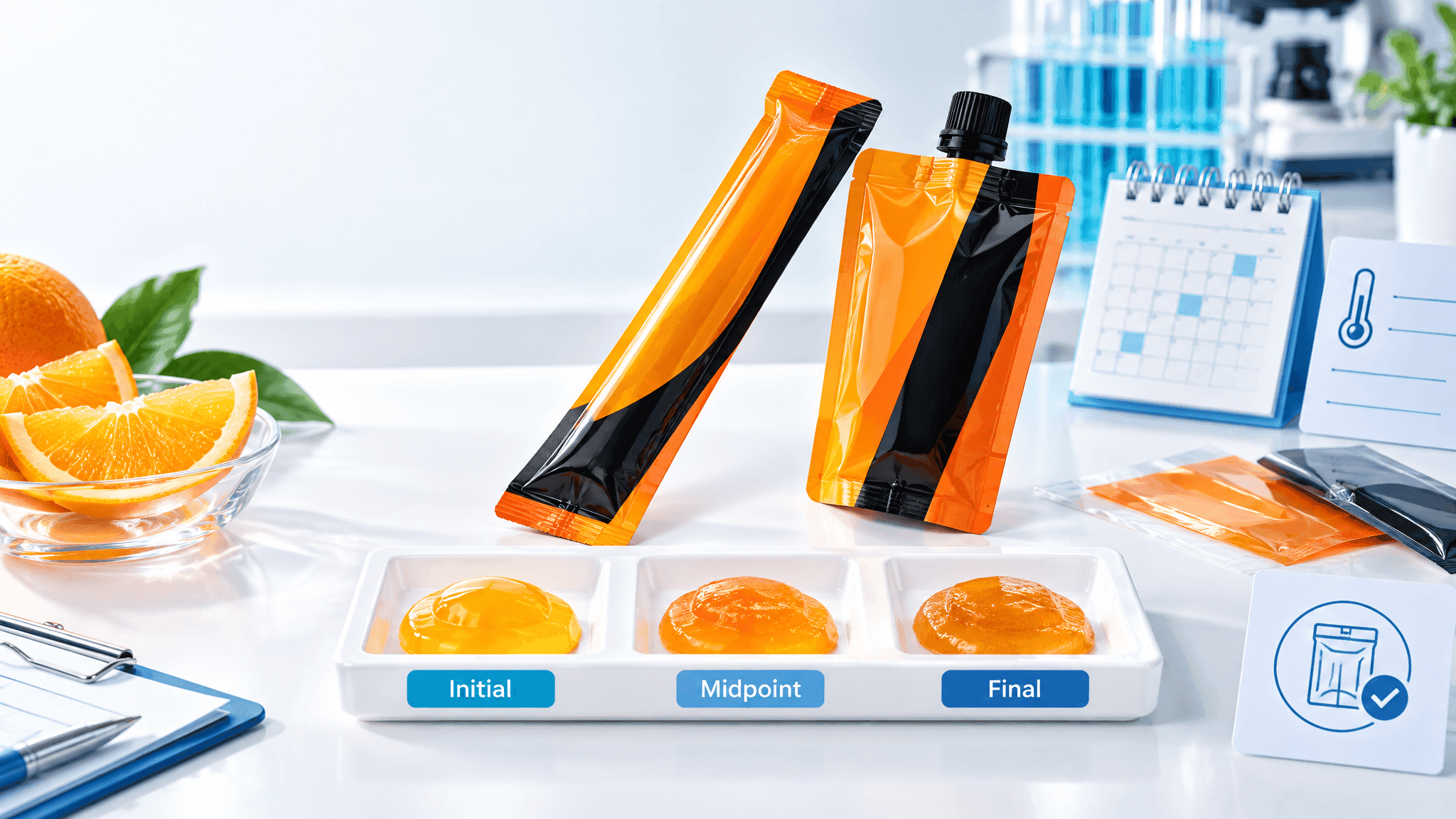
How to Plan Shelf Life Validation for Functional Jelly Products
A functional jelly can look excellent when the first sample arrives and still require important work before it is ready for commercial distribution.
The formula must remain appropriate over time. The texture should not change beyond the agreed limits. The package must continue to protect the product. The date code and storage instructions must match the intended market. If a functional ingredient or nutrition value is central to the product concept, the brand may also need evidence that is relevant to the finished product and its stated shelf life.
This is why shelf life should not be treated as a number copied from a similar jelly.
For an OEM or ODM project, shelf life belongs to a defined product system:
Final formula + Manufacturing process + Primary package + Storage conditions + Distribution route + Acceptance criteria
Change one part of that system and the existing evidence may no longer answer the same question.
This guide helps brands, importers, distributors and retailers discuss functional jelly shelf life with a manufacturer before approving artwork, production and launch inventory.
1 Define the Commercial Use Before Designing the Study
The shelf life a buyer needs depends partly on how the product will move and be sold.
Start by describing the real commercial route:
- destination country or region
- expected ambient, chilled or freeze-at-home handling
- likely transport duration and climate exposure
- warehouse and retail conditions
- e-commerce or traditional distribution
- desired retail life when the product reaches the buyer
- expected time needed for customs, receiving and channel distribution
- consumer instructions before and after opening
A product intended for ambient export and a product intended for refrigerated local sale do not have the same storage assumptions. An ambient freezer pop is stored and distributed unfrozen before the consumer freezes it. Its supply-chain condition and consumption condition must therefore be discussed separately.
Do not begin with "we need eighteen months" as an isolated request. Explain why that commercial window is needed, then ask the manufacturer what formulation, package and evidence would be required to support it.
2 Lock the Product Version Being Evaluated
A shelf-life result applies to the tested or otherwise justified product version. Buyers should be able to identify that version without relying on memory.
The study record should connect to items such as:
- formula or product specification version
- serving size and net content
- flavor and functional ingredient system
- manufacturing or pilot batch reference
- process and filling route
- primary packaging material and dimensions
- closure, cap or seal configuration
- retail and transport packaging where relevant
- date the samples entered storage
This version control matters during sample development. A later change in acidity, sweetener, hydrocolloid, active ingredient, fill weight or package film may affect the basis of the assessment.
The same principle applies to multiple SKUs. Different flavors may have different colors, acids, concentrates or inclusions. A shared platform can reduce development work, but the buyer and manufacturer should document why one set of evidence is or is not applicable across the range.
3 Separate Safety Quality Function and Package Performance
The phrase "shelf-life test" can hide several different questions. A useful plan separates them.
Food Safety
What evidence is needed to show that the product remains safe when manufactured, sealed, stored and used as intended? The answer should follow the product's hazard analysis and applicable market requirements.
Product Quality
How will the team judge whether flavor, aroma, color, appearance and eating experience remain acceptable? A product can remain within safety requirements while no longer meeting the brand's quality expectations.
Physical Stability
Will the jelly maintain the agreed structure? Relevant observations may include firmness, viscosity, squeezability, syneresis, separation, settling or changes around inclusions, depending on the format.
Functional or Nutrition Targets
If the product relies on a declared nutrient or functional ingredient amount, what finished-product evidence is appropriate at release and over the intended shelf life? This depends on the ingredient, claim, analytical method and destination market.
Package Performance
Will seals, closures and barrier properties remain suitable? Does the package protect the product while also preserving code legibility and consumer usability?
These workstreams may overlap, but they should not be reduced to one pass or fail line without defined criteria.
4 Build the Plan From the Product Risk Assessment
There is no universal shelf-life test list for every functional jelly.
A product-specific plan may consider:
- formulation characteristics such as acidity and available moisture
- heat treatment or other manufacturing controls
- ingredient sensitivity to light, oxygen, heat or time
- potential interaction among functional ingredients
- hydrocolloid behavior over time
- package barrier and seal performance
- intended storage and distribution conditions
- foreseeable consumer handling
- destination-market requirements
FDA explains that 21 CFR Part 117 establishes current good manufacturing practice and risk-based preventive controls requirements for many human-food facilities. This does not create a generic shelf-life protocol for every jelly. It reinforces the need to connect controls and records to the actual food, process and facility.
The manufacturer should lead the technical design of the product study, while the brand or importer defines the commercial route, customer specifications and destination-market questions. Qualified laboratories and regulatory advisers may also be required.
5 Choose Real Time and Accelerated Work Deliberately
Real-time storage follows the product under its intended conditions for the planned period. It provides direct evidence but takes time.
Accelerated or stress work uses selected conditions to help reveal possible changes sooner. It can be valuable during development, package screening or risk investigation, but it is not automatically a complete substitute for real-time evidence.
Buyers should ask:
- What question is the accelerated work intended to answer?
- Why were the conditions selected?
- Which changes are expected to behave meaningfully under those conditions?
- What assumptions are being used to relate the result to normal storage?
- Will real-time samples continue after an initial commercial decision?
- What happens if the two sets of observations do not agree?
Temperature can affect microbial, chemical, physical and sensory changes in different ways. A condition that accelerates color loss may not predict texture change with the same relationship. The protocol should therefore state its limits rather than promising a universal conversion formula.
6 Set Checkpoints and Acceptance Criteria Before Results Arrive
The team should agree what will be measured, when it will be measured and how the result will be judged.
Possible checkpoints may include an initial baseline and selected intervals during storage. The correct timing depends on the product, risk, target life and development stage. Avoid copying a timetable from another category without a technical reason.
Possible observations or tests, where relevant, include:
- appearance, color and clarity
- flavor, aroma and aftertaste
- texture, viscosity, gel strength or squeezability
- separation, syneresis or settling
- pH, water activity or soluble solids when useful to the control strategy
- microbiological criteria
- selected chemical or nutrition parameters
- functional ingredient content where appropriate
- net content and package appearance
- seal or closure integrity
- leakage, swelling or paneling
- print and code legibility
The list is not a specification for every product. The approved protocol should identify the method or reference, sample identity and acceptance limit where applicable.
Define sensory evaluation carefully as well. "Still tastes good" is difficult to audit. A simple scorecard tied to the approved sample can make decisions more consistent.
7 Test the Final Packaging System
Packaging is part of shelf life, not a decoration applied after formulation.
A laboratory sample in a temporary container cannot fully answer how the product will perform in the final commercial package. Film structure, cup material, seal area, cap, headspace, light exposure and oxygen or moisture transmission can influence the result.
The validation discussion should identify:
- exact primary packaging specification
- supplier and material reference where controlled
- sealing or closure process
- package dimensions and fill level
- code location and printing method
- orientation during storage and transport
- secondary packaging protection
- any special opening or freeze-at-home use
If the package changes after testing, ask whether compatibility or shelf-life work needs to be repeated or supplemented.
Printed packaging should not be ordered only because the design is finished. Formula, serving size, storage statement, date-marking plan and package specification should be sufficiently stable before the brand creates a large inventory of market-specific material.
8 Use Production Representative Samples
Early prototypes help screen a concept. They may not represent every part of commercial production.
Before relying on evidence for launch decisions, ask how the samples relate to the intended process:
- Were they made in the laboratory, on a pilot line or on the commercial line?
- Did they use the final ingredient sources and target ranges?
- Were they filled and sealed in the final package?
- Can the batch and sample storage history be traced?
- Were normal release checks completed?
- Does the plan need more than one batch or lot?
The answer will differ by project. An established platform with a limited flavor change may follow a different validation route from a new formula, unfamiliar ingredient combination or new package.
The important point is to record the relationship between the evaluated samples and the commercial product rather than assuming they are identical.
9 Include Distribution and Storage Conditions
Shelf life is not only a laboratory question. Product can encounter heat, cold, vibration, compression, light and repeated handling before it reaches consumers.
The buyer and manufacturer should discuss:
- factory storage before shipment
- container or truck conditions
- oute duration and season
- port, customs and warehouse delays
- pallet and carton configuration
- maximum or minimum conditions reasonably expected
- retailer and e-commerce handling
- consumer storage instructions
This does not mean every project requires the same transport simulation. It means the distribution route should be visible when the team decides what to evaluate.
If temperature excursions are plausible, define who will review them and what evidence will support disposition decisions. A vague statement such as "avoid high temperature" is not enough for a team that needs to release or reject inventory after a real event.
10 Align Date Marking With the Destination Market
Date marking is both a technical and a regulatory decision.
EFSA describes shelf life as the period during which food remains safe and or of suitable quality while the package is intact and the product is stored as instructed. Its date-marking decision tool helps food business operators consider whether a use-by or best-before date is appropriate in the EU context.
The European Commission also lists date marking and storage conditions among mandatory information for prepacked foods sold in the EU. Exact wording, format and other requirements depend on the applicable law and product.
For other markets, the responsible business should review the relevant local rules and customer requirements. A date format that is familiar in one country can be ambiguous in another.
Before artwork approval, confirm:
- type of date mark
- date format and language
- location on the package and carton
- relationship to lot coding
- required storage statement
- instructions after opening where applicable
- responsibility for generating and verifying the code
Official guidance is a starting point, not a substitute for market-specific label review.
11 Reassess Shelf Life After Important Changes
Once a shelf life has been established, change control protects the basis behind it.
Ask whether reassessment is needed after changes such as:
- a new functional ingredient or supplier
- a change in target ingredient level
- a new sweetener, acid, flavor, color or preservative system
- a change in hydrocolloid or process parameters
- a new serving size or fill level
- different primary packaging or closure
- new manufacturing equipment or site
- longer distribution route or different storage condition
- a revised claim or destination market
Not every change requires the same response. The technical team should document the impact assessment and decide whether existing evidence remains relevant, whether bridging work is sufficient or whether new validation is needed.
This is especially important for multi-market products. One formula may require different label statements, pack sizes or distribution assumptions across countries.
12 Ask the Manufacturer Specific Questions
Before approving mass production, buyers can ask:
1.Which exact formula and package does the shelf-life evidence cover?
2.What commercial storage and distribution conditions were assumed?
3.Which safety, quality, physical and package attributes are evaluated?
4.What methods, checkpoints and acceptance criteria are used?
5.Are samples production representative and traceable?
6.What accelerated work is used, and what are its stated limitations?
7.Will real-time monitoring continue after launch approval?
8.Which documents or summaries can be shared with the buyer?
9.What date mark and storage instructions are proposed for the target market?
10.Which formula, process or packaging changes would trigger reassessment?
These questions are more useful than asking only, "How many months is the shelf life?"
13 Record the Decision Before Printing and Ordering
A shelf-life decision should be connected to the product record and commercial approvals.
Before final artwork and purchase order release, confirm that the team has aligned on:
- approved formula and product specification
- final packaging specification
- target and supported shelf life
- storage and handling conditions
- date-marking and coding instructions
- agreed validation or monitoring plan
- unresolved risks and follow-up dates
- responsibility for market-specific review
- process for assessing future changes
The objective is not to create the largest possible report. It is to make sure the stated shelf life has a clear basis and that the product sold is the product evaluated.
Planning Functional Jelly Shelf Life With Victory Foods
Victory Foods China develops hydrocolloid-based product formats including functional jelly, konjac jelly, squeeze jelly, freezer pops, popping boba and sports-nutrition products.
For a productive shelf-life discussion, buyers can prepare:
Target market + Product format + Formula direction + Final package + Distribution route + Desired commercial window + Storage conditions + Required evidence
Victory Foods should confirm the appropriate development, packaging, validation and documentation route for the specific product inquiry. The achievable shelf life and supporting plan depend on the final product system and should be agreed in project documents rather than assumed from a website article.
FAQ
How long is the shelf life of functional jelly
There is no single shelf life for every functional jelly. The supported period depends on the formula, manufacturing process, package, storage conditions, distribution route and acceptance criteria for the specific product.
Can accelerated testing replace real time shelf life testing
Accelerated work can help identify changes sooner and support development decisions, but it is not automatically a complete substitute for real-time evidence. The protocol should state what it predicts, the assumptions used and whether real-time monitoring continues.
Does a packaging change affect functional jelly shelf life
It can. Changes in material, barrier properties, dimensions, headspace, seal or closure may affect product protection and compatibility. The technical team should assess whether existing evidence still applies.
What should buyers request from an OEM manufacturer
Ask for the product and package version covered, assumed storage conditions, study design, relevant checkpoints and acceptance criteria, sample traceability, date-marking basis and change-control approach. The shareable document set depends on the project and confidentiality arrangements.
When should shelf life planning begin
Begin during product development, before the final artwork and commercial packaging order. Early planning allows the formula, package, distribution route, launch schedule and evidence requirements to be developed together.