How to Compare Functional Jelly Quotations Before Choosing an OEM Manufacturer
A lower unit price does not always mean a lower-risk functional jelly project. This buyer guide shows how to normalize OEM quotations across formula scope, packaging, testing, MOQ, lead time, delivery terms and material ownership.
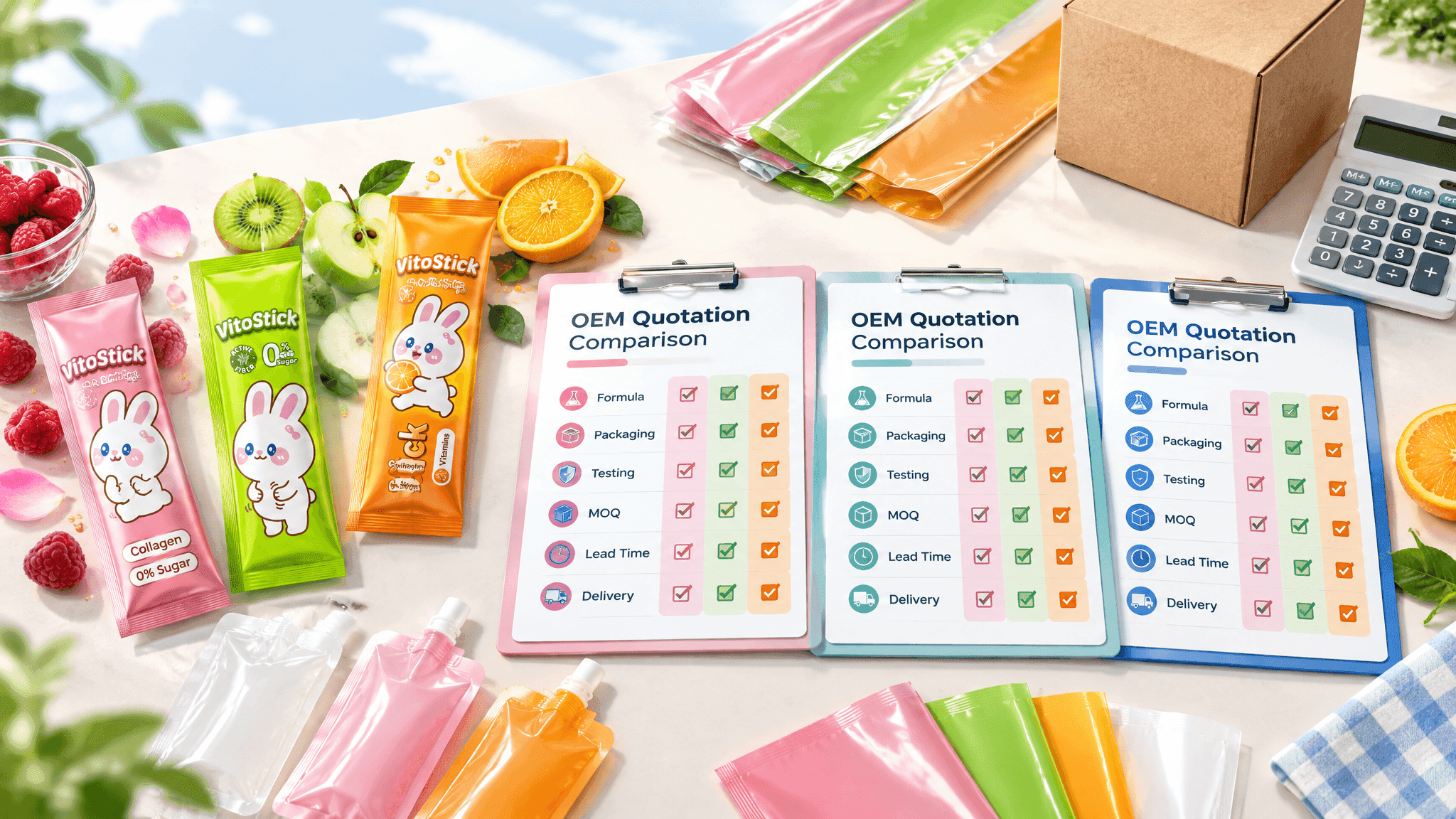
How to Compare Functional Jelly Quotations Before Choosing an OEM Manufacturer
Two functional jelly quotations can show similar products and very different prices. They may also describe two different projects.
One supplier may quote an existing formula in standard packaging. Another may assume a custom formula, printed film, additional testing and a different delivery point. If the buyer compares only the price per unit, the less complete quotation can appear cheaper even when the final project will cost more.
The objective is not to find the longest quotation. It is to make every important assumption visible.
A useful comparison should answer four questions:
- Are the suppliers quoting the same finished product?
- Are the same development, packaging and quality activities included?
- Are the quantity, delivery and payment assumptions comparable?
- What costs or risks remain outside the quoted price?
This guide provides a line-by-line framework for brands, importers, distributors and retailers evaluating a private-label functional jelly manufacturer.
1 Freeze the Product Brief Before Comparing Prices
A quotation is only as clear as the product brief behind it.
Before sending the inquiry to several manufacturers, define the same baseline for each supplier:
- target country or market
- intended product category and positioning
- jelly format and nominal serving size
- formula direction and priority ingredients
- flavor, sweetness and texture direction
- number of launch SKUs
- primary and secondary packaging concept
- expected first order and annual forecast
- requested testing or documents
If one supplier receives a detailed brief and another receives a short message asking for "collagen jelly," the responses will not be comparable.
The brief does not need to solve every technical question. It should separate fixed requirements from preferences. For example, a specific serving format may be essential, while the exact fruit flavor can remain open to recommendation.
That distinction gives suppliers room to propose a feasible route without silently changing the commercial basis of the project.
2 Put a Version and Validity Date on Every Quotation
Food development changes quickly. A new flavor, serving size or package can alter the price basis, MOQ and lead time.
Every quotation should identify:
- quotation number or version
- issue date
- validity period
- customer and project name
- formula or sample reference
- package specification or artwork reference
- quantity tier
- currency
- delivery term and named place where applicable
When a revision is issued, the buyer should be able to see what changed. A price copied into an email without its original assumptions can create confusion later.
Keep the quotation, approved sample reference and packaging specification together in the project record. The final purchase order should refer to the agreed version rather than an informal summary.
3 Separate Development Costs From Recurring Product Costs
Private-label projects may include both one-time work and recurring production costs. The categories vary by supplier and project, but buyers should ask for them to be distinguished.
Possible one-time or project costs include:
- formula development or customization
- prototype samples
- special ingredient sourcing
- packaging design support
- printing plates, cylinders, molds or tooling
- production trials
- initial laboratory or verification work
Possible recurring costs include:
- finished product units
- ingredients and processing
- primary packaging
- labels or printed film
- retail boxes and master cartons
- routine quality checks and batch documents
- pallets or export packing where included
A supplier may combine several elements into the unit price. That is not automatically a problem, but the quotation should state what the price includes.
Buyers should also ask which costs would repeat when they add a flavor, change artwork or revise the formula. A one-time charge for one SKU may become several charges when the product range expands.
4 Confirm the Unit Basis and Quantity Structure
The word "unit" can mean a stick, pouch, cup, retail box or master carton.
For every price line, confirm:
- what one quoted unit contains
- net content per primary pack
- primary packs per retail pack
- retail packs per master carton
- total primary units and total cartons
- MOQ per formula, flavor, artwork and SKU
- quantity allowed above or below the order where applicable
- price breaks at higher quantities
The quotation should also state whether the minimum is created by production, printed packaging, a special ingredient or another component.
Dividing a total order across several flavors can change the economics. Four flavors with one artwork each are not always equivalent to one flavor at the same total quantity.
A buyer should compare the commercial quantity that will actually be ordered, not an attractive unit price tied to an unrealistic volume.
5 Compare Packaging Assumptions Line by Line
Packaging can create large differences between quotations. Ask suppliers to describe the complete packaging system, including:
- primary format such as stick, sachet, cup or spouted pouch
- nominal dimensions and material structure subject to approval
- standard, labeled or custom-printed route
- print colors and finishing assumptions where relevant
- opening feature, cap, straw or accessory
- retail box or display carton
- master carton and case quantity
- date code and lot code method
- pallet or loading assumptions where available
If custom printing requires plates, cylinders or tooling, clarify the charge, ownership, storage, maintenance and reuse conditions.
Unused packaging also needs an agreement. Ask who owns printed material left after production, how long it may be stored, what storage charges or minimums apply, and what happens if the label changes before the material is used.
Packaging specifications should be matched before comparing prices. A standard transparent pouch with a label is not the same commercial product as a fully printed high-barrier pouch in a custom retail box.
GS1's GTIN Management Standard can also affect packaging planning because changes in net content, pack or case quantity, and new product configurations can require product-identification decisions.
6 Identify Formula and Ingredient Assumptions
The words "fiber jelly" or "electrolyte jelly" do not define a formula.
A quotation should connect the price to an agreed product direction. Depending on the project, buyers may need to confirm:
- named functional ingredients and supplier specifications
- target amount per serving or other agreed basis
- flavor and sweetener route
- color and acid system
- hydrocolloid or texture direction
- permitted substitutions and approval process
- branded ingredient or premix requirements
- ingredient documentation included
- treatment of unused special ingredients
The manufacturer should not be expected to disclose proprietary processing knowledge in a commercial quotation. The buyer does need enough information to know whether competing quotes are based on equivalent requirements.
If one quotation assumes a standard ingredient and another assumes a branded grade or custom premix, the price difference may reflect the brief rather than supplier efficiency.
Changes made after sampling should trigger a revised commercial and technical review. Formula changes can affect taste, texture, label declarations, testing, packaging compatibility and lead time.
7 Define Samples Trials Testing and Documents
Quotations often use broad phrases such as "samples included" or "testing included." Buyers should ask what those phrases mean.
Clarify:
- number and type of prototype rounds
- sample quantity and shipping responsibility
- whether samples are laboratory prototypes or production-line samples
- production-trial scope where required
- tests included in the quoted price
- tests charged separately
- responsibility for retesting after a change
- batch documents supplied with commercial orders
- destination-market documents requested by the buyer
- document language and format
The required program depends on the formula, package, target market and customer specifications. A longer list is not automatically better, and a generic document pack cannot replace product-specific evidence.
Buyers should map each requested document to a real purpose: supplier qualification, customs, product registration, retailer onboarding, label review or batch release.
The sample-to-mass-production plan should show when formula, packaging, artwork and commercial specifications become locked. Without that control, a quotation can become outdated before production begins.
8 Review Quality Controls and Acceptance Criteria
The quotation should make clear which routine quality activities are part of commercial production and which special requirements create additional scope.
Relevant questions may include:
- how raw materials and packaging are identified
- what in-process checks are used for the relevant format how net content, seals, coding and traceability are controlled
- what finished-product release checks apply
- what batch documents are available
- how retained samples are handled
- how nonconforming product or packaging is addressed
- what customer-specific inspections are requested
Quality discussions should refer to the actual product and package. A narrow jelly stick, a large spouted pouch and a cup each create different handling and seal questions.
Do not assume that a low price excludes quality or that a high price proves it. Ask for the process and evidence relevant to the project, then compare suppliers on the same requirements.
9 Test the Lead Time Assumptions
A single lead-time number can hide several stages.
Ask the supplier to separate, where relevant:
- product brief review
- formula development
- sample preparation and shipping
- buyer feedback and revision
- packaging sourcing or printing
- artwork approval
- testing or validation
- production scheduling
- finished-goods release
- export booking and transport
Lead time should begin from a defined event. "Thirty days" is ambiguous if one supplier counts from deposit, another from artwork approval and another from the arrival of custom packaging.
The quotation should also explain what resets the schedule. Late artwork, formula changes, delayed ingredient approval or additional market documents can move the production date.
For a time-sensitive launch, compare the critical path rather than only the factory production days.
10 Clarify Delivery Terms Freight and Payment
An export quotation needs a clear delivery basis. Ask which costs and responsibilities are included up to the named point.
The International Chamber of Commerce explains that the Incoterms Rules help define tasks, costs and risks in the delivery of goods from seller to buyer. The chosen rule and named place should be written clearly in the commercial documents, and the parties should obtain appropriate trade advice for the transaction.
Buyers should confirm whether the quotation includes items such as:
- export packing
- inland transport
- export customs formalities
- port or terminal charges
- international freight
- insurance where applicable
- import clearance
- duties and taxes
- delivery to the buyer's warehouse
The list will differ by the agreed delivery term. It is a comparison checklist, not a statement that every item should be included by the manufacturer.
Payment terms also need a shared basis: deposit, balance trigger, payment method, currency, bank charges and consequences of changes or cancellation. Commercial and legal teams should review the actual contract and transaction.
11 Assign Responsibility for Market Compliance
The manufacturer, brand owner, importer and local adviser may each hold different information or responsibilities. The quotation should not leave this allocation implicit.
Before artwork release, confirm who provides or approves:
- product classification in the destination market
- ingredient and claim review
- nutrition information
- allergen declaration
- label text and language
- responsible-party or importer details
- barcode or GTIN data
- product registration where applicable
- customs codes and import documents
The FDA Food Labeling Guide summarizes general labeling requirements for foods sold in the United States, while the European Commission lists mandatory information for prepacked foods in the EU. These official resources show why the destination market must be defined before label approval.
They are starting points only. The actual product, ingredients, claims and sales channel require qualified market-specific review.
A quotation that includes "label support" should explain whether this means supplying product data, preparing a draft layout, conducting regulatory review or simply printing customer-approved artwork.
12 Calculate the Commercial Exposure Beyond Unit Price
The lowest quoted unit price can require the largest inventory commitment.
To compare commercial exposure, calculate or estimate:
- total order value at the realistic MOQ
- one-time development and tooling charges
- printed packaging or ingredient inventory left after the run
- sample and courier costs
- testing and document costs
- freight and import costs outside the delivery term
- warehouse and handling needs
- cash tied up before launch
- risk of obsolete packaging after a change
- expected sell-through before the relevant shelf-life limit
This is not a universal landed-cost formula. It is a reminder to move from price per piece to the amount of cash and inventory the project creates.
A slightly higher unit price with a clearer, better-matched package or quantity may create lower launch risk. The opposite can also be true. The decision depends on the brand's channel, forecast, capital and operating plan.
13 Ask Follow Up Questions Before Negotiating Price
When quotations differ, first identify the assumption causing the difference.
Useful follow-up questions include:
1.Which formula and sample reference does this price cover?
2.Is the MOQ per SKU, flavor, formula or artwork?
3.Which primary and secondary packaging components are included?
4.Are printing plates, cylinders, molds or tooling charged separately?
5.Who owns unused printed packaging and special ingredients?
6.Which samples, tests and batch documents are included?
7.When does the stated lead time begin?
8.What delivery term and named place apply?
9.Which changes require a revised price or schedule?
10.What is excluded from the quotation?
Negotiating before answering these questions can reduce a number without improving the project.
14 Build a Supplier Comparison Scorecard
Price should remain part of the decision, but it should not be the only column.
A practical scorecard can compare:
- product and formula fit
- packaging fit
- quotation completeness
- MOQ and inventory exposure
- development process
- quality and documentation response
- lead-time clarity
- communication and change control
- delivery and payment terms
- total commercial exposure
Weight the criteria around the launch. A market test may prioritize manageable inventory and standard packaging. A major retail launch may place more weight on documentation, repeatability, capacity planning and packaging execution.
Record the evidence behind every score. "Good supplier" is not a useful note; "confirmed packaging MOQ per artwork and provided a clear change-control process" is.
The best quotation is the one that defines a workable project and makes the remaining decisions visible.
Comparing a Functional Jelly Quotation With Victory Foods
Victory Foods China develops hydrocolloid-based products across formats including functional jelly, konjac jelly, squeeze jelly, freezer pops, popping boba and sports-nutrition products.
For a clearer OEM or ODM quotation discussion, buyers can prepare:
Target market + Product format + Formula direction + Serving size + Flavor count + Packaging route + First order estimate + Annual forecast + Launch date + Requested documents
Victory Foods should confirm the formula, package, MOQ, included development work, validation requirements, commercial terms and lead-time basis for the specific inquiry. A website article cannot replace a written project quotation and final agreement.
FAQ
Why do functional jelly quotations vary so much
Suppliers may be quoting different formulas, serving sizes, packaging, print methods, quantity tiers, testing, documents or delivery terms. Normalize these assumptions before comparing the unit price.
What should be included in a functional jelly OEM quotation
The quotation should identify the product and package basis, quantity and unit, price, currency, MOQ, included and excluded work, lead-time basis, delivery term, payment terms and validity. Project-specific testing, documents and material ownership should also be clear.
Should development and testing be included in the unit price
Suppliers structure quotations differently. The important point is to distinguish one-time and recurring costs and understand which activities are included, charged separately or repeated after a change.
How can a buyer compare two OEM quotations fairly
Send the same product brief, create a common comparison sheet, translate every price into the same sellable unit and quantity, and list exclusions and unresolved assumptions beside the price.
Is the lowest functional jelly quotation usually the best choice
Not necessarily. Compare product fit, packaging, quality controls, documentation, MOQ, lead time, delivery terms and total inventory exposure. A low unit price is valuable only when it describes the product and service the buyer actually needs.