
Functional Jelly Secondary Packaging Guide for Retail and E Commerce
A functional jelly project needs more than a primary stick, pouch or cup. This buyer guide explains how to plan retail boxes, display cartons, shipping cases and e-commerce protection around the channel, pack count and product route.
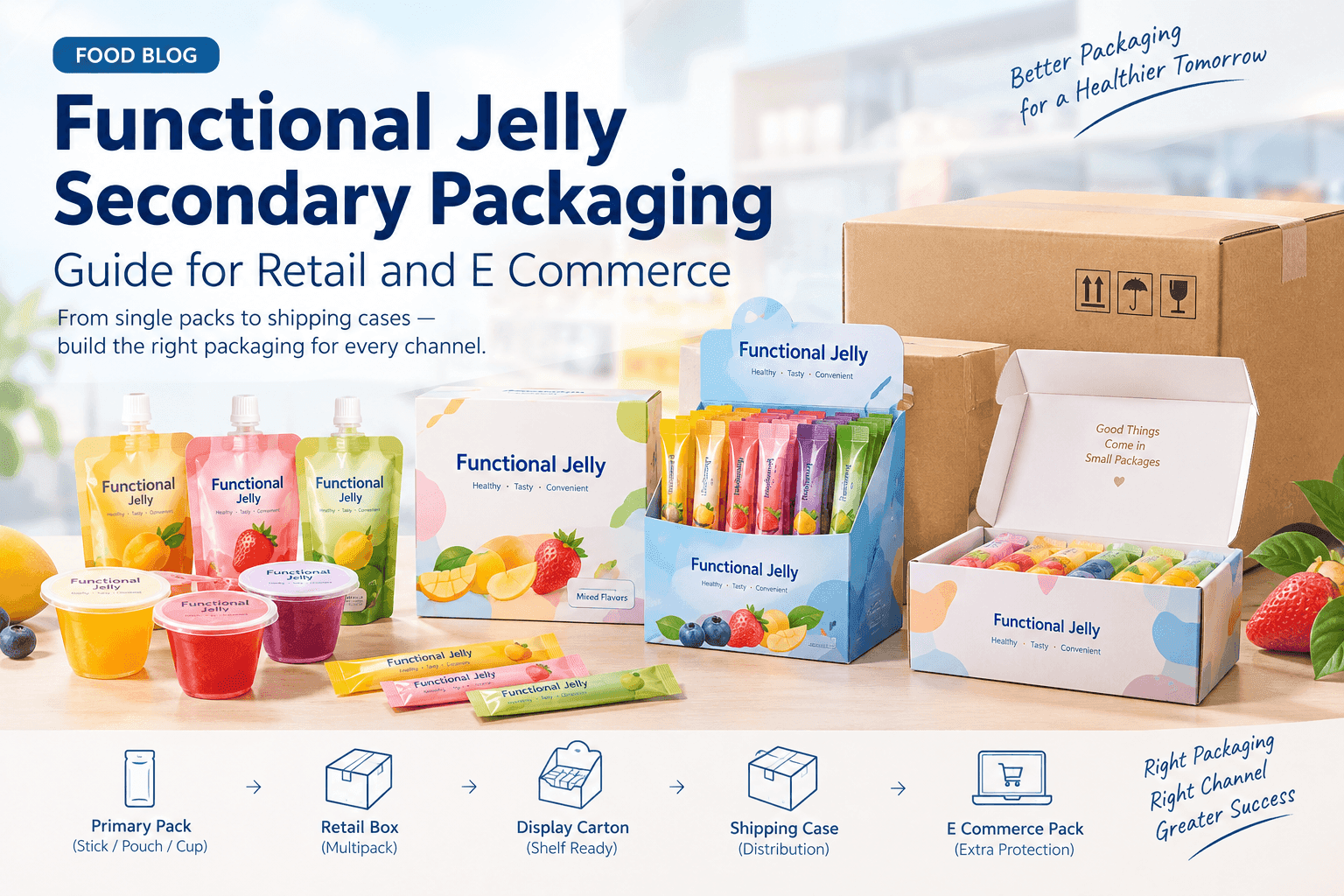
Functional Jelly Secondary Packaging Guide for Retail and E Commerce
A functional jelly package is a system, not a single wrapper.
The stick, spouted pouch or cup protects and presents the product at the point of consumption. A retail box may group several units, provide space for mandatory information and create shelf presence. A display carton can help store staff place the product quickly. A shipping case protects the saleable units through handling and distribution. An e-commerce configuration may need another layer of protection because individual orders experience different hazards from palletized retail deliveries.
When these layers are planned separately, the project can create avoidable problems. The primary pack may not fit the approved box. The case count may be inefficient for the distributor. The display opening may hide the product name. A barcode may identify the wrong level. A direct-to-consumer shipment may arrive crushed or leaking even though the retail carton looked attractive in a design review.
For brands, importers, distributors and retailers, the better sequence is:
Channel + Primary pack + Saleable unit + Retail configuration + Shipping case + Test route + Approved specifications
This guide explains how to structure those decisions for private-label functional jelly projects. It is not a universal engineering or regulatory specification. Final materials, dimensions, case strength, markings and testing should be confirmed for the actual product, destination market and supply chain.
1 Define the Packaging Hierarchy
- Start by naming every level in the commercial pack.
- A functional jelly project may include:
- an individual jelly stick, sachet, spouted pouch or cup
- an inner tray, divider or bundle
- a retail box or multipack
- a shelf-ready or display carton
- a shipping case
- pallet configuration
- an e-commerce overbox or mailer
These levels do not all need separate packaging in every project. A larger spouted pouch may be sold as one consumer unit with no retail box. Small jelly sticks may need a printed multipack to communicate the brand and carry product information. A club-store offer may use a larger count and stronger display structure. A direct-to-consumer subscription may use a plain protective mailer around a branded retail box.
Create a simple hierarchy table before artwork or quotation. Record the product code, quantity at each level, dimensions, gross weight, barcode owner, label owner and whether the level is consumer-facing, orderable or shippable.
The hierarchy becomes the reference for packaging drawings, quotations, master data, pallet planning and retailer setup.
2 Begin With the Sales Channel
The same product can require different secondary packaging for a supermarket, pharmacy, sports retailer, warehouse club, foodservice distributor or online store.
- Ask where the buyer expects the product to be handled:
- hanging display, shelf, counter unit or checkout area
- conventional retail shelf with individual sale
- multipack sale only
- shelf-ready tray placed directly into the fixture
- distributor case opened and replenished by store staff
- parcel shipment to an individual consumer
- mixed-SKU subscription or promotional bundle
A compact retail box may work well on a pharmacy shelf but provide too little front-facing area for a club-store display. A perforated display carton may save store labor, but only if it opens cleanly and remains stable after units are removed. A decorative box designed for shelf appeal may not protect the product when shipped alone through an e-commerce parcel network.
Do not approve the packaging concept until the intended handling route is written down.
3 Lock the Primary Pack Before Designing the Box
Secondary packaging dimensions should be based on the commercial primary pack, not an early mockup.Confirm:
- primary pack format and material structure
- filled dimensions rather than empty-film dimensions
- seal areas, spout or cap projection and natural product shape
- target net content and expected filled weight
- tolerance in width, thickness and fill distribution
- coding location and readable area
- orientation required during packing and display
- storage and temperature conditions
Flexible packs can change shape after filling. A spouted pouch can become thicker at the base. A jelly stick may curve or trap air differently depending on filling and sealing. Cups may need clearance for lids, flanges or spoons. A box drawn around nominal flat dimensions can therefore be too tight for commercial output.
Use samples from the intended packaging process when possible. If final filled samples are not yet available, state which dimensions are provisional and schedule another fit check before the die line is approved.
4 Decide What the Consumer Buys
The saleable unit must be explicit.
Will the consumer buy one pouch, one cup, one stick, a five-count box, a ten-count variety pack or another configuration? This decision affects price architecture, serving communication, net quantity, barcode assignment, retailer setup and case packing.
- Choose the count by balancing:
- intended consumption frequency
- individual serving size
- trial versus repeat-purchase positioning
- target retail price
- shelf width and height
- required label information
- product weight and box strength
- fulfillment and freight efficiency
- retailer or distributor requirements
Avoid selecting a count only because it creates a visually full box. The product proposition and channel economics should lead the decision.
For assorted flavors, define the exact mix and acceptable variation. A statement such as "mixed flavors" is not enough for production planning if the buyer expects a fixed ratio.
5 Choose the Retail Box Function
- A retail box can perform several jobs:
- group individual units into one saleable multipack
- protect seals, spouts or cup lids
- create a larger communication surface
- hold mandatory information that does not fit comfortably on the primary pack
- improve shelf blocking and brand recognition
- support tamper evidence or controlled opening
- organize assorted flavors
State which functions are essential. A minimal paperboard sleeve may group units but offer limited compression protection. A full carton may protect the product and provide more print area but add cost, material and packing steps. An insert can improve orientation while reducing usable volume.
Review the box with the actual primary packs inside. Check closure security, bulging, abrasion, cap pressure, seal contact, movement, opening experience and whether units can be removed without damage.
The pack should also remain understandable after opening. If consumers store loose sticks or pouches away from the outer box, determine what information must remain on each individual unit for the target market and intended use.
6 Plan Shelf Ready and Display Cartons Separately
Shelf-ready packaging is not simply a shipping case with a perforation.
A useful display configuration should be easy for store staff to identify, open and place. After opening, it should continue to support the remaining units and present the brand clearly.
- Review:
- opening direction and perforation quality
- tear-away panel removal without tools where intended
- front lip height after opening
- visibility of product name, flavor and key approved message
- stability as units are removed
- ease of replenishment and stock rotation
- hand access without damaging primary packs
- scannability and orientation of saleable units
- disposal or recycling instructions where relevant
Test the display at expected shelf height and depth. A carton that looks strong on a table can hide the lower half of a jelly pouch when placed below eye level. A tall back panel can carry useful branding, but it may interfere with shelf spacing.
Retailer specifications take priority when a customer has a defined shelf-ready standard.
7 Build the Shipping Case Around Handling
The shipping case must protect the finished saleable units through packing, warehousing, stacking, transport and receipt.
Define:
- number of retail units per case
- arrangement by rows, layers and orientation
- case internal and external dimensions
- gross and net weight
- board grade or other material specification
- closure method
- case markings and barcode level
- pallet pattern and maximum stack conditions
- handling and storage environment
Case count affects more than freight. It influences distributor ordering, warehouse picking, store replenishment and inventory accuracy. A very large case may improve cube utilization but be inconvenient for a small retailer. A very small case may increase handling, corrugated material and unit cost.
Do not finalize the case from a spreadsheet alone. Pack a physical case, inspect movement and compression, and confirm that employees can lift and open it safely under the intended workflow.
8 Protect Seals Spouts Cups and Corners
Secondary packaging should address the specific weak points of the primary format.
For jelly sticks and sachets, review seal-edge abrasion, bending and concentrated pressure from tightly packed rows. For spouted pouches, prevent caps or spouts from pressing into adjacent film panels. For cups, protect lid seals and flanges while controlling vertical load. For mixed packs, prevent heavier units from crushing lighter ones.
Possible solutions include deliberate orientation, dividers, trays, sleeves, pads or controlled headspace. Each addition should solve a defined risk. Extra material is not automatically better if it creates new pressure points or makes packing inconsistent.
Use a packaging failure log during trials. Record scuffing, leaks, crushed corners, opened closures, deformed displays and unreadable codes. Photographs should identify the packaging version and test condition so the team can compare revisions.
9 Treat E Commerce as a Different Route
E-commerce orders may travel as individual parcels through repeated drops, vibration, compression and changes in temperature or humidity. They may also be packed with unrelated products inside a fulfillment center.
Decide whether the branded retail box will ship:
- inside a protective overbox
- inside a padded or structured mailer
- as a ship-in-own-container package
- as part of a mixed order
Then evaluate leakage containment, closure security, product movement, edge protection and the condition in which the customer sees the brand.
The International Safe Transit Association publishes procedures and guidance for packaged-product testing, including a generalized e-commerce retailer fulfillment test. The correct test plan depends on the packaged product, route and customer requirements. A test result should be tied to the actual product and packaging version, not treated as a permanent approval for every future configuration.
Re-evaluate performance when the product, material, count, dimensions, closure, case or fulfillment route changes.
10 Connect Packaging to the Storage Route
Functional jelly products can be sold through different temperature and logistics models. The package must match the validated route for the specific product.
Record whether the finished goods are intended for ambient, chilled or frozen distribution, and whether consumers chill or freeze the product only after purchase. Confirm how temperature and humidity can affect the product, seals, labels, adhesives, cartons, perforations and coding.
A freeze-at-home item, for example, may need instructions that distinguish ambient distribution from consumer freezing. A refrigerated route may require attention to condensation and board performance. A long ambient shelf life still requires protection against excessive heat, light or humidity where these conditions are relevant to the approved specification.
Do not use a packaging statement from another SKU without confirming that the formula, process, pack and validation route are equivalent.
11 Confirm Food Contact Suitability
Primary packaging that touches the jelly requires market-appropriate food-contact review. Secondary materials can also matter when inks, coatings, adhesives, inserts or recycled content are used close to food-contact surfaces or when migration, set-off or contamination could occur.
For the United States, FDA maintains resources on packaging and food-contact substances, including food types and conditions of use. For the European Union, the European Commission explains the framework for food-contact materials, good manufacturing practice, documentation and traceability, with specific measures for certain materials.
Ask the responsible packaging supplier for information appropriate to the material and market, such as:
- material specification and layer structure
- intended food type and condition of use
- supplier compliance statements or declarations where applicable
- supporting migration or suitability information where required
- ink, coating and adhesive information relevant to the construction
- change-notification process
- traceability identifiers
The required evidence depends on the material, use and destination. Do not describe a package as universally compliant without defining those conditions.
12 Assign Barcodes and Product Data by Level
The retail unit, case and higher packaging levels can have different identifiers and data responsibilities.
Confirm:
- which level is scanned at checkout
- which level is ordered by the retailer or distributor
- which level is scanned in the warehouse
- whether each flavor, size or assortment is a separate trade item
- case quantity and contained-item relationship
- dimensions and gross weight entered in product master data
- barcode symbol, placement, contrast and quiet zone
GS1's GTIN Management Standard explains when product or packaging changes may require new identification. A substantial dimensional or gross-weight change can also affect higher packaging levels. The barcode decision should therefore be made with the person who manages commercial item data, not left to the artwork designer.
Verify printed symbols on production-representative material and confirm that the physical pack matches the data supplied to trading partners.
13 Control Artwork Across Every Pack Level
Secondary packaging artwork often contains information that must agree with the primary pack.
Compare:
- product and flavor names
- unit count and net quantity
- ingredient, allergen and nutrition information where present
- preparation, storage and use instructions
- date and lot-code location
- responsible business and origin statements
- claims and qualifying language
- barcodes and case markings
- recycling or disposal information where applicable
Create one source pack and identify which approved data belongs on each level. Use unique artwork numbers and revision dates for the primary pack, retail box and shipping case.
Do not approve a box merely because its front panel looks correct. Review every panel, glue flap, opening feature and code area at actual size.
14 Prototype Test and Approve the System
Packaging approval should follow a controlled sequence:
1.Confirm the channel, saleable unit and packaging hierarchy.
2.Obtain filled primary-pack samples or define provisional dimensions.
3.Create structural prototypes for the retail and shipping levels.
4.Run pack-out and assembly trials.
5.Review shelf, opening and consumer-use behavior.
6.Evaluate shipping and fulfillment risks using an appropriate test plan.
7.Confirm food-contact and material documentation for the intended market and use.
8.Approve barcodes, product data, artwork and coding areas.
9.Recheck the first commercial packaging against approved specifications.
Keep records of the version tested. If a supplier changes film, board, adhesive, closure or dimensions, determine whether the change affects fit, protection, food-contact status, artwork or distribution performance.
The objective is not to create the most elaborate package. It is to create a packaging system that performs the required jobs with controlled materials, clear data and an efficient pack-out.
15 Information to Include in a Packaging Request for Quote
- Before requesting a quotation, prepare:
- target market and sales channel
- product format, flavor count and net content
- filled primary-pack dimensions and tolerances
- saleable count and assortment ratio
- retail-box or display function
- case count and expected pallet route
- ambient, chilled or frozen handling model
- required print coverage and finishes
- barcode and coding responsibilities
- food-contact or retailer documentation requirements
- prototype and testing expectations
- forecast, order quantity and launch date
Separate confirmed requirements from preferences. If the retail count, box style or case configuration is still open, ask for clearly labeled options rather than one blended quotation that cannot be compared later.
Planning Functional Jelly Packaging With Victory Foods
Victory Foods China develops hydrocolloid-based product formats for international markets, including functional jelly, konjac jelly, squeeze jelly, freezer pops, popping boba and sports-nutrition products.
For a useful packaging discussion, buyers should provide the target market, product format, serving size, intended channel, saleable unit, retail configuration, case requirement and launch timing. Project-specific feasibility, materials, dimensions and packing arrangements should then be confirmed through the OEM or ODM development process.
The brand, importer and retailer remain responsible for approving the commercial configuration, market-specific information, barcodes and channel requirements before printed materials and finished goods are ordered.
FAQ
Does every functional jelly product need a retail box
No. The need depends on the primary pack, saleable unit, label area, protection requirement, channel and brand strategy. A larger pouch may be sold individually, while small sticks may be grouped in a multipack.
What is the difference between a retail box and a shipping case
A retail box is normally consumer-facing or sold as a multipack. A shipping case groups saleable units for warehousing and distribution. Some shelf-ready systems combine transport and display functions, but those functions should still be tested separately.
How should a brand choose the number of jelly sticks in a box
Use the intended consumption pattern, serving size, target price, shelf space, total weight, retailer requirements and case efficiency. Do not choose the count only to fill a package visually.
Can the same packaging be used for retail and e commerce
Sometimes, but it should not be assumed. Parcel fulfillment can expose the pack to handling conditions different from palletized retail distribution. The e-commerce route may need an overbox, mailer or another protective configuration.compare jelly sticks and squeezable pouches as primary formats
When should secondary packaging be finalized
Define the hierarchy early, but approve final dimensions after the commercial primary pack and fill are stable. Complete fit, artwork, barcode, pack-out and distribution checks before ordering printed inventory at scale.