How Alcohol Becomes Jelly Inside VOLT 12 Percent ABV Adult Confectionery Structure
Turning a 12% ABV formulation into a stable jelly confectionery requires more than adding alcohol to an ordinary gel. This technical guide explains VOLT's konjac-free hydrocolloid structure, sensory balance, cup sealing, ambient shelf life and production control.
How Alcohol Becomes Jelly Inside VOLT 12 Percent ABV Adult Confectionery Structure
VOLT is built as a structured food product. Alcohol content, water, sugar and flavor must work inside a gel network that can be filled, sealed, stored, transported and eaten consistently.
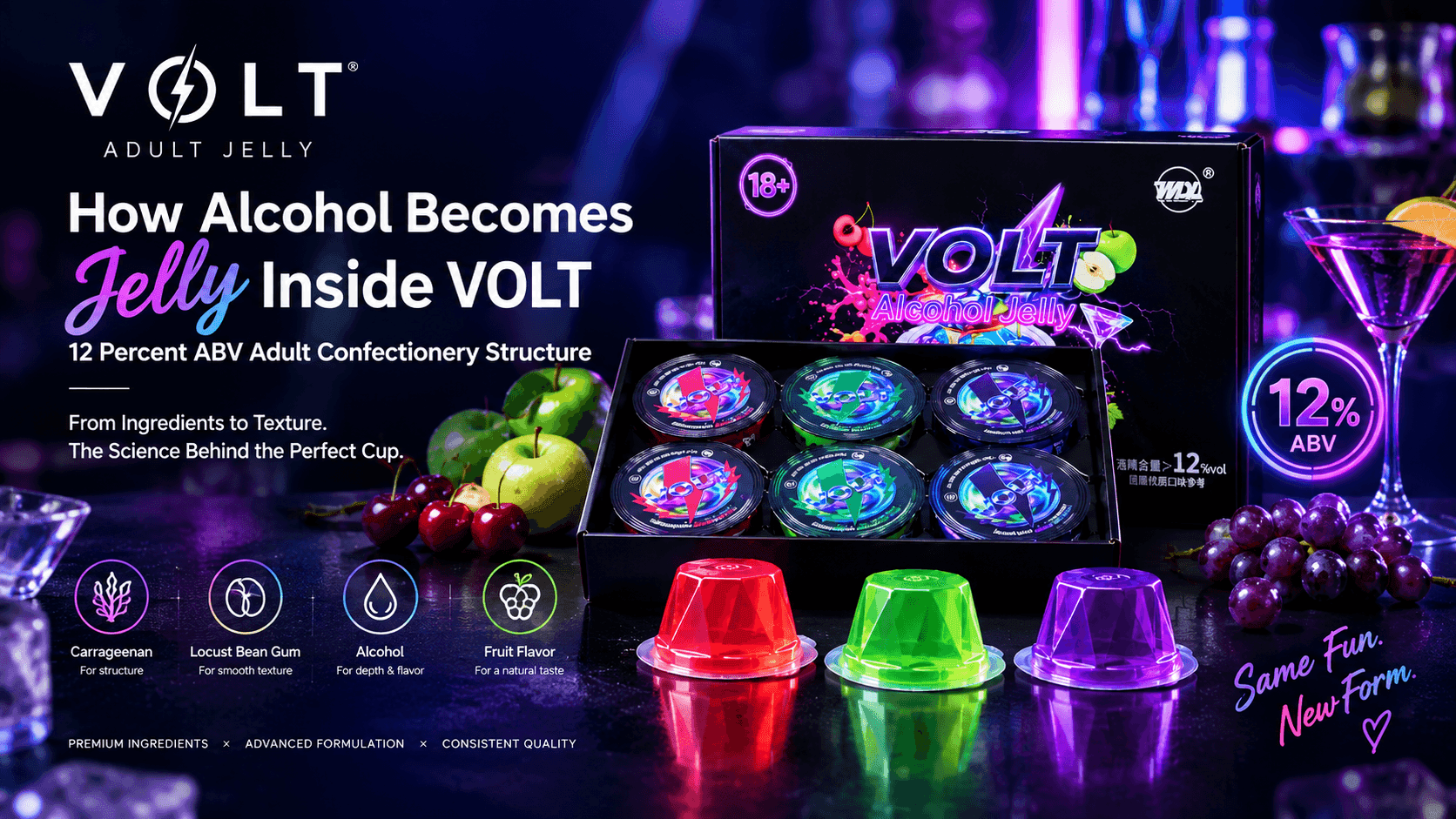
The current retail version contains six individually sealed cups at 12 percent alcohol by volume in apple, grape and cherry flavors. It is konjac-free and uses a hydrocolloid system that includes carrageenan and locust bean gum.
Those facts define a demanding formulation brief. The gel must hold together without becoming rubbery. It must release flavor without delivering a harsh alcohol impression. It must remain stable inside a small cup during an 18-month ambient shelf life when stored away from direct sunlight.
This article explains the product-development logic at a buyer level. It does not disclose proprietary ratios or process settings. A commercial formula must be validated as a complete system rather than reconstructed from a list of ingredients.
Alcohol Changes the Formulation Environment
An ordinary fruit jelly is primarily a water-based food system. Adding a meaningful level of alcohol changes that environment.
Ethanol affects solvent behavior, aroma release and sensory perception. It can also change how ingredients hydrate and how a gel network forms. Heat and open processing can increase aroma and alcohol losses, while the final balance of water, solids, acidity and salts affects texture.
For this reason, a 12 percent ABV target cannot be treated as a flavor added at the end of a standard jelly recipe. The technical team must develop the alcohol phase, hydrocolloid system, fruit profile, sweetness, acidity and process together.
The finished ABV is also a controlled product attribute. Raw-material inputs, processing losses, fill conditions and test method must be considered when the manufacturer defines the production specification.
The Hydrocolloid Network Gives the Product Its Form
Hydrocolloids are food ingredients that interact with water to thicken, stabilize or form gels. In VOLT, the system converts a pourable formulation into a portioned jelly that can remain in the cup and release when eaten.
- The network has several jobs:
- create enough structure for the product to hold together
- give the bite a cohesive rather than brittle character
- control water movement and visible separation
- support consistent filling and portion release
- carry flavor through the eating experience
These outcomes depend on the complete formula and process. The name of a gum does not predict the final texture by itself.
Why Carrageenan and Locust Bean Gum Work Together
Carrageenan is a family of polysaccharides obtained from red seaweed. Locust bean gum is a galactomannan obtained from carob seeds.
Published research on kappa carrageenan and locust bean gum shows that mixed systems can produce gel behavior that differs from either ingredient alone. Depending on concentration, ionic conditions, ratio and test method, the combination can improve cohesion, elasticity or rupture behavior and may help control syneresis.
This is useful in confectionery development because a small cup needs a texture that remains recognizable as jelly while avoiding a hard or fragile bite.
The research should not be read as VOLT's formula. Commercial performance depends on the actual ingredients, alcohol level, sugars, acids, flavor system, process and packaging. The manufacturer must determine and validate the working formulation.
Why the Current Formula Is Konjac Free
VOLT does not use konjac in the current six-cup product.
The konjac-free position gives the development team a clear formulation and market-review baseline. It does not mean the product is automatically permitted in every country or exempt from restrictions that apply to small jelly cups, alcohol-containing foods or adult products.
Importers should review the complete ingredient list, cup dimensions, serving instructions, alcohol declaration and destination-market rules. Compliance depends on the finished product and local law, not on the absence of one ingredient.
Building a 12 Percent ABV Sensory Profile
At 12 percent ABV, alcohol is part of the product's flavor and mouthfeel. The objective is not to hide it completely. The consumer should understand that the product contains alcohol, while the fruit system keeps the experience coherent and enjoyable.
Apple, grape and cherry offer different tools for balancing the profile.
Apple can support a fresh, bright direction. Grape can provide a rounder fruit body. Cherry can carry a deeper aromatic character. Sweetness and acidity must be adjusted around each flavor rather than copied mechanically across the range.
Texture also changes flavor perception. A firmer gel may release aroma differently from a softer, faster-melting structure. Alcohol warmth, sweetness, acidity and fruit aroma should therefore be evaluated in the final gel, at the intended serving temperature and in the production cup.
- A buyer sample review should consider:
- first aroma after opening
- initial fruit recognition
- alcohol warmth and timing
- sweetness and acidity balance
- texture during the first bite
- finish and aftertaste
- preference across all three flavors
The goal is a consistent brand experience with enough flavor distinction to make the mixed box interesting.
Process Order Matters
Hydrocolloids need controlled dispersion and hydration. Alcohol and volatile flavors require careful handling. The gel network must form at the correct stage for filling and cooling.
- The production method therefore needs a defined sequence for:
- dry ingredient preparation and dispersion
- hydrocolloid hydration
- solids and acidity adjustment
- alcohol and flavor incorporation
- control of exposure time and temperature
- transfer to filling
- portioning and sealing
- cooling and final structure development
Changing the order can alter lumping risk, hydration, alcohol retention, aroma and final texture. Scaling from a laboratory beaker to a production vessel can also change heating, mixing, hold time and transfer behavior.
The exact sequence and settings are proprietary manufacturing information. For buyers, the important question is whether the approved sample has a controlled, repeatable route to commercial production.
Individual Cups Are Part of the Technical System
The cup is not a decorative container added after formulation. Its dimensions, material, lidding film and seal condition affect filling, product protection and consumer use.
For the current VOLT format, each of the six cups is sealed individually. This supports portion control and allows the remaining units to stay unopened until another occasion.
- Production control should address:
- cup and lidding material suitability for the food and alcohol level
- fill weight and headspace
- cleanliness of the sealing surface
- seal temperature pressure and dwell conditions
- code readability and traceability
- leakage and seal-integrity checks
- fit inside the six-cup retail box
The chosen package must be evaluated under the intended storage and distribution conditions. A stable gel cannot compensate for an unreliable seal.
What an 18 Month Ambient Shelf Life Requires
The current VOLT six-cup product is specified for 18 months at ambient conditions away from direct sunlight.
That statement should be supported by evidence for the actual formula, process and package. Shelf-life review should consider more than microbiological acceptability. The commercial product also needs to retain an acceptable texture, appearance, aroma, flavor, alcohol level and package integrity.
- Relevant observations may include:
- visible liquid separation or shrinkage
- texture changes over time
- color and flavor stability
- alcohol and aroma retention
- seal performance and leakage
- package deformation or material interaction
- code and label legibility
Light exposure can accelerate quality changes in some products and packages, which is why the storage instruction includes avoiding direct sunlight.
The 18-month statement applies to the confirmed product version. A new cup, lidding film, ABV, flavor system or formula may require a new assessment rather than inheriting the existing shelf life.
Production Consistency Needs Measurable Checks
A strong commercial specification connects the sensory target with measurable manufacturing controls.
Depending on the approved method and market requirements, the control plan may include:
- ingredient and batch identity
- processing sequence and recorded conditions
- alcohol content using an appropriate method
- pH or soluble solids where relevant to the specification
- texture or deformation checks
- flavor and appearance review
- seal integrity and leak testing
- microbiological and other release criteria
- lot coding and retained samples
These checks must be defined for the actual product. A number is useful only when the method, sample condition, acceptance range and response to a deviation are clear.
The first production trial should confirm that the line can reproduce the approved product. Retained samples then allow later observations to be connected with a specific lot and process record.
Food Safety Systems and Facility Status
Victory Foods states that the manufacturing operation holds BRCGS certification, uses a HACCP food-safety system and is registered with the United States Food and Drug Administration as a food facility.
Each statement has a different meaning.
BRCGS certification is based on an audit against the applicable standard and certificate scope. HACCP provides a structured method for identifying significant hazards and defining controls, monitoring, corrective actions, verification and records. FDA food-facility registration is a regulatory registration requirement for applicable facilities supplying food to the United States; it is not FDA approval of the facility or the VOLT product.
Importers should review current documents, legal company and site details, scope, validity and destination-market requirements during supplier qualification.
Product Positioning Does Not Decide Legal Classification
VOLT is positioned as Adult Jelly Confectionery because that description helps consumers and buyers understand the eating format and social occasion. The product still contains 12 percent ABV.
Local authorities may classify, label, tax and control alcohol-containing confectionery differently. Importers must confirm licensing, age restrictions, permitted channels, alcohol declarations, ingredients, warnings, customs treatment and advertising rules for their market.
The comparison with familiar adult confectionery supports communication. It does not replace regulatory analysis.
Request a Technical Sample Review
Importers, distributors and retail buyers can request a finished VOLT sample set to assess the three flavors, 12 percent ABV sensory balance, jelly structure, cup opening and six-cup retail presentation.
Providing the destination market with the request allows the discussion to separate product evaluation from the classification, labeling and channel questions that require local confirmation.
Frequently Asked Questions
How does alcohol become a jelly
A hydrocolloid network gives the water-based formulation structure. Alcohol, water, solids, acids, flavors, hydrocolloids and processing conditions must be developed together so the final product gels and remains acceptable during storage.
Does VOLT contain konjac
No. The current six-cup VOLT product is konjac-free and uses a system that includes carrageenan and locust bean gum.
Why combine carrageenan and locust bean gum
Published food-science research shows that the two ingredients can create mixed gel behavior with useful cohesion and elasticity under suitable conditions. The actual result depends on the full formula and process.
Is VOLT FDA approved
No such claim should be made. Victory Foods states that its food manufacturing facility is registered with FDA. FDA explains that facility registration does not denote approval of the facility or its products.
How long can the current VOLT product be stored
The confirmed six-cup version is specified for 18 months at ambient conditions away from direct sunlight. New formulas or packages should be assessed before using the same shelf-life statement.
Can a buyer request production parameters
Buyers can request appropriate specifications, quality documents and validation information for supplier review. Proprietary ratios and detailed process settings may remain confidential.