
How Importers Can Market Test VOLT Adult Jelly Confectionery Before Launch
A positive exhibition response is a reason to test a new category, not proof of national demand. This guide shows importers how to evaluate VOLT through buyer review, controlled adult sampling and a limited retail pilot before committing to a wider launch.
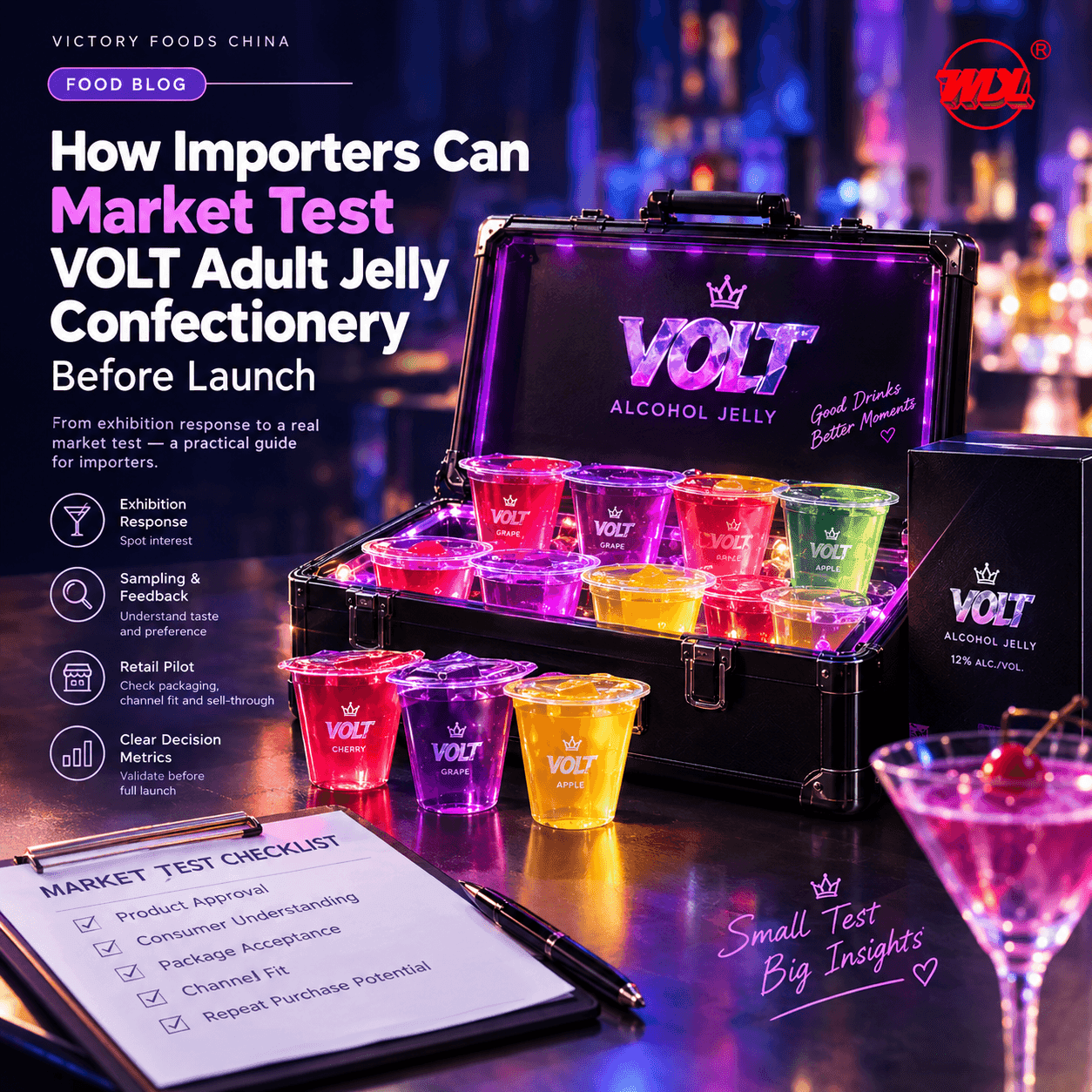
How Importers Can Market Test VOLT Adult Jelly Confectionery Before Launch
A successful exhibition trial can justify the next test. It cannot replace one.
At WorldFood Moscow 2026, the VOLT team sold approximately 100 six-cup boxes on the final day from the available sample stock. Some visitors bought two boxes and some bought four. That response shows that the product attracted enough interest for people to purchase a complete retail format rather than only taste a free sample.
The result remains limited to one exhibition in one city. It does not establish national demand, a recommended retail price or expected sell-through in supermarkets, licensed specialty stores or hospitality channels.
An importer should use the exhibition result as a starting hypothesis. A structured market test can then answer the questions that matter before a full launch: Do legal-age consumers understand the product, enjoy the experience, accept the package and want to buy it again at a locally viable price?
Start With the Product That Will Be Tested
The current VOLT Party Jelly format gives a test team a defined product rather than a loose concept.
Each box contains six individually sealed jelly cups at 12 percent alcohol by volume. The assortment includes apple, grape and cherry flavors. The formula is konjac-free and uses a hydrocolloid system that includes carrageenan and locust bean gum. The current version has an ambient shelf life of 18 months when stored as directed and protected from direct sunlight.
These facts should remain consistent across the buyer brief, sample instructions, scorecard and consumer explanation. If the package, formula, cup count or flavor mix changes during the test, the importer should record the change because the results may no longer describe the same proposition.
VOLT is positioned as Adult Jelly Confectionery. Alcohol Infused Jelly Confectionery can provide a useful explanation for search and trade communication. Neither phrase determines the product's legal classification in a destination market.
Separate Product Approval From Market Proof
An importer may like the flavor and still need evidence that the product can work commercially.
Product approval asks whether the sample meets an agreed specification. Reviewers examine the cup seal, appearance, aroma, texture, alcohol warmth, sweetness, flavor and packaging condition.
Market proof asks different questions. It examines whether a defined customer understands the product, whether a permitted sales channel can present it clearly and whether enough shoppers buy at a price that supports the importer's cost structure.
Both reviews matter, but they should not be combined into one general question such as whether people like it. A positive tasting score does not resolve product classification, duty, retailer margin, age verification or repeat purchase.
Define One Primary Test Question
A small test becomes difficult to interpret when it tries to answer every commercial question at once. The importer should choose one primary decision and a short set of supporting measures.
Useful primary questions include:
- Do legal-age specialty-store shoppers understand VOLT after a short product explanation?
- Which of the three flavors earns the strongest purchase preference?
- Does the six-cup box feel appropriate for sharing and gifting?
- Can a licensed retailer achieve acceptable conversion at the proposed local price?
- Does the product generate repeat interest after the first purchase?
The chosen question determines the test design. Flavor preference can be studied through controlled tasting. Retail conversion requires a live selling environment. Repeat interest requires a follow-up period or a second purchase opportunity.
Confirm Compliance Before Samples Reach Consumers
VOLT contains alcohol and is intended only for adults of legal drinking age. Before consumer sampling or retail sale, the importer should obtain local advice on product classification, import requirements, label language, alcohol declaration, tax treatment, licences, advertising limits, sampling permissions and age verification.
The product should not be presented as a way to avoid alcohol rules. Its confectionery format changes the eating experience, but it does not remove the need for a market-specific legal review.
Codex provides general international guidance for prepackaged food labeling, including the principle that product descriptions must not mislead consumers. National and local rules may add or replace requirements, particularly for alcohol-containing products.
The compliance review should happen before the test design is finalized. A channel that looks commercially attractive may be unsuitable if the local rules do not permit the planned placement, communication or sampling method.
Use a Four Stage Test
Stage One Importer and Buyer Review
Begin with a small internal group that includes commercial, quality and compliance perspectives. The team should inspect the finished package, open every flavor and document questions before showing the product to consumers.
The review should cover:
- condition of the outer box and individual cup seals
- clarity of alcohol and adult-only communication
- opening experience and portion handling
- appearance, aroma, texture and flavor of each cup
- storage instructions and protection from direct sunlight
- shelf presentation and space required for the six-cup box
- documents needed for local classification and import review
The purpose is to remove avoidable confusion from the consumer test. It is also the right point to decide whether the shipped sample accurately represents the intended commercial product.
Stage Two Controlled Adult Sampling
Where local rules permit, invite a defined group of legal-age participants rather than an unrestricted crowd. Record age-screening procedures, sample conditions and the exact message shown to participants.
Serve the product in its production cup and under consistent conditions. Let each participant see the retail box so the evaluation includes both product experience and package understanding. If flavor preference matters, rotate the tasting order to reduce first-sample bias.
ISO 6658 gives general guidance on sensory analysis. An importer does not need to turn a commercial trial into a laboratory study, but consistent sample handling and clearly worded questions make the results more useful.
Stage Three Limited Retail Pilot
Choose one or a small number of compliant outlets whose customer base matches the intended audience. Define the test period, starting inventory, display location, selling message and age-control procedure before stock arrives.
Keep the message simple. A shopper should understand that VOLT contains alcohol, is eaten as a jelly confectionery, comes in six individually sealed cups and offers three fruit flavors.
One brief comparison with liquor-filled chocolate may help consumers recognize the broader idea of adult confectionery. It should only serve as a mental reference. VOLT has a different format and may receive different legal treatment.
Retail staff should use one approved explanation rather than inventing claims at the shelf. Their questions and customer objections should be logged because confusion can reveal a messaging, packaging or placement problem.
Stage Four Reorder Decision
The importer should set decision criteria before seeing the results. This reduces the temptation to treat every positive comment as evidence for expansion.
A decision may consider:
- percentage of screened shoppers who understand the product correctly
- paid conversion from eligible shopper to box purchase
- sell-through during the defined period
- preferred flavor and reasons for rejection
- number of single-box and multiple-box purchases
- repeat purchase or stated repurchase intent
- retailer feedback on age control, display and customer questions
- damaged, leaking or difficult-to-open units
- gross margin after landed cost and channel deductions
The thresholds will vary by market and channel. The important step is to agree on them before the pilot begins.
Measure Understanding Before Excitement
An unfamiliar product can generate attention without creating accurate understanding. The test should check what people think VOLT is after seeing the package and again after reading the approved explanation.
Useful comprehension questions include:
- What type of product do you think this is?
- Does it contain alcohol?
- Who is it intended for?
- How is it eaten?
- How many cups and flavors are included?
- Where would you expect to find it in a store?
Wrong answers are useful. If participants miss the alcohol content or mistake the product for children's jelly, the importer should stop and revise the presentation. If they understand the adult-only nature but do not know how to eat it, serving instructions may need improvement.
Correct understanding should come before any attempt to optimize novelty or social-media interest.
Test Flavor Texture and Package Separately
A single overall score can hide the reason people accept or reject the product. Separate questions help the team identify what should change.
For each of the apple, grape and cherry cups, ask about fruit recognition, sweetness, acidity, alcohol warmth, texture and finish. Use the same scale for all three flavors and include a reason field for the highest and lowest score.
Evaluate the six-cup box separately. Ask whether the count suits sharing, gifting or personal use; whether the three-flavor assortment feels balanced; and whether the outer package clearly shows what is inside.
Keep the commercial sample intact. Testing loose cups without the box may provide flavor feedback, but it does not test the retail proposition.
Build a Local Price Test Without Copying the Exhibition Price
The WorldFood sale price should not become a recommended retail price for another market. Exhibition conditions, sample stock and visitor behavior are different from normal retail economics.
The importer should build a local price range from landed cost, duties and taxes, distributor margin, retailer margin, promotional allowance and expected shrink or compliance cost. It can then test a small number of realistic price points without changing the product message at the same time.
Record paid purchases separately from free-sample reactions. A consumer who enjoys one cup may not buy a six-cup box. The paid decision provides a stronger commercial signal.
Track Operational Findings
The market test should also reveal whether the product is practical to handle.
Record the condition of cases after transport, box scuffing, cup leakage, seal integrity, ease of opening, merchandising stability and storage conditions. Check that the product remains in ambient storage away from direct sunlight and that stock rotation follows the confirmed 18-month shelf life for the current version.
Retailers should report whether staff can explain the product consistently and carry out required age checks. Operational friction can limit a promising product even when tasting feedback is positive.
Use the Moscow Result as a Baseline
WorldFood Moscow 2026 ran from 15 to 18 September at Crocus Expo and brought together professionals from retail, distribution, wholesale and hospitality. On the final day, approximately 100 VOLT boxes were sold from the available samples. Some visitors selected two or four boxes.
This gives a useful baseline for the next market test. It suggests that the complete six-cup format can convert curiosity into paid box purchases in an exhibition setting. Multiple-box purchases also justify asking whether consumers see the product as shareable, giftable or suitable for more than one occasion.
The next test should narrow the uncertainty rather than repeat the same observation. A distributor may choose to test retail conversion, repeat purchase, message comprehension or flavor mix in its own channel.
Request a VOLT Sample Set
Importers, distributors and retail buyers can request a finished VOLT sample set for internal review and local test planning. Please include the destination market, intended channel and the main question you want the test to answer.
Victory Foods can provide the current product information needed for sample evaluation. The importer remains responsible for confirming local legal classification, import, labeling, licensing, sampling and sales requirements before market activity.
Frequently Asked Questions
What should an importer test first
Start with product understanding and compliance feasibility. Confirm that legal-age consumers recognize the alcohol content, adult-only positioning, jelly format and six-cup package before investing in a wider retail pilot.
Does the WorldFood Moscow result prove demand in Russia
No. Approximately 100 boxes were sold on the final exhibition day, including some purchases of two or four boxes. This is a useful onsite signal from one event, not a national demand forecast.
Should an importer use the Moscow selling price
No. Build a local price from landed cost, taxes, channel margins and the intended retail environment. The exhibition price is not a recommended retail benchmark.
Can VOLT be tested in an ordinary confectionery aisle
Only if the destination market permits that placement and the retailer can meet all applicable alcohol, labeling and age-control requirements. Adult Jelly Confectionery is a consumer positioning term, not a legal exemption.
What is included in the current VOLT sample
The current retail box contains six individually sealed cups at 12 percent ABV in apple, grape and cherry flavors. The current version is konjac-free, has an 18-month ambient shelf life and should be protected from direct sunlight.
What should buyers send with a sample request
Provide the destination market, intended channel, target customer, desired test date and main evaluation question. This helps the sample review focus on the decisions required before launch.