
How to Build a Responsible E Commerce Product Page for VOLT Adult Jelly
An online listing must explain VOLT before a shopper reaches the checkout. This retail guide shows how to structure the title, first screen, product images, adult-only message, product facts, fulfillment notes and local compliance review for the six-cup alcohol-infused jelly format.
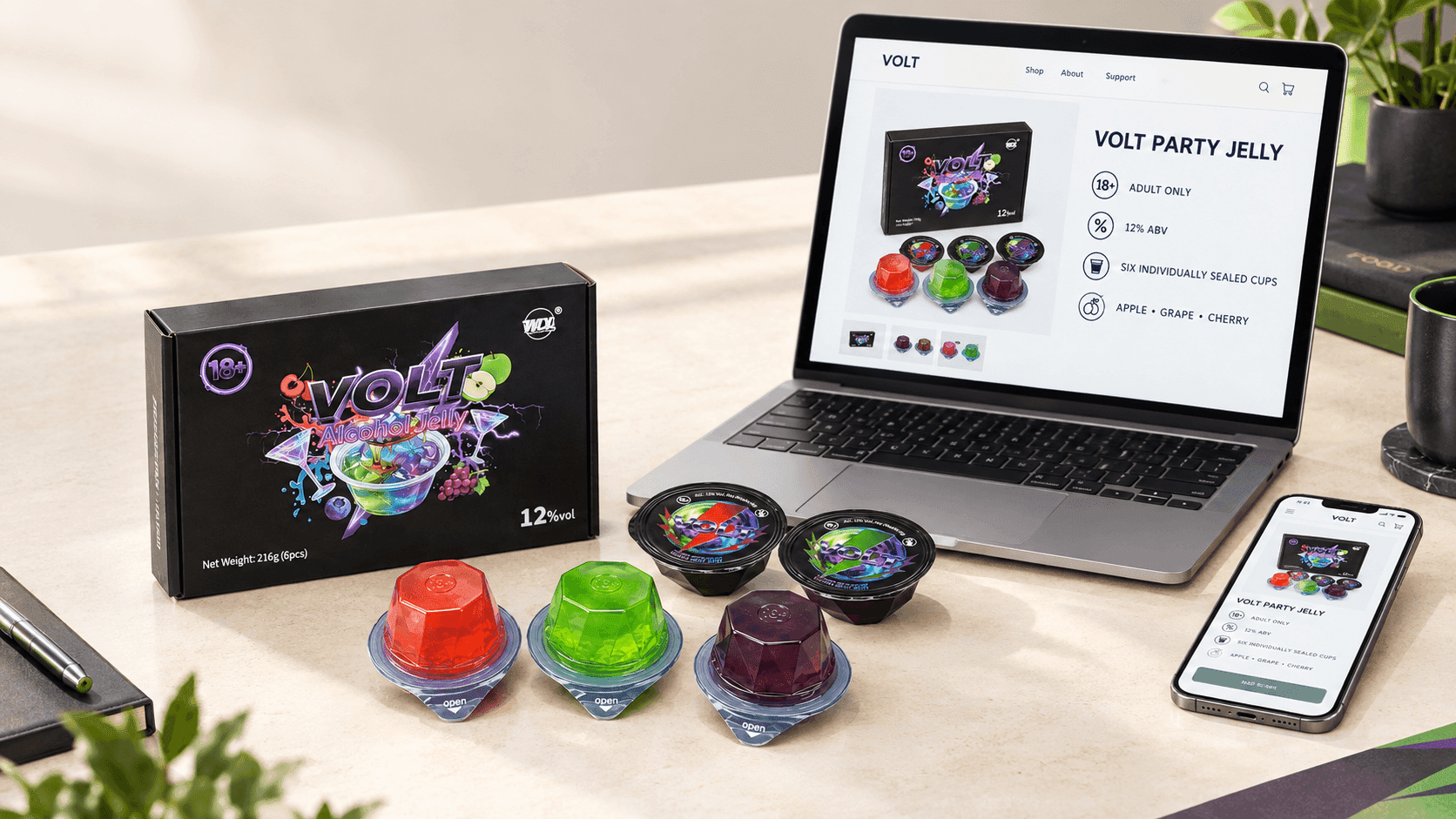
How to Build a Responsible E Commerce Product Page for VOLT Adult Jelly
An e commerce page has to explain VOLT without a store employee standing beside it.
The shopper should understand the product format, alcohol content, intended adult audience and six-cup presentation before deciding whether to buy. The retailer also needs a page that matches the approved pack and supports the sales controls required in the destination market.
The current VOLT Party Jelly format contains six individually sealed cups at 12 percent alcohol by volume in apple, grape and cherry flavors. It is eaten as a jelly rather than poured as a drink. Confirmed storage guidance is ambient storage for up to 18 months while avoiding direct sunlight.
Those facts provide the commercial story, but they do not decide the legal category. An importer or retailer must first confirm how the destination market classifies, labels, taxes, advertises, sells and delivers the product. The page can then translate that approved route into information a shopper can understand.
Give the First Screen One Clear Job
The first screen should answer the questions that determine whether the visitor continues.
- What is it
- Does it contain alcohol
- Who is it for
- What is included in the box
- What should the shopper do next
A practical information order is:
- VOLT Party Jelly
- Alcohol Infused Adult Jelly Confectionery
- 12 Percent ABV
- Six Individually Sealed Cups
- Apple Grape and Cherry Flavors
- For Adults of Legal Drinking Age Only
This is a content hierarchy for local review, not universal legal copy. The final product name, alcohol declaration, warnings, age language and mandatory details must follow the approved label and destination-market requirements.
Do not make the shopper scroll through lifestyle photography before learning that the product contains alcohol. The visual identity can remain colorful, but the adult-only and alcohol information should be easy to find at normal screen size.
Write a Searchable Title Without Hiding the Alcohol
The product title has to work for the shopper, the marketplace search system and the compliance reviewer.
A useful structure is brand, product format, adult or alcohol cue, pack count and flavor assortment. For example:
VOLT Alcohol Infused Adult Jelly Confectionery Six Cup Variety Box Apple Grape and Cherry
The exact wording should be adapted to the approved market name. Avoid using ordinary fruit jelly or candy as the only product description because those terms can hide the alcohol and create the wrong audience expectation.
Search terms such as alcohol jelly or jelly shots may appear in consumer queries. They can be addressed in supporting copy or an FAQ when accurate and permitted, but they should not replace a precise product description. The primary title should help the buyer understand what arrives, not chase every possible keyword.
Show the Real Pack and the Real Unit Structure
Online shoppers cannot pick up the box, so the image sequence has to replace that physical inspection.
The first image should show the real VOLT retail box clearly. The next images can explain the six individually sealed cups, the apple, grape and cherry assortment, the cup-opening experience and the jelly texture. A final image can show an appropriate adult social or gifting context if that treatment is permitted in the market.
Every image must preserve the real package design, colors, proportions and text. Do not create a fictional label, enlarge the cups until the scale becomes misleading or use a product render that no longer matches the item being sold.
Show the outer box and the cups together at least once. A closed box alone may not explain the format, while loose cups without the retail pack can obscure the product identity and required information.
The image order should also reduce avoidable confusion. A useful sequence is:
- front of the approved retail box
- box with all six sealed cups visible
- three-flavor identification
- close view of one opened jelly cup
- back or side panel with readable approved information
- responsible adult-only occasion image where permitted
Alt text should describe the product accurately without promotional claims. It can identify the VOLT box, six sealed cups, flavors and adult alcohol-infused jelly format.
Use a Familiar Category Reference Carefully
Some shoppers already understand liquor-filled chocolate as an adult confectionery that contains alcohol. That familiar reference can help explain why an alcohol-containing product may be eaten rather than poured.
The comparison should remain limited. VOLT uses a fruit-flavored jelly format, comes in individual cups and has its own 12 percent ABV specification. It is not chocolate, and the two products may not receive the same legal classification, tax treatment, sales permission or label requirements.
One sentence is enough: VOLT can be understood in the broad occasion space of adult confectionery such as liquor-filled chocolate, while offering a distinct jelly format and its own alcohol declaration.
The page should then return to the actual product facts. A familiar analogy can improve understanding, but it must not become a claim of regulatory equivalence.
Put Product Facts Before Promotional Copy
For a new format, product information does more selling than exaggerated adjectives.
The main details area should present the confirmed information in a scannable order:
- product format: alcohol-infused adult jelly confectionery
- pack structure: six individually sealed cups
- alcohol content: 12 percent ABV
- flavors: apple, grape and cherry
- use format: eaten from an individual cup as a jelly
- intended audience: adults of legal drinking age only
- storage: ambient storage for up to 18 months while avoiding direct sunlight
The retailer should add the approved net quantity, ingredient list, allergen information, responsible business details, origin, warnings, directions and other mandatory particulars for the exact commercial version. Those items are not included here because they must come from the approved market pack and current product file.
Codex guidance for prepackaged foods offered through e commerce emphasizes that required food information should be clear, prominent and readily legible on the product information page. Local law decides which particulars apply and when they must be available, but the operational lesson is useful in every market: do not rely on a blurry back-panel photograph as the only source of essential information.
Separate the Brand Description From Legal Classification
Adult Jelly Confectionery is the preferred consumer-facing category cue because it describes the experience and intended audience. It does not grant a licence, remove an age-control obligation or decide whether a competent authority treats the product as food, an alcoholic product or another regulated category.
The product page should avoid statements such as no alcohol licence required, legal everywhere or treated exactly like chocolate. If shoppers ask about local classification, the retailer should answer with the approved market position rather than a global claim.
This separation also matters for marketplaces. The consumer-facing title may say Adult Jelly Confectionery, while the platform backend may require a different regulated category, restricted-product flag or fulfillment rule. Both layers should be completed according to the marketplace and local requirements.
Build Age Controls Around the Whole Purchase Journey
An age gate on the landing page is not the same as a complete sales-control process.
Depending on the market and retailer, the journey may involve account eligibility, age affirmation or verification, restricted-product settings, checkout controls, payment rules, delivery-area restrictions and age checks at handover. The importer and retailer should map the complete path before the page goes live.
The product page should clearly state that VOLT is intended only for adults of legal drinking age. It should not imply that the jelly format makes age controls less important.
Digital marketing controls also extend beyond the product page. Search ads, social posts, marketplace banners, affiliate content and retargeting can reach a different audience from the store itself. Creative, targeting and placement should be reviewed together. Where an official market code applies, its age and audience rules should be built into the media brief rather than added after launch.
Keep the Creative Adult and Responsible
The package may be colorful, but the surrounding page should make the adult context unmistakable.
Use adult settings, restrained styling and product-centered information. Do not place the product beside children's candy, toys, school items or characters that are likely to create a child-oriented context. People shown consuming or presenting the product should clearly meet the applicable requirements for alcohol marketing in the destination market.
Avoid creative or copy that encourages speed, competition or excessive consumption. Do not connect the product with driving, improved confidence, social success, health, energy, relaxation or protection from alcohol-related effects.
The call to action should also remain neutral. Buy now is a standard retail function where permitted. Challenge your friends or see how many you can handle turns the format into a consumption contest and should not be used.
Make the Label and Product Page Agree
The page should be treated as part of the product information system, not as a separate marketing island.
Before publication, compare the listing with the approved pack and product data sheet. Check the product name, alcohol statement, six-cup count, flavor names, storage wording, adult-only message, package images and any mandatory market text.
If an image shows a label, it should reproduce the approved label version for that market. Old pack art should be removed from media folders when the commercial version changes. Translated listings should be checked by a qualified local reviewer rather than produced from an unapproved machine translation alone.
The same review should cover mobile and desktop layouts. Mandatory information that appears clearly on a wide screen may become hidden inside a collapsed panel or clipped image on a phone.
Plan Storage Fulfillment and Delivery Copy
The confirmed storage guidance for the current product is ambient storage for up to 18 months while avoiding direct sunlight. The listing should reproduce the approved wording for the exact order and market.
Ambient storage does not remove the need for controlled warehousing and transport. The retailer should confirm how the product is protected from direct sunlight, crushing, leakage and conditions outside the approved specification during storage and delivery.
Do not invent a shipping temperature or open-cup storage instruction. Those details must come from the approved product specification and local operating procedure.
The fulfillment plan should also identify whether the product can be delivered to the shopper's location, which carrier may handle it, what age check is required and what happens after a failed delivery. These are route-to-market decisions, not marketing copy, but the product page and checkout should reflect the approved outcome.
Keep Marketplace Listings Consistent
A distributor may sell through a brand site, retailer site and several marketplaces. Each channel has its own fields, but the consumer should not receive a different product story on every page.
Create one approved master content sheet containing the product title, short description, confirmed facts, image set, alcohol and adult-only wording, storage statement, prohibited claims and local mandatory information. Channel teams can then adapt length and formatting without rewriting the product from memory.
Consistency should include search snippets and structured data. A page that discloses alcohol only after the click can still create a misleading first impression in search results or marketplace tiles.
When a marketplace cannot support the required information, age controls or delivery restrictions, the correct response may be to delay that channel rather than force the product into an unsuitable category.
Run a Prepublication Page Review
Use a cross-functional review before the listing is published.
The commercial reviewer checks whether the page explains the value of the six-cup format. The product reviewer confirms the facts and images. The local responsible party checks classification, food information, alcohol statements, age controls, advertising, sale and delivery requirements. The digital team checks mobile display, links, checkout behavior and restricted-product settings.
A practical final review asks:
- Is alcohol visible before purchase
- Is 12 percent ABV stated accurately where approved and required
- Is the product clearly for adults of legal drinking age
- Do the images match the real pack
- Are all six cups and three flavors explained correctly
- Does the page avoid legal exemptions and unsupported claims
- Is essential information readable on mobile
- Do checkout and delivery controls match the approved route
- Is there a named owner for future updates
Save the approved page version, source product file and review date together. If the pack, formula, market rule or sales channel changes, reopen the review rather than assuming the old page remains suitable.
Frequently Asked Questions
What should the first image show
Show the real VOLT retail box clearly, using the approved market artwork without changing its design, colors, proportions or text.
What facts are confirmed for the current VOLT format
The current format contains six individually sealed cups at 12 percent ABV in apple, grape and cherry flavors, with confirmed ambient storage for up to 18 months away from direct sunlight.
Can the page call VOLT candy
Candy on its own can hide the alcohol and create the wrong audience expectation. Adult Jelly Confectionery or Alcohol Infused Adult Jelly Confectionery is a clearer consumer description, subject to local review.
Does an age gate make the online sale compliant
Not by itself. The responsible parties must review the entire purchase, payment, fulfillment, delivery and advertising journey under the rules that apply in the destination market.
Can the page compare VOLT with liquor filled chocolate
The reference can help explain the adult confectionery occasion, but the page must also state that VOLT has a distinct jelly format and may not share the same legal treatment.
Should label information be provided only as a photograph
Essential information should be readable and accessible on the product page according to applicable requirements; a blurry label image should not be the only source.
Review the Finished Product Before Publishing
Qualified importers, distributors and retail buyers can request a finished VOLT sample set to align the real pack, six-cup format and approved online product information before launch.