
How to Write a Functional Jelly Sample Revision Brief
A sensory scorecard records what evaluators notice, but an R&D team still needs a clear decision about what should change next. This guide shows buyers how to convert first-round feedback into a prioritized, traceable functional jelly sample revision brief.
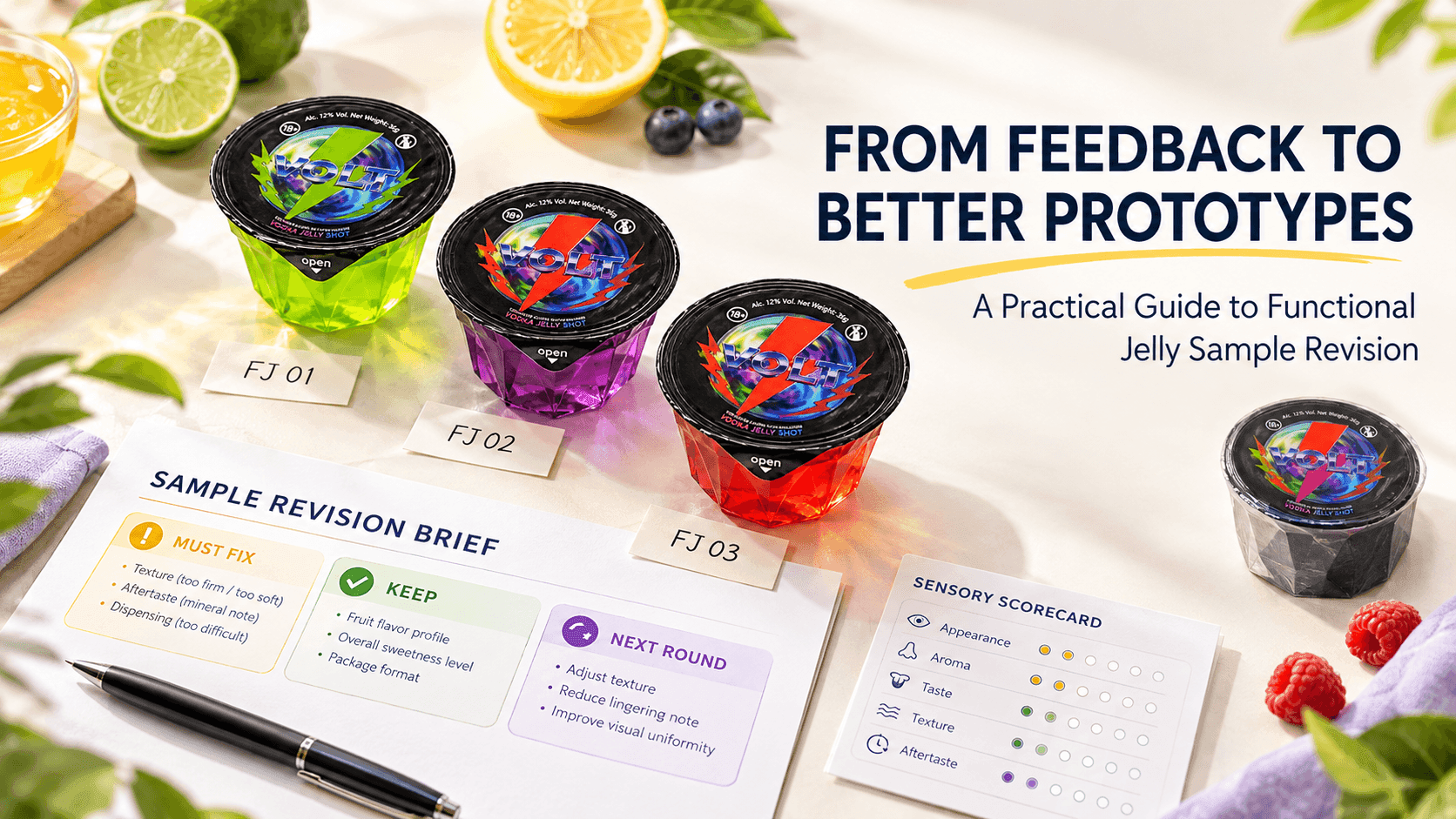
How to Write a Functional Jelly Sample Revision Brief
A functional jelly tasting session should end with a development decision, not a collection of unrelated comments.
The sensory scorecard records what evaluators saw, smelled, tasted and experienced. The sample revision brief turns those observations into a controlled request for the next prototype. It tells the manufacturer what is wrong, which direction the product should move, what must remain unchanged and how the next sample will be judged.
This distinction matters because a functional jelly is an interacting system. Sweetness, acidity, aroma, aftertaste, hydrocolloids, active ingredients, serving size and package use can affect one another. Asking for many changes without priorities can move the formula away from the original commercial target or make it impossible to understand why the next sample improved.
The most useful revision brief is short enough to act on and detailed enough to prevent guesswork.
Identify the Exact Sample First
Begin with traceability. A comment such as make version two softer has no value if the manufacturer and buyer do not agree which version two is.
The revision brief should identify:
- project name and buyer
- manufacturer sample code
- formula or development version where available
- flavor and product format
- sample production or dispatch date
- package used for evaluation
- date and place of evaluation
- storage and conditioning before evaluation
- benchmark or previous sample used for comparison
Record whether the sample arrived intact and whether the evaluator followed the intended preparation. A pouch tested immediately after refrigeration may not feel like the same product evaluated after controlled conditioning at the intended use temperature.
If several prototypes are compared, use their exact codes throughout the document. Do not rename them favorite, sweet one or soft one after the session.
Separate Observation From Requested Change
Good feedback begins with what happened, not with an assumed formulation solution.
An observation describes the experience:
- a mineral note remains after the fruit flavor fades
- the jelly requires too much force to squeeze through the opening
- sweetness arrives early and masks the acidity
- visible particles settle toward one end of the package
A requested direction states the intended outcome:
- reduce the lingering mineral impression while keeping the current citrus identity
- make dispensing easier without turning the product into a drinkable liquid
- lower the early sweetness and preserve the refreshing acidity
- improve visual uniformity in the finished serving
The manufacturer determines which formulation, process or material options are technically appropriate. A buyer can suggest a possible cause, but should label it as a question rather than a confirmed diagnosis.
This approach prevents the brief from prescribing an ingredient change that solves one symptom while creating another problem.
Define What Is Fixed and What Can Move
Every revision round needs boundaries.
Fixed requirements may include the destination market, serving format, target amount of a functional ingredient, required nutrition position, package dimensions or a confirmed allergen restriction. Adjustable preferences may include fruit intensity, sweetness direction, acidity balance, color shade or a narrow range of texture.
The brief should state which items are fixed, which are preferred and which are open to manufacturer recommendation.
For example:
- fixed: stick format and target serving size
- fixed pending regulatory confirmation: declared functional ingredient target
- preferred: current mango identity
- adjustable: sweetness and acidity balance
- open to recommendation: technical method used to reduce an aftertaste
Do not mark a requirement fixed if the brand is still deciding it. False certainty can force unnecessary reformulation and delay the project when the commercial team later changes direction.
Rank the Changes by Decision Priority
Not every comment should enter the next sample request.
Sort feedback into four groups.
1. Must fix issues prevent the sample from moving forward. Examples may include an unacceptable off-note, package failure, unexpected separation or a texture that does not work with the intended format.
2. High priority target gaps materially affect the product concept, such as a fruit identity that is too weak for the agreed brief or a sweetness level clearly above the target.
3. Optimization opportunities could improve the sample but should not disrupt more important work.
4. Personal preferences should be recorded separately unless they are supported by the agreed target or relevant consumer evidence.
Choose the smallest coherent set of changes for the next round. If the team requests lower sweetness, stronger acidity, a softer gel, a different active level, a new package and a different fruit profile at the same time, the result becomes a new concept rather than a controlled revision.
The manufacturer may recommend a different sequence because formula interactions or processing constraints make one change dependent on another. Record that recommendation and agree on the objective of the round before work starts.
Use Direction and Magnitude Together
Words such as more, less, smoother and better are incomplete.
State the direction and the intended magnitude relative to a known reference. Useful phrases include:
- slightly less sweet than sample FJ 02
- clearly softer than FJ 02 but still able to hold its shape after dispensing
- fruit aroma between FJ 01 and the approved mango benchmark
- shorter mineral aftertaste while keeping the current acidity level
Avoid false precision. A buyer should not request a specific percentage reduction unless the value refers to a defined measurable parameter and the team has a valid reason for that target.
For sensory attributes, an anchored scale from the previous evaluation can help. The revision brief can refer to the same target point rather than inventing new vocabulary for every round.
Preserve the Attributes That Already Work
A revision brief should protect successful parts of the sample.
If the color, package flow and fruit identity are already acceptable, say so. A useful request might read:
Reduce the lingering mineral note and lower sweetness slightly. Keep the current color, citrus identity, acidity direction and squeeze behavior.
This does not guarantee that every accepted attribute can remain identical. Formulation changes may alter several parts of the sensory system. The instruction tells the R&D team which tradeoffs require discussion rather than silent acceptance.
Create a keep list beside the change list:
- keep the current flavor identity
- keep the accepted color direction
- keep the approved package format
- keep the target serving size
- keep the attributes already within the agreed range
The keep list is especially important when different departments review the project at different times. It prevents a later stakeholder from restarting decisions that have already been made.
Connect Each Comment to the Product System
Functional jelly feedback should not be divided into flavor and texture as if they were independent.
A higher level of minerals, protein, fiber, botanical extract or another ingredient can affect taste, body, appearance or aftertaste. Sweeteners and acids can change flavor perception and may also influence the hydrocolloid system. Texture can change how aroma and sweetness are released during eating.
The brief should therefore flag connected requirements:
- ingredient or nutrition target
- sweetness and acidity
- aroma and flavor identity
- aftertaste
- viscosity firmness or squeeze behavior
- appearance and uniformity
- package opening and dispensing
- storage and shelf-life assumptions
Do not ask the R&D team to improve sensory performance by reducing a functional ingredient if that amount defines the commercial concept or planned claim. If the target itself is open for review, the brand and technical teams should make that decision explicitly.
Keep Claims and Label Inputs Under Change Control
A sensory revision can trigger a label or claim review even when the front-of-pack concept appears unchanged.
Changing the functional ingredient level, sweetener system, flavor, acid, color, preservative, carrier or serving size may affect the ingredient list, allergen assessment, nutrition values, claims, use directions or other mandatory information.
The revision brief should identify any claim or declaration that the team expects to preserve. It should also state that the final position requires review against the finished formula and destination-market rules.
Do not use prototype tasting to confirm a functional benefit. Evaluators can describe taste, texture, aroma and use experience. They cannot establish efficacy, absorption or a health outcome.
If the requested sensory direction conflicts with the ingredient or claim target, pause the revision and decide which commercial priority controls the project.
Include Package Use in the Revision
The same jelly can behave differently in a stick, sachet, cup or spouted pouch.
Record the package used during evaluation and describe the actual use problem. Too thick may mean the jelly is technically firm, the opening is too narrow, the sample was conditioned differently or the package geometry does not support the intended experience.
Useful package feedback includes:
- opening force and tear behavior
- control during squeezing or pouring
- whether the product dispenses completely
- leakage or residue around the opening
- fit between serving size and package
- whether the jelly can be consumed as intended without extra tools
If the prototype was supplied in temporary laboratory packaging, distinguish formula feedback from packaging conclusions. Do not approve commercial package performance from a pack that was never intended for production.
Ask for a Revision Plan Before the Next Sample
The manufacturer should review the brief and confirm how the next round will be structured.
The response does not need to reveal confidential formulation details. It should clarify:
- which priorities will be addressed
- which accepted attributes may be affected
- whether the proposed changes remain feasible
- whether new ingredient or packaging information is needed
- how many variants will be prepared
- how the variants will differ
- what decision the next evaluation is expected to make
Two controlled variants can be more informative than one sample that tries to combine every preference. For example, one version may keep the current texture while reducing sweetness, while another may also adjust firmness. The exact experimental design should be agreed with the manufacturer.
Avoid requesting several samples without defining why each one exists. More prototypes do not automatically create a faster decision.
Use Version Control for Every Round
Each revision should create a new record rather than overwrite the previous one.
Use a simple sequence such as FJ 01, FJ 02 and FJ 03, supported by the manufacturer's own formula or sample codes. Record the date, requested changes, samples received, evaluation result and decision for each version.
Keep the approved brief, scorecards, revision request, manufacturer response and final decision together. If possible, retain an appropriate reference sample under the defined storage conditions for the relevant comparison period, recognizing that a food sample can change over time and may not remain a valid reference indefinitely.
Version control should extend to the package, product specification, quotation and artwork. A formula can be approved while the label still reflects an earlier ingredient list. The final commercial record must connect the approved product with the correct documents.
Define the Next Approval Decision
End the brief by stating what success will look like.
The next round may be intended to:
- confirm that a must-fix defect has been resolved
- choose between two controlled sensory directions
- verify that a change did not damage accepted attributes
- select a version for a production trial
- decide that the concept requires a larger reset
List the attributes that will determine the decision and the conditions under which they will be evaluated. Reuse the same sensory vocabulary and scorecard where possible.
The outcome should be one of four clear decisions:
- approve for the next defined stage
- approve with documented minor actions
- request another controlled revision
- stop or reframe the concept
Approval should identify the exact sample code and what the approval covers. A sensory approval does not automatically approve the label, shelf life, package performance, regulatory position or commercial quotation.
Functional Jelly Revision Brief Template
A concise brief can follow this order:
- project and sample identification
- evaluation conditions
- decision summary
- must-fix issues
- high-priority target gaps
- accepted attributes to preserve
- fixed commercial and technical requirements
- adjustable preferences
- claim label or market constraints
- package-use observations
- requested next-round variants
- approval criteria for the next evaluation
- open questions and owners
- revision number and date
The document should be understandable to someone who did not attend the tasting. If the R&D team must schedule a call simply to learn which sample was tested or which change matters most, the brief is not finished.
Frequently Asked Questions
How many changes should be requested in one sample round
There is no universal number. Use the smallest coherent set that addresses the decision priority without turning the round into an uncontrolled redesign.
Should buyers tell the manufacturer which ingredient to change
Buyers should describe the observed issue, desired direction and fixed requirements. The manufacturer should recommend technically appropriate formulation or process options unless a specific material is already a confirmed project requirement.
What if evaluators disagree
Separate target fit from personal preference, review the original brief and record the disagreement. If the decision depends on consumer preference, use an appropriately designed consumer study rather than a louder internal debate.
Can the approved sensory scorecard be reused
Yes. Reusing the same attributes, anchors and conditions can make successive versions easier to compare, provided the product target has not changed.
Does a sensory revision require a label review
It can. Changes to ingredients, levels, serving size or other formula elements may affect the ingredient list, nutrition information, claims, allergens, directions or other market-specific content.
When should the team stop revising
Stop or reframe when the target is technically infeasible, commercially unsuitable, no longer aligned with the market brief or cycling through preferences without a stable decision criterion.
Prepare the Next Sample Round
Brands and qualified buyers can share their functional jelly target, current sample code and prioritized revision questions with Victory Foods for a focused next-round discussion.