
How to Brief a Private Label Pudding Cup Project Before Sampling
A pudding cup sample is meaningful only when the manufacturer knows how the finished product will be sold, stored, opened and eaten. This buyer guide turns the idea into a practical OEM brief covering channel, storage model, texture, flavor, cup, seal, label, logistics and sample approval.
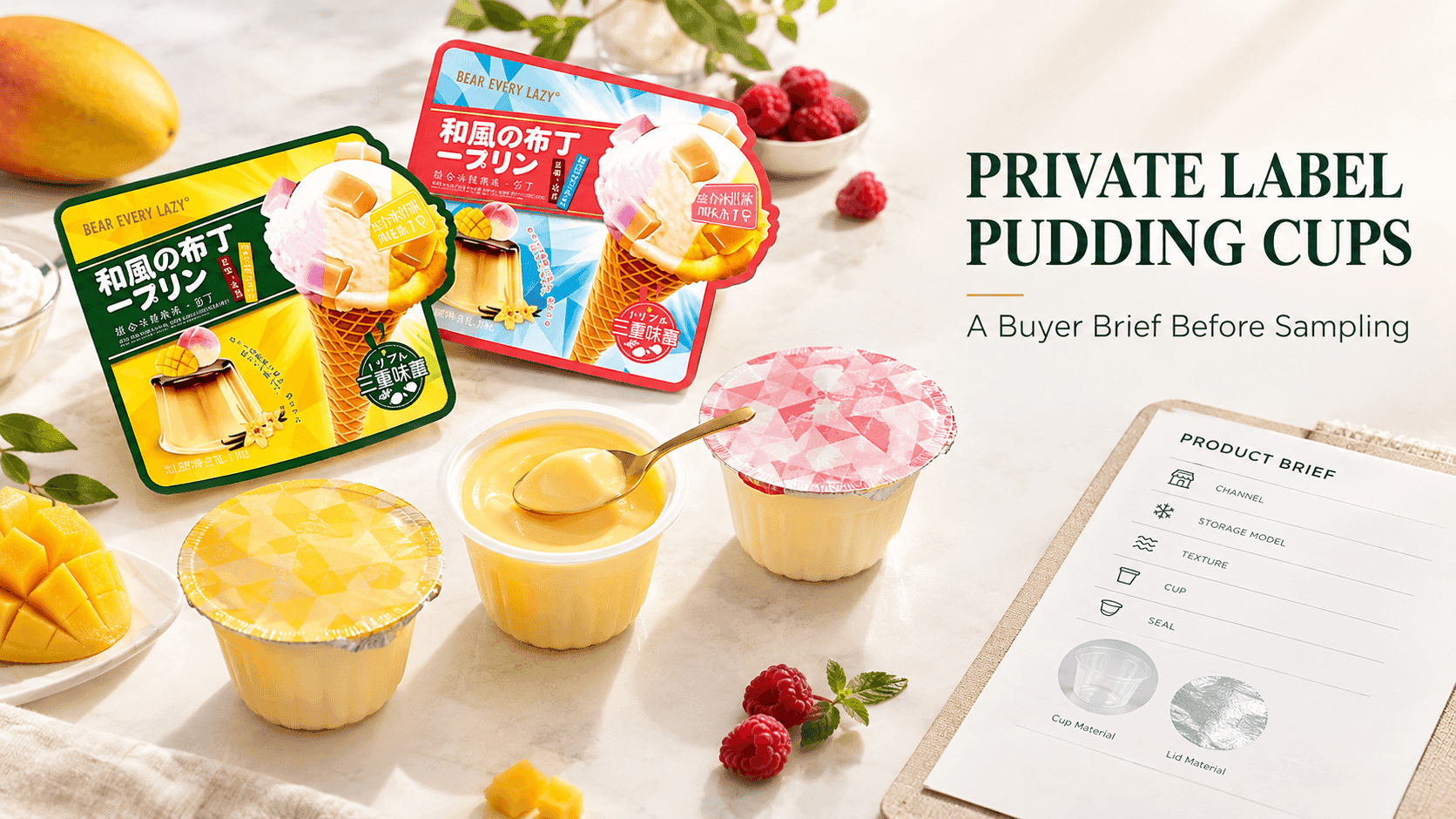
How to Brief a Private Label Pudding Cup Project Before Sampling
A request for mango pudding in a nice cup is not yet a product brief.
An OEM manufacturer still needs to understand where the pudding will be sold, how it will be stored, what texture the consumer should experience, how the cup opens and what the finished pack must communicate. Without those decisions, the first sample may taste pleasant but represent the wrong commercial product.
Victory Foods presents its pudding category as a shelf-stable ready-to-eat dessert platform, including classic and texture-led concepts. That platform can be a useful starting point for private-label development, but every project still needs product-specific confirmation of formula, process, package, storage, shelf life, label and destination-market requirements.
The purpose of the buyer brief is to define the finished experience before the sample is made.
Start With the Retail or Foodservice Job
Describe what the pudding must do in the market.
A single-serve grocery dessert, an Asian snack-store item, a multipack for family purchase and a foodservice pudding component may all require different product and packaging decisions. The same flavor name does not make them the same project.
Begin with one sentence:
This product is a ready-to-eat pudding cup for adult and family grocery shoppers who want a convenient dessert that can be eaten directly from the pack.
or:
This product is a portioned dessert for a cafe chain that needs consistent service with minimal preparation.
The sentence should identify:
- intended consumer
- sales channel
- eating occasion
- portion role
- expected storage route
- target price position
- destination market
These decisions help the manufacturer judge whether the concept, cup and production route belong together.
Define the Storage Model Before the Flavor
The project should state whether the commercial goal is a shelf-stable ready-to-eat pudding, a chilled product or another validated route.
Do not use shelf stable as a casual marketing adjective. It is a technical and commercial requirement that depends on the final formula, process, package, seal, hygiene controls, storage conditions and shelf-life evidence.
A buyer planning ambient distribution should explain the intended warehouse, retail and transport model. A chilled concept needs a defined cold-chain plan and appropriate label instructions. The manufacturer should then confirm which route is feasible for the specific product.
Do not transfer a shelf life or storage statement from another pudding. Even products from the same factory may use different formulas, pack sizes, inclusions or processes.
The brief should contain a target distribution model and an evidence question:
- target: shelf-stable ready-to-eat retail cup
- destination: named market and channel
- evidence needed: manufacturer proposal for product-specific validation and label support
This keeps the commercial ambition clear without inventing a technical conclusion before development.
Choose the Serving and Cup Together
Serving size affects the eating experience, retail price, nutrition information, case configuration and the amount of label space available.
The buyer should define whether the product is a small individual dessert, a larger sharing format, a multipack or a foodservice portion. If the serving size is still open, provide a target range and explain the commercial reason rather than selecting a number only because a competitor uses it.
Cup geometry matters as much as nominal capacity. A wide shallow cup can create a different visual and spooning experience from a tall narrow cup. The lid opening, headspace, wall strength, base stability and secondary packaging all influence real use.
The brief should ask:
- Will the consumer eat directly from the cup
- Is a spoon included or expected separately
- Should the product release cleanly from the side wall
- Does the cup need a transparent area
- How much surface is required for labeling
- Will cups be sold individually or in a multipack
- How will the unit be displayed and stacked
- What parcel or transport handling will it face
Do not approve a cup from a catalog image alone. Evaluate it with the actual pudding and lid system.
Translate Pudding Texture Into Observable Behavior
Smooth, creamy and premium are useful marketing ideas but weak R&D instructions.
Describe what the pudding should do when the consumer opens and eats it.
Useful texture observations include:
- holds a clean spoonful without feeling rubbery
- spreads softly under light spoon pressure
- feels smooth rather than grainy
- releases flavor without leaving an excessive coating sensation
- remains uniform from the top to the bottom of the cup
- supports any approved inclusion without unwanted settling or separation
- maintains the intended experience at the defined consumption condition
Add unacceptable outcomes:
- watery separation
- rubbery bite
- excessive stickiness
- graininess
- weak body
- unwanted skin formation
- inconsistent texture within the cup
Use a benchmark if one is available, but explain which attributes matter. Asking to copy a competitor exactly does not account for differences in formula, ingredients, process, package or legal position.
Build the Flavor Around the Base
A pudding flavor is not only a top note.
The base may be dairy-style, fruit-led, cocoa-based, tea-inspired or another dessert direction. Sweetness, acidity, aroma, color and texture need to work as one product.
The brief should identify:
- primary flavor
- supporting flavor if any
- desired sweetness direction
- acidity direction where relevant
- color expectation
- acceptable or unacceptable aftertaste
- target consumer familiarity
- benchmark product or flavor reference
A fruit pudding can be bright and refreshing or round and dessert-like. A milk-tea concept can emphasize tea aroma, creamy notes or a balanced combination. The manufacturer needs to know which direction matters more.
Avoid claiming real fruit, dairy content, natural flavor, high protein or another composition attribute unless the formula and destination-market rules support it. The product name, label and marketing claim must match the finished product.
Decide Whether Inclusions Are Essential
Fruit pieces, popping boba, sauce layers or other inclusions can create a more distinctive pudding, but they also change the project.
An inclusion may affect visual uniformity, texture contrast, filling behavior, distribution within the cup, package opening, shelf-life evaluation and consumer instructions. It may introduce additional ingredients, allergens or labeling requirements.
Before requesting a sample, define the role of the inclusion:
- is it the main reason to buy the product
- should it be visible before opening
- should every spoonful contain it
- is the contrast soft, chewy, crisp or bursting
- must it remain separate as a layer
- how should the consumer access it
Do not add an inclusion only because it is visually interesting. It should support a clear consumer experience and remain workable in the intended product system.
If the inclusion is optional, ask for the plain pudding base first. Approving the base can make later comparison more useful.
Define Ingredient Allergen and Positioning Boundaries
The buyer does not need to write the formula, but the manufacturer needs the commercial constraints.
These may include:
- dairy-containing or dairy-free direction
- permitted or prohibited allergens
- vegetarian or vegan positioning target
- sugar or sweetener direction
- color and flavor preferences
- ingredient restrictions from the retailer
- destination-market additive requirements
- nutrition or claim targets
Each target requires technical and regulatory review. Dairy-free does not automatically mean allergen-free, and vegan positioning does not decide whether a product may be labeled that way in every market.
Allergen management should cover the finished formulation and the relevant production environment. The label should be built from current product information rather than assumptions based on the flavor name.
If a requested claim cannot be supported by the final formula and market rules, change the positioning before artwork is approved.
Align the Pudding With the Manufacturing Process
A bench sample proves that an idea can be made at small scale. It does not establish that the same texture, flavor and appearance will remain consistent on the intended line.
The manufacturer should evaluate the formula as part of a production system that includes ingredient preparation, mixing, heat treatment where applicable, filling, sealing, cooling or other controlled steps, inspection and packing.
The buyer does not need confidential process settings. The buyer does need to ask whether the proposed cup, lid, fill level, inclusion and texture are compatible with the intended commercial route.
Changes made late in development can affect more than taste. A new flavor, inclusion or thickener may require a new review of process behavior, label information, packaging compatibility and shelf-life validation.
The approved sample should therefore be connected to a specific development version, not remembered only as the one we liked.
Treat the Lid and Seal as Part of the Product
A pudding cup fails commercially if the lid leaks, peels badly or leaves the consumer with an unpleasant opening experience.
During sample development, evaluate:
- seal appearance and continuity
- leakage after intended handling
- peel force and control
- whether the lid tears unexpectedly
- product contact with the underside of the lid
- residue around the rim
- cup deformation during opening
- tamper-evidence requirements where applicable
- clarity of any opening instruction
The seal system must also be suitable for the actual food, process and conditions of use. A cup and lid used for one product are not automatically appropriate for a different formula or treatment.
For destination markets with specific food-contact rules, obtain the relevant material and compliance documents for the intended use. A generic food-grade statement without material, supplier, condition-of-use or market context may not be sufficient for buyer review.
Plan the Label Before the Cup Is Final
The cup determines how much information can be displayed and how easily it can be read.
Before approving the final format, map the information required for the destination market. This may include the name of the food, ingredient list, allergens, net contents, responsible business details, origin where required, date marking, storage instructions, nutrition information, preparation or use directions, language and other market-specific statements.
The exact requirements depend on the product and market. Codex prepackaged-food labeling principles can provide a useful international reference, but national law and the final approved formula control the commercial label.
If the cup is too small for the required information, the project may need a sleeve, carton, multipack or another labeling solution. Make that decision before artwork and tooling are finalized.
Do not rely on a secondary carton to solve every problem without checking whether required information must appear on the individual unit.
Include the Secondary Pack and Logistics Route
The consumer cup sits inside a larger logistics system.
Define how many units will be packed in a tray, display box or master carton. Consider case weight, stacking, retail replenishment, e-commerce handling and the risk of lid or cup damage during distribution.
A visually distinctive cup may still be inefficient if it leaves too much empty carton space or cannot tolerate normal stacking. A low-cost cup may create higher losses if it deforms or leaks.
The brief should state:
- individual or multipack retail unit
- target units per inner and master pack
- display-ready requirement
- barcode level
- pallet or container planning needs
- distribution channel
- parcel testing need for e-commerce
- destination climate and handling concerns
The manufacturer and packaging team can then evaluate the complete pack rather than only the consumer-facing cup.
Design the First Sample Round to Answer Questions
The first sample does not need to solve every decision. It should answer the most important unknowns.
A useful first round might compare two texture directions while keeping the flavor constant. Another project might compare the same texture with two sweetness levels. If the package is already fixed, the sample can also test spooning and opening in the intended cup.
Each sample should have a code and a reason to exist. Record the formula or development version, package, evaluation condition and decision outcome.
Evaluate at least these dimensions:
- appearance and uniformity
- aroma and flavor identity
- sweetness and acidity balance
- texture and spoon behavior
- aftertaste
- inclusion distribution where applicable
- cup stability
- lid opening
- overall target fit
Use specific feedback. Replace make it more premium with a defined direction such as slightly lower sweetness, stronger tea aroma and a smoother finish while keeping the current spoonable body.
Prepare the Commercial Questions With the Technical Brief
Sampling and quotation should describe the same product.
Before asking for a commercial offer, align:
- intended formula direction
- serving size and cup
- number of flavors or SKUs
- inclusion or layer requirements
- label and artwork route
- inner and master packing
- destination market
- required testing and documents
- first-order estimate
- launch timing
MOQ may be influenced by production setup, cups, lids, printed materials, ingredients, carton quantities and SKU count. The manufacturer should confirm the actual drivers for the defined project.
A quotation based on a generic pudding cup should not be treated as final if the buyer later changes the size, package, inclusion or market requirements.
Frequently Asked Questions
What information should a buyer send before requesting pudding samples
Send the destination market, consumer, channel, storage model, serving size, cup direction, texture, flavor, inclusion plan, ingredient constraints, label needs and commercial quantity assumptions.
Can one pudding sample prove the shelf life
No. Shelf-life support should apply to the final formula, process, package and intended storage conditions through an appropriate validation plan.
Should the cup be chosen before the formula
Formula and package should be developed together. An early cup direction is useful, but final approval should reflect the actual pudding, process, seal and distribution route.
How should pudding texture be described
Use observable behavior such as spoonability, shape holding, smoothness, coating, uniformity and the response at the intended consumption condition rather than relying only on words such as creamy or premium.
Can a buyer add popping boba or fruit pieces later
An inclusion may require a new review of formulation, filling, distribution, allergens, labeling, packaging and shelf life, so it should be introduced through a controlled development change.
Does a food grade cup work in every market and process
No. Food-contact suitability depends on the material, intended use, food type, process, time, temperature and destination-market requirements.
Discuss a Pudding Cup Sample Brief
Brands and qualified buyers can share their target market, pudding concept, texture direction and cup requirements with Victory Foods for an initial project discussion.