
How to Evaluate Functional Jelly Samples With a Sensory Scorecard
Functional jelly samples should be compared against a defined product target, not judged with vague comments. This buyer guide shows how to control the tasting conditions, score key attributes and turn sensory feedback into a clear next development decision.
How to Evaluate Functional Jelly Samples With a Sensory Scorecard
Functional jelly development often slows down after the first samples arrive. One person says a sample is too sweet. Another calls it acceptable. A third focuses on color, while the formulation team needs to know whether to change the flavor, acid balance, hydrocolloid system or package.
None of those opinions is automatically wrong, but vague comments are difficult to convert into a controlled revision.
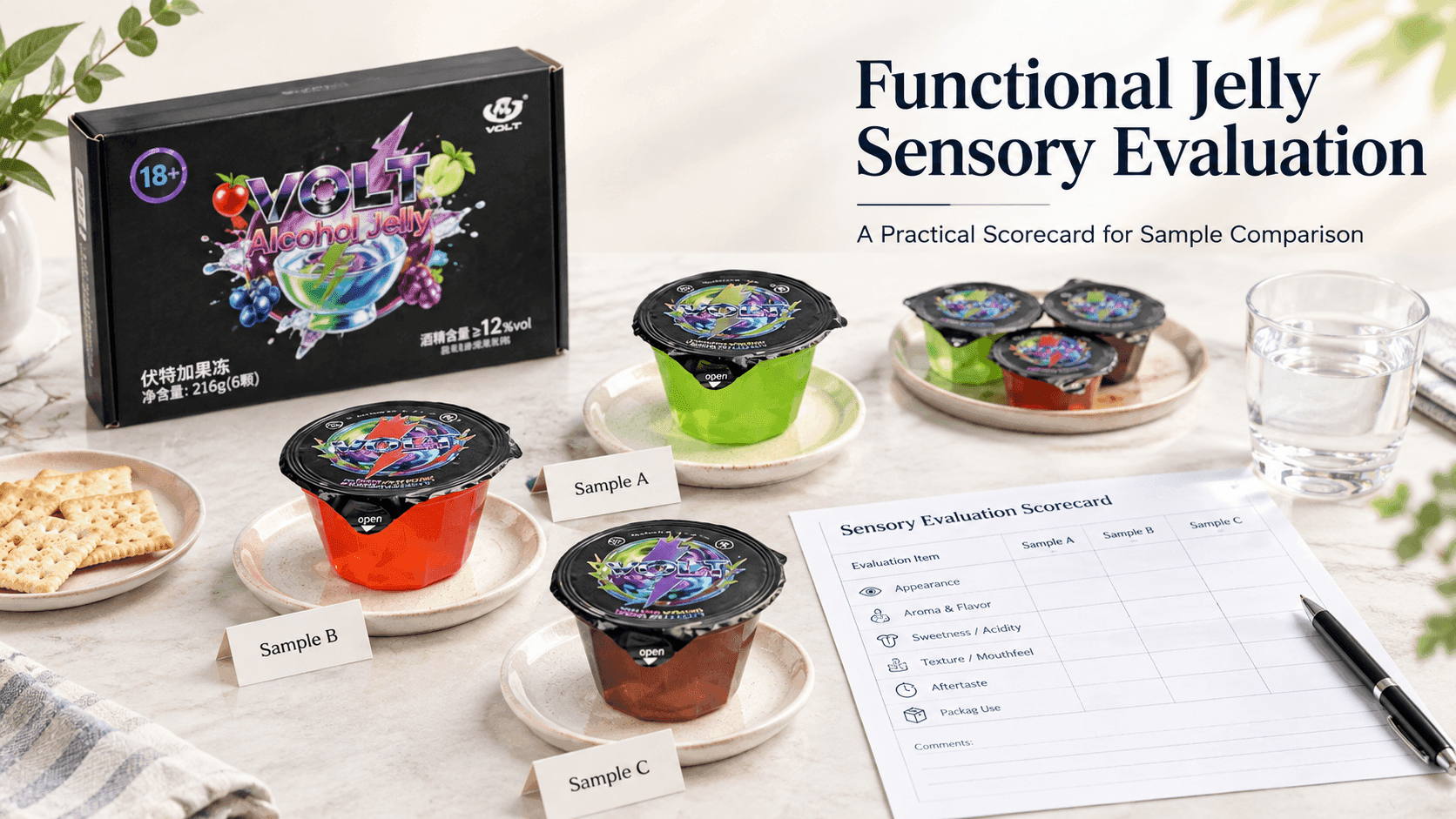
A sensory scorecard gives brand owners, importers and product teams a common way to examine a prototype. It does not turn a small internal tasting into consumer research, and it does not replace laboratory or stability testing. Its purpose is more practical: identify what the sample is, compare it with the agreed target and make the next development decision clearer.
Start With the Decision
Before anyone opens a sample, define what the session must decide. A tasting without a decision question usually produces more comments than useful direction.
The decision might be:
- choose one of three flavor directions for further development
- confirm whether a revised texture is closer to the approved target
- identify the main off-note associated with a functional ingredient
- compare a pilot production sample with the approved bench sample
- decide whether the formula is ready to enter shelf-life work
Do not use one session to answer every possible question. If flavor direction is still open, it may be too early to approve package copy or make a final shelf-life decision. A narrow purpose keeps the evaluation focused and makes the result easier to document.
Separate Product Description From Preference
Sensory evaluation can include different types of questions. Teams often create confusion when they mix them together.
Descriptive questions ask what the product is like. Is the color uniform? How intense is the fruit aroma? Is the texture soft, elastic, sticky or brittle? Does an aftertaste appear immediately or build over time?
Preference questions ask whether someone likes the product. A person may accurately describe a strong acid note and still enjoy it. Another person may dislike grape flavor in general even when the sample matches the brief.
Record description and preference in separate fields. The product team can then see whether a low preference score reflects a true mismatch with the target or an evaluator's personal taste. Formal consumer acceptance research requires a suitable study design and audience; an internal development panel should not be presented as evidence of market-wide liking.
Identify the Exact Sample
Every scorecard should point to one traceable sample. Record the sample code, formula version, package format, production or preparation date, lot where available and relevant storage history.
Do not rely on descriptions such as "the sweeter one" or "the new pouch." Those labels become ambiguous when a second revision arrives.
A simple identification block can include:
- project and destination market
- sample code and formula version
- flavor and functional ingredient system
- unit weight or fill format
- package type
- preparation or production date
- date received and date evaluated
- storage condition before evaluation
If a sample has been exposed to unusual heat, light, freezing or a damaged seal, record the event and evaluate a retained sample separately. Otherwise, the team may revise the formula to solve a distribution or handling problem.
Control the Evaluation Conditions
Functional jelly can taste and feel different when temperature, serving method and sample order change. The goal is not to create an artificial laboratory experience for every buyer meeting. It is to remove avoidable variation.
Use the same conditioning temperature, serving size and utensils for samples intended for direct comparison. Follow the intended use method: a spoonable cup, squeezable pouch and bite-size piece should not be evaluated as though they are the same format.
Provide water and a neutral palate cleanser when appropriate. Keep distracting odors away from the table. Avoid discussing expectations before individual ratings are recorded. When appearance is not the question, coded containers can reduce the influence of brand, color expectations and personal attachment to a formulation.
For several samples, consider varying or balancing the order between evaluators. The first product tasted can create a reference effect, while sweetness, acidity and lingering botanical notes can influence later samples.
Choose Attributes That Match the Product
A useful scorecard is product-specific. It should be short enough to complete carefully but detailed enough to separate one problem from another.
Appearance
Record color intensity, uniformity, clarity or opacity, visible particles, bubbles, surface condition and any liquid separation. The target depends on the concept. A botanical jelly may be intentionally opaque, while unexpected sediment in another product may indicate a dispersion issue.
Aroma and Flavor
Evaluate the intended character first. Does the sample communicate the named fruit or flavor direction? Then record overall intensity, balance and any unexpected notes.
Functional ingredients can contribute mineral, bitter, earthy, marine, vitamin-like or other distinctive sensations. Describe the note rather than writing only "bad taste." A precise description gives the formulation team a better starting point for flavor selection, acid balance, sweetener work or ingredient-form review.
Sweetness Acidity and Functional Off Notes
Sweetness and acidity should be judged in relation to the agreed target, not as isolated preferences. The scorecard can use directional anchors such as too low, on target and too high.
Record functional off-notes separately from fruit flavor intensity. If both are placed in one overall taste score, the team cannot tell whether to strengthen the desired flavor, reduce a masking system or investigate the active ingredient itself.
Texture Flow and Mouthfeel
Texture terms should describe what happens from opening to swallowing. Depending on the format, relevant attributes can include firmness, elasticity, cohesiveness, chew, slipperiness, stickiness, graininess, melt or breakdown, and residue in the mouth.
For a pouch product, also observe whether the jelly flows through the opening consistently and whether the consumer can control the portion. For a cup, consider spoon pickup, clean release and shape retention. A formula may feel pleasant in the mouth but still perform poorly in its intended package.
Hydrocolloids can influence both texture and the release or perception of flavor. For this reason, a texture revision should be tasted as a complete product rather than approved only from an instrumental reading or visual check.
Aftertaste
Record the type, intensity and duration of the aftertaste. A brief fruit finish is different from a lingering metallic, bitter or high-intensity sweetener note.
Use an agreed observation interval if the team needs to compare several versions. The exact duration is less important than using the same method for all samples in the round.
Package Use
The sensory experience begins before the jelly reaches the mouth. Check opening effort, seal behavior, leakage, product left in the package, dispensing control and contact between the product and the closure or seal.
Package observations should be recorded beside, but not confused with, formula observations. A difficult tear notch needs a packaging action. A weak fruit character needs a formulation action. Combining them into one score can hide both problems.
Use Anchored Scales
A number alone has little meaning unless everyone interprets it in the same way. Define anchors for each attribute before the session.
For target-based attributes, a five-position directional scale can run from much too low to target to much too high. For defect intensity, the anchors might run from not detected to strong. For package usability, the form can distinguish opens as intended, minor difficulty and unacceptable failure.
The important point is consistency, not the largest possible scale. Add a short comment field beside each rating so evaluators can explain what they noticed and where it occurred.
Do not average every number into a single "winner" score. One serious seal problem or strong unexpected off-note may matter more than several small advantages elsewhere. Review the pattern by attribute and apply the project's must-have requirements.
Evaluate Individually Before Group Discussion
Ask evaluators to complete their first ratings independently. Early group discussion can cause people to copy the vocabulary or opinion of the most confident person in the room.
After the individual forms are complete, compare observations. Look for agreement, disagreement and attributes that were interpreted differently. If one term means different things to different evaluators, improve the definition before the next round.
The discussion should end with a documented decision, not only a summary of opinions.
Distinguish Defects From Preferences
Classify comments into three groups.
1. Must-fix issues prevent approval, such as unexpected separation, an unacceptable off-note, inconsistent dispensing or a package failure.
2. Optimization opportunities could improve target fit but do not necessarily block the next stage, such as a slightly stronger fruit aroma or a small texture adjustment.
3. Personal preferences are worth recording but should not automatically change the brief, especially when they conflict with the defined target or intended consumer.
This classification prevents a project from cycling through endless revisions because each stakeholder has a different favorite sweetness or firmness.
Compare Against the Target and Reference
Whenever possible, place the written product target beside the scorecard. A retained approved reference, relevant benchmark or previous sample can also help stabilize the language used by the team.
The reference does not need to be copied. Its role is to make a phrase such as "softer" or "more intense" concrete. Record what the reference is and why it is being used.
If the target changes during development, issue a revised brief. Do not quietly move the goal after every tasting and then judge earlier samples against a standard they were never designed to meet.
Turn Results Into an Actionable Revision Brief
The scorecard becomes valuable when it produces a clear next-round request.
Instead of writing "improve the taste," state the observed issue, desired direction and attributes that must remain unchanged. For example: reduce the lingering mineral note, keep the current fruit identity and acidity direction, and preserve the approved soft texture and pouch flow.
Prioritize the changes. Altering many variables at once can make it impossible to understand why the next sample improved or declined. The manufacturer may recommend a different development sequence after reviewing ingredient interactions and process limits.
Close the review with one of four practical outcomes:
- approve the sample for the next defined stage
- approve with documented minor actions
- request a controlled revision
- stop or reframe the concept because the target is not technically or commercially suitable
Reuse the Scorecard at Production and Shelf Life Stages
The approved development scorecard can become part of later comparisons. During a production trial, use it to compare the scale-up sample with the approved reference. During shelf-life work, repeat the relevant attributes at planned checkpoints and record how appearance, flavor, texture, aftertaste and package use change.
Sensory results should sit alongside the required physical, chemical, microbiological, packaging and regulatory evaluations. A sample that tastes acceptable is not automatically safe, stable, compliant or supported for a functional claim.
Frequently Asked Questions
How many people should evaluate a functional jelly prototype
There is no universal number for every development decision. A small trained or aligned internal group can help compare prototypes, but it does not represent the target consumer population. Use an appropriately designed consumer study when the question is market acceptance.
Should functional jelly samples be blind coded
Blind codes are useful when brand expectations, formula ownership or visible version names could influence ratings. If package usability is being evaluated, the real package may need to remain visible; record which parts of the session were blinded.
Should founders and technical staff use the same form
They can use the same core attributes so results are comparable, while technical staff may add process observations. Keep personal preference separate from target-fit and defect fields for every role.
Can a sensory scorecard replace instrumental or laboratory testing
No. Sensory evaluation records human perception and use experience. It does not replace measurements for composition, texture, fill weight, seal integrity, microbiology, stability or other specifications required by the project.
Should a tasting panel score functional benefits
No. A tasting panel can describe sensory attributes but cannot confirm efficacy, absorption or a health outcome. Functional benefits and claims require separate scientific and regulatory substantiation for the final product and market.
When is a sample ready for approval
A sample is ready when it meets the defined product target and the project team has resolved or formally accepted the relevant formula, package, process and compliance questions for the next stage. Approval should identify the exact version and what the approval covers.
If you are preparing a functional jelly sample round, Victory Foods can discuss the scorecard, target attributes and next development step with your team.