
Functional Jelly Ingredient Compatibility Before Sampling
A promising active ingredient does not automatically become a stable, pleasant jelly. This buyer-focused framework explains which compatibility questions should be resolved before the first sample round.
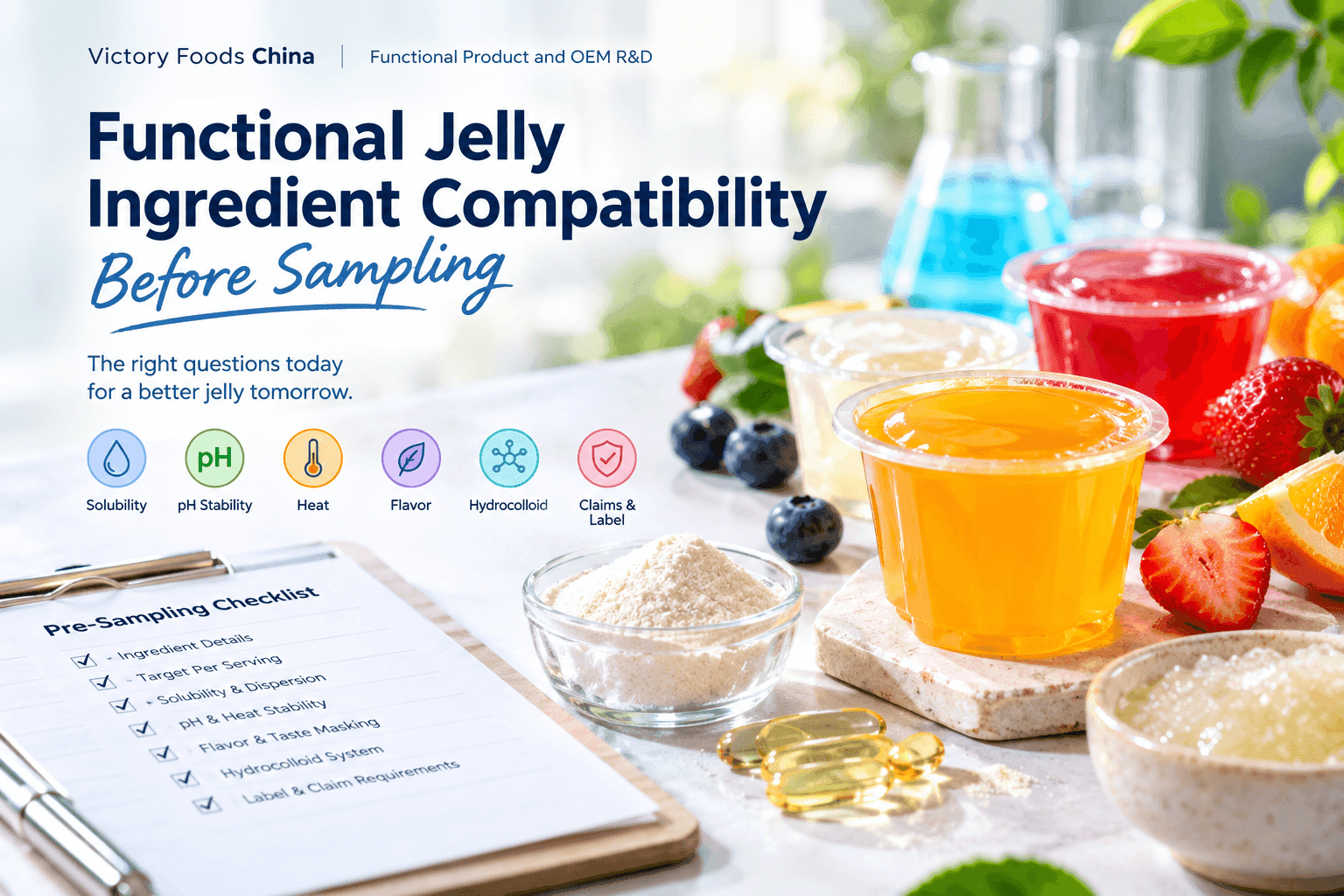
Functional Jelly Ingredient Compatibility Before Sampling
A functional ingredient can look excellent on a specification sheet and still perform poorly in a finished jelly.
The challenge is not simply whether an ingredient can be added. The development team must determine whether it can be dispersed, processed, protected, flavored, set into the required texture, packed and supported through the intended shelf life. The proposed serving must also fit the label and claim rules of the destination market.
These questions are easier and less expensive to address before the first formal sample round. For brand owners, importers and product managers, an ingredient compatibility review creates a clearer brief and reduces trial-and-error development.
Define the Ingredient Precisely
A common brief begins with a marketing name such as collagen, fiber, electrolytes or botanical extract. That is not enough for formulation work.
The manufacturer needs the exact commercial ingredient, supplier, grade and physical form. A powder, liquid concentrate, oil, suspension and encapsulated material can behave differently even when they deliver the same headline ingredient.
Useful starting information includes:
- technical data sheet and current specification
- full composition including carriers and processing aids where relevant
- allergen and origin information
- recommended storage conditions
- solubility or dispersibility guidance
- stability information for heat, pH, light and oxygen
- microbiological and contaminant limits appropriate to the ingredient
- intended target amount per serving
- documents needed for the destination market
If the brand supplies its own ingredient, responsibility for information flow should be agreed early. A sample pouch without traceable documents is not a reliable development input.
Calculate the Real Target Per Serving
The target should be expressed for the finished serving, not only as a percentage in a premix. The team should understand how much of the commercial ingredient is required, how much active component it contributes and whether expected processing or storage losses need investigation.
Serving size affects more than the label. A high target in a small jelly can increase solids, bitterness, acidity, mineral taste or viscosity. It may also leave too little room for water, sweetener, flavor and the hydrocolloid system.
Before sampling, confirm:
- finished unit weight or volume
- target amount of the declared ingredient per unit
- expected daily serving or use instructions
- overage assumptions if any and the evidence behind them
- tolerances and testing expectations
- whether the target supports the intended claim in the target market
The largest possible dose is not automatically the best commercial formula. The right target must balance product experience, process capability, label strategy and regulatory support.
Check Solubility and Dispersion
Some ingredients dissolve readily in water. Others swell, float, settle, clump or form visible particles. Oil-soluble materials may require a different delivery approach from water-soluble ingredients.
Poor dispersion can create uneven taste and inconsistent delivery from one unit to another. It can also interfere with filling, sealing or visual appearance.
A bench test should observe how the ingredient behaves during mixing and after the system rests. The team may need to adjust the order of addition, shear, hydration time or carrier system. Any change should be evaluated within the full formula because an ingredient can behave differently in plain water than in an acidic, sweetened jelly base.
Map Sensitivity to Heat pH Light and Oxygen
Functional jelly production may expose ingredients to heat, acidity and mixing. Finished products may then spend months inside a package exposed to varying temperatures and light conditions.
An ingredient compatibility review should identify known sensitivities before the process is selected. Heat-sensitive vitamins, oxidation-prone oils, color-sensitive botanicals and live microorganisms do not require the same strategy.
The response may involve changing the point of addition, reducing oxygen exposure, selecting a protective package, using a more suitable ingredient form or revising the shelf-life target. Sometimes the honest answer is that the proposed ingredient and format are not a good match.
Stability data from the raw-material supplier is useful, but it does not prove stability in the finished jelly. The complete formula and package need their own evaluation.
Review Interaction With the Hydrocolloid System
The gel network defines how a jelly holds water, releases flavor and responds when bitten or squeezed. Acids, salts, sugars, proteins and plant extracts can all change that network.
Minerals may strengthen one system and disrupt another. A high-solids ingredient can change water availability. Protein or fiber can create opacity, graininess or a firmer bite. Acid adjustments made for flavor or safety can alter setting behavior.
For that reason, texture should be treated as a measurable development target. The brief can describe whether the product should be soft, elastic, spoonable, squeezable or cleanly removable from its package. Sample feedback should be more specific than good or bad.
Research on food hydrocolloids also shows that texture and flavor perception are connected. Changing the gel structure can change how aroma and taste are released during eating. This is one reason a formula that meets the ingredient target may still need sensory redevelopment.
Anticipate Taste Color and Aroma
Functional ingredients rarely arrive without sensory consequences. Minerals can taste metallic or salty. Amino acids and botanicals can be bitter. Vitamins may contribute color or aroma. Fibers can make a product feel powdery or heavy.
Masking is not simply adding more flavor. The development team can work with sweetness, acidity, aroma profile, salt balance and texture to build a coherent product. The selected flavor should fit the natural character of the active system instead of fighting it.
Color also matters. A naturally dark extract may not suit a transparent concept. If a clear appearance is essential, the ingredient choice may need to change. Buyers should prioritize which attributes are mandatory and which can be adapted.
Check Claims Before the Front Label Is Designed
The presence of an ingredient does not automatically authorize a claim. Different markets apply different rules to nutrient content, health, structure and function statements. The required amount, wording, conditions of use and supporting evidence may vary.
The United States, European Union and other markets do not use one universal claim system. A concept intended for several countries may need different labels or a more conservative common message.
Before artwork, the buyer should identify the intended claim, target market, serving basis and evidence path. If the desired statement cannot be supported, it is better to revise the concept before spending time on packaging.
Include Packaging in the Compatibility Review
The package protects more than the shape of the jelly. Barrier properties, light exposure, headspace, seal integrity and food-contact suitability may affect quality throughout distribution.
The team should consider whether the ingredient stains the film, reacts with oxygen, settles visibly or changes during warm storage. A package selected only for appearance may not support the formula.
Compatibility work should therefore move from bench sample to pilot package, not stop with an unsealed laboratory cup.
Use a Structured First Sample Plan
A useful first round does not try to optimize every variable at once. It answers a defined set of questions.
For example, the team might compare two ingredient levels in one flavor, or one ingredient level across two hydrocolloid systems. Record the formula version, process, package, date and evaluation conditions for every sample.
Buyer feedback can cover:
- flavor intensity and off-notes
- sweetness and acidity
- color and visual uniformity
- firmness, elasticity and release from the package
- settling, syneresis or surface changes
- package opening and consumption experience
- alignment with the intended claim and serving size
This creates evidence for the next decision instead of producing a table full of attractive but untraceable samples.
Request a Feasibility Review
Brands and importers can share the target market, serving format, ingredient documents, target amount, flavor direction, claim concept and packaging idea for an initial feasibility review. If the ingredient is not suitable for the proposed jelly, identifying that limitation early is a productive result.
Frequently Asked Questions
Can any functional ingredient be added to jelly
No. Suitability depends on the ingredient form, target amount, processing conditions, gel system, sensory impact, package, shelf-life target and destination-market requirements.
Does raw ingredient stability prove finished product stability
No. Supplier data can guide development, but the finished formula and package require their own assessment.
Why can an active ingredient change jelly texture
Ingredients can change acidity, mineral balance, total solids, water availability and interactions within the hydrocolloid network.
Should claims be reviewed before sampling
The intended claim should be identified early because it can affect the required ingredient amount, serving size, evidence and label strategy.
What should a buyer send with a proprietary ingredient
Send the current specification, technical data, composition, allergen and origin information, storage guidance, stability data, target amount and relevant regulatory documents.