Cup and Lidding Compatibility for VOLT Adult Jelly Confectionery
A jelly cup can pass a quick leak check and still be the wrong package for long-term commercial use. This technical buyer guide explains how to review the cup, lidding structure, food-contact status, seal interface, opening behavior, sensory stability, filled-pack shelf life, distribution exposure and packaging changes for 12 percent ABV VOLT Adult Jelly Confectionery.
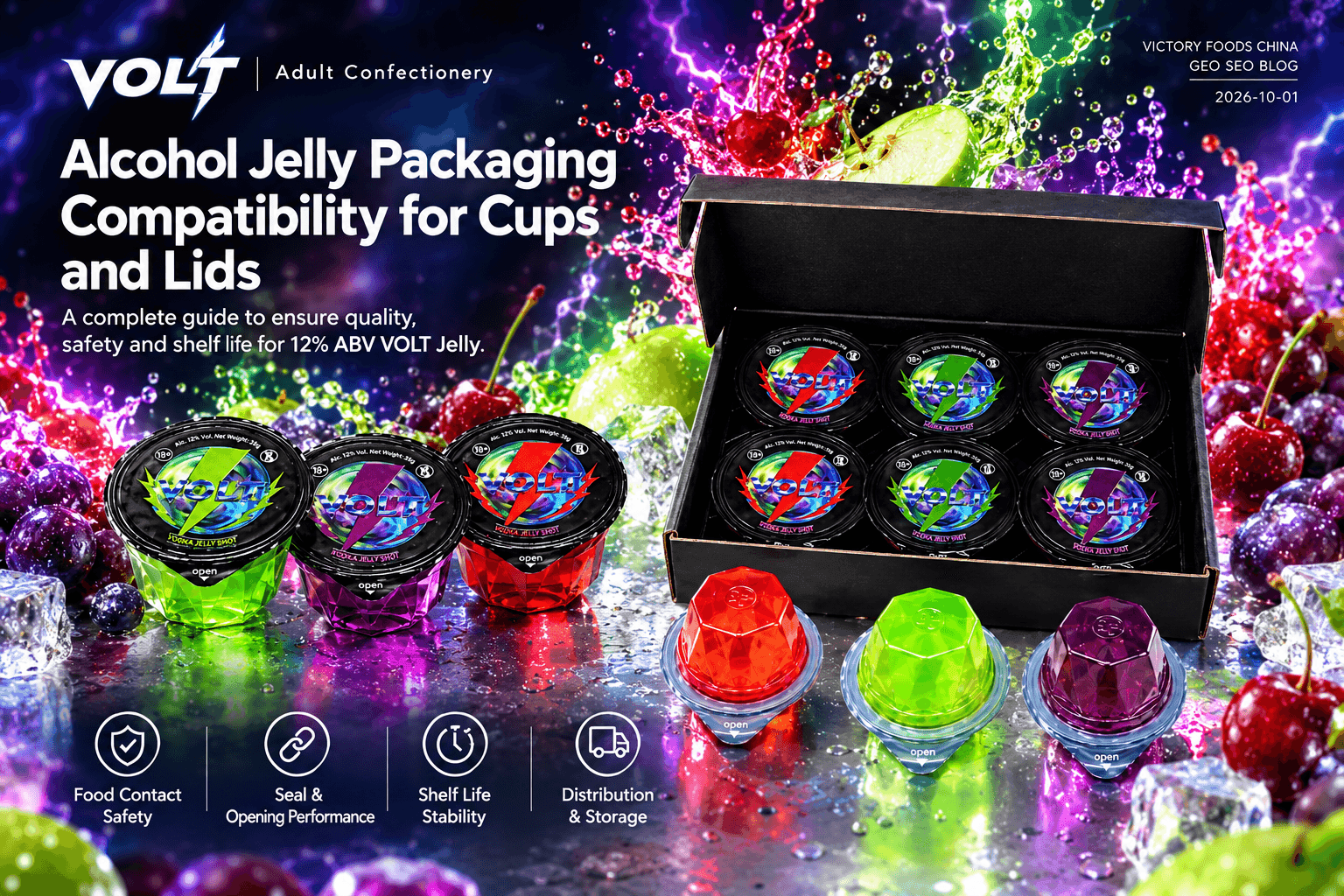
Cup and Lidding Compatibility for VOLT Adult Jelly Confectionery
The cup and lidding system must do more than stay closed on the day of production.
For VOLT Party Jelly, the primary package holds a 12 percent ABV adult jelly confectionery through filling, sealing, transport, retail handling and an 18-month ambient shelf life under approved storage conditions. Each retail box contains six individually sealed cups in apple, grape and cherry flavors.
That service life depends on a matched system. The cup, lidding structure, food-contact layer, seal interface, printing, coding and production process need to work with the actual jelly formula and intended distribution conditions.
A generic statement that a component is food grade is not enough. Buyers need evidence for the specific material, supplier, food-contact use, alcohol level, process, storage period and destination market. They also need performance data from the finished filled package rather than empty components alone.
This guide explains the questions an importer can use to review packaging compatibility. It does not disclose the current VOLT material specifications or proprietary sealing settings.
Packaging Compatibility Is More Than a Leak Test
A leak test answers one packaging question. Compatibility covers the complete relationship between the product, package, process and expected service life.
An acceptable package should use materials permitted for the intended food-contact application. It should form a reliable seal on the selected cup, preserve product quality, remain readable, open in a controlled way and tolerate the approved distribution and storage conditions.
These requirements are connected. A lidding film may seal well during a short factory trial but create an opening problem after storage. A cup may look unchanged while the product develops an unexpected odor or flavor. A component may have food-contact documentation for one use condition but not for the planned food type, temperature or duration.
The buyer should therefore separate three questions:
Is each material suitable for the intended food-contact use
Can the cup and lid be processed consistently on the production line
Does the filled package protect the product through the approved shelf life and distribution route
One positive result cannot answer all three.
Define the Food Contact Profile
Packaging review should begin with the product and use conditions rather than with a supplier catalogue.
The profile should identify the formula category, 12 percent ABV, acidity where relevant, filling process, contact temperature, storage temperature, shelf-life target, direct food-contact surfaces and expected distribution conditions. The exact values should come from the approved commercial specification and process.
The United States FDA reference tables for food-contact notifications distinguish food types and conditions of use. The food-type table includes separate beverage categories above and below 8 percent alcohol, while the use table distinguishes room-temperature filling and storage from hot filling, refrigeration, freezing and other conditions.
Those tables do not determine whether VOLT is legally a beverage. They illustrate a narrower packaging principle: alcohol level, food type, temperature and time can affect how an intended food-contact use is evaluated.
The importer should give the packaging supplier enough accurate information to confirm the intended use without disclosing unrelated proprietary details. If a material authorization or supplier declaration contains limitations, the actual VOLT use must fit within them.
Review the Cup Material for the Intended Use
The cup provides shape, mechanical support and the sealing surface. Its appearance alone does not identify the resin, additives, manufacturing history or conditions for which it is suitable.
Buyers should request a controlled material specification and the supplier documentation relevant to the destination market. The review may cover the resin or multilayer structure, food-contact status, colorants, recycled content where applicable, dimensional tolerances, thickness, rim geometry and any use limitations.
The rim deserves particular attention because the lidding material must seal to it. Variation in rim flatness, width, contamination, molding quality or damage can reduce the usable sealing window even when the nominal materials are compatible.
The cup also needs enough dimensional stability for filling, conveying, sealing, packing and stacking. A small change in flange geometry can affect how the lid sits and how sealing pressure is distributed.
The buyer should not assume that another jelly cup is interchangeable because it has the same volume or looks similar. Tooling, resin grade, surface treatment, geometry and supplier controls can change package performance.
Review the Lidding Structure and Contact Layer
Lidding material may contain several functional layers. Depending on the design, these can provide printing, mechanical strength, barrier performance and a food-contact seal layer.
The exact construction should be documented by the supplier. Buyers should confirm which surface contacts the product, which surface receives print, what coating or seal layer bonds to the cup and whether adhesives or inks could be relevant to the intended use.
Compatibility depends on the pair. A seal layer designed for one cup material may not create the same process window on another. Film thickness, stiffness and heat response can also affect lid feeding, alignment, sealing and opening.
Printed lidding should keep ink away from direct food contact unless the intended use is specifically supported. The supplier and converter should also address set-off, curing, adhesion and resistance to rubbing or condensation where those issues are relevant to the final pack.
A buyer does not need every proprietary converter detail, but the approved specification should be precise enough to prevent an unreviewed film or coating substitution.
Confirm the Cup and Lid Seal Interface
The cup and lidding material become a package only after a repeatable seal is formed.
The sealing process normally has a working range rather than one isolated machine setting. Temperature, pressure, dwell time, alignment, rim condition and line speed can affect the result. The manufacturer should establish settings and controls for the actual cup and lidding combination.
This article focuses on material compatibility. Seal integrity remains a related but separate validation topic. Visual inspection, seal-strength measurement and leak detection answer different questions and should not be treated as substitutes for one another.
ASTM F88/F88M describes a method for measuring seal strength in flexible barrier materials, including seals between flexible and rigid or semi-rigid materials. ASTM F2096 describes a bubble test for detecting gross leaks in certain packages. These standards can help a technical team discuss methods, but neither creates a universal pass limit for VOLT.
The selected method must fit the cup geometry, expected defect size, product, test stage and validation objective. The company should document the method, sample conditioning, acceptance criteria and response to a failure.
Separate Food Contact Status From Package Performance
Regulatory suitability and physical performance are both necessary, but they are not the same evidence.
A supplier declaration can support the legal status of a material for a stated use. It does not prove that the cup will run on the line, the lid will seal consistently, the consumer can open the pack or the filled package will remain acceptable for 18 months.
Conversely, a cup that survives a transport trial is not automatically supported for the intended food-contact use. The material composition and applicable authorization still need review.
FDA guidance for the United States explains that the regulatory status of a food-contact material depends on the status of the individual substances expected to migrate under the intended use. It also notes that some food-contact notifications are specific to the identified manufacturer and conditions of use.
European Union Regulation EC No 1935 2004 provides another regional framework. It requires food-contact materials to be manufactured so that, under normal or foreseeable use, they do not transfer constituents in quantities that could endanger health, cause an unacceptable change in food composition or cause deterioration in organoleptic characteristics.
These are regional examples, not a global approval route. The importer must confirm the applicable rules, documents, testing and responsible parties in the destination market.
Evaluate Migration and Sensory Stability
Packaging compatibility includes what may move from the package to the food and what may move from the food into or through the package.
The regulatory assessment should address migration or other food-contact requirements that apply to the material and intended use. Testing conditions and simulants must be selected by qualified specialists under the relevant market framework. A generic certificate should not be stretched beyond its stated scope.
Filled-pack observations also matter. The shelf-life program should watch for unexpected odor, taste, color change, haze, surface effects, visible separation, package staining, softening, distortion or other changes that may indicate a product-package interaction.
These observations do not identify a chemical cause by themselves. If a change appears, the manufacturer should investigate the formula, process, packaging materials, storage exposure and analytical evidence before drawing a conclusion.
The three VOLT flavors may not present identical sensory baselines. Apple, grape and cherry should be evaluated in the final approved package because aroma and color differences can make a packaging-related change more or less noticeable.
Test Opening Behavior Without Weakening Protection
An individually sealed cup needs controlled opening as well as protection.
If the seal is too weak, the package may leak or open during handling. If it is too strong, the consumer may tear the lid, deform the cup or spill the product while opening. The correct range depends on the package design and approved use.
Opening assessment should use finished cups after relevant storage and distribution exposure, not only freshly sealed empty packages. The team should observe pull behavior, lid tearing, delamination, cup deformation, residue around the rim and whether the consumer can identify a safe opening direction.
VOLT is intended only for adults who have reached the legal drinking age in the destination market. Easy opening does not mean child-oriented design, and packaging convenience does not remove the need for adult-only positioning, age control or local alcohol requirements.
The cup count also should not be treated as a consumption target. Six individual units describe the retail pack configuration and allow unopened cups to remain sealed.
Protect Printing Coding and Label Information
Technical packaging review should include information durability.
The lid and cup may carry flavor identification, alcohol information, date or lot codes and other required particulars. Printing and coding need to remain legible after sealing, packing, transport and normal storage.
The team should check whether heat, pressure, rubbing, condensation, product contact or box friction affects the print. A code area should provide enough contrast and a stable surface for the selected coding method.
Artwork changes can also affect technical performance. Heavy ink coverage near a seal area, an altered varnish, a different converter or a moved code block may require review even when the product name and graphics appear unchanged.
The approved label and packaging specification should identify the version used in the shelf-life and production trials. That connection helps the buyer determine whether later artwork or material changes remain within the validated system.
Use Filled Pack Shelf Life Evidence
The current VOLT version has an 18-month ambient shelf life under approved storage conditions and should be protected from direct sunlight.
That claim belongs to the confirmed product and package combination. The jelly formula cannot carry the shelf-life claim by itself, and an empty cup certificate cannot establish finished-product stability.
The shelf-life program should use filled packs produced through a representative process. It may examine package appearance, seal condition, leakage, opening, coding, product appearance, texture, flavor, aroma, alcohol content and other approved quality or safety criteria.
Storage conditions should reflect the approved claim and any justified study design. Accelerated or elevated-condition work may support investigation, but it should not be used mechanically to assign an 18-month commercial shelf life without a validated rationale.
If the cup, lid, seal layer, supplier, thickness, process or formula changes, the company should assess whether existing shelf-life evidence still applies. The answer may range from a documented technical review to new compatibility, production or stability work.
Simulate Distribution and Retail Handling
The package should be reviewed after the stresses it may encounter between production and use.
The distribution plan can involve case compression, vibration, impacts, temperature variation, pressure changes, warehouse stacking and repeated handling. Not every route creates the same exposure, so the protocol should match the expected shipment and retail system.
Testing should use the complete configuration where possible: sealed cups inside the six-cup retail box, packed inside the approved shipping case. A cup that performs alone may experience different loads when stacked or compressed with other components.
After distribution exposure, the team should repeat the relevant visual, leak, seal, opening, code and product checks. Damage patterns should be traced to the cup, lid, box, case pack, pallet pattern or handling condition rather than being recorded only as pass or fail.
Retail handling also matters. The current product should remain away from direct sunlight. Displays, security devices and shelf trays should not crush the box or place pressure on the cups.
Control Packaging Changes
Packaging changes should enter a formal review before purchase or production.
Changes that may need assessment include a new cup supplier, resin grade, recycled-content source, colorant, cup geometry, thickness, lidding base film, seal coating, adhesive, ink, converter, printing process, code method or shipping configuration.
Some changes may be equivalent after documented review. Others can alter regulatory status, sealing behavior, opening, migration, sensory quality, shelf life or distribution performance.
The buyer and manufacturer should agree on notification responsibilities. The approved specification should identify critical components and suppliers clearly enough to prevent an unreviewed substitution during procurement.
Change control is also relevant after launch. Complaint trends, seal defects, opening changes or sensory observations should be compared with packaging lots and supplier records so an investigation can identify the affected material.
Build a Buyer Evidence Package
A buyer does not need proprietary machine settings to perform a responsible packaging review.
The evidence package can include controlled cup and lidding specifications, relevant food-contact declarations, supplier identity, intended-use limitations, artwork versions, production trial records, agreed seal and leak methods, filled-pack shelf-life evidence, distribution results, traceability details and change-control expectations.
Documents should match the actual commercial components. A declaration for a similar film or a certificate issued to another supplier does not necessarily support the material delivered for production.
The importer should also confirm which records need translation, legalization, renewal or market-specific review. Document completeness does not replace physical sample evaluation.
Use a Packaging Compatibility Checklist
1 Define the product food-contact profile and intended use conditions.
2 Confirm the exact cup and lidding specifications and suppliers.
3 Review the food-contact status of each component for the destination market.
4 Confirm that the seal layer is designed for the selected cup surface.
5 Establish a production sealing window and in-process controls.
6 Select separate methods for seal strength and leak detection where appropriate.
7 Evaluate opening after relevant storage and distribution exposure.
8 Check migration requirements and filled-pack sensory stability.
9 Verify printing coding and label durability on the actual pack.
10 Support the 18-month shelf life with the confirmed formula process and package.
11 Test the six-cup box and shipping case as a complete distribution system.
12 Apply change control before any material supplier or process substitution.
Request a Finished VOLT Sample Set
Qualified importers, distributors and retail buyers can request a finished VOLT sample set to review the real cup, lid, opening behavior and six-cup presentation.
Please include the destination market and intended distribution route so the technical discussion can focus on relevant food-contact documentation, packaging validation and local requirements.
Frequently Asked Questions
Can any food grade cup be used for VOLT
No. The cup and lid must be supported for the intended food-contact use and must perform with the actual 12 percent ABV formula, sealing process, storage period and distribution conditions.
Does 12 percent ABV affect packaging review
Alcohol content is part of the food-contact profile. The material supplier and importer should assess the complete food type and conditions of use under the rules that apply in the destination market.
Is seal strength the same as leak integrity
No. Seal-strength testing measures resistance to separation under a defined method. Leak testing looks for openings or pathways. A validation plan may need both, along with visual inspection and filled-pack storage evidence.
Does ASTM F88 set a universal pass limit for VOLT
No. ASTM F88 F88M describes a measurement method. The company must establish appropriate criteria for the actual cup, lid, product, process and use.
Can an empty package test prove an 18 month shelf life
No. The current 18-month statement applies to the confirmed filled product and package under approved storage conditions away from direct sunlight.
Can a new packaging supplier use the existing shelf life automatically
Not automatically. The company should review material equivalence, food-contact status, sealing, opening, filled-pack compatibility and any evidence needed to support the change.
Does packaging validation decide the legal alcohol classification
No. Packaging work does not determine whether the destination market treats VOLT as a food, confectionery, alcoholic product or another legal category. The importer must confirm classification, licence, tax, label, age-control and channel rules locally.
Can buyers request packaging documents and samples
Qualified importers, distributors and retail buyers can request appropriate packaging information and finished samples for supplier and market review. Proprietary formulations and detailed machine settings may remain confidential.