How to Read a VOLT Adult Jelly Confectionery Label Before Import
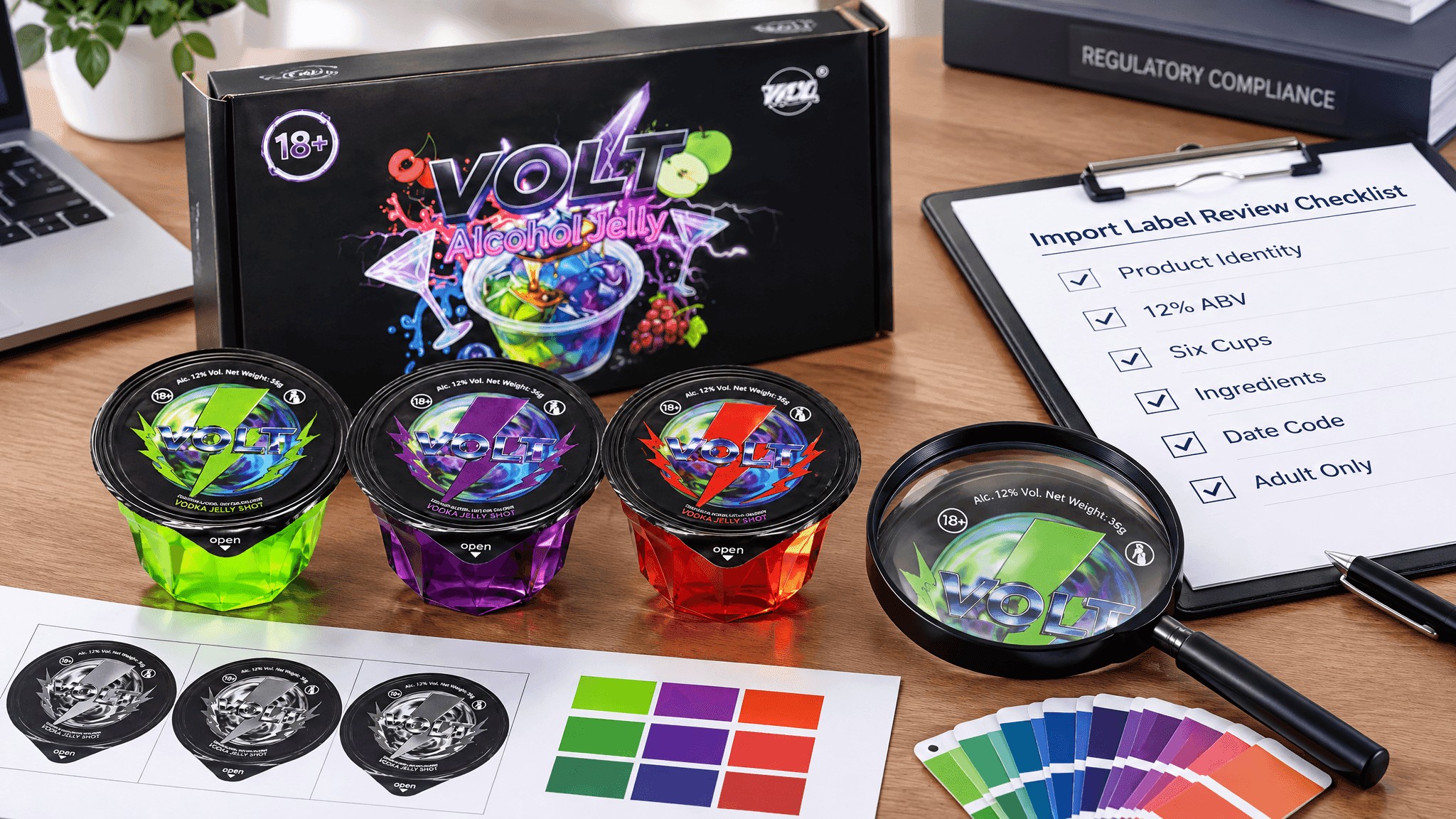
A VOLT label must explain an unfamiliar adult confectionery format without hiding its alcohol content. This buyer guide shows how to review product identity, 12 percent ABV disclosure, the six-cup pack, flavors, ingredients, date and storage information, translations and destination-market requirements before approving artwork.
How to Read a VOLT Adult Jelly Confectionery Label Before Import
A buyer should be able to identify VOLT Party Jelly, understand that it contains alcohol and recognize the six-cup format before opening the box.
That sounds simple, but an unfamiliar product creates several label decisions at once. The pack needs a clear product identity, a visible 12 percent ABV statement, adult-only communication, accurate flavor and unit information, an approved ingredient declaration, date and storage instructions, traceability information and the particulars required in the destination market.
The current VOLT retail version contains six individually sealed cups in apple, grape and cherry flavors. It is an alcohol infused adult jelly confectionery at 12 percent ABV. The current formula is konjac-free and uses a hydrocolloid system that includes carrageenan and locust bean gum. Its confirmed shelf-life statement is 18 months under approved ambient conditions, protected from direct sunlight.
Those product facts provide the starting point for label review. They do not replace a market-specific decision about product classification, licences, tax, mandatory language, warnings, age controls, sales channels or the party responsible for the food information.
Start With the Product Identity
The first reading task is to understand what the product is.
VOLT Party Jelly is the product name. Adult Jelly Confectionery is the preferred category language for brand and merchandising communication. Alcohol Infused Jelly Confectionery is the supporting phrase that explains the alcohol nature and helps search discovery.
The three expressions have different jobs. The brand name creates recognition. The category language tells the shopper how the product is eaten. The explanatory phrase makes the presence of alcohol explicit.
c
This hierarchy is not approved regulatory copy. The importer must confirm the legally required name of the food, the exact alcohol statement, language, warnings, type size and placement for the destination market.
The label should not rely on a creative phrase that leaves the product unclear. Solid cocktail may help some shoppers imagine the occasion, but it can also suggest a beverage. Candy alone can hide the alcohol nature. The final identity should remain specific enough to describe a jelly confectionery that contains alcohol.
Keep Alcohol Disclosure in the First Read
The alcohol content should not appear only after a shopper turns the box over or opens an online description.
The current product specification is 12 percent alcohol by volume. The label team should confirm how the destination market requires that information to be written, where it must appear and whether the statement belongs on both the outer box and individual cups.
The pack should also state that the product is intended only for adults who have reached the local legal drinking age. An age statement supports clear communication, but it does not replace age verification, channel restrictions or other legal controls.
The category of liquor-filled chocolate can provide a familiar adult confectionery reference in educational copy, yet it should never replace the actual VOLT identity or imply the same legal classification. VOLT has a jelly format, its own ABV specification and a separate market review.
Alcohol disclosure must remain consistent across the box, cups, shelf tag, product page, distributor catalogue and sampling material. If one surface describes an adult alcohol product while another looks like ordinary fruit candy, the combined presentation can confuse the buyer and consumer.
Read the Box and Cups as One System
The retail unit is a box containing six individually sealed cups. Label review should therefore examine the complete pack rather than treating the outer carton and cups as unrelated artwork.
The box can carry the main product identity, alcohol statement, flavor assortment and information required for the retail unit. The cups need enough information to remain identifiable and safely controlled after removal from the box. The exact requirements for an inner unit depend on the destination market, pack configuration and how the product is sold or served.
The importer should decide whether individual cups may ever be displayed, sampled, sold or distributed outside the closed box. If loose distribution is possible, the information needed on each cup may differ from a pack that must remain intact until it reaches the consumer.
The label review should also confirm that printed information is not damaged by the sealing process, condensation, rubbing inside the box or normal opening. A technically sound seal does not solve an information problem if the code or alcohol statement becomes unreadable.
Confirm Unit Count and Net Quantity
Six individually sealed cups is a verified pack fact. The label can use that statement to help the shopper understand the unit structure.
Unit count is not the same as net quantity. The approved artwork should use the measured net quantity and unit expression required by the destination market. Buyers should not infer a cup weight or volume from a photograph, an old sample or another market's label.
The declared quantity should agree across the retail box, commercial specification, customs documents, online listing and any case label. A mismatch can create avoidable questions during import review, warehouse receiving or consumer complaint handling.
The box should also avoid presenting six cups as a consumption target. The count describes the pack configuration. It does not encourage one person to finish the box or consume the product quickly.
Check Flavor Names and Visual Cues
The current assortment contains apple, grape and cherry flavors.
Each flavor name should match the approved formulation and finished artwork. The color of a cup can support identification, but color alone is not enough for a consumer who cannot distinguish it reliably or for a cup viewed under different lighting.
Fruit images and descriptive words need review against the actual product and local rules. A picture of fresh fruit can create an impression about juice, fruit content or natural flavoring. The buyer should confirm that every visual and claim is supported by the approved specification.
Mixed-box artwork should make the assortment clear without promising an unverified ratio of flavors. If the commercial box always contains a defined number of each flavor, the specification and packing records should support that statement. If the mix may vary, the label should not imply a fixed composition.
Review Ingredients From the Approved Specification
The ingredient declaration should come from the approved commercial formula, not from a blog post, a prototype or a supplier presentation.
The current VOLT formula is konjac-free and uses a hydrocolloid system that includes carrageenan and locust bean gum. Those facts help a buyer understand the texture platform, but they are not a complete legal ingredient list.
The final declaration may need ingredients in a defined order, permitted names, additive class names, compound-ingredient details, allergen information and market-specific language. The correct format depends on the destination market and the finished formula.
Konjac-free should not be used as a shortcut for compliance. The absence of one ingredient does not confirm the acceptability of the complete product, cup dimensions, alcohol content, label or sales channel.
Buyers should also compare the ingredient declaration with technical documents and translations. A small naming change can affect how an ingredient is understood, especially when gums, flavors, colors, sweeteners or compound ingredients use different legal terms across markets.
Separate Product Facts From Marketing Claims
A label should distinguish measurable product facts from optional sales language.
The 12 percent ABV, six-cup count, flavor names and approved storage statement are product facts when supported by the current specification. Claims about mood, confidence, social success, rapid effect, health, safety or superior regulatory treatment should not be added.
Factory credentials also need precise wording. Victory Foods may describe the relevant manufacturing site as BRCGS certified, operating a HACCP system and registered with FDA as a food facility when current documents support those statements. FDA food facility registration is not FDA approval of the factory or VOLT product.
If a certification mark appears on consumer packaging, the company should confirm permission, certificate scope, current validity and artwork rules. Supplier qualification documents do not automatically belong on the front of a retail pack.
Check Date Storage and Batch Information
The current VOLT version has an 18-month ambient shelf life under approved storage conditions and should be protected from direct sunlight.
The final pack should use the approved storage wording. Ambient does not mean that the product can remain in a hot vehicle, beside a heater, under freezing conditions or in a sunny window. Distributors and retailers need handling instructions that match the shelf-life basis.
Date marking must be planned for the destination market. The team should confirm the required date type, wording, format, location and minimum durability information. A numeric date that is clear in one country may be read differently in another.
Lot or batch identification connects the retail pack to manufacturing and quality records. The code should remain legible through transport, storage and normal handling. The buyer should confirm where the code appears on the box and whether each cup also requires identification.
Artwork approval should leave a practical code area. A code printed across a fold, dark graphic, curved edge or high-friction surface may be technically present but difficult to read.
Confirm the Responsible Business Information
Prepacked food labels commonly require the name and address of a responsible business, manufacturer, packer, importer or other operator, depending on the market.
The buyer should identify the legal entity before final artwork. Trading names, manufacturing-site details, importer details and customer-service contacts should not be mixed without review.
Country-of-origin or provenance statements may also be required or may become necessary when another part of the label could mislead the consumer. The importer should confirm the rule for the classified product and destination market.
The website, email, QR code or distributor contact can support consumer communication, but optional digital information does not normally replace mandatory on-pack particulars. Any QR destination should be version controlled so it does not contradict the physical label.
Review Language Legibility and Placement
Translation should begin only after the source copy is stable enough to review.
A translator needs the product context, not just a spreadsheet of isolated phrases. Adult Jelly Confectionery, alcohol statement, flavor names, ingredients, storage instructions and responsible-sale wording may require different legal or commercial treatment in each language.
The approved translation should be placed back onto the actual dieline and physical pack. Text that fits in English may wrap, shrink or move when translated. Small cups make this issue especially important.
The buyer should inspect font size, contrast, line spacing, print registration and the relationship between text and seams or folds. Required information should remain readable without relying on a perfect digital mock-up.
Color should not carry the only warning. A bright fruit design can coexist with mature adult positioning, but the alcohol nature and adult-only status must remain easy to find.
Use Codex as a Framework and Local Law as the Decision
The Codex General Standard for the Labelling of Pre-packaged Foods CXS 1-1985 provides a useful international framework. It states that prepackaged food should not be described or presented in a false, misleading or deceptive way. It also covers subjects such as the name of the food, ingredients, net contents, business identification, country information where relevant, lot identification, date marking and storage instructions.
Codex does not settle the legal classification or alcohol rules in every market. National and regional rules control the final label.
The European Union's food provides one regional example of why classification matters. It includes an alcoholic-strength declaration for beverages above 1.2 percent alcohol by volume. An importer should not assume that a rule written for beverages determines the label treatment of a jelly confectionery. The product first needs the correct classification and an assessment of all applicable provisions.
The United States provides another example of separated responsibilities. TTB guidance on food products containing ethanol explains formula treatment for certain nonbeverage products and notes that approval does not authorize manufacture or sale contrary to state law. That guidance is not a global label template and should not be treated as a determination for VOLT. It shows why federal, state and product-specific questions may need separate review.
Compare Every Sales Surface
The approved pack is only one part of the information system.
The importer should compare the box, cups, case label, product data sheet, customs description, website title, e-commerce listing, shelf tag, staff script and sampling card. Product identity, 12 percent ABV, cup count, flavors and storage statement should not change from one surface to another.
Marketing may use shorter language, but it should not remove a fact needed to understand the alcohol nature. Search terms such as alcohol jelly shots may help discovery in limited SEO contexts, yet public product copy should lead with the approved VOLT category language.
Retail placement should reinforce the same message. An adult-only label can still be undermined if the box is placed among children's candy or promoted with youth-oriented characters.
Build an Artwork Approval File
A controlled approval file helps the importer and manufacturer identify which label version may be printed.
The file can include the approved commercial specification, final ingredient data, allergen review, legal product name, required alcohol statement, net quantity, storage wording, date and lot format, responsible business details, country information, translations, dielines, barcode data, printer proof and written market approval.
Each artwork version should have a date or revision identifier. Comments should be resolved in one controlled master rather than across several email attachments with similar names.
The approval process should identify who confirms product data, who reviews local law, who approves the translation, who checks print production and who releases the final file. The manufacturer should receive only the approved version for printing.
Check a Physical Sample Before Production
A screen review cannot show every packaging problem.
The buyer should inspect a printed or production-representative sample of the box and cups. The review should confirm that text is readable, colors and flavor cues are correct, barcodes scan, codes can be applied, seals do not obscure information and the box protects the cups.
The sample should be compared line by line with the approved artwork and product specification. An attractive mock-up is not enough if a flavor name, quantity, ingredient, address, date area or alcohol statement is wrong.
Changes after the physical review should return to the controlled approval process. A late correction should not be made directly by a printer without updated approval.
Use a Buyerc
1 Confirm the destination-market legal classification and responsible authority.
2 Approve the product name and category language for the market.
3 Keep the 12 percent ABV and adult-only message visible and accurate.
4 Check what information belongs on the outer box and each cup.
5 Match the six-cup count and approved net quantity across all documents.
6 Verify apple grape and cherry flavor wording against the commercial specification.
7 Build the ingredient and allergen declaration from approved technical data.
8 Use the approved 18-month storage statement and protect the product from direct sunlight.
9 Confirm date marking lot coding business details origin and required language.
10 Review translations on the real dieline and inspect a physical sample.
11 Match the pack with online shelf sampling and distributor copy.
12 Release only the controlled final artwork for printing.
c
Qualified importers, distributors and retail buyers can cto compare the six-cup box, individual cup information and current product specification.
Please include the destination market and intended channel so the review can identify which classification, label, age-control and artwork questions require local confirmation.
Frequently Asked Questions
What should a VOLT label explain first
The first read should identify VOLT Party Jelly as an alcohol infused adult jelly confectionery, state the 12 percent ABV and make the adult-only status clear. Exact wording and placement require destination-market review.
Is Adult Jelly Confectionery a legal classification
Not necessarily. It is the preferred consumer and merchandising description for VOLT. The importer must confirm the legal classification, licence, tax, label, age-control and channel requirements locally.
Does every individual cup need a full label
Requirements depend on the destination market, pack configuration and whether cups may be sold or distributed outside the box. The importer should review the outer and inner packaging together.
Can the label claim that VOLT is approved by FDA
No. Victory Foods may state FDA food facility registration when supported by current records. Registration is not FDA approval of the facility or product.
Does konjac free mean the product is automatically compliant
No. Compliance depends on the complete formula, alcohol content, package, label, legal classification and destination-market rules.
Does the 18-month shelf life allow direct sunlight
No. The current version has an 18-month ambient shelf life under approved storage conditions and should be protected from direct sunlight.
Can one English label be used in every market
No. Mandatory language, product names, alcohol statements, warnings, date formats, business details and presentation rules vary. Each destination market needs its own review.
Can buyers request packaging samples before artwork approval
Qualified importers, distributors and retail buyers can request finished samples to review the real box and cups before adapting market-specific artwork.