
Route to Market Checklist for VOLT Adult Jelly Confectionery
A promising sample response does not make a product ready for import or retail. This practical route-to-market checklist shows importers how to organize classification, destination-market requirements, product data, labels, logistics, age controls, retailer onboarding, staff guidance and launch measurement for VOLT Adult Jelly Confectionery.
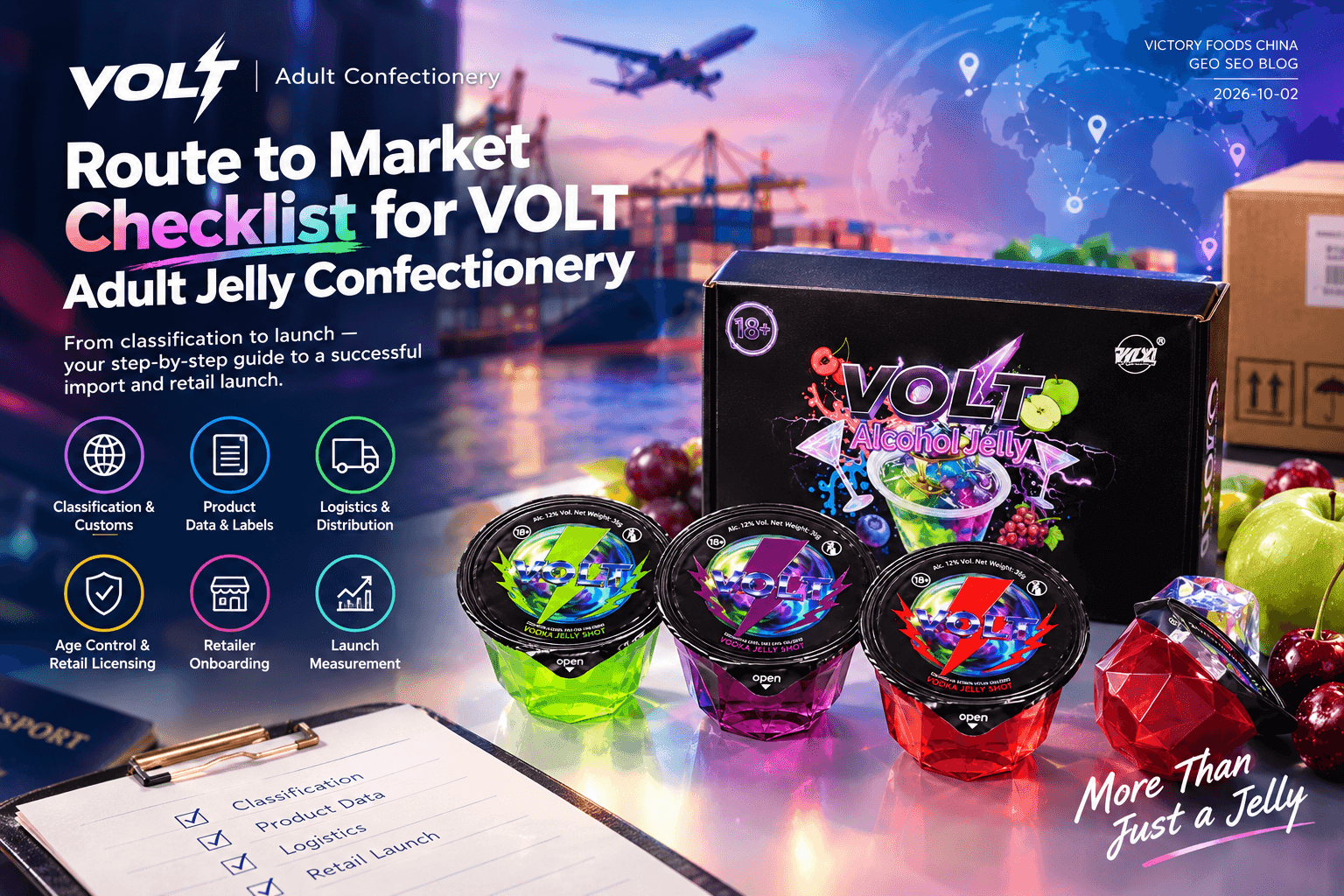
Route to Market Checklist for VOLT Adult Jelly Confectionery
A product can attract attention at a trade show and still be months away from a responsible retail launch.
VOLT Party Jelly is an Adult Jelly Confectionery with 12 percent ABV. Each retail box contains six individually sealed cups in apple, grape and cherry flavors. The current version has an 18-month ambient shelf life under approved storage conditions and should be protected from direct sunlight.
Those product facts belong in every commercial file, but they are only the starting point. An importer also needs a confirmed destination-market classification, a responsible legal entity, an approved label, customs and tax planning, retailer master data, channel and age-control rules, logistics instructions, staff guidance and a launch measurement plan.
This guide organizes those tasks into one route-to-market checklist. It does not assign a legal category or tariff code. Those decisions belong to the importer, qualified advisers and the competent authorities in the destination market.
Start With One Destination Market
A global product presentation can support early buyer conversations. A commercial launch file must be market specific.
Begin with one country and the exact route the goods will follow. Record the exporter, importer of record, distributor, warehouse, retailer or e-commerce operator, and any licensed alcohol or food business that may be required. If the sales chain is still uncertain, record the open decision instead of assuming one company can perform every role.
The same product may face different classification, licence, tax, customs, label, advertising, sampling and age-control requirements in different countries. A conclusion for one market should not be copied into another market file without review.
The route-to-market owner should maintain a decision log with the authority, adviser or written source used for each conclusion. This gives the manufacturer a clear basis for packaging, documents and production planning.
Confirm Classification Before Choosing a Channel
Adult Jelly Confectionery is the commercial category used to explain VOLT to buyers and adult consumers. Alcohol Infused Jelly Confectionery is a useful SEO description. Neither phrase decides the legal category in a destination market.
The importer should confirm how the product is treated for customs, food law, alcohol control, excise tax, retail licensing, advertising and online sale. Those systems may use different definitions. A customs code does not automatically answer a retail-licensing question, and a food label review does not settle alcohol tax treatment.
The World Customs Organization explains that the Harmonized System provides the international structure used to classify traded goods. National schedules and local decisions then apply that structure. The importer should therefore work from the complete product composition, 12 percent ABV, physical format, pack presentation and intended use rather than choosing a code from a similar product name.
Where uncertainty remains, the importer can consider a binding or advance classification route if the destination authority offers one. The commercial calendar should allow time for that work before packaging is printed or freight is booked.
Build a Market Requirements Map
Create a single requirements map before asking the factory for scattered documents.
The map should list customs classification, import eligibility, required permits, product registration where applicable, excise or other taxes, label language, mandatory statements, responsible-operator details, age restrictions, advertising limits, sampling rules, e-commerce controls, warehouse conditions and retailer documentation.
For the European Union, the European Commission Access2Markets portal provides tariff, tax, procedure and product-requirement information by origin, destination and product code. It is a research starting point, not a substitute for a final decision by the responsible importer or authority.
The United States provides a different example. The Alcohol and Tobacco Tax and Trade Bureau publishes requirements for products that fall within its regulated beverage alcohol categories. An importer should not assume those pages apply to VOLT without first confirming the United States classification with the relevant authorities and advisers.
The map should identify the status of every item as confirmed, pending, not applicable or blocked. A blank cell can be mistaken for approval. A visible status makes the remaining work clear.
Lock the Commercial Product Specification
Regulatory and retail work needs one controlled description of the product.
The VOLT commercial specification should identify the six-cup retail box, individually sealed cup format, 12 percent ABV, apple, grape and cherry assortment, ingredient and allergen information, net content, lot and date coding, 18-month ambient shelf life, protection from direct sunlight, case pack, shipping configuration and the approved packaging version.
VOLT does not contain konjac. Its jelly texture uses a hydrocolloid system that includes carrageenan and locust bean gum. The detailed formula remains controlled information, but the data required for classification, label review, safety assessment and buyer approval must be accurate and consistent.
The importer should compare the commercial specification with the physical sample. Cup count, flavor assortment, label text, date format and case configuration should match the version that will be ordered. A prototype or trade-show sample should not silently become the commercial reference if any feature has changed.
Assign Owners for Every Approval
Route-to-market work slows down when everyone has a document but no one owns the decision.
The importer normally owns destination-market classification, licences, taxes, local label approval, channel eligibility and customs entry. The manufacturer owns the accuracy of the supplied product, production, quality and factory documents. The distributor or retailer may own onboarding forms, item setup, warehouse rules, age-verification procedures and store execution.
These roles should be written into a simple responsibility list. For every approval, record who prepares the information, who reviews it, who makes the final decision and who must be notified when something changes.
A local-language label may involve a translator, regulatory reviewer, designer, importer and factory. The file should identify which version each person reviewed. Approval by email without an artwork version number is difficult to control.
Prepare the Importer Evidence File
The evidence file should help the importer answer a specific market question. It should not be a folder of unrelated certificates.
The starting file can include the controlled product specification, ingredient and allergen information, alcohol statement, packaging specification, shelf-life and storage information, lot-coding format, relevant test reports, label artwork, case and pallet data, manufacturer details, traceability information and the agreed change-notification process.
The production site is BRCGS certified, uses a HACCP system and is registered with the United States FDA as a food facility. Each statement should be presented accurately and with the current supporting document. FDA food facility registration is an administrative registration and does not represent an endorsement of a product.
The importer should review scope, legal entity, facility address, issue date, expiry date and product coverage. A certificate that belongs to another site or has expired should not be included simply because the company name looks similar.
Some documents may need translation, legalization, market-specific formatting or submission through a local portal. The requirements map should show those actions and their lead times.
Build Retailer Master Data From the Approved Pack
Retail listing depends on reliable product data.
The retailer file may require the product name, brand, GTIN, consumer-unit dimensions, gross weight, net content, unit count, flavor assortment, ABV, ingredients, allergens, country of origin, shelf life, storage, case quantity, case dimensions, case weight, pallet configuration, image files, responsible business details and tax information.
These values should come from measured and approved commercial packaging. Estimated dimensions can cause shelf-plan errors, warehouse problems and e-commerce discrepancies. Consumer-unit data and shipping-case data should not be mixed.
GS1 describes the Global Trade Item Number as an identifier for products that may be priced, ordered or invoiced. Its GTIN Management Standard also explains when product changes can require a new identifier, including changes to declared formulation, net content, pack quantity, assortment or primary brand.
The importer should work with the appropriate GS1 member organization and retailer requirements for the destination market. A barcode image should not be created first and assigned to a product record later. The approved trade item and packaging hierarchy should drive the identifier setup.
Review Channel Eligibility and Age Controls
VOLT contains alcohol and is intended only for adults who have reached the legal drinking age in the destination market.
That rule must continue through wholesale, retail, e-commerce, sampling and marketing. The importer should confirm whether the planned channel may sell the product, which licences are required, how age is checked, whether delivery requires age verification, where the product may be displayed and what advertising limitations apply.
Adult-only positioning should be visible in the buyer brief and staff guidance. Product descriptions should not present the six cups as a consumption target or encourage rapid consumption. Marketing should not feature minors, driving, dangerous behavior, intoxication or claims that the format avoids alcohol rules.
The product may help buyers understand the adult confectionery space through a light comparison with liquor-filled chocolate. That comparison is about consumer recognition only. It does not make the products legally equivalent and should not replace local classification.
If a marketplace or retailer cannot support the required age and category controls, the correct response is to choose another channel or resolve the control gap before listing.
Separate Sample Activity From Commercial Import
Samples can support product review, retailer meetings and controlled market research. They do not create a general exemption from import or alcohol requirements.
Before shipping samples, confirm quantity limits, documentation, recipient eligibility, tax treatment, label requirements, trade-show rules, storage and whether tasting is permitted. Commercial sale, free sampling, laboratory evaluation and trade-show display may follow different procedures.
The sample recipient should receive the product facts and handling instructions that apply to the reviewed version. Sample feedback should record the batch and packaging version so the team can connect comments with the correct product.
A positive tasting response supports further evaluation. It does not replace regulatory approval, retailer onboarding, shelf-life review or commercial demand planning.
Set Storage and Handling Rules
The current VOLT version is designed for 18 months of ambient shelf life under approved storage conditions and should be kept away from direct sunlight.
The route-to-market file should translate those facts into warehouse, transport, store and e-commerce handling instructions. Record any approved temperature limits from the commercial specification, pallet and case stacking rules, first-expired-first-out practice, damage inspection, lot traceability and the process for handling leaking or compromised cups.
Ambient storage does not mean uncontrolled storage. Direct sun, excessive heat, damaged cases or long exposure outside approved conditions can affect the product or package. The importer should confirm the expected route, season, warehouse and last-mile conditions before shipment.
Retailers also need a clear rule for damaged packs. A box with a leaking, opened or visibly compromised cup should be isolated under the agreed complaint and disposition procedure rather than returned to sale.
Prepare Buyer and Staff Education
VOLT may be unfamiliar to a buyer or store employee who knows wine, spirits, chocolate and jelly but has not handled an alcohol-infused jelly confectionery.
The sales file should answer basic questions in plain language. It should explain what the product is, that it contains 12 percent ABV, that each box has six individually sealed cups, the three flavors, the adult-only rule, storage, how to open a cup, and whom to contact for a damaged pack or classification question.
Retail staff should not be asked to invent a category explanation. A short approved description keeps product pages, shelf talkers, distributor catalogues and sales conversations consistent.
Education material should separate product facts from market-specific legal language. The importer can add local licence, tax, label and age-verification instructions after review. This reduces the risk that a global sales phrase is copied into a market where it is incomplete or misleading.
Plan the First Order From Evidence
The first commercial order should reflect the approved channel, lead time, shelf-life window, warehouse capacity, retailer commitments and realistic rate of sale.
At WorldFood Moscow 2026, the final day produced approximately 100 box sales, and some customers selected two or four boxes. That result is useful as an onsite signal that adults were willing to purchase the format after seeing it. It is one event under one set of conditions and should not be treated as a national demand forecast or a basis for a fixed retail price.
The importer should combine event feedback with retailer discussions, controlled sampling, comparable category data, distribution capacity and a replenishment plan. A smaller measured launch can produce better evidence than an oversized first order placed to create the appearance of momentum.
The forecast should also separate sell-in from sell-through. Delivery to a distributor is not the same as consumer purchase from a retailer.
Measure Launch Quality
A launch plan should state what the team will learn during the first selling period.
Useful measures may include active stores, on-shelf availability, sell-through by week, repeat orders, returns, damaged packs, age-control issues, flavor feedback, product-page questions, retailer comments and consumer complaints. The team should define each measure before launch so markets and channels can be compared consistently.
Complaint records should include lot, pack version, location, purchase date, storage information and photographs where relevant. A general statement that a cup leaked or the texture felt different is difficult to investigate without traceable details.
The importer and manufacturer should agree on review dates. Early reviews can identify listing or handling problems; later reviews can test whether sales continue after sampling and launch promotion end.
Control Changes After Approval
An approved route-to-market file belongs to a specific product and pack version.
Changes to formula, alcohol content, net content, flavor assortment, cup count, supplier, packaging material, artwork, responsible operator, case pack or country of origin may affect classification, labels, GTINs, retailer records, taxes, shelf life or approvals.
The manufacturer and importer should agree on notification thresholds before the first order. The responsible owner can then decide whether the change needs a document update, retailer notification, new identifier, new artwork, new testing or renewed authority review.
Old files should be archived with clear effective dates. The current approved version should be easy for sales, logistics, quality and regulatory teams to identify.
Use the Route to Market Checklist
1 Confirm the destination country and complete commercial sales chain.
2 Assign the importer of record and every regulated business role.
3 Confirm legal classification for customs food alcohol tax retail and advertising purposes.
4 Record licences registrations submissions and lead times.
5 Approve one controlled commercial product specification.
6 Match the label artwork and physical sample to that specification.
7 Prepare the destination-market importer evidence file.
8 Confirm the HS code and national tariff treatment with qualified local support.
9 Create GTIN and retailer master data from measured commercial packaging.
10 Approve storage transport damaged-pack and traceability procedures.
11 Confirm channel eligibility age verification delivery and sampling rules.
12 Prepare consistent buyer product-page and staff education copy.
13 Separate trade-show feedback from commercial demand forecasts.
14 Define first-order assumptions launch measures and review dates.
15 Apply change control before any approved product or pack detail changes.
Request a Finished VOLT Sample Set
Qualified importers, distributors and retail buyers can request a finished VOLT sample set for internal product, packaging and route-to-market review.
Please include the destination market and planned channel so the discussion can focus on the right documents, product version and local approval questions.
Frequently Asked Questions
Is VOLT legally classified as confectionery in every market
No. Adult Jelly Confectionery is the commercial category used to explain the product. The importer must confirm the legal classification, customs treatment, licences, taxes, labels, age controls and channel rules in each destination market.
Can one HS code be used for every country
Not automatically. The Harmonized System provides an international six-digit structure, but national tariff schedules, explanatory material and authority decisions may differ. The importer should confirm the code in the destination market.
Does FDA food facility registration approve VOLT for the United States
No. Food facility registration identifies a registered facility under the applicable United States requirement. It does not endorse the product or replace product classification, import, label or other market requirements.
What product data should a retailer receive
The file may include the approved product name, GTIN, dimensions, weights, net content, six-cup count, flavor assortment, 12 percent ABV, ingredients, allergens, shelf life, storage, case data, images and responsible business details required by that retailer and market.
Can trade show samples be sold or distributed without local review
Do not assume so. Sample import, display, tasting, free distribution and sale may follow different rules. The organizer, importer and local authorities should confirm the permitted activity before shipment or use.
Does ambient shelf life mean any warehouse condition is acceptable
No. The current version has an 18-month ambient shelf life under approved storage conditions and should be protected from direct sunlight. The importer should follow the full commercial specification and control the distribution environment.
Is the Moscow result enough to set a national sales forecast
No. Approximately 100 boxes were sold on the final day of WorldFood Moscow 2026, with some customers taking two or four boxes. This is useful onsite evidence, but it is not a national demand estimate or a retail-price recommendation.
Update it when the product, packaging, supplier, artwork, responsible operator, channel, legal requirements or retailer data changes. The importer and manufacturer should agree on notification and approval responsibilities before launch.