How to Plan a Responsible In Store Sampling Trial for VOLT Adult Jelly
An in store sampling trial can help legal age shoppers understand VOLT as an alcohol infused adult jelly confectionery, but it needs a market specific operating plan. This guide explains how retailers can confirm permission, choose an adult controlled location, train staff, keep the 12 percent ABV and six cup format clear, manage unopened and opened samples, record shopper questions and decide whether the trial supports a wider retail launch.
How to Plan a Responsible In Store Sampling Trial for VOLT Adult Jelly
An in store sample can explain VOLT faster than a shelf card alone, but the activity must be planned as an adult retail operation rather than a casual giveaway.
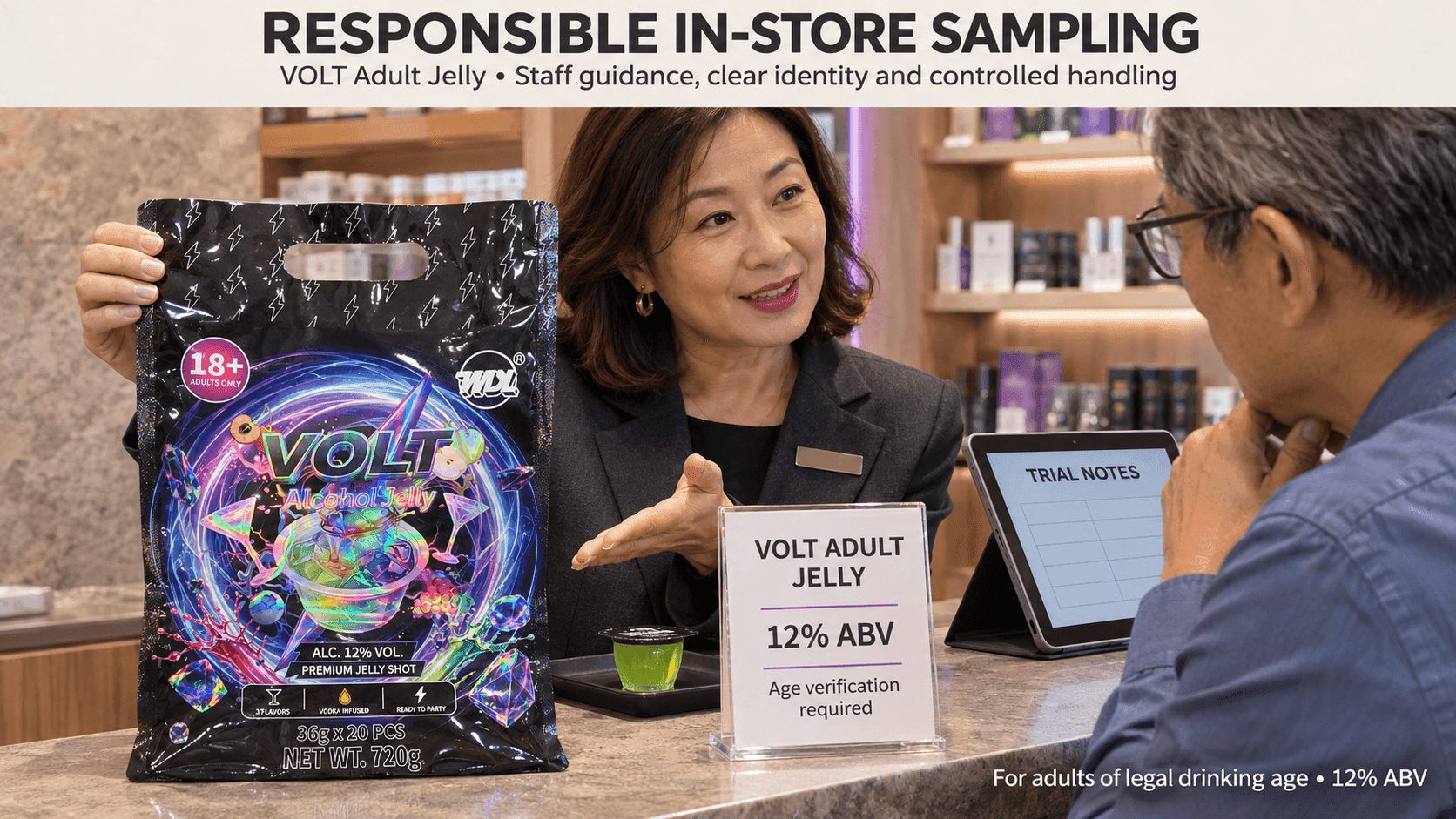
VOLT is an alcohol infused adult jelly confectionery. The current retail box contains six individually sealed cups at 12 percent alcohol by volume in apple, grape and cherry flavors. The product is eaten as a jelly, but its format does not remove the need for destination market review of classification, licensing, age control, labeling, promotion and sampling.
A responsible trial begins with permission and a written purpose. It keeps the product identity visible, limits participation to eligible adults, gives staff an approved procedure and records what shoppers actually understand. The result should answer a retail question, such as whether the product explanation works or whether the location supports controlled adult engagement. It should not be used to make a broad demand claim from a short event.
Separate Public Sampling From a Buyer Tasting
A buyer tasting and an in store sampling trial serve different audiences.
A structured VOLT buyer tasting helps importers, distributors and retail teams compare the pack, texture, flavors and commercial fit in a controlled business meeting. An in store trial introduces the finished product to eligible shoppers in a live retail environment. It adds operational questions that may not appear in a private meeting, including traffic flow, age checks, queue behavior, product custody, shopper questions, interruptions and cleanup.
Keep the records separate. Buyer feedback can support a decision to test one retail account, but it does not prove that public sampling is permitted or operationally ready. The in store plan must be approved for the actual location, date, staff and market.
Confirm the Legal Route Before Scheduling
The retailer or responsible market partner should confirm whether the proposed activity is allowed before announcing it.
The review may need to cover the product classification, the store or event authorization, who may supply an alcohol containing sample, age verification, permitted promotion, required notices, sample custody, food handling, waste and recordkeeping. The answer can differ by country, region, store format and licence.
Do not assume that a free sample sits outside alcohol controls. Do not assume that a confectionery format receives the same treatment as liquor filled chocolate or ordinary jelly. The adult confectionery comparison can help a shopper understand the occasion, but the competent authority and responsible market partner determine the legal route.
If approval is incomplete, change the activity. Staff can show the sealed six cup box, explain the format and collect questions without opening or serving the product. A non tasting product demonstration is more responsible than improvising a sampling procedure.
Write the Local Control Plan
Turn the market review into a short operating document that staff can follow at the counter.
The plan should identify the responsible manager, approved area, permitted participants, staff roles, product version, sample handling method, required information, refusal procedure, stop conditions, incident contact and record location. Replace general phrases such as follow the law with the store's approved action for that market.
Local examples should never be copied without checking jurisdiction. For example, current Home Office guidance for licensed premises in England and Wales describes an age verification policy for the sale or supply of alcohol and makes the responsible operator accountable for staff awareness and application. That source can help an England or Wales team locate the relevant control, but it does not decide how VOLT is classified or sampled in another market.
The final plan should be approved by the party responsible for the location and market. A manufacturer blog cannot replace that review.
Define One Retail Decision
Sampling produces better evidence when the team knows what decision it must support.
Possible questions include whether legal age shoppers understand adult jelly confectionery, whether the 12 percent ABV statement is noticed, whether the six cup box explains the format, which shopper questions repeat, whether the planned display location is manageable and whether staff can use the approved explanation consistently.
Choose one primary decision and a small set of supporting observations. A trial designed to test product explanation should not become an unstructured flavor popularity contest. A trial designed to test an operating procedure should not claim national consumer demand.
Write the decision before the event. Examples include proceed to a defined second store, revise the staff script, change the display location, request a packaging clarification, complete a compliance action or stop the concept for the current channel.
Choose an Adult Controlled Location
The location should make adult supervision easier and product confusion less likely.
The retail placement guide for VOLT recommends an adult controlled retail context where the destination market allows the product. For a sampling trial, the team should also consider sight lines, staff control, access to the approved product information, separation from children's products, queue space and the ability to stop service immediately.
Avoid a position that makes the cups look like ordinary children's jelly or unattended candy. Do not place open samples where people can take them without speaking to trained staff. A high traffic area is not useful if the store cannot apply its approved age and service procedure.
The display should not block exits, payment areas or normal store operations. The retailer should decide how the activity interacts with the store's existing alcohol, food safety and incident procedures.
Assign Roles Before the First Sample
Each task should have an owner.
The plan may distinguish the person who verifies eligibility, the person who explains the product, the person who controls unopened stock and opened materials, the person who records observations and the manager who can stop the activity. One employee may perform more than one task if local rules and store policy permit it, but the responsibility should still be explicit.
Staff need to know who answers product questions and who handles legal, licensing, medical or driving questions. They should never guess. A visible escalation route is especially important during a busy period, when a reassuring but unsupported answer can quickly become part of the shopper's understanding.
Hold a short rehearsal with the real pack and approved materials. Staff should be able to identify the current box, state the confirmed facts, follow the age control procedure, handle a refusal calmly and close the station safely.
Lock the Product and Sample Identity
The trial record must identify the exact product used.
Record the product version, flavors, batch or lot, date received, package condition, storage history and approved use status. The VOLT six cup box contains individually sealed units, so the team should also confirm that the box and cups belong to the same approved sample set.
Do not mix old artwork, development samples and commercial representative samples without clear separation. A shopper reaction to an outdated pack should not be attached to the current design. If the product, label, cup, seal or assortment changes, determine whether the earlier trial still answers the same question.
The confirmed storage statement for the current version is ambient storage for 18 months while avoiding direct sunlight. Follow the approved label and specification for the exact batch. Do not leave the product in an uncontrolled display simply because the general storage statement is ambient.
Keep Product Identity Visible
The display should explain the product before a shopper agrees to taste it.
Show the real retail box and keep the six individually sealed cups, apple, grape and cherry flavors, adult only context and 12 percent ABV clear. Do not hide the alcohol statement behind decorations, a sample tray or a generic candy sign.
Codex CXS 1 1985 states that prepackaged food should not be described or presented in a false, misleading or deceptive way and that the food name should indicate its true nature. National alcohol and food rules remain controlling, but this principle supports a display that does not disguise VOLT as ordinary children's jelly.
Use the approved product name and local language. If a liquor filled chocolate reference is used, keep it secondary and factual. The comparison may help explain an alcohol containing confectionery occasion; it does not make the products legally equivalent.
Train Staff With One Approved Explanation
The retail staff guide provides a concise starting point for explaining VOLT.
Staff should state that VOLT is an adult jelly confectionery containing alcohol, that the current box contains six individually sealed cups, that the product is 12 percent ABV and that the current flavors are apple, grape and cherry. They should explain that it is eaten as a jelly rather than poured as a drink.
The local team can adapt the wording to the required language and approved classification. The core product facts should remain consistent across the package, display, staff script and any digital promotion.
Test the explanation during rehearsal. If staff omit the alcohol, call the product ordinary candy or imply that jelly avoids alcohol rules, the script is not ready. If the approved explanation takes too long to use in normal store traffic, simplify the wording without deleting the adult and alcohol identity.
Apply the Approved Eligibility Check
Sampling should be offered only to people who meet the destination market and retailer requirements.
The store should use its approved age verification and refusal procedure. Staff should not invent a separate informal check for VOLT, and the blog should not prescribe one universal document, age threshold or visual estimation rule.
The process should protect privacy and avoid public arguments. Staff need a clear response when a shopper does not provide acceptable evidence, when an adult tries to pass a sample to another person or when the environment becomes unsuitable.
Children and people below the applicable legal drinking age should not participate. The station should not use youth oriented characters, school imagery, toys or language that makes the product look like an all ages treat.
Make Participation Voluntary
A shopper should be able to learn about VOLT without consuming it.
Offer a non tasting path. The shopper can inspect the sealed pack, read the product information, ask questions and give feedback on the explanation or display. Staff should not pressure a person to taste all three flavors, finish a portion or explain why they decline alcohol.
The six cup count describes the retail pack. It is not a sampling target and not a recommended amount for one person. Avoid scoreboards, countdowns, dares, competitions and any message that connects faster consumption with fun or status.
Provide ordinary food, water and alcohol free options if required by the approved plan and local operating rules. These items should support responsible service, not be used to extend or intensify consumption.
Control Unopened and Opened Samples
The operating plan should show how product moves from controlled stock to the participant and then to waste or approved disposition.
Keep unopened cups in the approved package or controlled sample stock until staff use them. Inspect the cup and seal before service. Do not use a damaged, leaking, unidentifiable or incorrectly stored unit.
Define how opened product, utensils, surfaces and waste are handled under the store's food safety procedure. Do not return an opened unit to stock. Do not leave partially used samples on the display or allow participants to carry open product into an area where the store cannot maintain the approved controls.
The team should record any recurring opening, seal, spill or handling issue against the exact sample version. These observations may require packaging or quality review rather than a change to the marketing message.
Protect the Activity From Rapid Consumption Cues
The purpose of the trial is product understanding and retail learning.
Do not use shot language as a command, a countdown, a group challenge or a promise of intoxication. Do not encourage participants to combine VOLT with other alcohol products. Do not suggest that jelly changes the effect of alcohol or makes driving acceptable.
Staff should stop the activity according to the approved plan if a participant behaves unsafely, tries to obtain repeated samples outside the procedure, transfers a sample to an ineligible person or disrupts the controlled area. The stop rule should be written before the event so employees do not have to negotiate it in the moment.
Lifestyle photography or social posts from the trial require separate approval. Any image should show legal age adults, the real packaging and a responsible setting without intoxication, risky behavior or youth appeal.
Record Actions and Questions
The observer should record what happened before writing an interpretation.
Useful observations include whether shoppers notice the adult category, whether they see the 12 percent ABV, which words they use to describe the format, which questions repeat, whether the six cup box is understood, whether staff follow the script, whether the location causes confusion and whether the operating procedure can be followed during normal traffic.
Do not collect unnecessary personal information. The record can use anonymous counts or participant codes where appropriate to the approved research and privacy plan. Photographs, video or contact details require permission and the correct data controls.
Separate product feedback from operational feedback. A shopper may like cherry but misunderstand the alcohol identity. Another may understand the product but find the location inappropriate. Those findings lead to different actions.
Classify Findings Before Deciding
Group the evidence into product, communication, operations, channel and compliance topics.
A product finding may concern flavor, texture, cup opening or pack condition. A communication finding may concern the product name, alcohol statement or staff explanation. An operational finding may concern queue control, stock custody or cleanup. A channel finding may concern the location or shopper expectation. A compliance finding should be referred to the responsible market specialist rather than resolved by the sampling team.
Record the evidence, owner and next action for each material issue. Do not hide an unresolved control problem inside an average satisfaction score. Do not treat one enthusiastic comment as proof of market demand.
The decision should match the evidence. The team may proceed to a limited second trial, revise the script, move the location, review the pack, request legal guidance, retrain staff or stop the activity for the current channel.
Close the Trial With a Controlled Record
At the end of the activity, reconcile the sample stock according to the approved procedure and secure or dispose of remaining materials correctly.
The final record should identify the store, date, approved plan version, product and lot, responsible staff, material deviations, shopper questions, operational observations, incidents, unresolved issues and decision. If the event did not follow the approved plan, state the deviation instead of presenting the result as fully comparable.
Store the record with the product and market project. A later trial should reference the earlier version and explain what changed. This makes the next decision more useful than a collection of disconnected event notes.
Qualified importers, distributors and retail buyers can request a finished VOLT sample set to review the pack and discuss a market specific retail trial.
Frequently Asked Questions
Is an in store VOLT trial the same as a buyer tasting
No. A buyer tasting is a controlled commercial evaluation. An in store trial introduces the finished product to eligible shoppers and requires a location specific operating plan for staff, access, custody, records and local controls.
Can a store run a trial before product classification is confirmed
The responsible market partner should confirm the legal route first. If sampling permission is unresolved, the store can consider a sealed product demonstration without consumption, subject to local rules and retailer approval.
Does the six cup box mean six samples should be served
No. Six cups describe the retail pack. The sampling plan must not turn pack count into a serving target or consumption recommendation.
Should shoppers taste all three flavors
Not automatically. Participation should be voluntary and follow the approved market specific plan. A shopper can review the pack and explanation without consuming any product.
Can staff say VOLT is the same as liquor filled chocolate
No. Liquor filled chocolate can be a limited mental reference for adult confectionery containing alcohol. VOLT has its own jelly format, 12 percent ABV specification and destination market review.
What should staff do when a shopper asks about licences or driving
Use the retailer's approved response or refer the question to the designated manager. Staff should not guess, claim a licence exemption or suggest that consuming alcohol is compatible with driving.
What evidence should the trial produce
The record should show what shoppers understood, which questions repeated, whether staff followed the procedure, whether the location worked and which product, communication, operational or compliance actions remain open.