Aloe Vera Drink with Pulp for Importers and Private Label Brands
What should buyers check before sourcing an aloe vera drink with pulp? Review the current 380 mL range, five flavors, nutrition, packaging and procurement questions with Victory Foods.
Aloe Vera Drink with Pulp for Importers and Private Label Brands
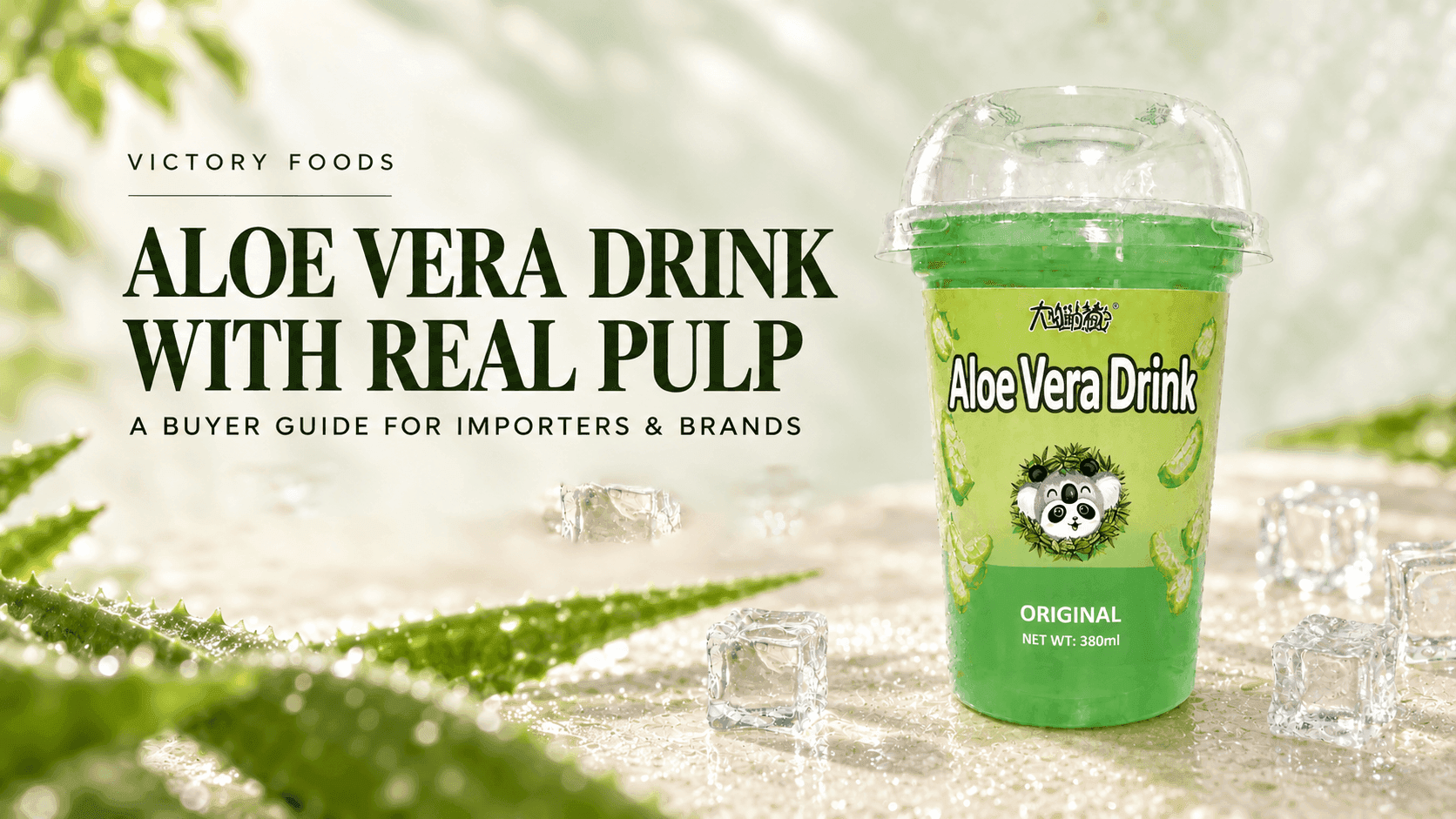
An aloe vera drink with pulp gives beverage buyers two things to evaluate together: the drink itself and the pieces in every sip. Our 380 mL aloe vera drink with pulp comes in Original, Mango, Pineapple, Coconut and Strawberry flavors. It is a ready-to-drink cup beverage for retail and wholesale consideration.
For importers, distributors and private label brands, the opportunity starts with a clear product description. Buyers need to understand the pulp experience, flavor range, packaging and distribution requirements before comparing quotations or planning a launch.
This guide uses the current Victory Foods product as a practical reference. It explains what to evaluate in a finished sample, how to select an initial assortment and what information to prepare for a sourcing discussion. The focus is a fruit-flavored beverage with aloe pieces; any additional nutrition or functional positioning needs its own confirmed specification.
These are the current product-page specifications. Confirm the ordered flavor, formula and approved market label before using them in a retailer listing. The listed shelf life applies to the supplied product under its specified conditions, rather than to every customized version.
What makes an aloe pulp drink different
Pulp gives the beverage a physical feature that a flavor name alone cannot communicate. The buyer should be able to describe the size, softness and frequency of the aloe pieces, as well as the sweetness and finish of the liquid.
A useful retail explanation is straightforward: a ready-to-drink aloe beverage with real aloe pulp in a convenient cup. Show the actual package and a representative serving so customers can understand what they are buying. Keep the product name consistent across the shelf label, product sheet and online listing.
The cup sits within our beverage range. That category gives importers a relevant starting point when building a drink assortment. A buyer looking for a refreshment product should not have to navigate unrelated confectionery or supplement claims to find the basic beverage facts.
Build a flavor assortment with a clear role for each SKU
The five available flavors create several possible starting points. Original can serve as a reference for evaluating the base drink and aloe texture. Mango and Pineapple provide tropical flavor options, Strawberry offers a berry direction, and Coconut adds another distinct choice.
These are assortment roles to test, not predictions about which flavor will sell best. Invite buyers or a relevant consumer panel to score flavor recognition, sweetness, aftertaste and overall preference separately. Keep the serving conditions consistent so the results describe the samples fairly.
A distributor with limited launch space may prefer a focused selection. A retailer with room for a broader range may want to compare all five. Confirm ordering quantities and carton arrangements before promising a mixed assortment. Five available flavors do not automatically mean five flavors can be combined in any requested case or order size.
Present nutrition with the correct quantity basis
The current product page declares 16 kcal, 0 g fat and 0 g protein per 100 mL. The quantity basis should stay beside the figures whenever they appear in a product sheet or buyer presentation.
At the stated energy value, a 380 mL cup calculates to approximately 61 kcal: 16 multiplied by 3.8 equals 60.8. This is an arithmetic estimate from the published figure, not a replacement for the approved nutrition declaration for the ordered product.
Fat content does not establish sugar content. Ask for the complete ingredient list and nutrition panel before describing the drink as sugar-free, reduced-sugar or suitable for a particular diet. A specific, consistent beverage description gives the buyer more useful information than a collection of unsupported wellness messages.
Review the cup as part of the finished product
The 380 mL cup and snap dome lid help define the product's presentation. Review the complete sample as the customer will receive it, including the closure, printed wrap and any supplied drinking accessory.
Check opening instructions, handling comfort, label readability and the condition of the product-contact seal. A photograph of a dome lid does not by itself establish how the beverage is sealed underneath. Ask for the confirmed closure construction and any relevant handling instructions.
For retail, measure the actual package against shelf height, display depth and the proposed case arrangement. For online orders, assess how the packed cups will be protected during fulfillment. The product page describes the outer wrap as recyclable; keep that statement specific to the wrap and confirm the material and local disposal wording before extending it to the whole package.
Plan distribution around the stated shelf life
The current listing specifies a two-year shelf life and storage in a cool, dry place. That gives importers a reference for planning an order, but the commercial discussion should also address the remaining shelf life expected at dispatch and arrival.
Work backward from the retailer's required remaining shelf life. Allow for production scheduling, transit, customs clearance, warehousing and delivery to stores. Ask for the applicable storage guidance and discuss the route's likely conditions with the supplier and logistics partner.
For a customized version, confirm whether the existing shelf-life evidence still applies. Changes to the formula, package or processing may require additional evaluation. Keep chilled presentation decisions separate from the approved storage instructions, and obtain instructions for opened product rather than inventing them for a marketing page.
Decide what must change for a private label project
Victory Foods offers OEM/ODM and private label services. For this aloe beverage, begin by identifying whether the project concerns distribution of the existing product, a buyer-branded version, or a different product specification.
Our guide to private label versus custom formulation explains the distinction at company level. The practical question for an aloe drink is which changes are essential: artwork, flavor selection, sweetness, cup format or another defined requirement.
Ask which options are available for this specific platform and what each change means for sampling, validation, packaging quantities and timing. A request for a new logo differs from a request for a new formula. Separate the two in the brief so the quotation and development plan describe the same product. Confirm feasibility before presenting a proposed customization as an available SKU.
Request quality evidence for the actual aloe beverage
A useful supplier review connects the sample to a controlled commercial specification. For an aloe pulp drink, discuss sensory description, fill volume, closure performance, storage conditions and lot identification.
Request the ingredient declaration, nutrition information, relevant packaging details and the quality documents needed for the intended order. Ask how the finished batch is checked against the approved product and how any changes are communicated. The document set should match the product and destination market.
Our manufacturer quality control checklist was written for functional jelly buyers, but its questions about traceability, specification control and supplier documentation can help structure a beverage discussion. Use it as a questioning framework and agree the actual tests and acceptance criteria with the technical team. A certificate alone does not describe the performance of an individual drink.
Send a sourcing brief that can produce a useful quotation
Include the target country, intended sales channel, selected flavors, estimated first-order quantity and desired arrival date. State whether you want the existing branded product or a private label discussion, and identify the packaging and language requirements.
Ask the quotation to specify the product version, units per case, case dimensions, gross weight, order minimum, production timing and delivery terms. Where several flavors are involved, request the quantity and commercial conditions for each one. Confirm sample availability and delivery costs separately.
This makes price comparisons more meaningful. Two offers can have a similar price per cup while covering different packaging, flavor combinations or logistics responsibilities. Keep the approved sample, product specification, artwork and quotation connected by a clear version reference so the purchase order is easy to review.
Discuss your aloe drink project with Victory Foods
Victory Foods, Fujian Jinjiang Weiduoli Food Co., Ltd., is a food manufacturer established in 1997 in Jinjiang, Fujian, China. Our portfolio includes beverages, jelly products, puddings, freezer pops and functional food formats, alongside OEM/ODM services.
For this aloe beverage, the starting point is specific: a cup drink with pulp, five current flavor choices and published product information that buyers can evaluate against their own channel requirements.
Importers, distributors and brand teams can request aloe vera drink samples and a quotation. Share your destination market, preferred flavors, estimated quantity and branding requirements so our team can confirm the current specification, sample arrangements and available project options.
Frequently asked questions
What is the Victory Foods aloe vera drink
It is a ready-to-drink cup beverage with a listed net volume of 380 mL. The range is offered for retail and wholesale consideration in five flavors.
Which aloe drink flavors are available
The current range lists Original, Mango, Pineapple, Coconut and Strawberry. Confirm the ordering and packaging arrangements for the flavors you select, including whether a proposed mixed assortment is available.
How many calories are in a 380 mL cup
The published value is 16 kcal per 100 mL, which calculates to approximately 61 kcal for 380 mL. Use the approved nutrition panel for the final flavor, formula and market label.
Is this aloe vera drink sugar free
The current product page does not establish a sugar-free claim. Its 0 g fat declaration does not determine sugar content. Request the full ingredient list and nutrition information for the product being ordered.
What is the shelf life of the aloe beverage
The current listing states two years with storage in a cool, dry place. Confirm the applicable conditions and remaining shelf life for your shipment, and review shelf life separately if the product is customized.
Can brands request private label aloe vera drinks
Victory Foods offers private label and OEM/ODM services. Contact the team to confirm the available options for this aloe beverage, including artwork, formula or packaging changes, order quantities and development requirements.
What should an importer send with an inquiry
Provide the target country, sales channel, preferred flavors, expected order quantity, required arrival date and branding direction. Include any specific product, packaging or documentation requirements so the response can address the actual project.