
How to Turn VOLT Buyer Tasting Feedback Into a Market Action Plan
Buyer comments only become useful when they are tied to the exact sample, separated by issue type and converted into a documented decision. This guide shows how to organize VOLT tasting feedback, distinguish product facts from market questions, assign owners and define the next market action without overstating a small buyer session.
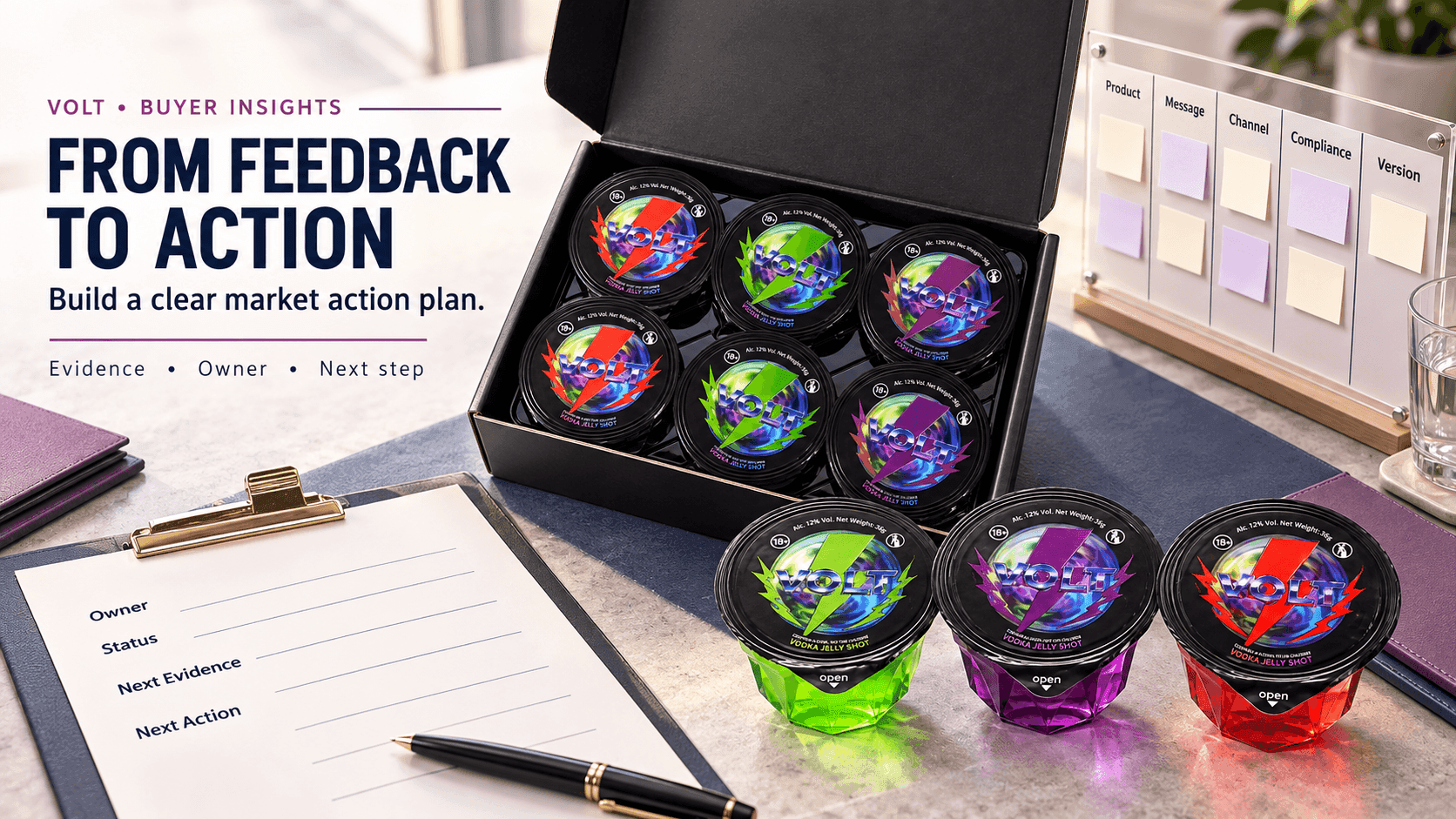
How to Turn VOLT Buyer Tasting Feedback Into a Market Action Plan
A buyer tasting can generate pages of comments and still produce no useful decision. People may like one flavor, question the category name, suggest a different channel or ask whether the product can be imported. Those observations do not all belong in the same task list.
The work begins after the tasting ends. The team must connect every comment to the exact sample, separate observation from interpretation and decide which function owns the next step. A product issue may require a controlled sample review. A wording issue may require revised buyer copy. A licensing question belongs with a qualified adviser in the destination market, not with the flavor-development team.
For VOLT, this distinction is especially important. The confirmed product facts are a six-cup retail box, individually sealed cups, apple, grape and cherry flavors, 12 percent alcohol by volume, ambient storage for up to 18 months and protection from direct sunlight. The phrase adult confectionery can help explain the market position, but it does not determine legal classification.
This guide shows brands, importers and distributors how to turn tasting notes into a controlled market action plan without treating a small session as proof of demand.
Lock the Feedback to the Exact Session
Before interpreting a comment, identify the session that produced it. Record the date, destination market under discussion, buyer organization, participant roles, sample version, flavor, packaging version and product documents available at the meeting.
This matters because feedback can change when any of those conditions change. A buyer who sees only loose cups may respond differently after seeing the complete six-cup box. A participant who does not receive a clear alcohol statement may misunderstand the category. A sample from one version should not be used to approve another.
Keep factual session notes separate from later conclusions. If the grape cup used a particular sample code, preserve that code in the action record. Do not replace it with a general phrase such as latest sample unless the version is verified.
Separate Observation From Interpretation
An observation records what happened. An interpretation proposes what it might mean.
For example, buyer said the product needs a clearer one-sentence explanation is an observation. Consumers will not understand alcohol jelly is an interpretation. The first can be entered as evidence from a named session. The second requires more testing before it becomes a market conclusion.
Useful records can follow a simple sequence:
- What the participant said or did
- Which product, flavor, message or channel the comment concerned
- What evidence is attached
- What the team thinks the comment may indicate
- What evidence is still missing
This discipline prevents a confident internal opinion from being presented as a buyer fact.
Sort Feedback Into Five Workstreams
Every comment should have one primary workstream. Cross-references are useful, but a comment with five owners usually has no owner.
Product Experience
Place comments about appearance, opening, aroma, texture, sweetness, acidity, flavor identity and finish here. Record the exact flavor and sample code. A comment such as cherry finish feels stronger than expected is more useful than product is too strong because it identifies the experience that needs confirmation.
Do not revise the formula after one unverified remark. First check whether the comment repeats across qualified participants, whether the tested sample was correct and whether the requested change would affect the other product attributes.
Product Explanation
Use this workstream for questions about what VOLT is, how the six-cup box works, why it belongs in an adult confectionery occasion and which facts must appear in buyer materials.
The response may be a clearer product definition, a revised FAQ or a better sequence in the sales deck. It should never hide the alcohol content. A useful explanation makes the format familiar while stating 12 percent ABV and the adult-only audience clearly.
Channel Fit
Place comments about retail setting, gifting, specialty distribution, hospitality, display, price architecture or promotional use here. The action is not automatically change the product. The team may need to test a different channel, interview a different buyer role or build a channel-specific commercial case.
Distinguish a buyer preference from a channel constraint. I would present this as a premium gift is a viewpoint. Our chain requires a specific case configuration is an operational requirement that can be verified.
Compliance and Import
Questions about legal classification, alcohol licensing, age control, tax, label content, advertising, sampling and import documentation belong in a separate review track for the destination market.
Do not answer them by analogy with liquor-filled chocolate or ordinary candy. Adult confectionery is a positioning concept, not a substitute for local legal analysis. Record the question, jurisdiction, responsible reviewer and source that will be used. Until the review is complete, the status should remain open rather than guessed.
Sample and Version Control
Use this workstream when the issue may come from the sample rather than the commercial concept. Examples include an unconfirmed formula version, an outdated mock-up, a damaged cup, missing flavor identification or incomplete storage history.
The next action may be to verify the sample, repeat the review with controlled units or withdraw a comment from the decision set. Version uncertainty should be resolved before the team debates a formula change.
Protect the Confirmed VOLT Facts
Market feedback can improve how a product is explained, but it should not rewrite facts for convenience. Maintain one approved fact block for all follow-up materials.
The current confirmed block includes:
- Six individually sealed cups in the retail box
- Apple, grape and cherry flavors
- 12 percent ABV
- Ambient storage for up to 18 months
- Avoid direct sunlight
- Intended for adults of legal drinking age
The final specification and approved market label should control the exact order. If a buyer asks for a different pack, alcohol level, flavor or claim, record it as a new development request rather than silently editing the existing product description.
Separate Fixable Issues From Market Conditions
Some feedback points to a change the project team can make. Other feedback describes the market in which the product must operate.
A confusing slide can be rewritten. An untraceable sample can be replaced. A texture target can be investigated through controlled development. By contrast, a destination-market licensing rule, retailer category policy or importer margin requirement is a market condition. It may change the route to market even when the product remains unchanged.
Use three questions to separate them:
- Is the issue inside the approved product or communication scope
- Can the team verify the issue directly
- Would the proposed change solve the cause or only make the presentation look different
This prevents unnecessary reformulation when the real gap is channel information or regulatory evidence.
Weigh Comments by Role and Evidence
Not every comment carries the same commercial meaning. A quality manager, category buyer, distributor, store operator and consumer-facing salesperson observe different parts of the opportunity.
Record the participant role without treating seniority as proof. A category buyer may provide strong evidence about assortment decisions but may not be the right person to resolve legal classification. A store operator may identify display friction that a head-office team never sees. A technical reviewer may find a sample-control issue that invalidates part of the tasting feedback.
Evidence strength also varies. A written retailer requirement is different from a personal preference. A repeated opening problem across verified samples is different from one damaged cup. A direct question from several buyers is a useful signal, but it still does not prove national consumer demand.
Identify Repeated Signals Without Overstating Them
Repeated comments deserve attention when the sessions are comparable. Tag similar observations using consistent language, then check whether they came from the same market, buyer type, product version and presentation.
Avoid turning three similar remarks into a percentage unless the study was designed to support that calculation. Use careful language such as repeated question in three buyer sessions or recurring request among specialty retail contacts. This is more credible than calling the result a market trend.
Also retain conflicting feedback. One buyer may prefer apple as the lead flavor while another prefers cherry. The action may be to test assortment emphasis by channel, not to declare one universal winner.
Convert Each Issue Into a Decision Record
An action plan should show how a comment moves toward a decision. Each record can include:
- Issue statement
- Workstream
- Exact evidence and source session
- Affected sample or content version
- Current interpretation
- Missing evidence
- Decision owner
- Status
- Next action
- Review date
Keep the issue statement neutral. Replace buyers dislike the category with two buyers asked for a clearer category explanation. The second version preserves the evidence and leaves room to test a solution.
Use Clear Decision Status Terms
A short status vocabulary helps teams understand what is happening. One practical set is proceed, test, revise, hold and stop.
Proceed means the available evidence supports the next planned step. Test means a defined question remains and a method has been assigned. Revise means an approved change is being prepared. Hold means the project is waiting for evidence, authority or a dependency. Stop means the team has documented why the proposed route should not continue.
These terms are workflow labels, not quality or regulatory approvals. Define them internally and state who has authority to change each status.
Assign One Owner and One Next Action
Every open item needs one accountable owner even when several functions contribute. The owner is responsible for moving the issue to a decision, not for doing every task personally.
Write the next action as an observable deliverable. Review wording is vague. Draft a one-sentence product definition using the approved fact block is clear. Check compliance is vague. Obtain a written destination-market classification opinion for the identified product and pack version is clearer.
Do not invent aggressive deadlines during the tasting debrief. Set dates based on the actual development, documentation and external-review path.
Build a Missing Evidence List
The most valuable output may be a list of what the team does not yet know. Missing evidence can include a current specification, verified sample code, packaging drawing, importer requirement, local classification opinion, landed-cost input, retailer shelf dimensions or controlled feedback from another buyer type.
Rank missing evidence by decision impact. If the legal route to market is unresolved, further work on promotional captions may be premature. If the only open issue is which flavor image leads the sales sheet, a small communication test may be enough.
Decide What Actually Needs to Change
Once the evidence is organized, choose the smallest justified change.
A product change affects formulation, flavor, texture, alcohol level, cup or pack configuration and therefore requires formal feasibility, sample and approval control. A message change affects product definitions, sales materials, FAQs or training. A channel change alters the buyer target, placement or commercial model. A compliance action obtains market-specific guidance without pretending that marketing language can settle the question.
More than one action may be needed, but they should remain separate so the team can see which change produced which result.
Prepare a Focused Buyer Follow Up
The buyer does not need the entire internal tracker. Send a concise follow-up that confirms what was heard, states which questions are being checked and explains the next agreed step.
Use only verified product facts. If the buyer asked about classification or licensing, say that the question is under destination-market review. Do not offer an instant answer merely to keep the conversation moving.
A useful follow-up can include the approved product sheet, the exact sample identification, answers already verified, open items with expected response timing and one proposed next meeting or sample review.
Control Revised Samples and Messages
If the team changes a formula, package or key message, assign a new version. Link the revision to the issue that prompted it and state what did not change.
Do not compare a revised sample with old feedback unless the relationship is clear. Do not send a new mock-up while referring to an earlier pack description. Version control protects both the buyer conversation and the internal approval trail.
Set the Next Test
The next test should answer the highest-impact unresolved question. It might compare two product explanations, verify an opening concern across controlled samples, review channel fit with a different buyer role or confirm a compliance requirement with a qualified local adviser.
Define the question before choosing participants or materials. A follow-up session should not become another collection of unrelated opinions.
Close the Feedback Loop
At the next review, update the original record rather than creating a disconnected task. Mark the evidence received, decision made, approver, affected version and any follow-on question. Share the approved outcome with sales, product, quality and compliance teams that use the information.
A disciplined feedback loop does not make the market predictable. It makes each decision traceable. That is what allows buyer interest to become a controlled market-development process instead of a folder of comments.
Frequently Asked Questions
Can one buyer tasting prove market demand
No. It can identify questions, objections and promising signals from a defined group. Broader demand requires additional evidence from the intended market and channel.
Should every buyer comment trigger a product change
No. First verify the sample, context and repetition. Some comments are better addressed through clearer messaging, channel research or compliance review.
How should conflicting buyer feedback be handled
Keep both comments, identify the participant roles and contexts, and design the next test around the decision that matters. Do not average unlike opinions into a false consensus.
Can adult confectionery language resolve legal classification
No. It is a commercial positioning concept. Classification, licensing, taxation, labeling, advertising and age-control requirements depend on the destination market and the competent authorities.
When is a revised sample required
A revised sample is appropriate when the approved development process calls for a product or packaging change. A wording question alone may need revised communication rather than a new formula.
What should be sent back to the buyer
Send a concise summary of confirmed points, verified answers, open questions and the agreed next step, supported by the correct product and sample documents.
Qualified importers, distributors and adult retail buyers may request a finished VOLT sample set and share their intended market and channel for a focused project discussion.