
How to Run a Responsible VOLT Buyer Tasting for Apple Grape and Cherry
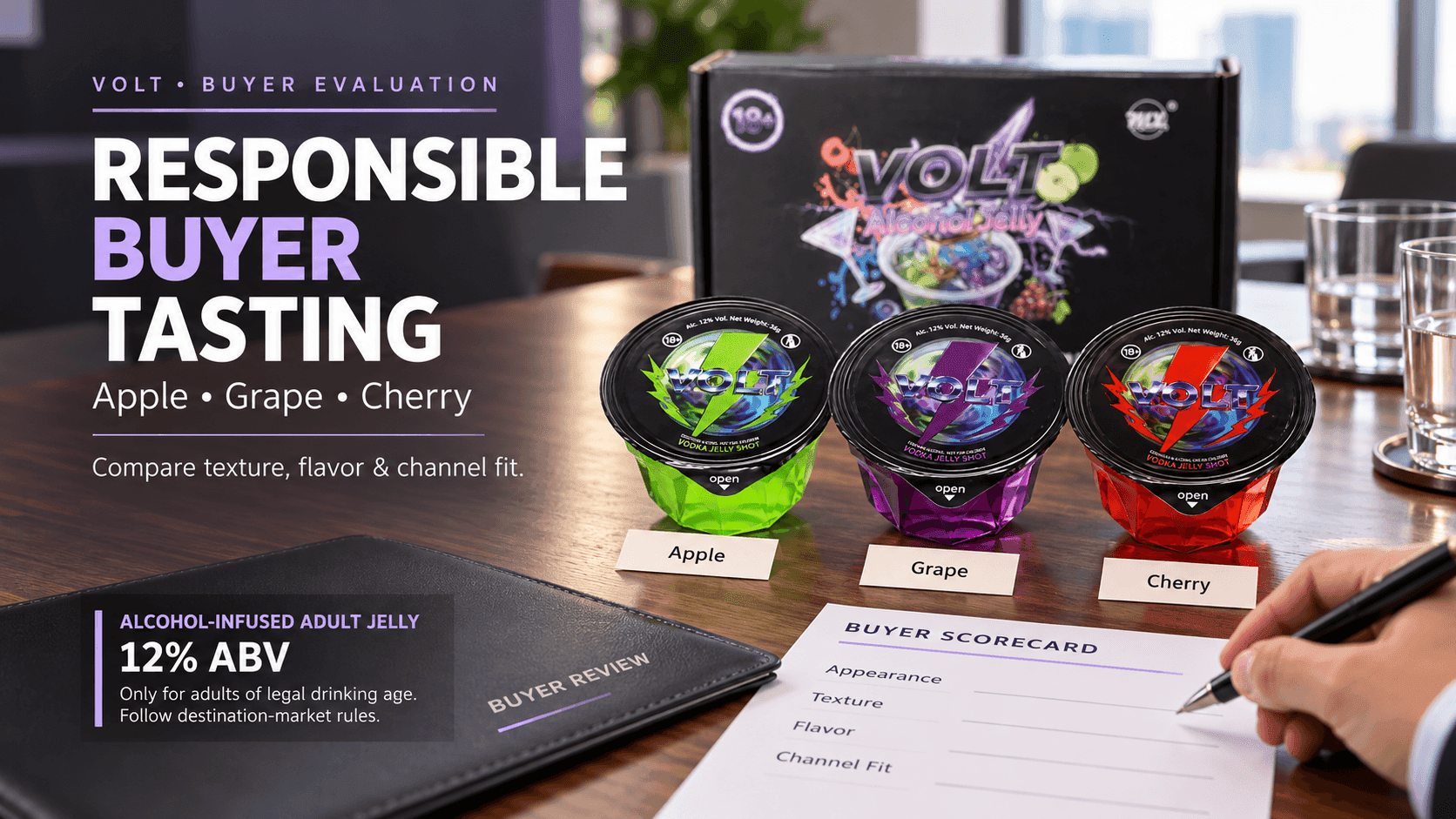
A buyer tasting should do more than collect quick flavor reactions. This guide shows importers, distributors and retail teams how to present VOLT accurately, compare apple, grape and cherry, record text
How to Run a Responsible VOLT Buyer Tasting for Apple Grape and Cherry
An unfamiliar product is difficult to judge from a specification sheet alone. Buyers need to see the pack, open the individual cup, experience the jelly texture and compare the flavors in a setting that reflects the intended adult channel.
VOLT is an alcohol-infused adult jelly confectionery. The current retail box contains six individually sealed cups in apple, grape and cherry flavors at 12 percent alcohol by volume. It is eaten as a jelly rather than poured as a drink and is intended only for adults who have reached the legal drinking age in the destination market.
A buyer tasting can clarify the product quickly, but only when it is planned as a structured commercial evaluation. The session should protect the adult and alcohol identity, avoid pressure to consume and produce feedback that can support a real decision about channel, messaging, pack and market fit.
Define the Buyer Decision
Write the decision before sending invitations or opening samples.
The team may need to decide whether the product fits a specialty retail assortment, whether all three flavors should remain in the launch mix, which product explanation is easiest for buyers to understand or what information is still needed before an import review.
Keep the tasting question separate from legal classification. Positive flavor feedback does not determine whether the product may be imported, sold or sampled in a market. Adult confectionery is a positioning frame; it is not a substitute for local decisions about alcohol rules, licensing, tax, labeling, advertising or age control.
Confirm the Session Is Permitted
Before planning service, the importer or host should confirm whether alcohol-containing food samples are permitted at the venue and which authorizations, notices, age-verification procedures or staff controls apply.
Trade fairs, retailer offices, distributor showrooms and hospitality venues may operate under different rules. A private buyer meeting does not automatically remove local alcohol or food-sampling requirements.
Document the responsible host, approved attendee group, service plan and stop procedure. If the local route is not confirmed, review the unopened product, packaging and commercial information without conducting a tasting.
Invite the Right Adult Participants
The most useful group includes people who can contribute different parts of the decision. Depending on the project, that may include the importer, distributor, category buyer, retail operations representative, marketing reviewer and a person responsible for local compliance.
Participation must be limited to people who have reached the applicable legal drinking age. Attendance should be voluntary. No participant should be pressured to taste every flavor, finish a cup or explain a personal decision not to consume alcohol.
Provide a non-tasting role for anyone who needs to evaluate packaging, communication or channel fit without consuming the product.
Prepare an Accurate Product Brief
The first explanation should be short and factual.
State that VOLT is an adult jelly confectionery containing alcohol. Show the current six-cup retail box and explain that the cups are individually sealed. Identify apple, grape and cherry and state 12 percent ABV clearly.
Also state the boundary: the format is jelly, but local authorities may still regulate it under alcohol-related rules. Avoid opening with phrases that hide the alcohol, such as ordinary candy, harmless party treat or alcohol-free-feeling dessert.
A liquor-filled chocolate reference can help an adult buyer understand the broad idea of alcohol inside a confectionery format. Use the comparison only as a mental category cue. VOLT is a fruit-flavored jelly in individual cups, not chocolate, and the two products may have different legal treatment.
Lock the Sample Identity
Record the product version, flavor, batch or lot, sample status, date received and package condition. Photograph the unopened box and cups when that supports traceability.
Do not combine cups from unrecorded sample versions. If a flavor or pack has changed since an earlier meeting, state the difference before collecting feedback. A buyer should not approve a commercial direction based on a sample whose relationship to the intended product is unclear.
Use intact, appropriately stored samples. The current VOLT version has an 18-month ambient shelf-life statement under approved conditions and should be protected from direct sunlight. That statement does not replace inspection of the exact sample or the approved handling plan for the tasting.
Design a Neutral Tasting Order
Apple, grape and cherry each need a fair evaluation. The order should not suggest that one flavor is the hero and another is included only to complete the box.
For a small commercial tasting, the team can rotate the order between participants or divide participants across different sequences. This reduces the chance that the first or last flavor receives an advantage simply because of position.
Do not present the six-cup box as a requirement to consume six units. The outer pack is a retail fact and a sharing format. The tasting plan should use only the amount permitted and appropriate for the controlled evaluation, without turning the session into a speed test or challenge.
Offer water and neutral palate support if appropriate to the approved plan. Do not use additional alcoholic drinks as palate cleansers or as a way to make the event feel more exciting.
Evaluate the Opening Experience
The consumer experience begins before flavor.
Ask participants to observe whether the cup identity is clear, whether the seal appears intact and whether the opening method is understandable. Record any difficulty, splash, torn lid, product left on the seal or uncertainty about how the jelly should be eaten.
These comments can reveal a packaging or instruction issue that a flavor-only score would miss. They should be tied to the exact sample and reviewed with the packaging and quality teams rather than treated as an isolated opinion.
Separate Appearance Texture Flavor and Finish
One overall score hides too much. Use separate prompts for the elements that drive the experience.
- Appearance: color, product integrity and first expectation after opening
- Aroma: fruit identity and any note that feels unbalanced
- Texture: how the jelly holds, releases and feels during eating
- Flavor: clarity of apple, grape or cherry and balance of sweetness and acidity
- Alcohol integration: whether alcohol warmth feels integrated with the flavor and texture
- Finish: aftertaste and overall impression after the sample
The form should not ask whether the product is strong enough to create intoxication. It should focus on product quality, identity and commercial fit.
Record Flavor Differences in Useful Language
Ask participants to describe what they perceive before asking which flavor they prefer. A preference without a reason is difficult to use in development or launch planning.
Useful comments connect a reaction to a product decision. Apple may feel familiar for one channel but need clearer flavor communication in another. Grape may create a richer impression but require a different visual setting. Cherry may feel distinctive but receive divided feedback on sweetness or finish.
Do not convert a small buyer group into a claim about national consumer preference. The result is directional feedback from a defined session. Broader market conclusions require a suitable research design.
Test the One Sentence Explanation
After tasting, ask each participant to explain the product in one sentence as if speaking to a retail buyer or legal-age shopper.
The response should preserve four facts: it is an adult jelly confectionery, it contains alcohol, the box has six individually sealed cups and the flavors are apple, grape and cherry. The 12 percent ABV statement should remain clear where the approved communication requires it.
If participants describe VOLT only as candy, a drink, a jelly shot challenge or something that does not count as alcohol, the product message is not yet controlled. Improve the sales script before moving into wider promotion.
Discuss Channel Fit After Product Evaluation
Do not mix channel pressure into the first sensory reaction. Let participants evaluate the product, then discuss where it may fit if the legal route is confirmed.
Questions can include:
- Which adult retail or hospitality context makes the format easiest to understand
- Does the six-cup box communicate sharing, tasting or gifting clearly
- Which shopper question is most likely at the shelf
- What staff explanation or shelf message would be needed
- Which compliance and import questions remain unresolved
- Does the current three-flavor assortment fit the intended account
The purpose is to identify a testable route, not to claim universal placement.
Use a Structured Scorecard
Create one form per participant or one digital record with individual responses preserved. Include session date, product version, flavor order, participant role and whether the person tasted or reviewed without tasting.
Use a consistent scale for sensory items, but leave space for comments. Add decision fields such as proceed, revise, request information, test with a defined account or do not pursue at this stage.
Do not average unlike questions into one impressive number. Texture approval, legal-route uncertainty and channel interest are different signals. Keep them separate so the next action is visible.
Capture Questions Without Guessing
Buyers may ask about classification, licenses, tax, warnings, ingredients, allergens, case configuration, lead time, shelf life or import documentation.
If the answer is not confirmed for the exact product and market, record the question and owner. Do not improvise a reassuring answer during the tasting. In particular, never state that jelly format means the product is exempt from alcohol licensing or age-control rules.
The follow-up should distinguish product facts supplied by Victory Foods from market decisions owned by the importer, retailer or competent authority.
Close With One Documented Next Step
A good buyer tasting ends with a decision, not a pile of scorecards.
Summarize the product version, participants, flavor order, strongest observations, open compliance questions and agreed owner for each follow-up. Identify whether the next step is a revised sales explanation, a packaging review, a formal import assessment, a controlled account test or no further action.
Store photographs, scorecards and meeting notes with the sample identity. If the product or message changes, begin a new record rather than overwriting the earlier result.
Qualified importers, distributors and retail buyers can request a finished VOLT sample set for an adult-only evaluation planned around their destination market and intended channel.
Frequently Asked Questions
What facts should be stated before a VOLT tasting
State that VOLT is an alcohol-infused adult jelly confectionery at 12 percent ABV, sold in a six-cup box with individually sealed apple, grape and cherry cups. Also state that destination-market rules determine classification and sampling requirements.
Should every participant taste all three flavors
No. Participation should be voluntary and must follow the approved service plan. A participant can review packaging, message and channel fit without consuming the product.
Is the six-cup box a serving recommendation
No. Six cups describe the retail pack. It is not a recommendation for one person or one occasion.
Can liquor-filled chocolate be used as a comparison
It can be a limited mental-category reference for an alcohol-containing confectionery. It must not imply that VOLT and liquor-filled chocolate have the same legal classification or sales permissions.
Can a buyer tasting prove national flavor preference
No. It provides directional feedback from the defined participants and sample. Wider consumer conclusions require an appropriate research design.
What should happen when a compliance question cannot be answered
Record the question, responsible owner and required source. Do not guess or turn brand positioning into legal advice.