
How to Build a Retain Sample Plan for Functional Jelly Production
A retained sample is useful only when it can be traced to the correct production lot and protected well enough to support a future question. This guide explains how brands and manufacturers can define sample purpose, quantity, identity, storage, access, review triggers and disposal before commercial production.
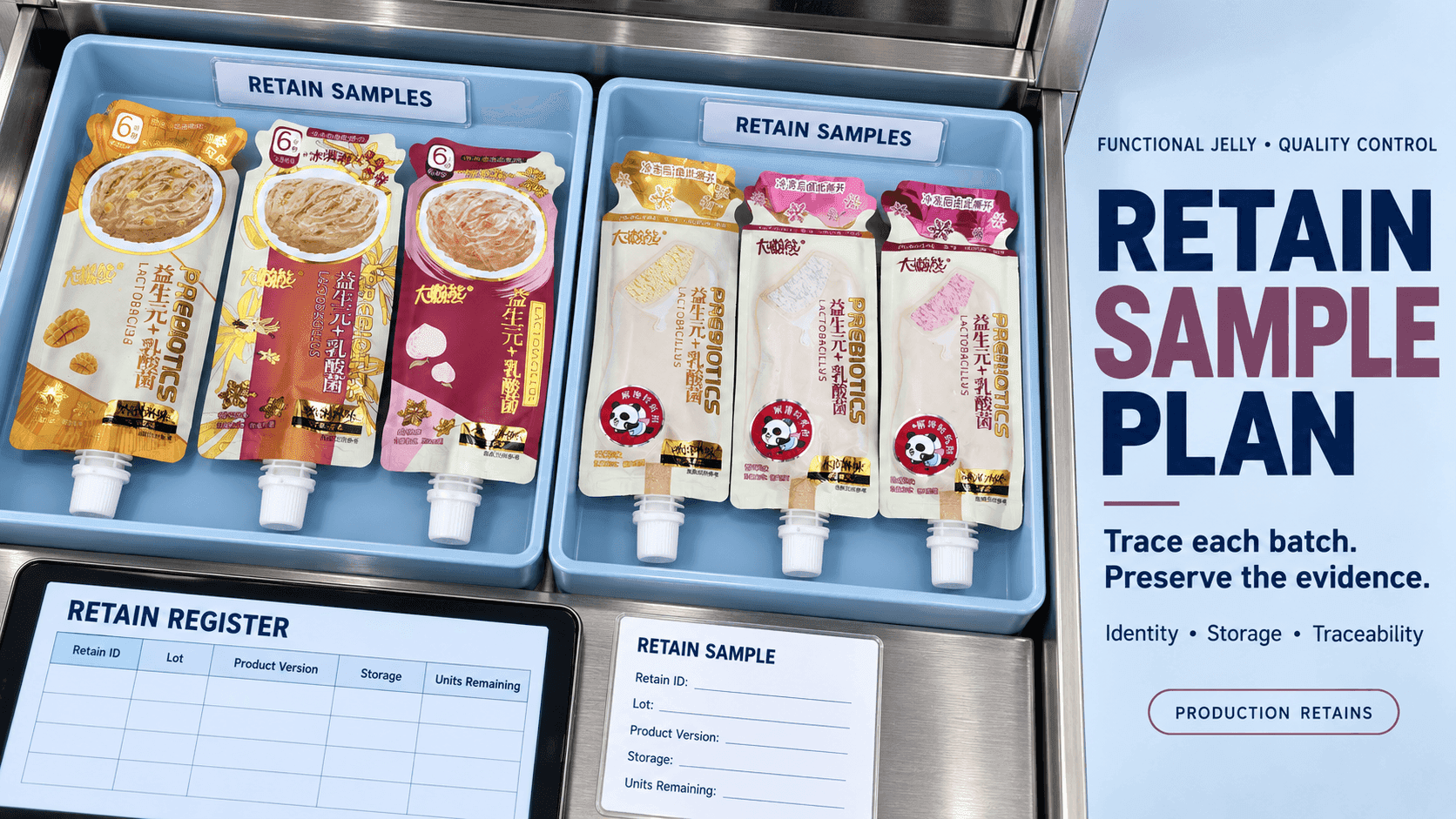
How to Build a Retain Sample Plan for Functional Jelly Production
A finished production lot may look correct on release day, but questions can appear later. A distributor may report a seal concern. A consumer complaint may describe unusual texture. A shelf-life review may need to compare current product with an earlier batch. A label or ingredient change may require the team to confirm which version was actually produced.
A retained sample can help only when it is representative, traceable and stored under a defined system. A cup, stick or pouch placed in an unmarked cabinet is not a retain program.
For functional jelly brands and OEM manufacturers, the plan should be agreed before commercial production. It should explain why samples are kept, which lots and pack levels are represented, how identity is protected, who can access them, what observations are permitted and when disposal is authorized.
Define the Purpose Before the Quantity
Do not begin with a universal rule such as keep one box from every batch. The necessary sample depends on what the sample may need to support.
Possible purposes include:
- investigating a complaint or distribution concern
- confirming package, print and code identity
- observing physical changes during the approved shelf-life program
- comparing product before and after an approved change
- supporting an internal deviation or trend review
- verifying the commercial pack configuration
One sample quantity may not support every purpose. A complaint investigation could require unopened units for visual, packaging or analytical review. A scheduled observation plan may require separate units for each time point so the same package is not opened repeatedly.
Write the purpose and the tests or observations that may be requested. Then determine the quantity with quality, technical, regulatory and customer requirements in view.
Confirm Whether the Plan Is Required or Voluntary
Retain-sample requirements differ by product type, market, customer contract and quality system. Some categories or jurisdictions may prescribe samples, records or retention periods, while another project may use retained samples as an internal risk-control practice.
The brand and manufacturer should identify the requirements that apply to the exact functional jelly and destination market. Do not copy a rule from a dietary supplement, pharmaceutical or unrelated food category and assume it applies.
Record the basis for the plan. It may reference a law, customer agreement, certification scheme, validated shelf-life protocol or internal procedure. If no specific legal quantity exists, the business still needs a documented rationale for its chosen approach.
Connect the Sample to the Approved Product Version
Every retain must point to a controlled product identity.
The record should connect the sample to the finished product name, formula or bill-of-material version, packaging-artwork version, unit format, flavor, lot or batch, production date and release status. Include the contract manufacturer and line or run reference when relevant.
For a functional jelly, raw-material changes can matter even when the front label looks unchanged. The retain record should make it possible to trace the approved active ingredient, supplier version and any authorized substitution through the batch documentation.
Do not rely only on handwritten flavor names. The physical pack, batch code and retain register should agree.
Decide Where in the Run to Collect Samples
A sample taken from one convenient case may not represent the whole production run.
The plan should define the sampling points relevant to the process. Depending on the risk and line, that may include units from the beginning, middle and end of the run, different filler lanes or heads, or separate packaging lots. The exact design must come from the manufacturer's process knowledge and approved sampling procedure.
Record where each unit came from. If samples from multiple points are pooled into one retain set, preserve enough information to understand the relationship.
Sampling should not interfere with release controls or create unidentified gaps in case counts. The units should be removed, recorded and transferred into retain custody through an approved method.
Determine the Necessary Pack Levels
The primary package shows the product-contact and opening condition. The retail box shows unit arrangement, artwork, instructions and code visibility. The shipping case shows case labels, lot identity and transport configuration.
The plan should decide which levels are needed for its stated purpose.
For a stick-pack project, individual sticks may be needed for product and seal observations, while one complete retail carton may be needed for artwork and count verification. For cups, the retain may need intact lidding and the outer multipack. For pouches, spout, cap and seal areas may require visual access without sacrificing all retained units.
Do not keep only loose units if the future question could involve the commercial presentation. Do not retain an entire case without considering whether smaller, clearly identified units would support the purpose more efficiently.
Establish the Sample Quantity From the Planned Work
List the possible tests and observations, then identify how many unopened units each one consumes. Include repeat or confirmation work only when the rationale supports it.
Separate destructive and non-destructive activities. A visual inspection may leave a package intact. Opening a jelly for texture review, sending a unit to an external laboratory or performing package-integrity testing may consume it.
Reserve units so one early investigation does not exhaust the complete batch retain. Where different teams need access, define whether one central sample set or controlled sub-sets will be used.
There is no single quantity that fits every functional jelly. The approved number should be documented in the product or site procedure and reviewed after meaningful changes.
Label the Retain Without Obscuring the Product
The retain label should make the sample easy to identify while preserving the original pack information.
Include a retain ID, product code, flavor, lot or batch, production date, collection point if relevant, quantity, storage condition, date placed into storage and responsible person. Add the approved disposal or review date if the procedure uses one.
Do not cover the batch code, ingredient list, date mark, seal or artwork area that may need future inspection. Use an outer bag, tray or shelf label when adding a sticker to the unit would change or hide evidence.
If a sample is removed for testing, record the date, purpose, person, number of units and remaining balance.
Use Storage Conditions That Preserve Meaning
A retained sample should be stored under the condition defined by the plan. The default should not be chosen merely because space is available.
If the purpose is to represent normal commercial life, use the approved product storage condition unless the protocol specifies another condition. If the project includes accelerated, light-exposure or temperature-challenge work, keep those samples separate and clearly identify them as study samples rather than normal retains.
Protect the retain from unplanned sunlight, moisture, pests, contamination, crushing and unauthorized access. Monitor the storage environment at a level appropriate to the product and program.
Do not treat a sample held in uncontrolled office conditions as reliable shelf-life evidence.
Separate Retains From Reference and Development Samples
Teams often use the words retain sample, reference sample, stability sample and development sample interchangeably. That creates confusion.
A development sample supports formulation work and may not represent commercial production. A reference sample may be kept to show an approved appearance, flavor or package standard. A stability sample is allocated to a defined study protocol. A production retain represents a specific commercial lot for a defined future purpose.
The same physical unit should not silently perform all roles. If a program intentionally combines roles, document the controls, quantity and priority of use.
Create a Retain Register
The register is the map to the physical sample.
At minimum, record the retain ID, product and version, lot or batch, quantity collected, pack level, sampling point, storage location, condition, collection date, responsible person, withdrawals and remaining units.
Use a location system precise enough for another authorized person to retrieve the correct sample without guessing. Shelf, bin or cabinet identifiers should match the register.
Electronic records should be backed up and access controlled. Paper records should remain readable and protected. Corrections should preserve the original information and identify who made the change.
Define Routine Observations Carefully
Some programs inspect retains at planned intervals. Others leave samples unopened until a trigger occurs. The plan should state which approach applies.
Routine observations may include pack appearance, leakage, swelling, code readability, color, separation or other attributes defined in the finished-product specification or stability protocol. Use the approved method and record the result against the correct batch and time point.
Do not open the only remaining unit for a casual check. Do not add sensory or analytical tests that the retained quantity cannot support. If an unexpected change appears, preserve evidence and move the issue into the approved investigation process.
Define Trigger Events and Investigation Access
Triggers can include a complaint, distribution incident, trend alert, label question, shelf-life observation, supplier change review or comparison with a current batch.
The procedure should identify who can authorize withdrawal, who performs the evaluation and how results connect to the complaint or deviation record. Maintain chain of custody when samples leave the storage area or go to an external laboratory.
The retain result is one piece of evidence. It should be reviewed with production records, release results, distribution history, returned product and other relevant information. A normal retain does not automatically disprove a customer's report, and an abnormal retain does not by itself identify the root cause.
Protect the Program From Uncontrolled Use
Retained samples should not become convenient stock for photography, sales meetings or informal tasting. Removing units for an unrelated purpose can leave the quality team without enough material for a later investigation.
Define authorized uses and approval. Keep marketing samples, sales samples and laboratory retains in separate inventories even if they come from the same lot.
If emergency use is permitted, record the reason and assess whether replacement material can still be collected without compromising representativeness.
Set the Retention and Disposal Rule
The retention period should be based on applicable requirements and the purpose of the program. Consider the labeled shelf life, distribution period, complaint window, customer contract, study plan and local record-retention rules.
Do not assume that shelf life alone answers the question. A program may require access before, through or after the labeled period depending on its purpose. The exact decision must be documented for the product and market.
At the end of the approved period, obtain authorization before disposal. Record the retain ID, quantity, disposal date, method and person responsible. Products containing sensitive ingredients, allergens or market-controlled materials may require specific disposal controls.
Audit the System
Periodically compare the register with the physical storage area. Check whether required batches are present, labels are readable, quantities match, conditions are controlled and expired samples are handled according to procedure.
Review whether investigations have repeatedly lacked enough sample or whether the storage area holds material with no clear purpose. Those findings can support a justified update to quantity, sampling point or retention rule.
When formula, supplier, primary package, shelf life, manufacturing line or destination market changes, assess whether the retain plan must change as well.
If your functional jelly project is moving toward commercial production, the retain-sample plan can be aligned with the finished specification, batch records and complaint process before the first lot is released.
Frequently Asked Questions
Is a retain sample the same as a stability sample
Not automatically. A stability sample follows a defined study protocol and time points. A production retain represents a specific lot for a stated future purpose. A project may coordinate the two programs, but the roles and quantities should be documented.
How many functional jelly units should be retained
There is no universal number. Determine the quantity from applicable rules, contract requirements, planned destructive tests, pack levels and investigation needs, then document the rationale.
Where should retained samples be stored
Use the condition defined by the approved program and product requirements, with protection from unplanned light, moisture, damage, contamination and unauthorized access. Challenge-study samples should be separated and clearly identified.
Can retained samples prove shelf life
Casual storage and observation cannot prove shelf life. Shelf-life support requires an appropriate stability and verification program. Retains may contribute evidence when they are managed under a defined protocol.
Can sales teams use retained samples
They should use a separate sample inventory. Removing quality retains for sales activity can compromise future investigation capability.
When should the plan be reviewed
Review it after meaningful changes to the formula, active ingredient, supplier, package, line, shelf life, destination market or quality requirements, and when audits or investigations reveal a gap.