
How to Build a Popping Boba Portion and Yield Test for Foodservice
A nominal pack weight does not tell a foodservice operator how many consistent menu portions a container will produce. This guide explains how to define the serving method, measure pearl and syrup carryover, compare employees, record spill and residue, and calculate usable yield under the actual menu workflow.
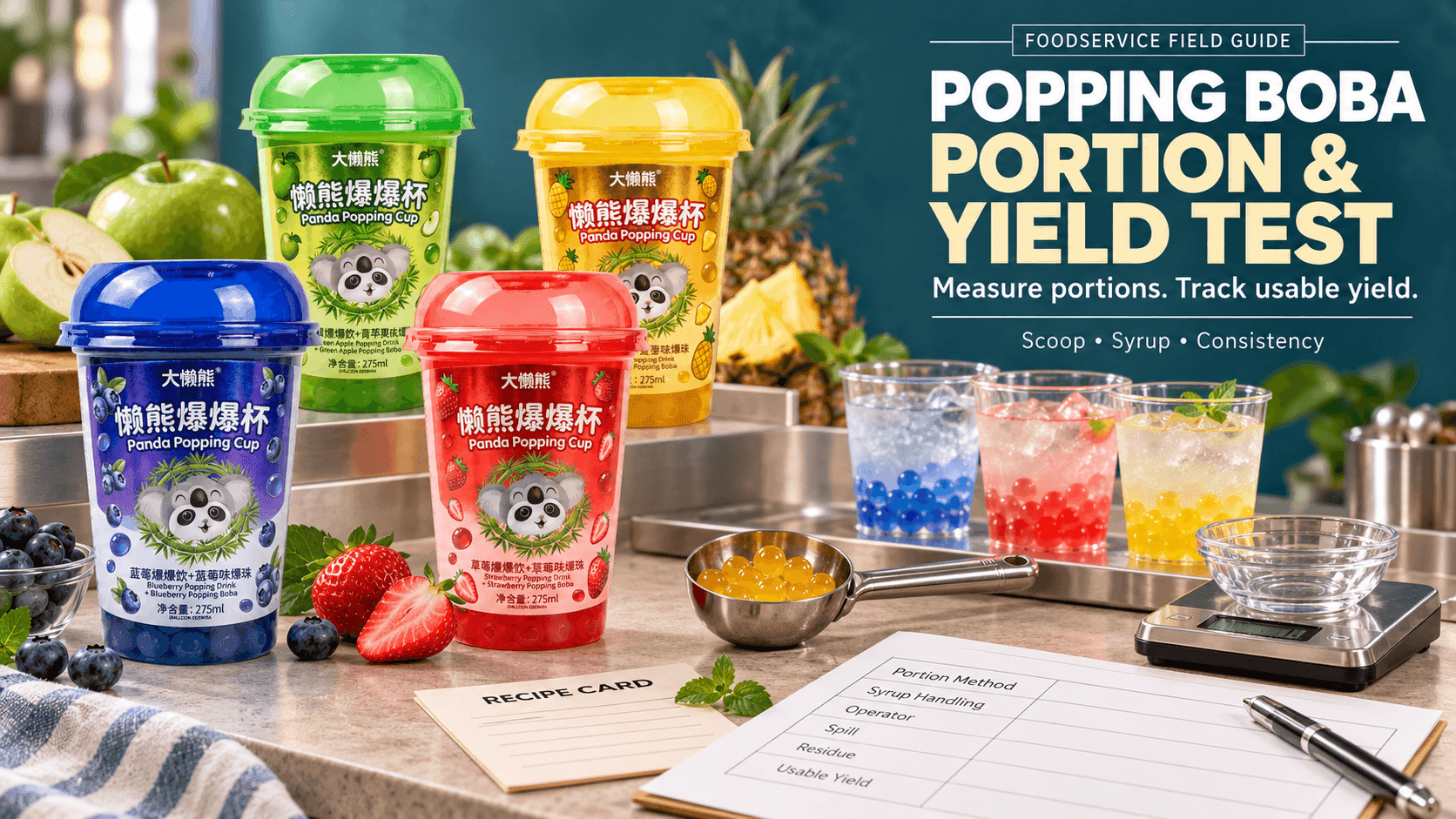
How to Build a Popping Boba Portion and Yield Test for Foodservice
A popping boba container has a declared net quantity, but that number does not automatically tell a cafe how many sellable drinks or desserts it will produce.
The answer depends on the portion method, the amount of syrup carried with the pearls, the cup and recipe, employee technique, spill, product left on utensils and residue that cannot be served at the end of the container. If those variables are not defined, two stores can use the same product and report very different yield.
A practical portion and yield test turns that uncertainty into an operating method. It gives the buyer a repeatable way to compare dispensing options, train staff, estimate usable portions and build a more credible menu cost. It should be run with the exact commercial product and the real service workflow rather than with an assumed serving number.
Begin With the Decision the Test Must Support
Do not begin by selecting a scoop. Begin by writing the decision.
The operation may need to choose between a scoop and a weighed portion, confirm whether a proposed topping amount works in a cup, compare staff consistency, estimate the usable yield from one container or investigate why stores are reporting different costs.
Write one primary question and keep the test focused on it. A portion test designed for menu presentation is not automatically a pack acceptance test. A yield test is not a shelf-life study. A foodservice trial cannot establish an after-opening period unless the required safety and quality evidence already supports it.
Lock the Product Pack and Menu Recipe
Record the exact popping boba identity before opening the container. Include the product name, flavor, batch or lot, container size, sample or commercial status and date received. Photograph the unopened pack and its condition when useful.
Then lock the menu item used in the trial. Record the cup or bowl, base beverage or dessert, ice, other inclusions and intended presentation. A portion that looks balanced in one drink may overwhelm a smaller cup or disappear in a larger one.
The test record should make it possible to repeat the work with the same product and recipe. If the pearls, syrup ratio, container or menu formula changes, the earlier result may no longer represent the current system.
Decide What Counts as One Portion
The word portion is ambiguous until the operation defines it.
One business may mean a level scoop of pearls with normal syrup carryover. Another may use a stated weight of the combined product. A third may portion drained pearls for a particular application. None of these methods should be assumed to be universal.
Write the target in the same measurement basis that staff will use. If the method is by weight, record weight. If the method is a specific scoop or volume measure, identify the utensil and the fill level. Do not calculate with weight in one part of the test and volume in another unless a verified conversion has been established for that product and method.
The target should be evaluated inside the finished menu item. A mathematically neat portion is not useful if it damages drink balance, clogs the intended straw, creates spill at the lid or gives the customer an inconsistent topping experience.
Choose a Method Staff Can Repeat
A digital scale can make variation visible during development, even if the final store method uses a scoop. A scoop can be faster in service but only when its size, fill level and handling are defined. A ladle or cup measure may bring more syrup with each portion and therefore change both yield and the finished drink.
Compare methods against the actual operating need.
- Speed: can the method fit the expected service flow
- Repeatability: do repeated portions stay close enough to the approved target
- Clarity: can a new employee understand a level, heaped or drained measure
- Product handling: does the utensil damage the pearls or create unnecessary spill
- Cleaning and hygiene: can the approved utensil and station be maintained under the local food safety plan
- Recordability: can the operation observe and correct drift without interrupting service
The fastest method is not always the lowest-cost method if it produces wide variation.
Standardize Syrup Handling
Syrup is one of the largest hidden variables in a popping boba yield test.
A scoop taken from the surface may have a different pearl-to-syrup relationship from one taken deeper in the container. An employee may pause over the container and allow syrup to drain, while another transfers the portion immediately. A perforated utensil and a solid utensil do not produce the same result.
Define the method in observable words. State the utensil, how the product is mixed if mixing is approved, where the scoop enters, whether the utensil is leveled and whether there is a controlled pause before transfer. Do not use vague directions such as remove most of the syrup.
The goal is not to eliminate syrup automatically. Syrup may be part of the designed flavor and service behavior. The goal is to make its treatment intentional and consistent.
Prepare the Test Station
Use a clean station that reflects real service conditions. Prepare the approved utensil, scale if used, empty cups, complete menu ingredients, waste or spill record and a simple result sheet.
Check that the scale or measuring device is appropriate for the internal test and working as intended. If the operation relies on a scale for commercial transactions, legal-for-trade requirements may apply separately. This internal method does not replace those requirements.
Allow the product to be handled only as directed by the supplier and the operation's food safety plan. Do not invent a holding condition for the sake of the test. Record the actual time and conditions so the result has context.
Record the Starting Quantity
The declared net quantity is useful product information, but the yield test should also record the starting point it actually uses.
For a weight-based internal study, the team may record the gross container weight before service and the packaging or remaining container weight afterward, using a consistent method. For a portion-count study, it may count completed portions from the container while separately recording product that was spilled, left behind or rejected.
Define whether the test is measuring combined pearls and syrup or another approved basis. The starting quantity and the target portion must use compatible units. Otherwise, the yield calculation can look precise while comparing different things.
Measure Repeated Portions
Ask the operator to portion the product as it would be served, not as a laboratory demonstration. Record each result in sequence rather than recording only an average.
The sequence reveals drift. Early portions may be generous while later portions become smaller. The operator may change technique when the container is less full. A scoop may be easy to level at the beginning but difficult to fill near the bottom.
For each repetition, record the operator, utensil, portion result, obvious syrup carryover and any spill or damaged pearls. If a result is outside the operation's approved range, record what happened instead of deleting it as an inconvenience.
There is no universal number of repetitions for every operation. The test should include enough repeated portions to reveal variation relevant to the service environment, and the business should document why the chosen sample is adequate for its decision.
Compare More Than One Operator
A method is not standardized simply because the person who designed it can repeat it.
Have more than one trained employee follow the same written instruction independently. Compare the distribution of their results, not only the combined average. Two employees can produce the same average while one is highly consistent and the other alternates between large and small portions.
Observe the words or movements that cause confusion. Does level mean level with the rim. Does one scoop permit a second small top-up. Must the utensil touch the container wall. Does the employee shake the scoop.
Use the observations to improve the instruction. The purpose is not to rank employees; it is to find whether the method can survive normal staff variation.
Test the Beginning Middle and End of the Container
Popping boba service may change as the container empties. The ratio of pearls to accessible syrup can shift, the utensil angle can become awkward and product may remain in corners or below the reach of the scoop.
Divide observations into beginning, middle and end stages. Keep the same portion instruction and record whether the result becomes slower, less consistent or more wasteful.
Do not solve an end-of-container problem by combining old and new product unless that practice is approved by the supplier, the food safety plan and local rules. The test should observe the current method first, then send operational questions through the proper review.
Record Spill Residue and Unusable Product
Usable yield is lower than a simple theoretical calculation when product is lost during service.
Create separate reason codes for spill, product left on the utensil, pearls damaged during handling, residue that cannot be removed by the approved method and product excluded for a documented quality reason. Do not put every difference into a single waste number.
Reason codes help the operation choose the right response. A container-shape issue needs a different solution from an oversized scoop. Repeated spill at the cup rim may point to the recipe sequence or workstation layout. Damaged pearls may indicate rough handling or an unsuitable utensil.
The record should not encourage staff to serve questionable residue merely to improve yield. Food safety and approved product quality come before the yield target.
Calculate Theoretical and Usable Yield
Theoretical yield is a planning calculation. On a consistent measurement basis, the team divides the defined starting usable quantity by the target portion. The result assumes perfect recovery and perfect portioning.
Actual usable yield is based on the completed portions produced by the approved method under the test conditions. Record any partial final portion separately rather than silently counting it as a full menu item.
The gap between the two results is useful. It shows the combined effect of portion variation, syrup behavior, spill, residue and other recorded losses. It should be investigated, not automatically converted into a universal loss allowance.
Once the operation knows its delivered product cost and verified usable yield, it can estimate product cost per portion. That calculation should use the current commercial inputs and should be updated when the pack, price, recipe or method changes.
Check the Portion in the Finished Menu Item
A yield-efficient portion can still be commercially wrong.
Build the complete drink or dessert with the approved portion. Check flavor balance, visual distribution, customer access through the intended straw or spoon, headspace, lid fit and behavior over the expected service period. Test dine-in and takeout conditions separately if both are relevant.
If the portion is changed after this review, repeat the yield calculation. Do not approve one quantity for presentation and cost the menu using another.
Convert the Result Into a Recipe Card
The final recipe card should identify the product, utensil or weight method, portion instruction, syrup handling, assembly sequence and approved menu application. Add a clear photograph when it helps staff recognize the correct fill level.
Training should include practice and observation. A poster alone does not prove that the method works. During the first store trial, record actual use and compare it with the development result. Differences may reveal a station-layout, pace or training issue that was not visible in a controlled test.
Recheck After Meaningful Changes
Repeat the portion and yield test when the product, supplier, pack, syrup relationship, utensil, cup, recipe or workflow changes in a way that could affect the result. Also investigate when store-level usage no longer matches the approved expectation.
Keep the original record, the revised method and the reason for change together. That history helps purchasing, operations and quality teams understand whether the difference came from the product or from the way it was served.
If your team is evaluating a popping boba project, a finished sample can be reviewed with your real cup, utensil and menu workflow before a commercial portion method is approved.
Frequently Asked Questions
Should popping boba be portioned by weight or volume
Either method may work. Weight is useful for development and variation checks, while a defined scoop or volume method may fit faster service. The operation should test repeatability, speed and product handling before choosing.
Should syrup be included in the portion
That depends on the approved product and menu method. The test must state whether it measures pearls and syrup together or uses another defined handling method. Do not switch between methods during the same calculation.
How many portions should be tested
There is no universal number for every business. Use enough repetitions, operators and container stages to reveal variation relevant to the decision, and document the basis used.
Is the net quantity enough to calculate servings
It can support a theoretical estimate, but it does not account for the actual portion method, syrup carryover, spill, residue or incomplete final portions. A real workflow test provides usable yield.
Can a yield test establish an after-opening period
No. A portion and yield test does not establish microbiological safety, quality life or a permitted holding period. Follow the validated product information, local requirements and the operation's food safety plan.
When should the test be repeated
Repeat it after a meaningful change to the product, pack, portion utensil, recipe or service method, or when actual store usage no longer matches the approved result.