
How to Run a Functional Jelly Traceability Test Before Commercial Launch
A functional jelly traceability test checks whether one finished lot can be connected backward to its approved ingredients and packaging and forward to every recorded shipment. This guide shows brands, importers and OEM manufacturers how to define the exercise, retrieve records, reconcile quantities, record gaps and approve corrective follow-up without inventing universal time or recovery targets.
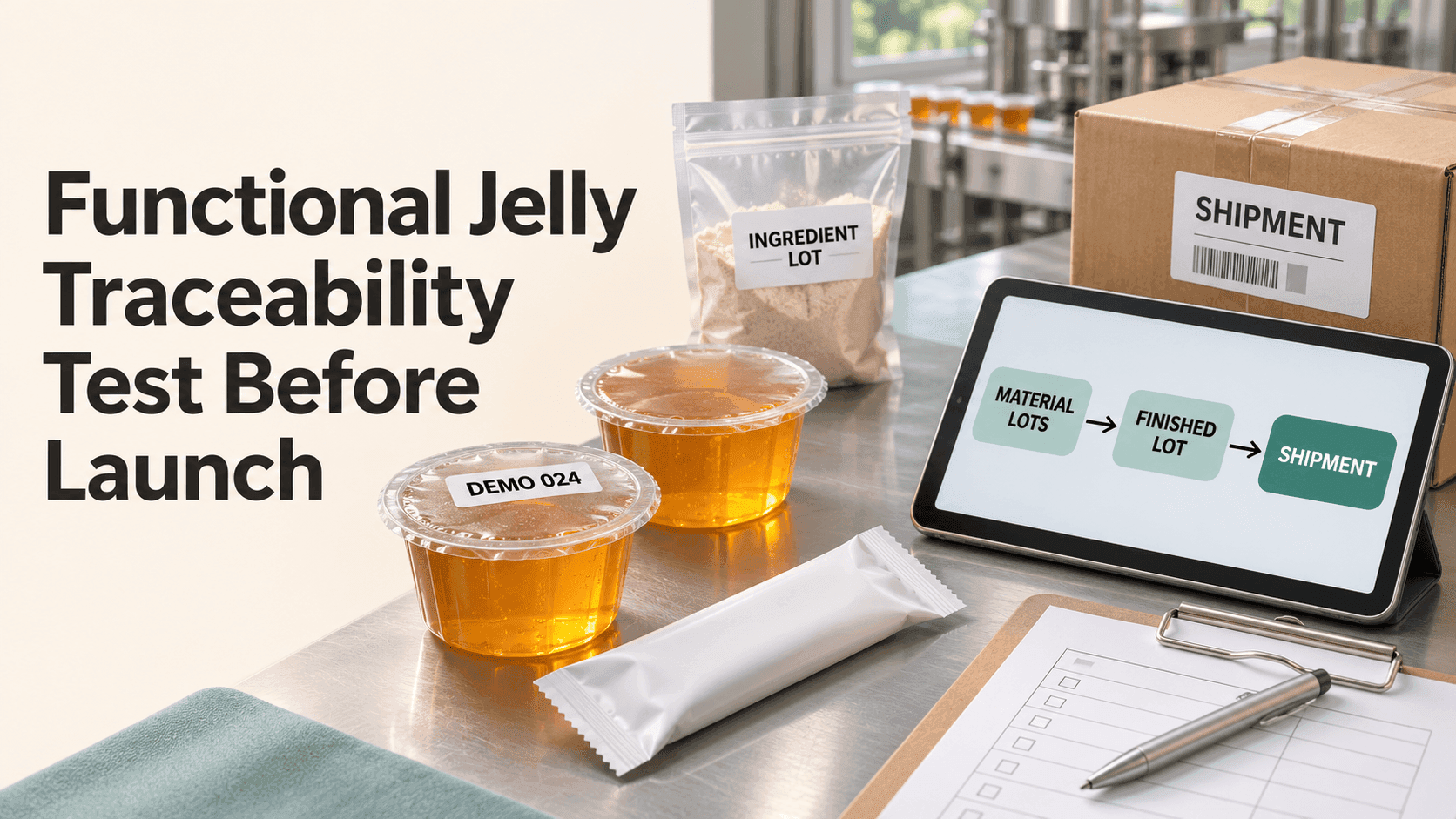
How to Run a Functional Jelly Traceability Test Before Commercial Launch
A functional jelly traceability system should do more than print a lot code on a pouch, stick or cup. When a buyer, manufacturer or responsible authority starts with one finished unit, the records should identify the product version, production batch, relevant ingredient and packaging lots, warehouse movements and distribution path. The same system should also work in the opposite direction when the starting point is an ingredient lot, packaging lot or production batch.
Codex defines traceability or product tracing as the ability to follow the movement of food through specified stages of production, processing and distribution. Its principles describe one-step-back and one-step-forward identification as appropriate to the objective. Codex also explains that traceability is a tool; by itself, it does not improve food-safety outcomes unless it is combined with suitable measures and requirements.
A planned test checks whether the records work before a real incident creates pressure. It is not a release test, shelf-life study or automatic recall. It should create evidence about retrieval, linkage, scope and record quality, then turn every confirmed gap into assigned follow-up.
Confirm the Test Objective and Authority
Define why the exercise is being run. A prelaunch test may verify that a new OEM workflow connects the approved product with receiving, production, packing, warehousing and shipment records. A routine test may confirm that an established process still works after a formula, supplier, packaging, line, coding or distribution change.
Name an exercise controller and the participating functions. The controller should prepare the starting clue, protect the answer key and record when each request is issued and answered. Quality, production, warehouse, purchasing, packaging, sales, logistics and the relevant buyer or importer may each hold part of the record chain.
State whether the exercise is document-only or includes physical stock checks, code reading, sample retrieval or communication with a distributor. Do not let the exercise become an unapproved inspection of confidential records. The manufacturer and buyer should agree which evidence is reviewed internally and which summary is shared.
Define the Exact Product and Test Scope
Select one controlled scope. Record the product name and code, formula or bill-of-material version, flavor, functional ingredient system, package format, artwork version, destination market, production site, lot or batch and the date range under review.
The test can begin with a finished unit, retail box, shipping case, customer shipment, production batch, raw-material lot or packaging lot. The starting point should contain enough real information to begin but should not reveal the complete route. A photograph of a lot code, a shipment reference or a material-lot number can be a practical starting clue.
Define the boundaries before the clock starts. If the product uses a mixed-flavor retail box, several filler lanes, multiple packaging lots or more than one warehouse, include those conditions explicitly. A simple single-lot test cannot prove that a more complex assortment is controlled.
Lock the Product and Code Relationships
A visible code is useful only when the team can explain what it identifies. Document the relationship between the finished code and the internal production batch, packing run, unit format, flavor, market version and date information. Avoid relying on an employee's memory of an undocumented code pattern.
Check every packaging level used in distribution. The individual cup, stick or pouch may carry one code while the retail box, master case, pallet and warehouse record use related references. The system should explain how those identifiers connect and what happens when units are repacked, assorted or removed for samples.
Packaging identity also matters. The exercise should confirm which primary pack, printed film, lid, cap, carton, label or case version was used where those components affect product identity, market presentation or investigation scope. This does not mean every packaging detail is legally required in every traceability system; it means the project should define the records needed for its own product and obligations.
Build a Record Map Before the Test
List the records that should connect the selected scope without writing the answers in advance. The map may include purchase and receiving records, material status, supplier lot or batch, internal material code, dispensing or issue record, production batch record, packaging issue and reconciliation record, finished-product code, case or pallet label, warehouse movement, shipment document, customer or consignee reference, returns and approved sample withdrawals.
Use the functional jelly batch record review as the production anchor. That record should identify the actual material lots, processing history, packaging run, finished results, deviations and release status for the lot being traced. The traceability test then checks whether that internal history connects accurately to upstream and downstream records.
For each handoff, identify the record owner, system, search field and expected link. If one team searches by customer order while another searches by lot code, document the translation between them. A record that exists but cannot be found or understood by an authorized replacement person is still a weakness.
Run the Backward Trace
Start with the selected finished unit, case or shipment. Identify the finished lot, production batch, pack version and packing run. Then retrieve the ingredient and packaging lots recorded for that batch, together with their receiving and approved-use references.
Confirm that the records point to the exact material identity rather than a general ingredient name. Functional ingredients, premixes, flavors, colors, sweeteners and hydrocolloids may have different grades, carriers, concentrations or supplier versions. The test should show which approved lot entered the selected batch without assuming that similar names mean the same material.
Record every manual interpretation. If a code must be decoded through an undocumented spreadsheet, personal notebook or one employee's memory, the result may be correct but the control is fragile. Capture the dependency and decide whether the process needs a controlled reference.
Run the Forward Trace
Choose a raw-material lot, packaging lot or production batch and identify every finished lot and quantity that used it within the defined scope. Then follow those finished units through warehouse locations, transfers, samples, returns and shipments to the next recorded recipient.
Do not stop after finding the largest shipment. The exercise should account for all recorded paths in scope, including units held at the factory, quality retains, sales samples, laboratory samples, rework where authorized, damaged stock and documented waste. Each category should use the status and records defined by the facility.
If the same material lot entered several flavors or formats, the result should separate affected and unaffected products from evidence. A broad product-family answer may lead to an unnecessarily large response, while an incomplete answer may omit relevant stock.
Reconcile Quantities With a Defined Method
Quantity reconciliation tests whether the recorded inputs and outputs form a credible history. Compare the quantity received or issued with the quantities used, returned, held, rejected, sampled, wasted, reworked where permitted and converted into finished units. Then compare produced and packed quantities with warehouse and shipment records.
Use the site's approved units, conversion factors and review method. Do not invent a universal recovery percentage for functional jelly. Normal differences can arise from sampling, startup, transfer loss, damaged packaging, unit conversion or measurement basis, but each difference still needs an explained category and supporting record.
Record both unexplained shortage and unexplained excess. Excess finished quantity, unused printed packaging or duplicate identifiers can reveal a counting, coding or version-control problem even when the trace reaches the right customer.
Test Mixed Packs and Split Lots
Mixed-flavor packs create more than one relationship. The outer retail box should connect to the individual flavor lots inside it, the packing or assortment run and the finished case code. If several production lots enter one assortment, the system should define how the relationship is preserved.
Split lots also need clear boundaries. One production batch may be packed on different dates, use more than one packaging lot or ship through several warehouses. Conversely, one shipment may contain several production lots. Test the actual commercial configuration rather than assuming one batch always equals one shipment.
When a code cannot express every relationship on the physical pack, the supporting records must preserve the link. The exercise should show how an authorized reviewer moves from the visible code to the underlying record set without guessing.
Check External Record Handoffs
Traceability can fail at the boundary between the OEM manufacturer, brand owner, importer, distributor and retailer even when each party has an internal system. Agree which identifier travels with the goods and which party records receipt, transformation, repacking, transfer and onward shipment.
Run at least one communication handoff when the scope requires it. Confirm the current contact, request format, secure transfer method, response owner and language needed to understand the records. A spreadsheet or report should retain the identifier definitions and date range used in the test.
Do not request unrestricted customer or supplier data without a defined need. The exercise can preserve confidentiality by sharing an agreed evidence summary while the responsible party verifies detailed records within its own system.
Set Internal Performance Measures
Define the measures before the exercise begins. Useful measures can include whether the selected scope was fully identified, whether each record link was supported, how long authorized retrieval took, whether quantities reconciled under the approved method and how many manual interpretations or missing records were found.
There is no universal completion time or acceptable reconciliation percentage for every functional jelly project. Legal requirements, customer agreements, certification programs and internal procedures may impose specific expectations. The test should use the criteria approved for the actual product, site and destination market.
Separate speed from accuracy. A quick response with an incorrect lot boundary is not successful, and a complete answer that depends on one unavailable employee may not be resilient. Record the actual result against each approved measure.
Separate Traceability From Product Release and Retain Samples
A traceability result does not prove that the lot passed its finished specification. Release depends on the product-specific records, tests, deviations and authorized decision required by the applicable system. The traceability exercise only checks whether the correct evidence and product movement can be connected.
A retained sample is also different from a traceability record. The functional jelly retain sample plan explains why selected physical units are stored and how they are identified, protected, accessed and disposed. During a traceability test, the team may verify that the correct retain exists, but opening or testing it requires the approved retain or investigation procedure.
If the exercise reveals an actual food-safety, legality, identity or quality concern, stop treating it as a simulation. Escalate through the site's real hold, investigation, notification and recall or withdrawal procedure as applicable.
Confirm Destination Market Requirements
Traceability duties vary by product, activity, destination market and supply-chain role. The importer or qualified local adviser should determine which laws, customer requirements and certification rules apply to the exact functional jelly and business.
The FDA overview of tracking and tracing of food describes backward and forward supply-chain linkage. It also explains that the additional U.S. Food Traceability Rule applies to certain foods on the Food Traceability List. That is a regional example, not evidence that every functional jelly is covered or exempt.
Document the basis used for the exercise. If the team tests a customer or certification requirement that goes beyond a legal minimum, identify it as such. Do not turn a voluntary internal target into a universal regulatory statement.
Record Gaps and Require a Retest
Close the exercise with a factual report. Identify the starting clue, scope, participants, records requested, actual retrieval path, timing, quantities, confirmed links, missing or ambiguous records, manual workarounds and final assessment. Preserve the evidence used so the result can be reviewed later.
Assign each gap to an owner with a due date and defined evidence of completion. Corrective work may include a code-reference update, system field change, warehouse procedure, record template, training, supplier-data requirement, distribution handoff or change-control action.
A written action is not proof that the gap is fixed. Repeat the affected part of the trace, or run a new controlled exercise, after the change is implemented. Keep the first result and the retest linked so improvement is visible without rewriting the original history.
Prepare the Buyer Evidence Summary
The manufacturer should keep the detailed traceability records required by its system. The buyer or importer can agree on a summary that identifies the tested product and site, exercise date, scope, result, significant gaps, corrective status and the record package available for a real request.
The guide to documents importers should request from a functional jelly manufacturer explains how traceability information fits with specifications, testing, shelf-life, packaging and shipment documents. The objective is not to collect confidential factory data without purpose. It is to know what evidence exists, who controls it and when it can be provided.
Qualified brands and importers can discuss a functional jelly project with the Victory Foods export team and include the destination market, product format, proposed pack, distribution route and buyer evidence requirements in the initial brief.
Frequently Asked Questions
Is a traceability test the same as a recall
No. A traceability test is a controlled exercise that checks record retrieval and product linkage. A real recall or withdrawal follows the applicable legal and company procedure when an actual issue requires action.
Should packaging lots be included
Include packaging components and versions when they affect product identity, market version, investigation scope or an applicable requirement. The project should define the necessary detail rather than assuming one universal rule.
How quickly should the test be completed
Use the requirement or internal target approved for the site, product and market. Record actual retrieval time and accuracy. Do not copy an arbitrary target from another category or jurisdiction.
Does a passing traceability test release the product
No. Release requires the product-specific specification, test results, packaging checks, deviation review and authorized decision required by the applicable quality system.
Can a buyer ask for every internal traceability record
The quality agreement should define access. A buyer may receive an agreed summary or selected evidence while the manufacturer protects confidential supplier, customer and process information.
What happens if the exercise finds a real problem
Stop the simulation and use the applicable hold, investigation, notification and recall or withdrawal procedure. Protect the evidence and define the affected scope from controlled records.
When should the test be repeated
Repeat it on the approved schedule and after changes that could alter product identity, coding, suppliers, packaging, manufacturing, warehousing, systems or distribution handoffs.