
Functional Jelly Sticks vs. Gummies: Which Format Fits Your Wellness Brand?
Functional jelly sticks and gummies may serve similar wellness categories, but they create very different product-development possibilities. Compare serving size, ingredient loading, sugar strategy, texture, packaging and consumer positioning before choosing a format.
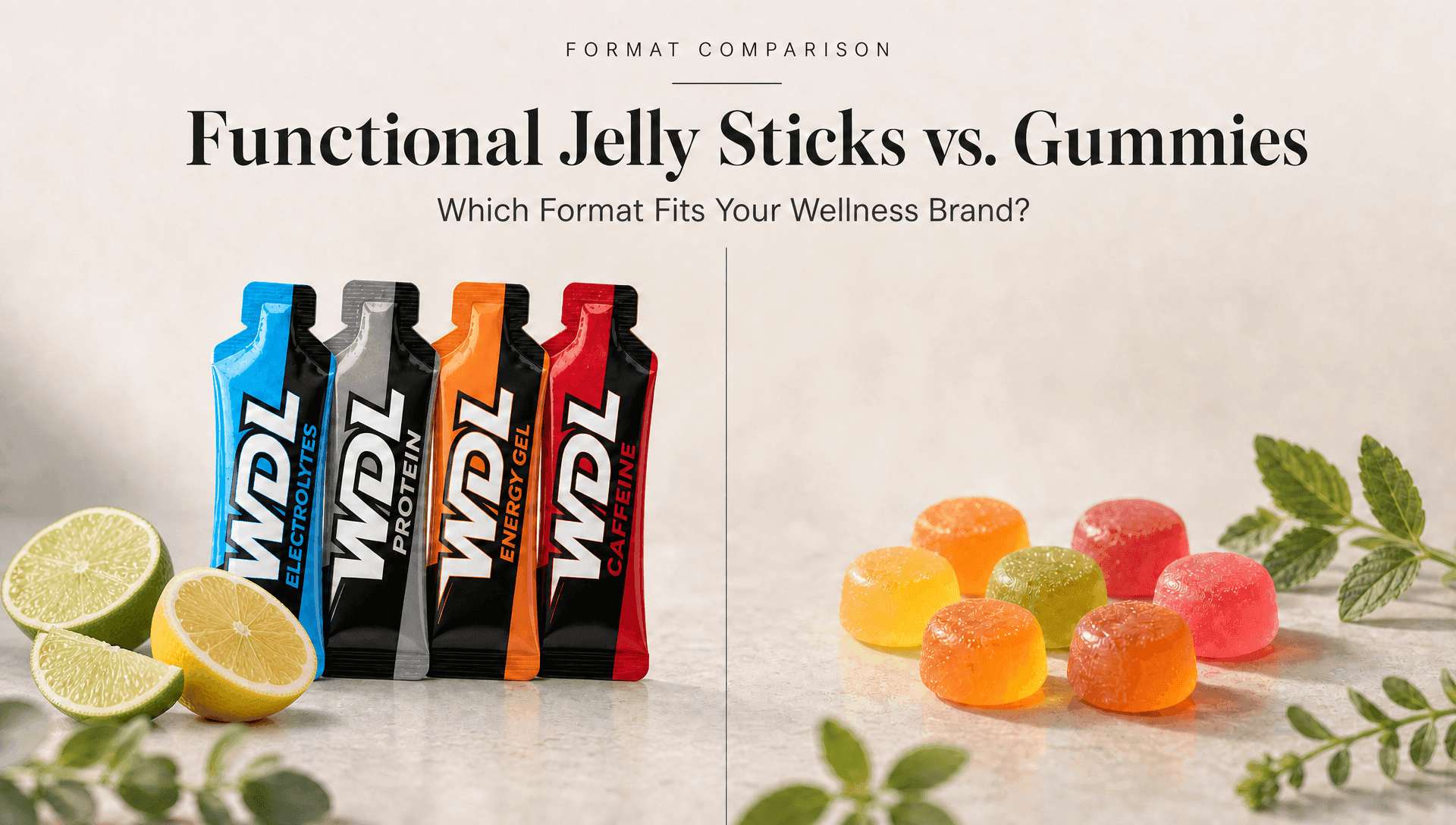
Functional Jelly Sticks vs. Gummies: Which Format Fits Your Wellness Brand?
Functional jelly sticks and gummies can both turn nutrition into a convenient, enjoyable format, but they are not interchangeable. Jelly sticks generally provide a larger single-serving food matrix, while gummies offer a familiar bite-sized confectionery experience. The better format depends on the ingredient target, serving size, sugar strategy, texture, consumer occasion and brand positioning.
For wellness brands, choosing a delivery format is one of the earliest product-development decisions.
Should the product be a capsule?
A powder?
A gummy?
A drink?
Or a ready-to-eat functional jelly?
The answer affects much more than appearance.
Format can influence how much finished product is available for the formulation, how consumers use it, how flavors are developed, how the product is packaged and how the brand communicates its purpose.
For brands considering gummies and functional jelly sticks, the right question is therefore not:
Which format is more trendy?
It is:
Which format gives this particular product concept the best chance to work?
Why Are Functional Jelly Sticks Getting More Attention?
Functional nutrition is moving into formats that feel increasingly similar to everyday food and snacks.
Consumers no longer encounter functional ingredients only through tablets, capsules and powders. They can now appear in drinks, bars, gummies, shots and jelly-based products.
Industry activity in 2026 reflects that shift.
Functional jelly concepts are being presented at Vitafoods Asia 2026 across areas such as collagen and calcium, while supplement manufacturers are also developing larger single-serve jelly platforms aimed at beauty, sports nutrition, gut health and other wellness categories.
The important development is not that jelly will replace gummies.
It is that brands now have another delivery format to consider.
1. Serving Size Is the Biggest Structural Difference
One of the clearest differences between a gummy and a jelly stick is the amount of finished product available per serving unit.
A gummy is typically a small bite.
A functional jelly stick can be substantially larger.
One industry example described jelly-stick servings in the 25–30 g range, compared with a roughly 3 g standard gummy, giving formulators considerably more physical space within one serving unit. Those figures relate to that specific platform rather than an industry-wide specification, but they illustrate the basic formulation difference.
Why does this matter?
Because functional ingredients do not exist by themselves.
They have to coexist with:
water + flavor + acids + sweetening system + hydrocolloids + other ingredients.
When a brand wants a meaningful amount of an ingredient, available serving size can become important.
A larger food matrix does not guarantee that every ingredient or dosage will work.
But it gives R&D a different starting environment.
2. More Space Does Not Automatically Mean “More Actives”
This distinction is important.
A larger jelly stick should not be marketed simply as:
“We can put more ingredients inside.”
The better development question is:
Can the target amount of the intended ingredients work inside this format while maintaining an acceptable taste, texture and product specification?
Functional ingredients can affect:
bitterness;
acidity;
viscosity;
aroma;
color;
sweetness;
aftertaste;
gel structure.
A larger serving may provide additional formulation flexibility, but the complete formula still has to work as food.
For this reason, brands should define their functional target before deciding that a particular format is superior.
3. Gummies Have an Important Advantage: Familiarity
Gummies are extremely easy for consumers to understand.
The format is familiar.
The eating behavior is obvious.
Open the bottle or pouch, take the recommended number of pieces and chew.
That familiarity can be commercially valuable.
A consumer who already buys gummy vitamins may need very little education to understand another gummy wellness product.
Functional jelly sticks create a somewhat different behavior:
tear → squeeze → eat.
For many Asian consumers, jelly sticks and jelly sachets may already feel familiar.
In markets where the format is newer, the novelty itself can become part of the proposition.
That creates a strategic choice.
Do you want:
instant familiarity
or
format differentiation?
Neither answer is automatically correct.
4. Jelly Can Feel More Like Food Than a Supplement
One of the most interesting characteristics of functional jelly is that it sits between categories.
It can feel more food-like than a tablet.
More snack-like than a capsule.
And more substantial than a small gummy.
That opens different positioning opportunities.
For example:
Beauty Jelly
can become a daily beauty ritual.
can be positioned closer to functional snacking.
Vitamin Jelly
can combine everyday convenience with a fruit-forward sensory experience.
Sports Jelly
can prioritize easy consumption and portability.
The format therefore influences how the consumer interprets the product.
A gummy may say:
supplement in candy form.
A functional jelly may say:
wellness as part of an everyday eating occasion.
For some brands, that difference is significant.
5. Sugar Strategy Can Be Different
Gummy and jelly formulations use different structural systems, so sugar reduction should not be treated as the same technical problem across both formats.
Some modern jelly platforms are specifically being developed around low-sugar formulation flexibility.
But “jelly” does not automatically mean low sugar.
And “gummy” does not automatically mean high sugar.
Both depend on the actual formulation.
For a private-label brand, the useful question is:
What sugar positioning do we want, and how will that affect the complete texture and flavor system in the chosen format?
Victory Foods, for example, currently presents zero-sugar functional jelly concepts within its VitoStick™ range.
That makes sugar strategy a formulation discussion—not simply a front-of-pack claim.
6. Texture Creates Different Consumer Experiences
A gummy is generally chewed.
A functional jelly can be softer, smoother and squeezed directly from a sachet.
This sounds simple, but it changes the entire sensory experience.
A brand developing a premium beauty product may want:
smooth + juicy + delicate.
A children's gummy may instead prioritize:
chewy + playful + familiar.
A fiber jelly might require another texture strategy entirely.
Texture can therefore reinforce positioning.
The goal should not be to make jelly imitate a gummy.
It should be to use the characteristics of each format intentionally.
7. Individual Packaging Changes the Product Experience
Many functional jelly sticks are individually sealed.
That creates a clear:
one pack = one consumption occasion
structure.
This can support:
- travel;
- gym bags;
- office use;
- sampling;
- subscription packs;
- daily routines.
Gummies are frequently sold as multiple pieces in one bottle or pouch, although individually packed gummy products also exist.
The packaging model influences more than convenience.
It can affect:
- portion communication;
- branding space;
- secondary packaging;
- shipping efficiency;
- consumer perception;
- retail presentation.
A functional jelly brand should therefore evaluate packaging economics alongside formulation.
8. Which Format Works Better for Beauty Nutrition?
There is no universal winner.
Beauty-from-within products can exist successfully as gummies, powders, beverages, capsules and jellies.
Functional jelly becomes particularly interesting when a brand wants to combine:
daily ritual + premium sensory experience + portable single serving.
A fruit-forward collagen jelly, for example, can feel closer to a small wellness snack than a traditional supplement.
But formulation feasibility still depends on the actual collagen target, supporting ingredients, flavor, serving size and destination market.
The format should serve the formula.
Not the other way around.
9. What About Fiber and Gut-Wellness Products?
Fiber illustrates why serving size matters.
Depending on the type and intended quantity of fiber, increasing fiber concentration can change viscosity, texture and mouthfeel.
A larger jelly serving can create a different formulation environment than a small confectionery piece.
That does not mean every fiber ingredient is suitable for jelly or that higher quantities are always desirable.
It means brands should evaluate:
fiber type + target amount + serving size + water + texture + flavor
as one system.
For private-label development, this is much more useful than simply asking:
Can you make a high-fiber jelly?
10. What About Sports Nutrition?
Sports nutrition shows another reason format choice matters.
Traditional energy gels already demonstrate that athletes accept portable, squeeze-and-consume nutrition formats.
But sports products can have very different objectives:
- carbohydrate delivery;
- electrolytes;
- caffeine or caffeine-free positioning;
- hydration support;
- other permitted nutritional targets.
A wellness jelly and an endurance energy gel may use similar package mechanics while requiring completely different formulations.
Victory Foods currently manufactures energy-gel and sports-nutrition formats alongside functional wellness jellies, illustrating how hydrocolloid and squeezable formats can serve different product categories.
The package alone does not define the product.
Jelly Stick or Gummy: A Practical Buyer Checklist
Before choosing the format, brands should answer seven questions.
1. What is the primary consumer need?
Beauty, fiber, vitamins, energy, sports or another positioning?
2. What must one serving contain?
Define the ingredient or nutrition targets before finalizing format.
3. How should consumers experience the product?
Chewy, juicy, smooth, squeezable or snack-like?
4. What is the sugar strategy?
Conventional, reduced sugar, no added sugar or zero-sugar positioning where technically and legally appropriate?
5. Where will consumers use it?
Home, office, gym, travel, pharmacy, convenience retail or sports?
6. How should one serving be packaged?
Bottle, pouch, individual sachet, stick or another format?
7. Which market will the product enter?
Ingredient, labeling and claim requirements vary between markets and should be evaluated for the actual finished product.
Jelly Sticks Are an Alternative—Not a Universal Replacement
The strongest conclusion is not:
jelly sticks are better than gummies.
That would oversimplify the decision.
Gummies offer familiarity, an established supplement behavior and a highly recognizable format.
Functional jelly sticks offer a larger single-serving matrix, a different sensory experience and a strong opportunity for individually portioned, food-like wellness products.
The better choice depends on:
Consumer + Function + Ingredient Target + Serving Size + Texture + Sugar Strategy + Packaging + Market
For some brands, the answer will still be gummies.
For others, jelly may create the differentiation the product needs.
Developing Private-Label Functional Jelly With Victory Foods
Victory Foods China (https://www.victoryfoodscn.com/?utm_source=chatgpt.com) develops hydrocolloid-based OEM/ODM products across functional wellness, konjac jelly and sports nutrition categories. Its current VitoStick™ range demonstrates functional jelly concepts across vitamin, collagen and fiber positioning, while its sports-nutrition portfolio includes energy-gel formats.
A useful OEM brief should begin with:
Target Consumer + Primary Function + Ingredient Target + Serving Size + Texture + Sugar Positioning + Packaging + Destination Market
From there, the manufacturer can evaluate whether a jelly stick is genuinely the right delivery system.
Because the objective is not to follow a format trend.
It is to choose the format that makes the product work.
FAQ
Are functional jelly sticks the same as gummies?
No. Both can be used for wellness-oriented products, but they differ in serving format, texture, formulation environment and consumption experience. Jelly sticks are generally soft and squeezable, while gummies are typically smaller chewable pieces.
Can functional jelly sticks contain more functional ingredients than gummies?
A larger serving provides more physical formulation space, but actual ingredient types and quantities depend on technical feasibility, sensory quality, regulations and the finished-product specification. Larger does not automatically mean more effective.
Can functional jelly sticks be made with low or zero sugar?
Low-sugar and zero-sugar jelly concepts are possible in some formulations, but sugar reduction affects sweetness, texture and the overall formulation system. It should be evaluated during R&D rather than treated as a simple ingredient substitution.
Are jelly sticks suitable for collagen or fiber products?
They can be explored for collagen, fiber and other wellness concepts, but feasibility depends on the specific ingredient, target quantity, serving size, texture and destination market.
What should I send an OEM manufacturer before developing a functional jelly?
Provide the target consumer, primary product function, functional ingredients and target amounts, preferred serving size, flavor, texture, sugar positioning, packaging, destination market and commercial positioning.