
How to Evaluate Freezer Pop Samples Before Launch
A freeze-at-home freezer pop must perform before freezing, during freezing and while it is eaten. This buyer guide explains how to compare samples across both ambient and frozen conditions without inventing universal freeze times or acceptance limits.
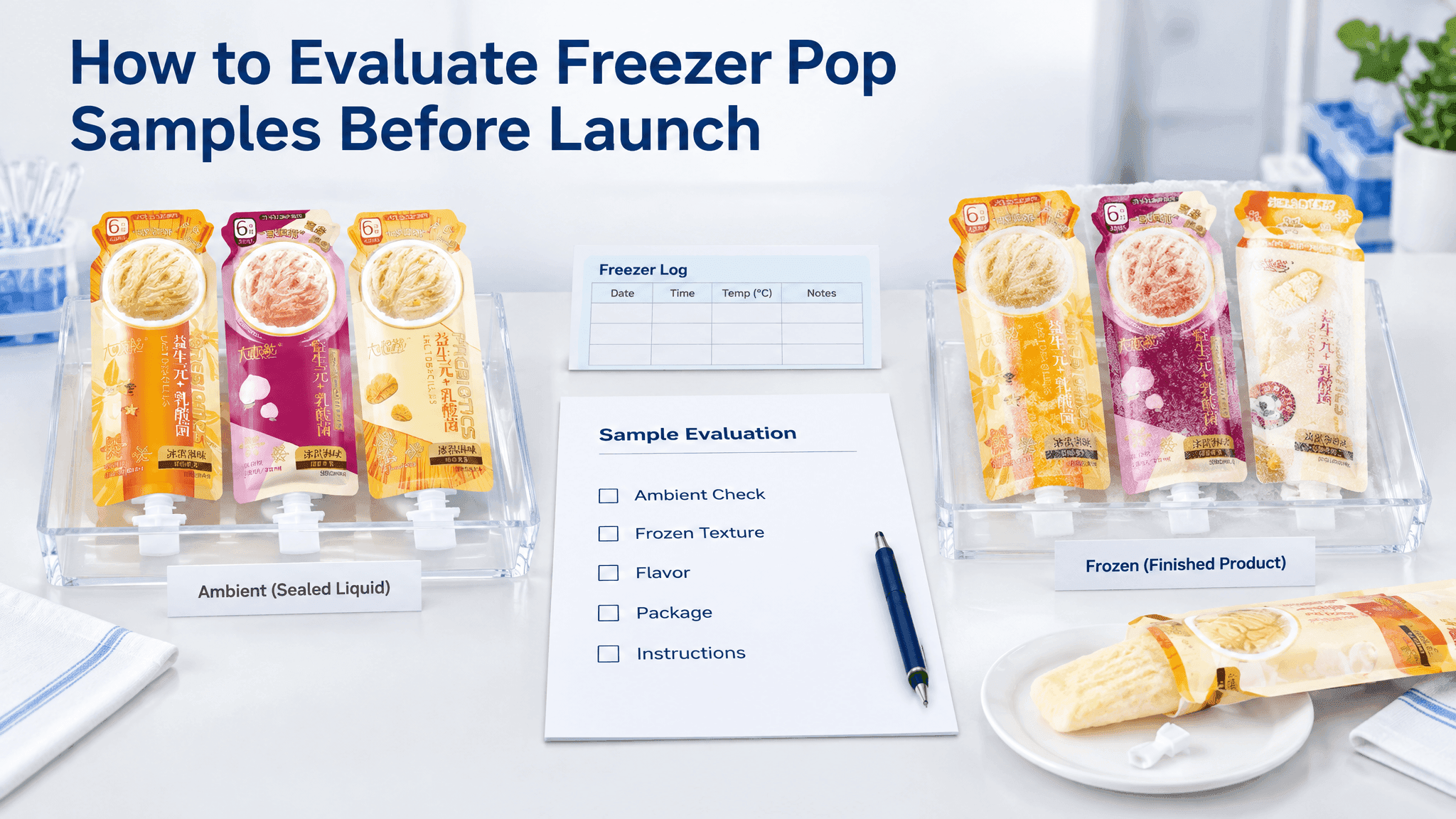
How to Evaluate Freezer Pop Samples Before Launch
A freeze-at-home freezer pop has two product states that matter to a buyer. It may be shipped and stored as an ambient product, then frozen before it is eaten. A sample that looks acceptable before freezing can still become too hard, difficult to open or weak in flavor after freezing.
That is why a freezer pop should not be approved from a room-temperature tasting alone. Buyers need a controlled review that follows the product from the sealed ambient sample through freezing, opening and consumption.
This guide provides a practical structure for that review. It does not set one freeze time, freezer temperature or quality limit for every product. Those requirements should come from the final formula, package, intended market and validated consumer instructions.
Lock the Sample and Package Version
Begin by identifying exactly what is being tested. Freezer pop projects often change formula and packaging at the same time, which makes informal feedback difficult to interpret.
Record the sample code, flavor, formula revision, fill date if supplied, primary package version, artwork or label version and any special storage. If the manufacturer sends several options, use neutral sample codes rather than descriptions such as "the sweeter one" or "the softer pack."
The test record should also note whether the package is production representative. A laboratory sleeve can help compare formulas, but it may not demonstrate the opening, seal or printed-package performance of the commercial item.
Define the Intended Product Route
Write down how the product is expected to move from the factory to the consumer.
For an ambient freeze-at-home item, the route may include ambient transport and storage followed by freezing at the retailer, foodservice location or consumer's home. Another product may be distributed or merchandised under different conditions. Do not treat these routes as interchangeable.
Clarify:
- the condition used for transport and warehousing
- the condition used for retail display
- who is expected to freeze the product
- the intended state at consumption
- whether the package is opened before or after freezing
- which consumer instructions must appear on the final label
This route determines which sample checks matter. It also helps the buyer separate a validated product requirement from a convenient test condition used only during development.
Build a Two Stage sensory evaluation scorecard
The simplest useful plan has an ambient stage and a frozen stage.
The ambient stage checks the product as it will be received, handled and stored before freezing. The frozen stage checks the condition in which the consumer opens and eats it. Both stages should use samples from the same identified version.
Prepare enough units to compare flavors or formula variants without relying on one package. The number of units and the sampling approach should be agreed for the project rather than selected from a universal checklist.
Use the same review form for every variant. Keep formula observations, package observations and instruction problems in separate fields so the development team can assign the right corrective action.
Inspect the Sample Before Freezing
Examine the unopened sample under the intended pre-freezing condition. The goal is to establish a baseline and identify issues that already exist before the product enters a freezer.
Record observations such as:
- package cleanliness and overall condition
- leaks, seal damage or trapped product near the seal
- fill consistency and unfilled headspace where it can be observed
- code and instruction legibility
- color and visual uniformity
- separation, settling, sediment or air pockets
- unusual swelling or deformation
- aroma, flavor and texture if an ambient tasting is part of the intended evaluation
Do not assume that every visible difference is a defect. The approved specification should explain which characteristics are expected and which require investigation.
Photograph the samples in consistent lighting when a visual comparison will help. Include the sample code in the frame without covering the package or creating the impression that a handwritten code is final artwork.
Freeze Samples With a Recorded Method
Freezers differ in loading, airflow, set point, door opening and actual product temperature. A test result is difficult to compare when the preparation method is described only as "frozen overnight."
Use the product's current development instruction or an agreed test protocol. Record the freezer used, sample placement, starting condition, time placed in the freezer, time removed and any other condition the technical team considers relevant. If actual product temperature is measured, record the method and location rather than presenting one reading without context.
Arrange samples so they are exposed to comparable conditions. Avoid placing one variant against a freezer wall and another in a crowded door compartment if the purpose is to compare formulas.
The development protocol may include more than one preparation condition when the team needs to understand normal consumer variation. That work should be planned and documented. It should not silently change the final instructions.
Check the Package After Freezing
The package must continue to protect the product and remain usable after the state change.
Inspect the frozen units before opening. Look for seal lifting, leakage, layer separation, cracking, brittleness, distortion, damaged printing or a code that has become difficult to read. Check whether the frozen shape creates sharp or awkward edges during normal handling.
Then evaluate the opening method. Depending on the package, relevant observations may include tear initiation, tear direction, cap or closure behavior, film grip and the amount of force needed to access the product. Record any product loss or uncontrolled breakage during opening.
A package material being suitable for one room-temperature product does not automatically establish suitability for a freeze-at-home use. The material, seal system, food contact conditions and intended market should be reviewed for the actual product.
Evaluate Frozen Texture and Eating Experience
Texture should be assessed in the way the product is intended to be eaten. A freezer pop may be bitten, sucked, squeezed or allowed to soften briefly. The test method should reflect the intended instructions rather than a reviewer's personal habit.
Useful observations can include:
- initial hardness and resistance to the first bite or squeeze
- iciness or visible crystal perception
- smoothness, chew or brittleness
- ability to release from the package
- consistency from the first portion to the last
- liquid separation or drip as the product warms
- residue left in the package
- comfort and control during normal handling
Use descriptive terms and an approved reference where possible. A comment such as "bad texture" does not tell the formulator whether the issue is excessive hardness, large crystal perception, weak structure or uneven softening.
The buyer should also distinguish a preference from a failure. One panelist preferring a softer bite is different from repeated package cracking or a product that cannot be consumed as instructed.
Review Flavor in the Frozen State
The formula should be tasted in the final intended condition. Cold products can present flavor, sweetness and acidity differently from an ambient sample, so approval should be based on the frozen experience when that is how the product will be consumed.
Evaluate flavor identity, aroma, sweetness, acidity, aftertaste and any ingredient-specific notes that matter to the concept. Serve comparison samples under consistent conditions and use neutral codes when visual branding is not part of the question.
Do not make a formula change from one isolated comment. Look for repeated observations, identify which attribute needs to move and state what should remain unchanged. A useful revision note might ask for clearer fruit identity while preserving the approved frozen texture and package performance.
Observe the Product as It Warms
A freezer pop changes after removal from the freezer. The relevant question is how it behaves during the realistic eating period for the intended product.
Record observations at agreed points in the test rather than relying on memory. Note whether the product softens evenly, becomes difficult to control, develops excessive drip, separates or remains trapped in the package.
The objective is not to claim that the product will perform for an arbitrary period in every climate. It is to compare variants under a repeatable method and decide whether the consumer instructions and product design work together.
Warm-climate use, outdoor service or retail freezer handling may require additional work. Those conditions should be evaluated in a project-specific plan.
Use Freeze Thaw Testing Carefully
Repeated freezing and thawing can answer a different question from normal consumer preparation.
If the product is intended to be frozen once and eaten, routine sample approval should reflect that use. A technical team may still study an unintended thaw event, distribution deviation or consumer handling scenario, but the purpose and decision rule should be stated in advance.
Do not convert a robustness investigation into a consumer instruction. If refreezing is not supported, the label and evaluation form should not imply that it is an approved use.
Separate Formula Package and Instruction Issues
The test record should point each problem toward the correct workstream.
Excessive hardness, weak flavor or uneven structure may require formulation review. A difficult tear, brittle film or leaking seal may require packaging review. Confusing freeze directions or an unreadable code may require an artwork or instruction change.
Some observations involve more than one area. Product trapped near a seal could relate to filling conditions, package design or formula flow. Record what was observed before proposing a cause.
This separation makes sample feedback more useful. It also prevents the team from changing the formula to solve a packaging problem or rewriting instructions to hide a product limitation.
Connect Sample Approval to Production Evidence
A successful hand-prepared sample does not complete commercial validation.
Before launch, the approved formula and package need to be evaluated through the appropriate production, quality, shelf-life and packaging controls. The buyer should know which frozen-state observations will be repeated on production-representative samples and which criteria will appear in the finished product specification or quality agreement.
The evaluation record should link to:
- the approved sample and formula version
- primary package and artwork references
- sensory or texture criteria
- seal and finished-pack checks
- storage and shelf-life evidence
- consumer preparation instructions
- deviation and change-control records
If a later change affects the formula, package, filling process or freeze instruction, determine whether the sample evaluation needs to be repeated.
Make a Clear Approval Decision
End the review with a decision that another team can understand.
The result may be approved, approved subject to defined document updates, revised sample required or not approved. List the observations that drive the decision, the responsible workstream and the version required for the next review.
Avoid approving the flavor while leaving the package status unclear. A freezer pop is approved as a complete consumer product only when the relevant formula, frozen experience, package and instructions are aligned.
Buyers planning a private-label freezer pop can ask Victory Foods to prepare production-relevant samples for a structured ambient and frozen-state review.
Frequently Asked Questions
Should a freezer pop sample be tasted before and after freezing
If the product is stored ambient and consumed frozen, both states provide useful information. The ambient review establishes the condition before freezing, while the frozen review evaluates the intended eating experience.
How long should a freezer pop be frozen before testing
There is no universal time for every formula, package and freezer. Follow the agreed development protocol or validated product instruction and record the actual preparation conditions used.
Can one frozen sample prove that the package is suitable
No. A sample can identify issues and support development, but commercial package suitability requires an appropriate review tied to the final material, seal system, process, product and intended conditions of use.
Does a frozen tasting replace shelf life validation
No. A frozen tasting assesses the sample at a defined point and condition. Shelf-life validation evaluates the identified product and package over the supported storage period using an approved plan.
Should buyers test refreezing
Only when the technical team has a defined reason and protocol for that scenario. Do not imply that refreezing is an approved consumer practice unless the final product evidence and instructions support it.