
How to Run a Pudding Cup Spoonability Test Before Retail Launch
A pudding can taste pleasant and still be awkward to open, scoop or finish from its cup. This guide gives brands and buyers a repeatable way to evaluate spoon entry, scoop formation, shape holding, smoothness, separation, cup access and sample consistency before approving a retail product.
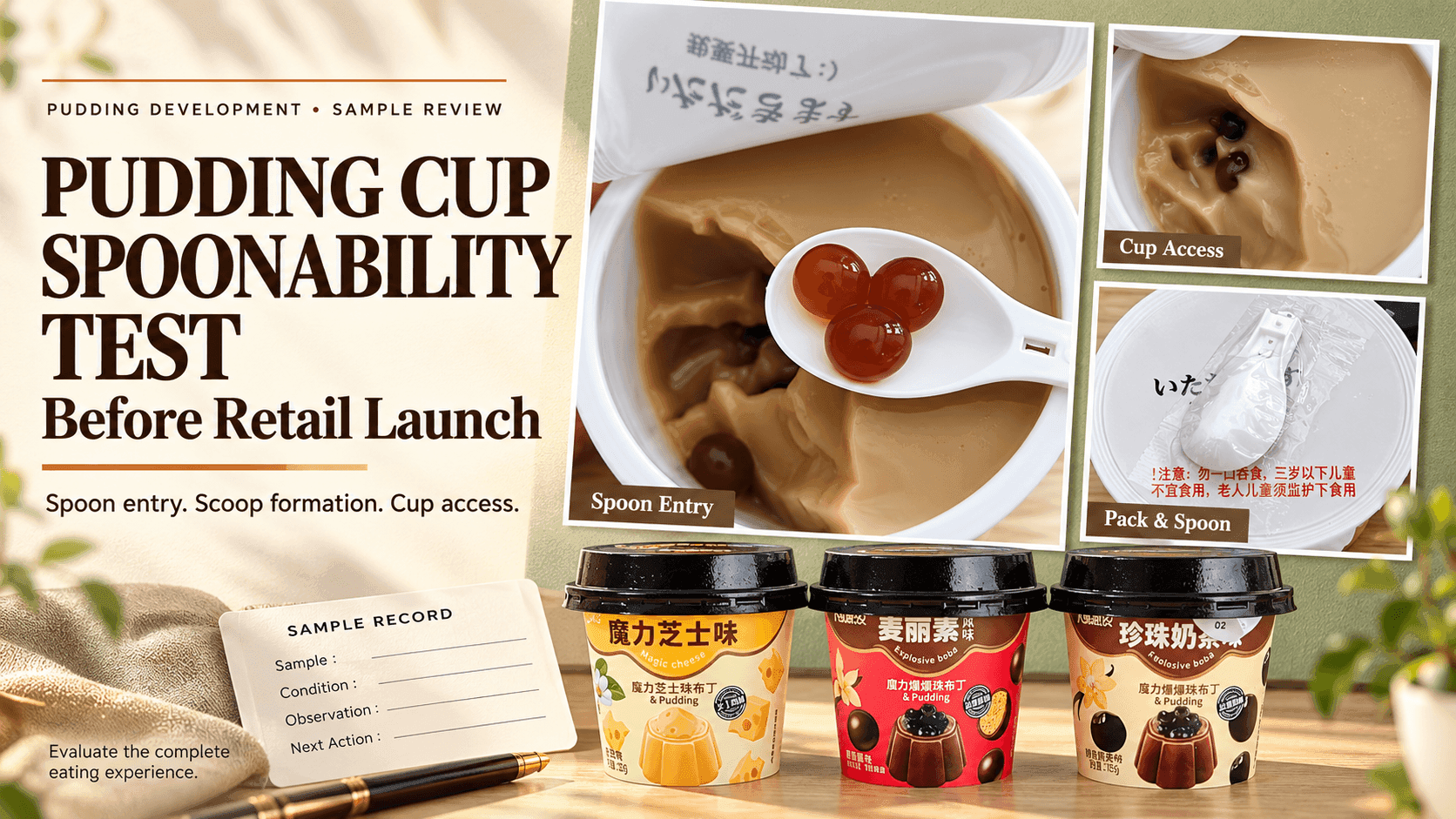
How to Run a Pudding Cup Spoonability Test Before Retail Launch
A pudding sample can have the intended flavor and still fail at the moment of use. The lid may lift cleanly, yet the first spoonful breaks apart. The top may look smooth while the bottom feels dense. The pudding may hold an attractive scoop but leave too much product on the cup wall. None of these issues is captured by a comment such as tastes good.
A spoonability test examines the product, cup and utensil as one eating system. It turns the consumer action of opening, scooping and finishing the pudding into observations that an R&D, quality or packaging team can use.
The test should not create a universal definition of good pudding. A soft dairy-style dessert, a fruit pudding, a layered cup and a product with inclusions may need different behavior. The purpose is to compare the actual sample with the agreed product target under defined conditions and make the next decision traceable.
Define the Decision Before Testing
Start with one decision question. A session may need to determine whether a revised formula is easier to scoop, whether the selected cup works with the intended spoon, or whether the approved texture remains consistent across samples.
Keep the scope narrow enough to produce an action. A spoonability test should not be presented as proof of shelf life, consumer acceptance or manufacturing capability. Those questions require separate evidence.
Write the target in observable terms before opening the sample. For example, the product may be expected to accept the spoon without cracking, form a complete spoonful, hold its shape briefly, feel smooth in the mouth and release from the cup without excessive residue. If the target is intentionally soft and flowing, replace shape holding with the behavior that fits that concept.
Also list the outcomes that would block approval. These may include unexpected liquid separation, a rubbery break, persistent graininess, difficult access to the cup base or strong differences between the top and bottom. The team should agree on these terms rather than invent them after seeing the samples.
Lock the Sample and Package Identity
Record exactly what is being tested. Include the sample code, formula or development version, production or preparation date when available, cup and lid version, fill condition, flavor, inclusion or layer, storage history and any conditioning step used before the session.
The cup matters because geometry changes the eating action. A wide shallow cup offers a different spoon angle from a tall narrow one. Wall taper, rim width, base shape and headspace can affect access even when the pudding formula is unchanged.
Do not pour the sample into a neutral bowl if the decision concerns the retail cup. A bowl can help isolate formula behavior in a separate comparison, but it removes the package-use question. If both tests are useful, label them clearly and avoid combining the results.
Use the intended lid and, where the product includes a spoon, the intended spoon version. A convenient laboratory utensil may hide a problem with the commercial pack.
Set Comparable Evaluation Conditions
Samples intended for direct comparison should be handled in the same defined way. Record the storage condition before testing, the time or condition used for preparation, the serving sequence, the utensil and the room or test environment relevant to the session.
Do not select a universal serving temperature. Test the product under the intended use condition and any additional condition that the project needs to understand. If a pudding may be eaten directly after ambient storage or after chilling, those can be separate, named test conditions rather than mixed into one score.
Keep distracting odors away from the session. Use consistent lighting when appearance and separation are being judged. Evaluators should record their first observations before group discussion so that one confident opinion does not supply the vocabulary for everyone else.
If several versions are compared, use neutral sample codes when brand or formula names could influence the result. Balance the serving order when practical. A firmer or more strongly flavored sample can change how the next one is perceived.
Inspect the Unopened Cup
Begin before the lid is removed. Check whether the cup sits level, the lid appears intact, the fill looks appropriate for the intended presentation and the product has reached the seal or rim unexpectedly.
For a transparent cup, observe whether the product looks uniform around the wall. Record visible bubbles, particles, settling, layer movement or separated liquid without deciding the cause during the test.
These observations belong to the sample record because opening can disturb the evidence. Photograph an unexpected condition before handling the cup further, using the sample code in the image record.
Record the Opening Experience
Open the cup as a consumer would. Note whether the pull tab can be gripped, whether the cup remains stable and whether the lid peels in a controlled way. Record tearing, sudden release, splash, product transfer to the lid, rim residue and any deformation that makes the cup harder to hold.
Opening is related to spoonability because it determines the condition of the surface and the available access area. A partially torn lid can obstruct the spoon. Excess product on the underside of the lid can also change the first impression and create avoidable mess.
Keep seal integrity and opening convenience as separate observations. An easy peel does not prove that the package protects the product, and a seal test is not replaced by a pleasant opening experience.
Observe the Surface Before the First Spoon
After opening, examine the undisturbed surface. Record smoothness, gloss, skin formation, bubbles, cracks, inclusions, color uniformity and visible liquid.
If liquid is present, describe where it appears and whether it is free on the surface, collected near the wall or associated with a layer. Do not stir it back into the pudding before recording the observation.
Visible separation may influence both appearance and the first spoonful, but the test should not diagnose formulation or process causes from appearance alone. The next step is to document how the product behaves when disturbed.
Test the First Spoon Entry
Insert the spoon at a defined location and angle that represents normal use. Record the initial resistance and the way the surface yields.
A useful description explains the behavior. The spoon may enter smoothly, compress the surface before breaking through, cause a crack, push the whole product sideways or meet a dense layer. Words such as good, bad, premium or weak do not tell the development team what happened.
Use a simple anchored scale only after defining its points. One project might distinguish very low resistance, target entry, high resistance and unacceptable cracking. Another may need different anchors. The scale should describe the intended product, not impose a generic preference for softness.
Keep instrument measurements separate if the project uses them. A penetration or viscosity result can support comparison, but it does not show whether the spoon fits the cup or whether a consumer can collect a clean portion.
Evaluate Scoop Formation
Draw the spoon through the pudding using a repeatable motion and lift a normal spoonful. Observe whether the product gathers into one portion, fragments, smears, stretches or slides away before the spoon clears the cup.
Record how much effort is needed to form the scoop and whether the cup must be braced with the other hand. A product that requires scraping or repeated cutting may not fit an easy ready-to-eat occasion even if its mouthfeel is acceptable.
The target scoop should reflect the concept. A softly flowing pudding may mound gently and settle. A firmer dessert may hold a defined curve. A layered pudding may be expected to collect more than one layer in a normal spoonful. Describe the intended result before judging it.
When comparing samples, use a similar scoop path and portion approach. The goal is not to force identical spoonfuls but to reduce variation created by the evaluator.
Check Shape Holding and Spoon Release
Observe the lifted spoonful for the brief period needed by the project. Record whether it holds, relaxes, drips, breaks, stretches or slides from the spoon.
Then note how the pudding leaves the spoon during eating. A sample can hold an attractive shape yet cling heavily to the utensil. Another can release easily but feel too thin for the concept.
Do not turn shape holding into a contest for maximum firmness. Excessive elasticity or a rubbery bite can indicate that the product has moved away from the desired pudding experience. The decision should compare behavior with the brief, not reward the highest resistance.
Evaluate Smoothness Breakdown and Coating
Mouthfeel observations should follow the sequence of eating. Record the first contact, breakdown under the tongue or palate, smoothness, graininess, elasticity, stickiness and the amount of coating or residue after swallowing.
Use specific descriptions. Graininess may be fine or coarse, immediate or delayed, uniform or limited to one part of the cup. Coating may disappear quickly or remain long enough to affect the next spoonful.
Texture can change flavor release. Record whether the target flavor appears promptly, builds slowly or becomes muted as the product breaks down. Keep flavor quality and texture observations in separate fields even when the evaluator believes they are connected. This lets the team decide whether the next action belongs to formulation, flavor work or both.
Preference should also be separate. An evaluator can describe a smooth, slow-melting pudding accurately and still prefer a lighter style. The project decision should use target fit first unless the session was designed as consumer research.
Compare the Top Middle and Bottom
One spoonful cannot show whether the cup is uniform. Take observations from defined positions, such as the top, middle and base, without overworking the product before each check.
Compare entry resistance, scoop formation, smoothness, flavor and visible separation at those positions. Record whether the bottom is denser, the top is wetter, inclusions have settled or a layer prevents normal access.
Also check product near the wall. A pudding may look uniform in the center while a thin liquid layer or denser band appears around the perimeter.
If the product is intentionally layered, judge the layer design rather than demanding complete uniformity. The questions become whether each layer remains distinct as intended, whether a normal spoon can reach them and whether their combined texture works in the selected cup.
Check Cup Wall and Base Access
Continue eating or sampling until the test can assess the side wall, shoulder and base. Note whether the spoon follows the cup shape, whether the rim blocks the hand and whether corners or a recessed base trap a meaningful amount of product.
Residue should be described, not guessed. It may appear as a thin coating, isolated patches or an inaccessible pool near the base. Record whether the cause appears related to pudding adhesion, spoon shape, cup geometry or the interaction among them. Confirm the cause through follow-up work rather than treating the first observation as a final diagnosis.
If the product includes a small spoon, test handle length, bowl size, edge shape and stiffness with the filled cup. The utensil must reach the intended product area without making the consumer's hand contact the rim or product.
Record Separation Without Hiding It
Syneresis or other visible liquid release should have its own field. Record the sample position, amount using the project's method, appearance and effect on spooning. Do not mix the liquid back into the product before the initial observation.
The team may later evaluate whether the condition relates to formula, processing, storage, package interaction or normal behavior for the concept. The spoonability session should preserve what was seen and when it appeared.
A single cup does not establish a trend. Compare the defined number of samples or production positions required by the project and connect unusual results to their sample identity.
Handle Inclusions and Layers Separately
Fruit pieces, popping boba, sauce, grains or other inclusions change the spoon action. Record whether they are distributed as intended, fit on the spoon, remain pleasant beside the pudding and can be reached without excessive digging or mixing.
Check whether the inclusion damages the pudding structure or releases liquid. For a deliberate layer, record the force needed to cross the boundary and whether a normal spoonful can combine the intended components.
Do not approve the base texture and assume the inclusion will behave the same in commercial production. The complete product and package need their own assessment.
Separate Description From the Approval Decision
The test form should distinguish observations, scores, preference and decision. Start with the observed behavior. Add a score only when its anchors are defined. Capture personal liking separately. End with the action and owner.
A practical outcome may be:
- Approve this exact sample and cup for the next defined stage
- Continue with a specific formula or package revision
- Repeat the test because sample identity or conditions were not controlled
- Hold the decision pending packaging, instrumental, stability or production evidence
- Reject the version against a stated requirement
Avoid an overall average that hides a serious defect. Easy opening and pleasant flavor do not cancel unexpected separation or an inaccessible cup base if either is a project requirement.
The decision record should identify the approved version, what the approval covers and what remains open. Photos and short videos can support the record when they use the same sample codes and do not replace written observations.
Connect the Result to the Next Development Step
Translate each issue into the team that can investigate it. High spoon-entry resistance with acceptable mouthfeel may point toward the structure or serving condition. Heavy residue at the base may require a cup and spoon review. Graininess may need formulation, process or storage investigation. Lid obstruction belongs to the packaging workstream.
Do not prescribe the technical solution from a buyer observation alone. Record the behavior, target and priority, then ask the manufacturer to propose and document the revision.
When a sample changes, repeat the relevant parts of the test under comparable conditions. The record should show whether the revision solved the original problem without creating a new one.
Use the Test Again at the Right Stages
Spoonability can be checked during bench development, package selection, pilot or production trials and planned shelf-life evaluations. The purpose changes at each stage.
Early testing helps choose a direction. Pilot testing checks whether the process and package reproduce it. Production checks support consistency against the approved target. Shelf-life work examines change under the defined storage plan.
Keep these records connected to the same product version and approved terminology. A later test should not quietly change the meaning of smooth, target entry or unacceptable separation.
Frequently Asked Questions
Is spoonability the same as pudding firmness
No. Firmness may be one part of spoon entry or shape holding. Spoonability also includes scoop formation, utensil release, access within the cup, top-to-bottom consistency and the eating experience.
Does every pudding need to hold a clean spoon shape
No. The target depends on the product concept. A softly flowing pudding and a firmer set dessert may both be appropriate if their behavior matches the approved brief and package.
Should pudding samples be tested cold or at room temperature
Use the intended consumption condition and any additional condition the project needs to evaluate. Record the condition and keep it consistent for direct comparisons rather than applying one temperature to every pudding.
Can one cup be enough for sample approval
One cup can reveal an issue but cannot establish consistency. The project should define a suitable sampling approach for the development or production decision and preserve each sample's identity.
Can a spoonability test replace a texture instrument
No. Sensory and use observations answer different questions from instrumental measurements. The project may use both when they help define and control the product.
Does a passing spoonability test prove shelf life
No. Shelf-life support must address the final formula, process, package, storage conditions and the full set of relevant quality and safety requirements over time.
Brands and buyers comparing pudding cup samples can share their target texture, cup and intended eating condition for a focused sample discussion.