
How to Review a Functional Jelly Batch Record Before Product Release
A finished batch should be released from evidence tied to the actual lot, not from an approved sample or a passing certificate alone. This guide shows buyers and manufacturers how to review functional jelly production records, material and packaging versions, in-process and finished results, reconciliation, deviations and release status.
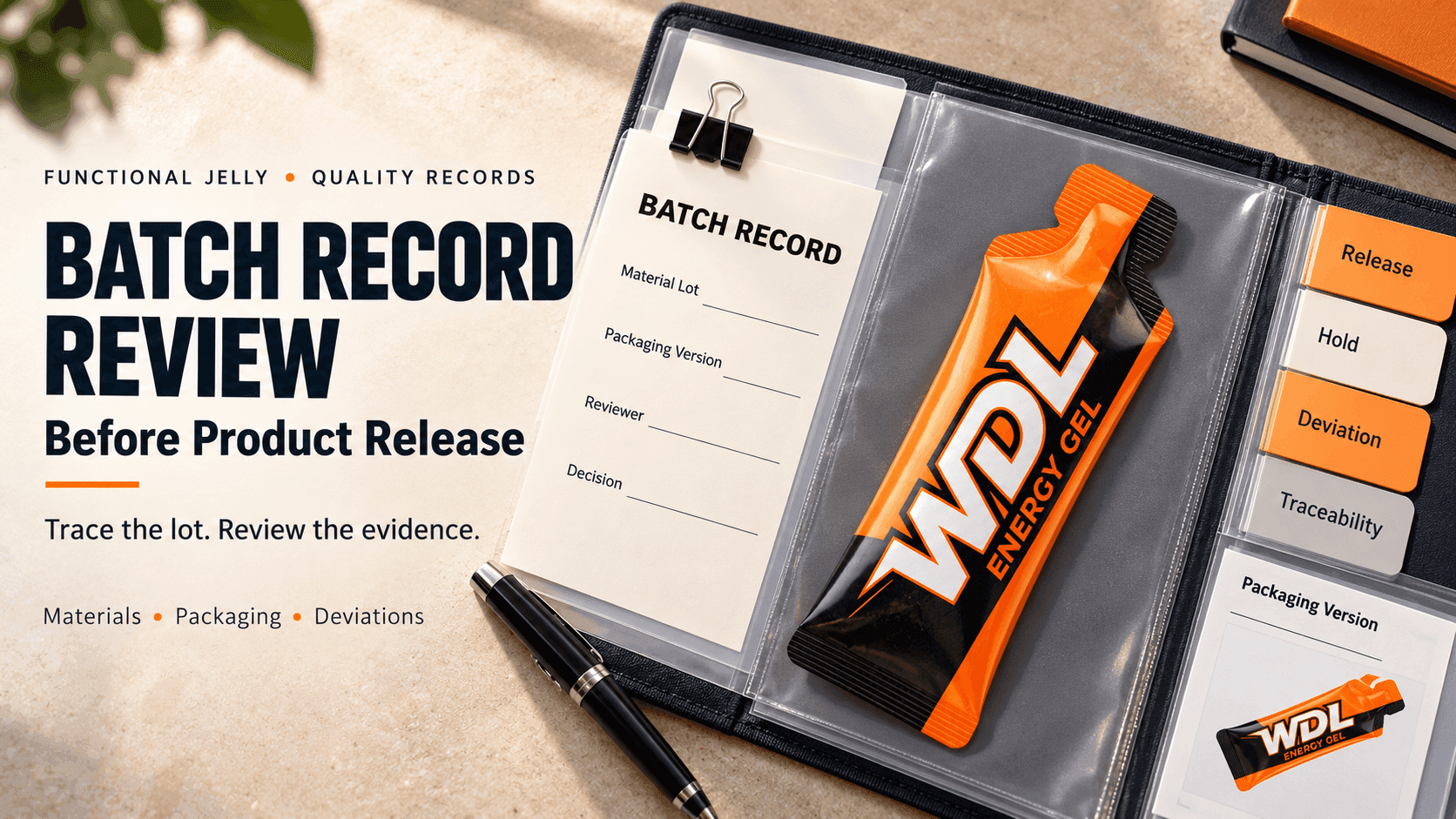
How to Review a Functional Jelly Batch Record Before Product Release
An approved sample defines what a functional jelly project is trying to produce. A finished product specification defines agreed characteristics and acceptance requirements. Neither document proves that a particular commercial lot was made, packed and checked as approved.
That evidence comes from the records for the actual batch.
A batch record review connects the product version, raw material lots, production steps, in-process observations, packaging components, finished results, deviations and final disposition. The purpose is to confirm that authorized reviewers can reconstruct what happened and decide whether the lot may be released under the applicable quality and food-safety system.
This is not a universal release checklist. The necessary records, tests, limits, signatures and review times depend on the product, process, facility, destination market, customer agreement and identified hazards. Buyers should understand the review structure, while the manufacturer retains responsibility for operating its approved system and authorizing product disposition.
Start With the Exact Lot and Release Scope
Define what the review covers before opening individual records. Identify the product name, internal code, formula revision, pack configuration, destination market, production date, lot code, batch size and purchase order or customer reference.
One manufacturing batch may feed several packaging runs. One packaging run may include several flavors or market versions. The review scope should make those relationships visible. If a mixed-flavor retail box combines units from several lots, record which lots entered the assortment and how the finished box can be traced.
Do not use broad wording such as October production when a specific lot is being released. The decision should identify the exact material under review and the quantity or range covered by that decision.
Confirm the Approved Baseline
The reviewer needs a controlled baseline for comparison. Depending on the project, that baseline may include:
- Master formula or manufacturing instruction and revision
- Finished product specification and test methods
- Approved reference sample or sensory standard
- Raw material and packaging specifications
- Approved artwork and coding requirements
- Allergen and market-specific instructions
- Sampling and testing plan
- Change approvals that became effective before production
The batch record should point to the versions actually used. A file marked latest is not enough. If the team approved a formula change after the manufacturing instruction was issued, the record must show whether the change applied to this lot and how the production team received it.
Check Record Identity and Completeness
Each record should identify the activity, date, responsible person and relevant product or lot. Entries should be legible, attributable and made according to the facility's approved procedure. Electronic records need the same level of control as paper records within the applicable system.
The review should also confirm that expected pages, attachments and linked records are present. Missing pages can conceal whether an activity was performed or simply make the history impossible to reconstruct.
Look for unexplained blank fields, copied values, overwritten entries, inconsistent times, missing signatures and records created long after the work occurred. A correction should preserve the original information and show who made the change and why, as required by the applicable procedure.
Completeness does not mean every field contains a number. A field may be not applicable, but the reason should be clear rather than assumed.
Reconcile the Formula and Actual Material Use
Compare the approved formula with the quantities issued and recorded for the batch. Confirm the unit of measure, batch scale, expected adjustments and treatment of premixes, carriers, processing aids or rework where relevant.
The reviewer should be able to answer:
- Were the intended ingredients issued
- Did the quantities align with the authorized batch instruction
- Were additions recorded at the required stage
- Were adjustments authorized and documented
- Was unused or returned material accounted for
- Was any rework permitted and traceable
Do not calculate a universal acceptable variance. Some differences reflect normal dispensing or process behavior, while others can affect ingredient declarations, nutrition values, functional targets, allergens, flavor, texture or safety. The approved system should define how differences are evaluated.
Verify Raw Material Lots and Approval Status
The batch record should link every relevant ingredient to an identifiable lot. Confirm that the material identity, supplier or source, status and expiry or retest information were acceptable for use according to the facility's program.
For a functional jelly, this includes the hydrocolloid system, sweeteners, acids, flavors, colors and any functional ingredients or premixes. A functional ingredient name alone is not enough when different grades, concentrations or carriers are available.
Review whether any substitution occurred. A material described as equivalent should still have an approved identity and documented assessment. If a supplier, grade or premix composition changed, check the change-control status and any effect on the formula, label, claim support, testing or shelf-life evidence.
Do not treat the supplier certificate of analysis as proof that the finished batch meets its specification. It supports the raw material review and must remain linked to the correct incoming lot.
Review the Production Sequence
The batch record should show that the required production steps occurred in the intended order. For functional jelly, the sequence may involve material charging, dispersion, hydration, heating or holding, addition of sensitive ingredients, acidity adjustment, flavor addition, transfer, filling, sealing, cooling or setting and packing.
Compare actual entries with the current instruction. Review the values and observations that the approved process requires without creating new limits during the release meeting.
Where the process relies on time, temperature, mixing, pH, solids or another parameter, confirm that the record contains the necessary actual result and that any required monitoring was completed. A check mark without the underlying observation may not provide enough evidence when the procedure calls for an actual value.
If a step was delayed, repeated or performed out of sequence, route it through the deviation process. The reviewer should not normalize an undocumented process change merely because the finished product looks acceptable.
Confirm In Process Checks and Responses
In-process checks help show whether the batch remained controlled before final testing. The relevant checks depend on the product and process. They may relate to appearance, dispersion, acidity, soluble solids, texture or flow, fill weight, seal condition, coding, unit count or other project-specific characteristics.
The review should consider the result, sampling point, time, method and response. A passing average can hide an isolated failure if the underlying observations are not reviewed. A later acceptable result does not automatically erase an earlier out-of-limit result.
When an adjustment occurred, confirm who authorized it, what was added or changed, which quantity was affected and whether another check followed. The record should show the event rather than present only the final acceptable reading.
Review Filling Sealing and Packaging Records
Product release includes the package that protects and identifies the jelly. Confirm that the actual cup, pouch, film, cap, retail box, case and label versions match the approved packaging set for the order.
Review the relevant line-clearance and packaging-use records. Check whether the lot code, date code, flavor, language, net content, barcode and assortment configuration were applied to the correct product and market version.
Filling and sealing records may include product-specific checks for weight, seal appearance, closure, leakage, code legibility or pack count. Use the approved method and limits. Do not invent a new packaging acceptance rule after production.
If obsolete or incorrect printed material reached the line, the batch should remain under control while the affected quantity and disposition are determined.
Match Finished Results to the Specification
Compare the finished batch results with the active specification and the defined sampling and test methods. The required review may include relevant sensory, physical, chemical, microbiological, nutrition, functional-ingredient or packaging results.
The list should be product-specific. A functional jelly containing vitamins, minerals, collagen, fiber, electrolytes or botanical ingredients may require different evidence depending on the formula, claim, market and quality agreement.
Confirm that the laboratory sample is linked to the correct lot and pack version. Check the test method, unit, result, specification and approval status. If an external laboratory performed the work, preserve the sample and report identifiers.
A certificate of analysis can summarize selected lot results. It does not replace the production record, deviation review, packaging confirmation or authorized release decision.
Review Yield and Packaging Reconciliation
Reconciliation helps the team understand whether inputs, finished units, rejects, samples, rework, returns and waste form a credible batch history.
Compare theoretical and actual quantities using the facility's approved method. Review unusual loss, excess output, unexplained packaging use or discrepancies between produced and packed units.
No single yield percentage applies to every functional jelly. Batch size, equipment, startup and shutdown conditions, viscosity, transfer loss, sampling and pack format can all affect the result. The important point is that the facility defines its review approach and investigates differences that meet its escalation criteria.
Packaging reconciliation also protects version control. An unexplained excess or shortage of printed film, labels or cartons may indicate counting error, waste, damaged material or use outside the recorded order.
Resolve Deviations Before Release
List every deviation, nonconformance, unplanned adjustment and result outside an approved limit that affects the lot. Confirm that the record describes what happened, when it happened, the quantity involved, the immediate control, the investigation status and the authorized disposition.
Do not close a deviation with product passed because the final sample looked normal. The evaluation should address the actual risk to safety, legality, identity, quality, packaging, claims and traceability.
Corrective and preventive actions may continue after a lot decision, but the release reviewer must determine whether the open action affects the current product. If required evidence is incomplete, the lot should remain in the facility's defined hold status until an authorized decision is made.
Confirm Change Control and First Batch Conditions
If this is the first batch after an approved change, check whether the change plan required additional verification. The change may involve an ingredient supplier, formula, processing condition, filling line, package material, artwork, test method or target market.
Review the evidence specified in the change approval rather than assuming ordinary batch checks are enough. Confirm that obsolete materials and instructions were removed from use and that the new versions were issued before production.
The first batch can reveal implementation problems even when the technical change was approved. Record the outcome and any required follow-up without silently moving the baseline again.
Verify Traceability and Retain Samples
The record set should connect incoming material lots, the production batch, finished units, packaging runs and distribution or customer references as required by the applicable system.
Confirm that the finished code is readable and corresponds to the internal lot identity. Where the retain sample plan applies, verify that samples were collected, labeled, registered and stored under the defined conditions. Retained samples are part of future investigation capability; their existence does not prove that the lot passes today.
If shelf-life or stability samples were also collected, keep their purpose and storage plan separate from routine retains.
Check Hold and Release Status in the Physical System
The paperwork and the physical or electronic inventory status should agree. Product awaiting results or review should remain identified and controlled under the facility's hold procedure.
Confirm which quantity is available, held, reworked, rejected, destroyed or released. If part of a batch has a different status, define the boundaries precisely. An email that says looks fine should not move inventory when the approved system requires an authorized release entry.
The person making the disposition should have documented authority and access to the evidence required by the facility, market and customer agreement.
Record the Final Decision Clearly
The final record should state the lot, quantity or scope, decision, date, authorized reviewer and any conditions that remain applicable. Common internal outcomes may include release, hold pending evidence, rework under an approved instruction or rejection. The facility should use its own defined status terms.
A conditional commercial promise is not the same as a quality release. If a required result is pending, the record should show what remains open and prevent unintended shipment.
The buyer may receive a release document or certificate according to the quality agreement. That exchange does not transfer the manufacturer's responsibility for its records or give the buyer authority that has not been assigned.
Prepare a Focused Buyer Release Pack
Buyers rarely need the complete confidential manufacturing record. They do need enough controlled information to confirm that the ordered product and released lot match the commercial agreement.
The agreed release pack may include:
- Product and lot identification
- Manufacturing and release dates where applicable
- Certificate of analysis or conformity with agreed results
- Pack and artwork version confirmation
- Quantity and assortment reference
- Approved deviation or concession information relevant to the buyer
- Storage and transport requirements
- Authorized release statement
Define this pack in the quality agreement before production. Do not request sensitive internal records without a clear purpose, and do not accept a generic certificate that cannot be linked to the shipment.
Use the Review to Improve the System
After release, recurring discrepancies can be trended through the manufacturer's quality system. Repeated late entries, packaging count differences, adjustments, seal defects or document gaps may indicate that instructions, training, equipment, material control or review timing needs attention.
Trend information should support corrective work without rewriting the completed batch history. Keep the original record, investigation and approved changes connected.
A disciplined batch review creates a traceable decision for one actual lot. It also gives the buyer and manufacturer a clearer basis for the next production order.
Frequently Asked Questions
Is an approved sample enough to release a commercial batch
No. The sample is a development or sensory reference. The actual batch still needs the records, results and authorized review required by the product and quality system.
Is a certificate of analysis the same as a batch record
No. A certificate of analysis summarizes selected results for a lot. The batch record documents how the product was made and packed, together with linked checks, deviations and disposition records.
Should a buyer review the complete manufacturing record
Responsibilities depend on the quality agreement, product and market. The manufacturer normally controls its production and food-safety records, while the buyer receives agreed evidence relevant to the purchased product and shipment.
Can a batch be released while a required result is pending
Follow the applicable system and authorized procedure. If a result is required for the release decision, the lot should remain controlled until the necessary evidence and disposition are complete.
Does every functional jelly need the same tests
No. Testing should follow the approved specification, hazards, formula, process, packaging, claims, destination market and customer requirements for the actual product.
What happens when the batch record contains a correction
The correction should follow the facility's record-control procedure, preserve the original information where required and show who made the change and why. An unexplained overwritten value should be investigated.
Brands and importers preparing a functional jelly production order can share their product specification and release-document requirements for a focused project discussion.