
How to Evaluate Jelly Cup Lid Peel Experience Before Retail Launch
A jelly cup can remain sealed and still be awkward or messy to open. This guide shows food brands and retail buyers how to evaluate tab access, peel initiation, cup stability, controlled opening, tearing, splash, rim condition and product presentation while keeping opening convenience separate from seal integrity and shelf-life evidence.
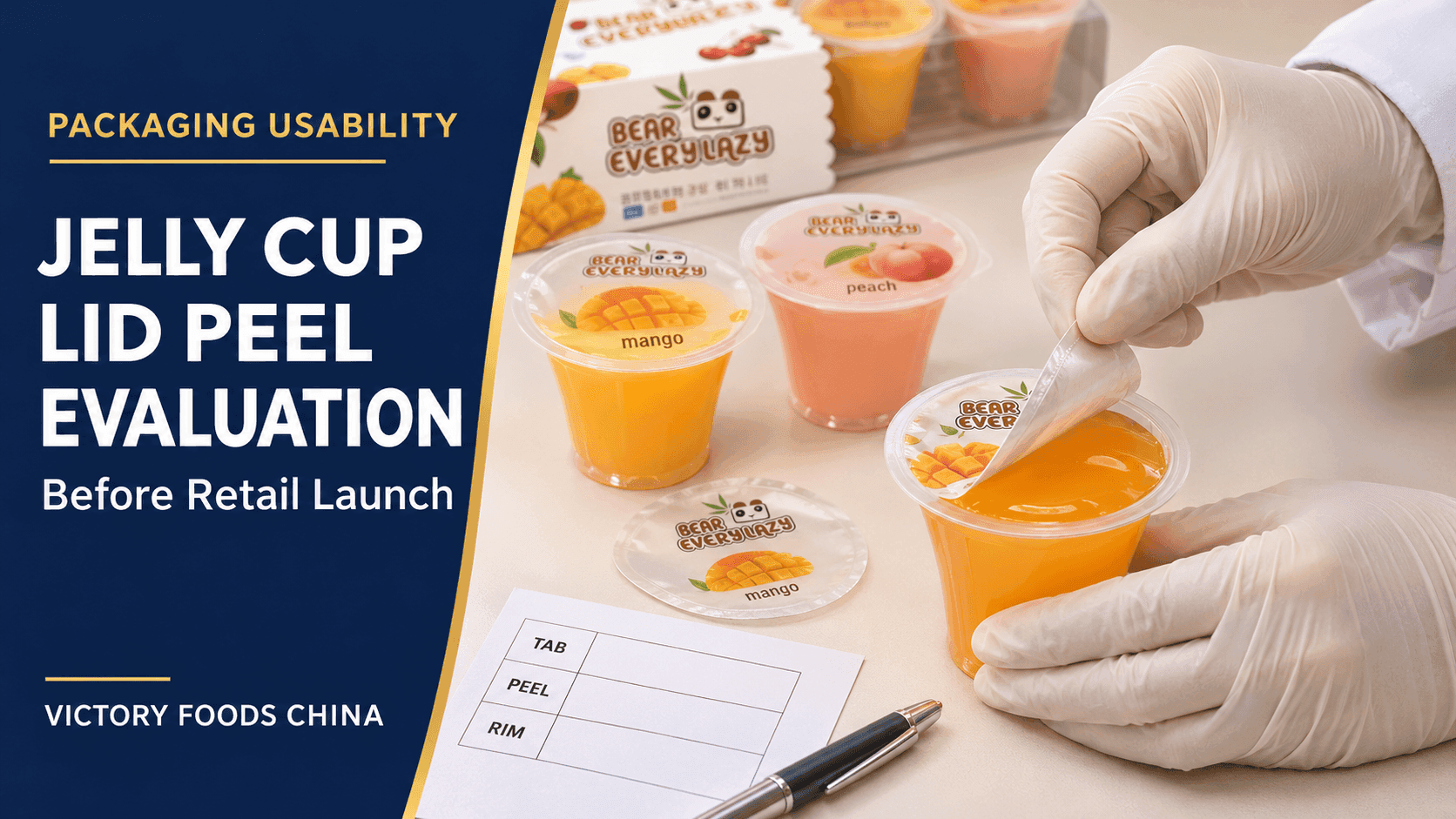
How to Evaluate Jelly Cup Lid Peel Experience Before Retail Launch
A lid can look intact and still create a poor first use. The tab may be difficult to grip, the cup may flex, the lid may tear halfway across the opening or the final release may splash product onto the hand or table.
A lid peel evaluation turns that moment into observable packaging and product information. It helps a buyer compare samples, identify whether the cup and lid work together and decide which issue belongs to usability, packaging validation, product fill or production control.
The evaluation should not invent one peel force or opening style for every jelly cup. It should test the exact product, cup, lid and process version against the intended user and retail brief under defined conditions.
Define the Decision Before Opening
Choose one decision for the session. The team may need to compare two lid structures, confirm that a revised tab is easier to reach, check whether production samples open consistently or determine whether the selected cup stays stable during normal peeling.
Write the intended opening behavior in observable terms. The user should be able to find and grip the tab, begin the peel without an improvised tool, control the cup, remove enough lid for normal access and avoid an unexpected tear, sharp edge or splash.
Keep the decision narrow. A pleasant opening experience does not prove leak resistance, food-contact compliance, shelf life or consumer preference across a market.
Lock the Product Cup and Lid Version
Record the product name, flavor, formula or sample version, batch, fill date when available, cup supplier and version, lid material and artwork version, sealing process or trial reference and the sample condition received.
Use filled packages made through a process representative of the decision. An empty cup with a hand-applied lid may support an early design discussion, but it cannot reproduce the interaction among product, headspace, rim condition, sealing process and opening action.
Do not mix samples from different cup or lid lots without identifying them. A result that cannot be connected to the exact package version cannot support a controlled change or approval.
Set Comparable Evaluation Conditions
Handle comparison samples under the same defined conditions unless the test is intentionally studying a difference. Record sample age, storage history, orientation and the use condition relevant to the project.
Do not apply one universal temperature or conditioning time. Use the approved product instructions and the conditions needed for the actual market or project. If more than one condition matters, evaluate each as a separate named set.
Use the intended cup orientation and open the product on a normal surface. Provide a consistent way to photograph the lid, tab, rim and product before and after opening.
Inspect the Unopened Package First
Before touching the tab, inspect the cup wall, rim, lid position, printed information and visible product. Record folds, wrinkles, punctures, product at the seal area, lifted areas, deformation, unreadable codes or damage from transport.
Photograph an unexpected condition before opening. Peeling can change a wrinkle, move product at the rim or destroy evidence of where a tear began.
Keep visual seal observations separate from peel convenience. A lid that looks neat can still open poorly, and a lid that opens smoothly can still require separate evidence for package integrity.
Check Tab Visibility and Access
Ask whether the user can identify the opening tab without turning the cup repeatedly or covering important label information. Record whether the tab is large enough to approach and whether it lies flat against the cup or neighboring packaging.
Grip the tab in the way intended for the target user. Note whether the fingers slip, whether the tab folds, separates from the lid or requires the user to press against the product surface.
If a tool is needed, stop and record the condition unless tool use is part of the approved design. Do not normalize an improvised knife, scissors or teeth as an acceptable retail opening method.
Observe Peel Initiation
Record what happens when the first lifting force is applied. The lid may begin smoothly, resist and then release suddenly, stretch, delaminate, tear at the tab or deform the cup rim.
Describe the direction and location of the first change. A comment such as hard to open is less useful than the tab folded before the seal began to separate or the cup wall flexed while the first corner remained attached.
If the project uses an instrumented peel method, keep the measurement and the user observation as related but separate records. A force result does not show whether the tab is visible or whether a person can control the cup.
Evaluate the Peel Path
Continue the opening in the intended direction and record whether separation progresses evenly around or across the rim. Note stops, jumps, tearing, material splitting, print transfer, partial layers left on the rim or a path that pulls the lid into the product.
Observe the hand position and cup stability. The package should not require a grip that crushes the cup, touches the jelly or places the hand in the likely path of sudden release.
If the lid is designed for partial opening, check whether the remaining attachment stays out of the eating path. If full removal is intended, check whether the final section releases cleanly without a long strip or sharp fragment.
Record Splash Spill and Product Transfer
Watch the product surface, lid underside, rim, hand and work surface during opening. Record whether product or free liquid moves because of cup flex, sudden lid release or product contact with the underside of the lid.
Separate the event from its suspected cause. Splash may relate to fill condition, headspace, product texture, handling, cup stiffness, peel direction or the lid release pattern. The evaluation should preserve the observation before the technical team investigates the cause.
A small amount of product on the lid may be expected for some concepts, while another brief may require a clean presentation. Define the target for the actual product rather than applying a generic preference.
Inspect the Rim Lid and Product After Opening
Examine the exposed rim for torn material, residue, distortion or an edge that could interfere with eating. Check the removed lid for delamination, fragments and print or coating changes.
Observe whether the product surface remains presentable and accessible. A torn lid can obstruct the spoon or fingers, while rim residue can create mess even when the jelly itself is unchanged.
The pudding cup spoonability test shows how opening condition affects access to the product while keeping opening convenience separate from seal performance. Use that distinction when the jelly cup is intended for spooning or another direct eating action.
Separate Usability From Seal Integrity
A lid peel evaluation answers how the package opens. Seal integrity work asks whether the closed package remains continuous and protective under approved manufacturing, handling, storage and distribution conditions.
The alcohol jelly cup seal integrity guide explains that visual inspection, mechanical seal-strength work, leak detection and shelf-life evidence answer different questions. The same principle applies to non-alcohol jelly cups: one smooth opening does not prove the package is leak-tight or suitable for the stated shelf life.
If opening is difficult, the team should not weaken the seal without assessing package protection. If the package passes a seal test, the team should not ignore a repeatable tearing or splash problem. Both results belong to the final package decision.
Compare Samples and Record the Decision
Use neutral sample codes when comparing versions. Record each package separately before discussing the group result, because one dramatic tear can influence how evaluators describe the next sample.
A practical record includes sample identity, condition, unopened observations, tab access, peel initiation, peel path, cup stability, tearing, splash, rim condition, product presentation, photographs and the evaluator's comments. Keep preference separate from the observed behavior.
Choose a clear outcome such as approve for the next defined stage, revise and retest, hold pending seal or production evidence or reject against a stated requirement. Do not average away a serious safety, integrity or usability issue.
Repeat the Evaluation After Relevant Changes
Reassess opening behavior when the cup, lid, seal layer, supplier, artwork, tab geometry, product formula, fill condition, sealing process, secondary pack or intended use changes in a way that may affect the result.
Production samples should be compared with the approved reference and specification. Record whether variation appears by line position, time, material lot or handling condition without assuming a cause from a small set.
Keep the final decision connected to the exact product and package version. A successful test on one jelly cup should not be reused as approval for a different system without a documented assessment.
Food brands and retail buyers can share their target jelly cup, lid and opening brief with Victory Foods for a focused sample review before launch.
Frequently Asked Questions
What is a jelly cup lid peel evaluation
It is a controlled usability review of how the tab is accessed, how the peel begins and progresses and what happens to the cup, lid, rim and product during opening.
Does easy opening prove seal integrity
No. Opening convenience, seal strength, leak resistance, food-contact suitability and shelf life require related but separate evidence.
Should every jelly cup use the same peel force
No. The package and project must define suitable performance for the exact product, cup, lid, process, user and intended use. This guide does not set a universal force limit.
Can empty cups be used for the evaluation
They can support early design review, but filled packages made through a representative process are needed when the decision depends on product contact, headspace, rim condition and production sealing.
What should be recorded when a lid tears
Record the exact sample, where the tear began, the peel direction, cup behavior, remaining material, product movement and photographs. Do not assign cause until the package and process evidence is reviewed.
Should a difficult lid be opened with a tool
Only if tool use is part of the approved design. Otherwise, stop and record the issue rather than treating an improvised tool as normal consumer use.