How to Build a Functional Jelly Complaint Intake Record Before Investigation
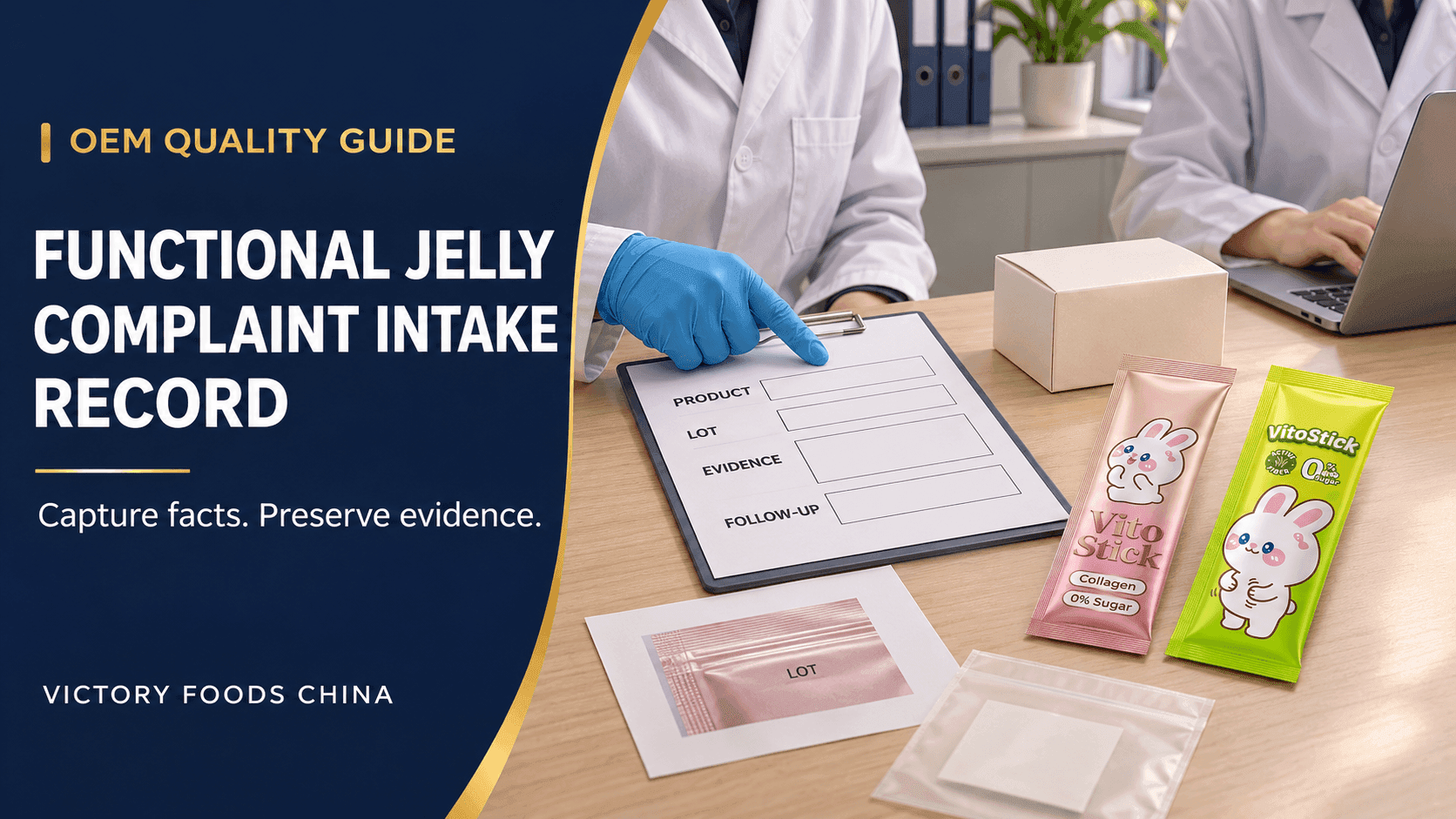
A useful complaint record preserves the facts needed for a later investigation without assigning a cause too early. This guide shows functional jelly brands, importers and OEM teams how to capture product identity, lot information, the reported condition, handling history, evidence, affected scope and escalation status in one controlled intake record.
How to Build a Functional Jelly Complaint Intake Record Before Investigation
A complaint can arrive as a short email, a photograph from a distributor or a message from customer service. If the first record says only that the jelly was wrong, the quality team may lose the details needed to identify the product, preserve evidence and decide what should happen next.
A complaint intake record has a narrow purpose. It captures what was reported, which product may be involved, what evidence exists and whether immediate escalation or control is required. It should not assign root cause, approve product disposition or close the case before qualified reviewers have examined the evidence.
For a functional jelly project, the intake must connect the commercial report to the exact formula, flavor, format, package and lot whenever possible. The record then becomes a reliable starting point for traceability, technical review and communication with the reporter.
Define the Intake Decision
State what the intake reviewer must decide. The first decision is usually whether the report contains enough information to open an investigation, whether more evidence is required and whether the matter needs immediate escalation.
Keep intake separate from investigation. The reviewer may classify the reported issue and protect affected information or samples, but should not write supplier failure, process error or consumer misuse unless evidence later supports that conclusion.
Define who receives complaints, who checks completeness, who can place product on hold and who can activate food safety, legal, recall or market communication procedures. The form should point to those procedures rather than trying to replace them.
Identify the Reporter and Communication Route
Record the date and time received, the channel, the organization or person reporting the issue, contact details and the market or location involved. If a distributor reports on behalf of a retailer or consumer, preserve that relationship so follow-up reaches the person who observed the product.
Use a unique complaint number from the first contact. Include that number in emails, photographs, sample labels and internal records so evidence is not separated from the case.
Record the preferred language and any response deadline stated by the customer or required by the applicable procedure. Do not promise a cause or resolution date before the team understands the scope.
Lock the Exact Product Identity
Capture the product name, product code, flavor, functional jelly format, pack size, destination market and any visible artwork or packaging version. Ask for photographs of the full front, back, lot or date code and the reported condition when that can be done safely.
Do not identify a product from color or a partial logo alone. Similar flavors, samples and commercial versions may use related packaging. Mark the identity as confirmed, probable or not yet confirmed.
If the report concerns a sample, record the sample code and dispatch reference. A development sample should not be treated as a released commercial lot, and a commercial complaint should not be investigated against a later sample version.
Capture Lot and Distribution Information
Ask for the lot or batch code exactly as printed, including spaces and characters. Record the date marking, case code, shipment or order reference, purchase location and purchase date when available.
The functional jelly traceability test guide explains why a finished unit should connect backward to ingredients and packaging and forward to recorded shipments. The complaint intake record supplies the starting clue, but it does not prove that the traceability chain is complete.
If the lot code is unreadable or missing, record that fact and request photographs of the code area, outer pack and shipping case. Do not invent a lot from the purchase date or assume all units in a store came from one batch.
Describe the Reported Condition Without Diagnosing It
Write the observation in concrete terms. Examples include a lifted lid, liquid outside the cup, a different texture from previous units, unexpected color, missing or incorrect printing, a damaged pouch, an unusual odor or the wrong flavor in a multipack.
Preserve the reporter's wording and add clarifying facts separately. Ask where the condition appeared, how many units were observed, whether the package was open, whether the issue was present before use and what happened immediately before the observation.
Avoid broad labels such as contamination, spoilage, defective formula or seal failure during intake unless the reported facts establish the term. The investigation can later classify the condition using the approved specification and methods.
Record Storage Handling and Use Context
Ask where the product was stored before and after purchase, whether it was exposed to unusual heat, freezing, direct sunlight or physical damage and whether the package was transported after opening. Record only what the reporter knows.
For products with preparation or consumption instructions, ask whether the reported unit was used as directed and whether other ingredients or utensils contacted it. These questions add context; they should not be used to blame the reporter.
Separate confirmed history from assumption. Unknown storage history is an open evidence gap, not proof that the product was mishandled.
Preserve Physical and Digital Evidence
Record whether unopened units, the affected unit, outer packaging, receipts, shipping cases or photographs remain available. Give clear instructions for identification and secure handling under the company's procedure.
Do not ask someone to taste, smell closely or reopen a questionable product merely to complete the form. If the report suggests a possible safety issue, follow the applicable escalation procedure and provide only approved instructions.
Keep original images and files when possible. Record who supplied them and when. If a physical sample is collected, document its identity, condition, transfer and storage so later testing is connected to the item actually reported.
Define the Potential Scope Carefully
Record the number of units reportedly purchased, opened, affected, remaining and available for review. These quantities are different and should not be combined into one complaint count.
Ask whether another unit from the same pack, case or lot showed the same condition. Also record whether similar reports have been received, but do not call the issue a trend until the data has been reviewed under a defined method.
The intake scope may change after traceability and production records are examined. Mark the initial scope as reported, then preserve each later revision and its evidence.
Triage the Report and Protect Product
Use the approved triage categories and escalation rules for the project. A report involving illness, injury, an undeclared allergen, foreign material, loss of package integrity, incorrect identity or other possible safety or legal concern may require immediate action beyond routine quality review.
The intake reviewer should not invent universal severity scores. The applicable food safety plan, destination-market rules, customer agreement and company procedures determine who evaluates the risk and which notifications or controls apply.
When product control is required, link the complaint to the hold, traceability, withdrawal, recall, deviation or market record. The functional jelly deviation and corrective action guide is useful after an internal requirement or affected batch has been defined; it should not be used to guess a cause from the first complaint.
Assign Follow Up and Communication Ownership
List every missing item, its owner and the date requested. Typical gaps may include lot photographs, sample availability, purchase details, distribution records or the exact number of affected units.
Name the person responsible for acknowledging the complaint and the person responsible for technical review. Customer communication should describe the current status and next step without promising an unsupported conclusion.
If the reporter cannot provide more information, keep the limitation visible. The case may still require a documented risk review, but the final conclusion should state which evidence was unavailable.
Transfer the Intake Into a Controlled Investigation
Before handoff, confirm that the complaint number, product identity status, lot information, reported condition, available evidence, potential scope, triage decision and assigned actions are complete or clearly marked as open.
The investigator should work from the preserved intake rather than a rewritten summary that removes uncertainty. Link later laboratory results, production records, retain samples, supplier information and disposition decisions back to the same case.
Close the intake stage when responsibility has transferred and urgent controls have been addressed. Close the complaint itself only under the approved complaint procedure after the required evaluation, communication and authorization are complete.
Brands and importers planning a functional jelly project can discuss the complaint evidence and record structure they expect their OEM partner to support.
Frequently Asked Questions
What is a functional jelly complaint intake record
It is the controlled first record of a reported product issue. It captures identity, lot information, the observation, evidence, scope and escalation status before a full investigation assigns cause or disposition.
Should the intake form identify root cause
No. It should preserve facts and open questions. Root cause belongs to the investigation and must be supported by evidence.
What if the lot code is unavailable
Record that it is unavailable, request photographs and other purchase or shipment information and keep the identification limitation visible. Do not invent a batch from dates or appearance.
Should the reporter keep the product
Follow the approved company and market procedure. When retention is appropriate, give safe, controlled instructions and document the sample identity and chain of custody.
Does one complaint prove that a full batch is affected
No. It can trigger review, but the affected scope must be established from traceability, production, distribution and complaint evidence.
When should a complaint be escalated
Use the applicable food safety, legal, customer and market procedures. Possible illness, injury, allergen, foreign-material, identity or package-integrity concerns may require immediate qualified review.
Can the complaint record replace a deviation or recall record
No. It may link to those records when the facts require them, but each record has a different decision and authorization purpose.