
How to Choose the First Retail Channel for VOLT Adult Jelly
VOLT needs a first retail channel that can manage an alcohol-containing product, explain an unfamiliar jelly format and generate useful launch evidence. This guide shows importers and distributors how to compare channel eligibility, adult shopper fit, product education, age controls, six-cup pack handling, staff support and pilot data before expanding distribution
How to Choose the First Retail Channel for VOLT Adult Jelly
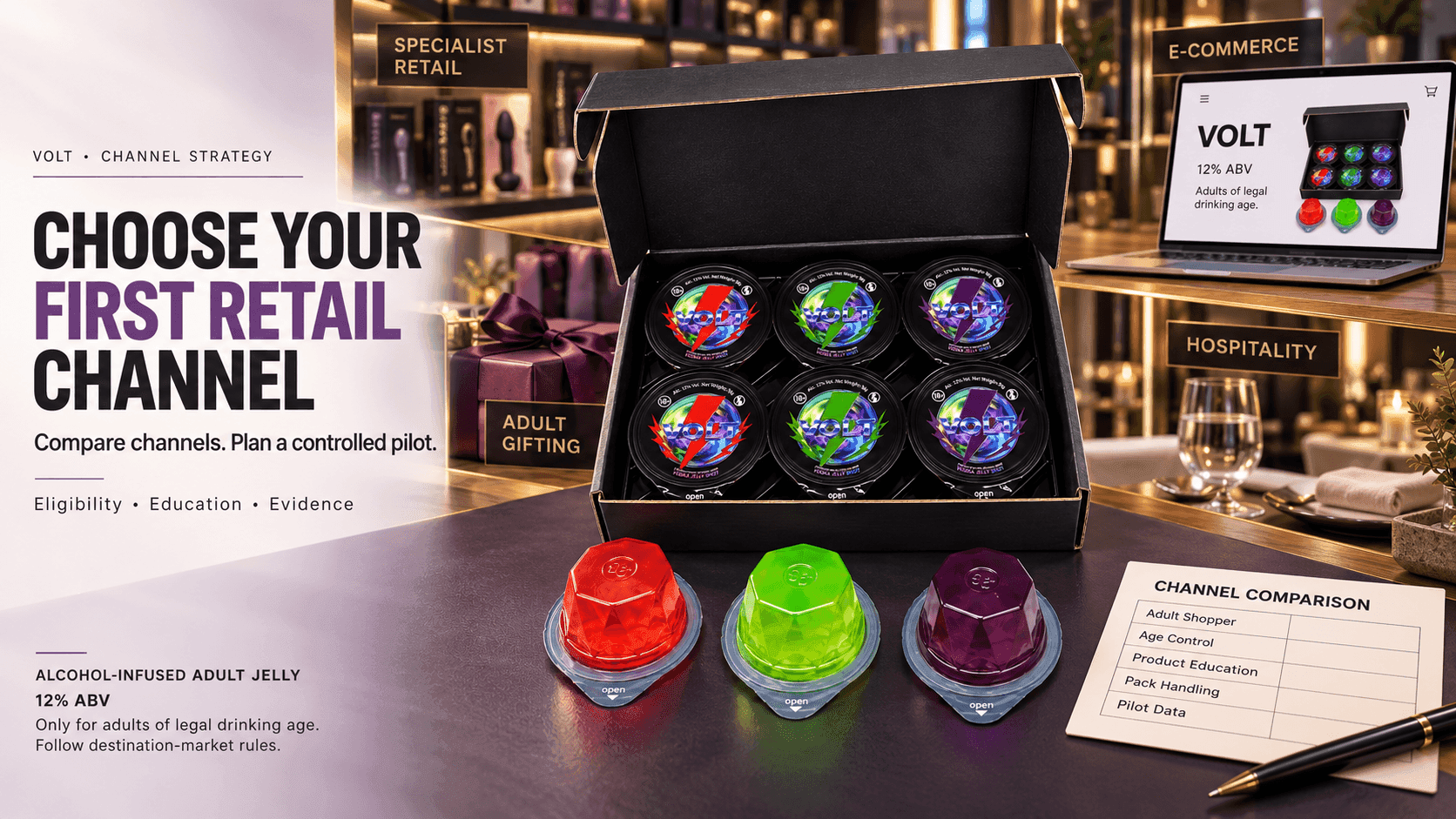
The first retail channel for VOLT should make the product understandable, control an alcohol-containing sale and produce evidence that the importer can use for the next decision.
VOLT is positioned as an adult jelly confectionery containing alcohol. The current retail format contains six individually sealed cups at 12 percent ABV in apple, grape and cherry flavors. It can be stored under approved ambient conditions for up to 18 months and should be protected from direct sunlight.
Those facts define the product. They do not determine where it may be sold. Product classification, import permission, licensing, tax, label requirements, age controls, advertising and channel eligibility depend on the destination market and the responsible authorities.
Once those requirements are understood, channel selection becomes a commercial comparison. The best first channel is not automatically the largest account or the outlet with the most traffic. It is the channel that can present the product accurately, reach eligible adult shoppers, operate the required controls and return useful information from a controlled pilot.
Treat Legal Eligibility as an Entry Gate
Start with a written market review before scoring commercial appeal. A channel that cannot lawfully or operationally sell the classified product should not remain on the shortlist.
The importer or responsible market partner should confirm:
- Product classification and the authorities involved
- Importer, wholesaler and retailer permissions
- Tax and customs treatment
- Approved product name, alcohol statement, warnings and local language
- Permitted sales channels and hours where applicable
- Age verification at sale, service and delivery
- Sampling, promotion and advertising restrictions
- Responsibilities for records, refusals and staff training
Do not use adult jelly confectionery as a shortcut around that review. It is a useful brand and merchandising description because it tells adults that VOLT is eaten as a jelly. It does not create a legal exemption.
If two channels operate under different licences or authorities, document those differences before comparing sales potential. A store, hospitality venue, e-commerce platform and event may each have a separate approval route even in the same market.
Define the Job of the First Channel
A first channel needs a specific learning goal. Without one, the pilot can produce sales numbers but little guidance for expansion.
Choose the primary question. The importer may need to learn whether adults understand the category, whether the six-cup box fits a gifting occasion, whether staff can explain the product, whether the price position supports reordering or whether online content can convert interest without a live explanation.
Write the channel job in one sentence. For example:
This pilot will test whether legal-age adult shoppers in a specialist retail setting understand VOLT as an alcohol-containing adult confectionery and whether the account reorders after the first controlled placement.
Another pilot may focus on e-commerce:
This pilot will test whether an approved product page and age-controlled delivery journey can explain the six-cup format clearly enough to generate qualified orders and manageable customer-service questions.
Do not ask one pilot to prove every market assumption. Select the channel that gives the clearest evidence for the current question.
Build a Market Specific Channel Shortlist
Create the shortlist only after legal and retailer eligibility have been reviewed. Possible channel types may include licensed specialist retailers, authorized supermarket alcohol departments, adult gifting businesses, duty-free or travel retail, approved hospitality venues, age-controlled e-commerce and permitted adult events.
These examples are not recommendations for every market. The list should show which actual accounts are available, what permission each one holds and what product rules the account applies.
Describe each candidate channel in operational terms:
- Named account or account type
- Eligible product classification
- Target adult shopper
- Purchase occasion
- Physical or digital selling environment
- Age and access controls
- Staff or content support
- Pack and case handling
- Data available from the pilot
- Commercial owner and approval status
A label such as premium retail is too broad. One premium store may have trained staff and controlled alcohol sales. Another may sell only ordinary confectionery and have no process for an alcohol-containing jelly product.
Match the Channel to an Adult Shopper and Occasion
Define who is expected to buy VOLT in the proposed channel and why that shopper is there.
A specialist adult beverage retailer may reach shoppers who already accept age verification and expect product explanation. An adult gifting business may provide a familiar occasion for a six-cup box. A hospitality venue can demonstrate the eating experience, but the sale or service model may be different from take-home retail. An online account can reach a broad area, but it must explain the format without relying on staff at the shelf.
Use a concrete adult occasion rather than a general claim that the product is for parties. The occasion might be an adult host gift, a tasting with friends, a novelty confectionery purchase for a legal-age recipient or an addition to an approved adult celebration range.
Keep the audience definition tied to legal-age adults. Terms such as Gen Z are too broad because the generation includes people below the legal drinking age in many markets.
Compare the Product Education Burden
VOLT is not a familiar bottle, chocolate box or ordinary fruit jelly. The first channel must help the shopper understand what it is, that it contains alcohol, how the six-cup box works and how the product is eaten.
Compare how much explanation each channel can provide before purchase. A staffed specialist store may use an approved shelf card and a short verbal explanation. A supermarket may offer wider reach but less time for staff education. An e-commerce page can carry complete product information, yet the content must work without a salesperson.
Liquor-filled chocolate can be used as a brief consumer reference when it improves understanding. Both can sit within a broader adult confectionery occasion. The comparison must stop before it suggests that VOLT is chocolate, shares the same formula or has the same legal classification.
The core explanation should remain accurate:
VOLT is an alcohol-containing adult jelly confectionery with six individually sealed cups at 12 percent ABV in apple, grape and cherry flavors.
Score a channel on whether this message can appear clearly and consistently in the pack presentation, shelf or page content, staff language and customer-service response.
Evaluate Age and Access Controls
Age control is part of channel capability, not a footnote added after listing.
Review the complete transaction. In a physical store, this may include product placement, staff awareness, point-of-sale prompts, identification procedures and refusal records. Online, the workflow may also include account restrictions, checkout controls, delivery instructions and verification when the product is handed over.
The exact requirements depend on local law, the product's classification and retailer policy. A website age pop-up does not by itself prove that the whole sale and delivery process is compliant.
Ask the channel owner to show how the current system handles an unfamiliar alcohol-containing food. Confirm that the product code, category and staff instruction will trigger the correct controls. Test the process before the first public sale.
Also review visibility to unintended audiences. A channel may be legally eligible but still use youth-oriented placement, creative content or adjacent categories that make the product hard to present responsibly. Correct that risk before launch or remove the channel from the pilot.
Check the Fit of the Six Cup Box
The first channel should be able to present the complete retail format. The box contains six individually sealed cups and three flavors, so it needs enough space and explanation to show the assortment.
Review how the account receives, stores, displays, picks and replenishes the product. Confirm that the outer box remains intact, the individual cups are protected and required information stays visible. The product should remain under its approved ambient storage conditions and away from direct sunlight.
Channel fit questions include:
- Will the box be sold intact or opened by the account
- Can the shelf or page show all three flavors accurately
- Does the account understand that six cups do not equal a serving recommendation
- Can the case configuration support normal replenishment
- Will security devices or shelf fixtures damage or hide the pack
- Can e-commerce picking and parcel handling protect the box and seals
Do not judge fit from a rendering alone. Use the finished box and commercial case in the proposed workflow when possible.
Review Staff and Content Capability
An unfamiliar format creates predictable questions. The first channel should have a practical way to answer them without improvising.
For staffed retail, confirm who trains the team, where the approved product sheet is stored and how updated wording reaches each location. Staff should know the product identity, 12 percent ABV, six-cup structure, flavors, storage guidance and adult-only status. They should send legal or medical questions to the approved contact rather than inventing an answer.
For e-commerce and marketplaces, the same role belongs to the product page, images, FAQ, customer service and delivery messaging. The page should disclose the alcohol nature early, show the real box and cups and explain the format in plain language.
Compare the amount of support each channel requires. A small specialist account may need a short training session. A large chain may require centralized product data, approved training material and version control across many locations. The larger account is not necessarily the easier first test.
Assess Sampling and Demonstration Options
VOLT becomes easier to understand when an eligible adult can see the sealed cup, open it and experience the jelly texture. That makes sampling valuable, but the activity must be permitted and controlled.
Confirm who may host the activity, where it may occur, who can participate, how age is checked, what product information must be given and how opened and unopened samples are handled. The session should demonstrate the product without encouraging speed, competition or volume.
If consumer sampling is not permitted or practical, the channel may still use a sealed display sample, product video, cup cross-section image or staff demonstration with no consumption, subject to local rules and retailer approval.
Score the channel on its ability to support responsible product education, not on the number of samples it can distribute.
Compare the Quality of Available Data
The first channel should provide information that can guide the second channel decision.
Ask what the account can report. Useful evidence may include units received, units sold, reorder timing, returns, damaged packs, staff questions, customer-service topics, product-page behavior and reasons for refusal or cancellation where records are permitted.
Separate sales from interpretation. A high-traffic outlet may sell more units while producing little information about who understood the product. A smaller specialist account may reveal clearer patterns in category explanation, gifting interest and repeat orders.
Do not treat likes, views or one enthusiastic event as proof of repeat demand. Define the pilot measures before launch and connect them to the decision question.
The importer should also agree on the reporting period, inventory basis and data owner. A reorder means something different when the first order was intentionally small, transferred between stores or supported by a one-time promotion.
Model the Channel Economics With Confirmed Inputs
Compare economics using current quotations and actual channel terms. Do not invent a universal recommended retail price, margin or sell-through rate.
The channel model may include landed cost, distributor and retailer terms, listing fees, promotional support, samples, content production, delivery cost, breakage, returns, taxes and working capital. Include the cost of education and control. A channel that requires extensive field training or special fulfillment may need a different pilot size from one using an existing adult retail system.
Record which inputs are confirmed, estimated or still open. Test more than one realistic volume scenario if the account has not committed to a reorder plan.
The first pilot does not need to maximize short-term profit. It should still have a credible commercial path if the evidence supports expansion.
Choose a Controlled Pilot Scope
Limit the first launch to a scope that the team can support and observe. The scope may be a defined group of stores, one approved e-commerce region, selected hospitality accounts or a time-bound seasonal range.
The pilot plan should identify:
- Product and artwork version
- Participating accounts and locations
- Start and review dates
- Opening inventory and replenishment process
- Approved shelf, page and staff materials
- Age-control and refusal procedure
- Sampling or demonstration plan where permitted
- Storage and damaged-pack handling
- Data fields and reporting owner
- Decision criteria and escalation contacts
Do not choose the number of stores or weeks from a generic benchmark. Use the quantity and duration needed to observe the intended decision while maintaining control of stock, training and reporting.
Use a Channel Comparison Scorecard
A scorecard makes assumptions visible. Use the same factors for each eligible candidate and define what a high or low score means.
Relevant factors can include:
- Legal and retailer eligibility confirmed
- Fit with the target adult shopper and occasion
- Ability to explain adult jelly confectionery clearly
- Age and access controls
- Six-cup pack handling and visibility
- Staff or digital content capability
- Responsible sampling or demonstration options
- Quality of sales and feedback data
- Commercial viability using confirmed terms
- Ability to run a controlled pilot
Do not average away a blocking requirement. A channel cannot compensate for missing legal eligibility with strong shopper traffic. Mark mandatory gates separately from commercial scores.
Add a short evidence note beside every rating. The team should be able to see whether a score comes from a retailer policy, system demonstration, signed commercial term, staff interview or assumption that still needs confirmation.
Record the Decision and the Next Gate
The decision record should name the selected channel, pilot scope, supporting evidence, open conditions, owner and next review point. It should also explain why other channels were deferred.
Possible outcomes include:
- Approve one channel for a controlled pilot
- Hold the channel pending a legal or retailer decision
- Revise the product explanation or sales material before testing
- Test two channels because they answer different questions
- Reject a channel that cannot meet a mandatory requirement
Expansion should follow evidence from the pilot. If adults understand the product but staff questions remain high, improve training before adding stores. If the channel produces initial orders but no repeat purchase, investigate the product, price, occasion and availability before increasing distribution.
The first channel is a learning environment for a new adult confectionery format. A controlled choice gives the importer a clearer basis for the next retail conversation.
Frequently Asked Questions
Is adult jelly confectionery a legal retail category
Not necessarily. It is a brand and merchandising description for VOLT. The destination market determines legal classification, permissions, tax, labeling, age controls and channel eligibility.
Should VOLT launch first in the largest retail chain
Not automatically. The first account should be eligible, able to explain and control the product and capable of providing evidence relevant to the next decision.
Can VOLT be compared with liquor filled chocolate
The comparison can help adults understand the broader adult confectionery occasion. It does not determine legal classification or prove that the products share the same license, tax or retail rules.
Is a specialist alcohol retailer always the best first channel
No. It may offer useful controls and staff knowledge, but suitability depends on the product classification, shopper, occasion, account capability, commercial terms and purpose of the pilot.
Can e commerce be the first channel
It may be considered when the destination market, platform, retailer and delivery process permit the product and the complete age-control and information journey has been reviewed.
What should decide whether the pilot expands
Use the criteria set before launch. These may include accurate product understanding, controlled sales, reorder evidence, manageable staff or customer questions, pack condition, compliant operations and a credible commercial model.
Importers and qualified retail buyers comparing launch channels can share their destination market, proposed account type and sample requirements for a focused discussion.