
How to Test Squeezable Jelly Pouch Usability Before Retail Launch
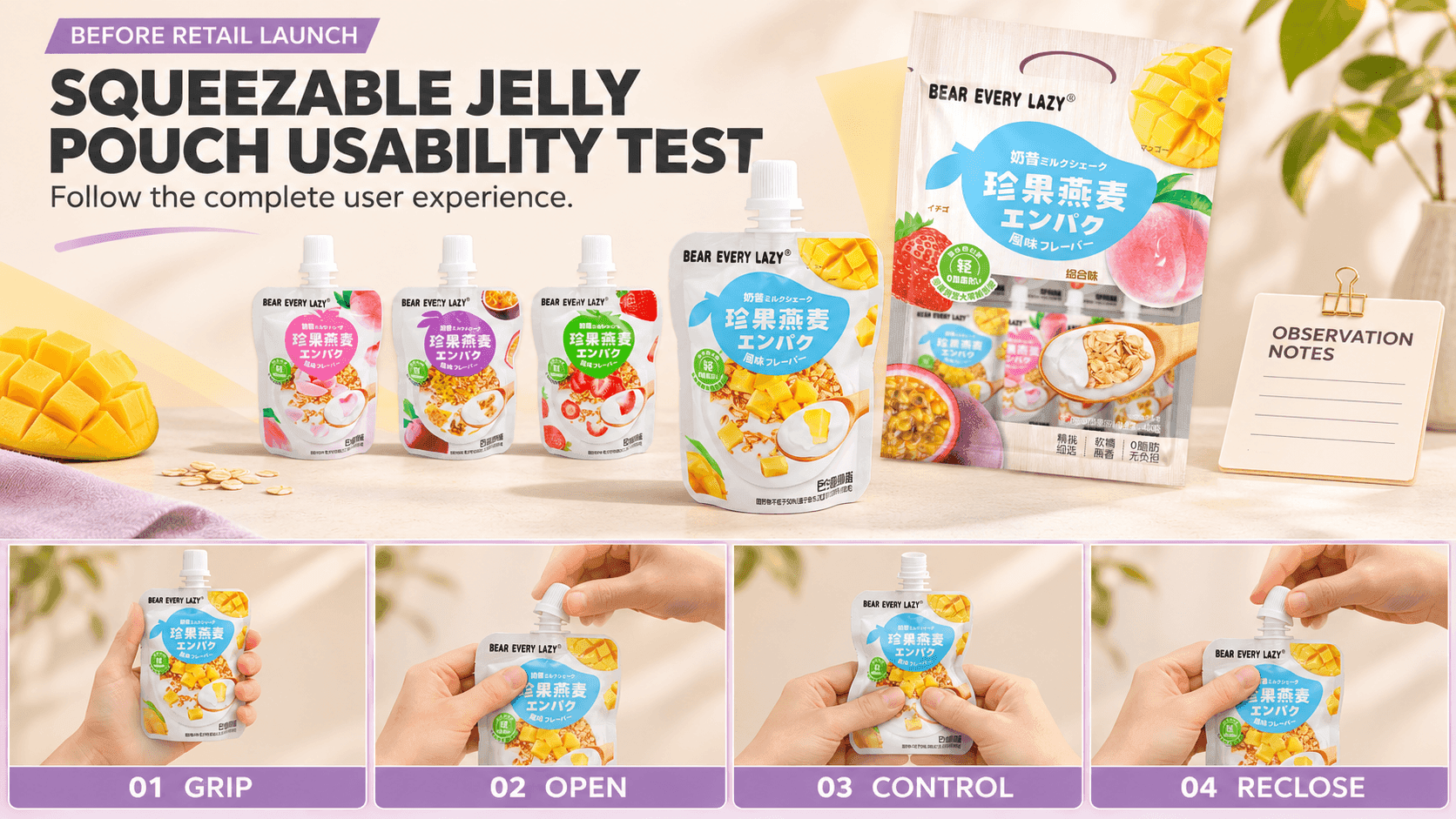
A squeezable jelly pouch can look finished and still be awkward to grip, open, control or empty. This guide shows brands, retailers and manufacturers how to test a production-representative pouch through the complete user sequence, separate formula issues from packaging issues, record participant observations and make a clear approve, revise or investigate decision without inventing universal force, temperature or acceptance limits.
How to Test Squeezable Jelly Pouch Usability Before Retail Launch
A squeezable jelly pouch can pass a design review and still be frustrating in the hand.
The cap may be difficult to identify. The pouch may twist during opening. The first squeeze may release too much product, while the final portion stays trapped around a corner or fitment. A smooth jelly can become difficult to control if the opening is too large, and a suitable pouch can feel unsuccessful if the formula is too firm at the temperature of use.
These are usability questions. They sit between product development, packaging evaluation and the real consumer experience.
A useful test follows the complete action sequence with a defined product version. It records what the user sees, holds, opens, squeezes, pauses, recloses and disposes of. The goal is not to produce one universal force or pass rate. It is to find where the approved concept and the physical product do not yet work together.
Confirm Why the Pouch Was Chosen
Begin with the intended role of the package.
A squeezable pouch may support a larger serving, a drinkable or soft jelly texture, more branding area or a use occasion that benefits from controlled dispensing. A comparison of a jelly stick and a squeezable pouch can help a brand choose the broad format, but usability testing starts after that direction has been selected.
Write the reason in one sentence. For example, the pouch may be intended to provide a portable fruit jelly snack that can be opened, consumed in several controlled squeezes and reclosed between short pauses.
This sentence becomes the test boundary. If the concept is intended for one continuous use, do not create a resealing requirement merely because the pouch has a cap. If it is intended for several uses, the test must examine how the pouch behaves after opening, carrying and reclosing under the approved conditions.
Define the User and Use Occasion
The same package can feel very different at a desk, in a car passenger seat, after exercise or at home.
Record the intended consumer, setting, body position, available hands, expected serving temperature and whether a utensil is involved. Also record where the pouch will normally be stored before use and whether the consumer is expected to finish it at once.
A private label functional jelly sample brief should define the consumer and occasion before the formula and packaging are finalized. For a conventional squeeze jelly, the same principle applies even when no functional claim is involved.
Do not test every imaginable situation. Choose the most important intended situations and any reasonably foreseeable handling condition that the responsible team decides should be included. Avoid presenting an unapproved use as a marketing suggestion simply because it was easy to simulate.
Lock the Sample Version
Every observation must belong to a known sample.
Record the formula or product reference, flavor, production or pilot batch, fill quantity, pouch supplier, material and drawing reference, fitment, cap, tamper feature, artwork revision, filling and sealing route, sample date, storage history and intended test condition.
If one variable is being compared, keep the others as stable as practical. A test comparing two cap designs is difficult to interpret if the pouches also contain different formulas and were stored differently.
Use production-representative samples when the decision concerns commercial launch. A hand-filled mock-up can support an early grip or graphic review, but it cannot prove the opening, dispensing or closure behavior of the final filled package.
Mark prototypes clearly. Do not allow an attractive development sample to become the unrecorded reference for a different commercial version.
Map the Complete User Sequence
Write the action sequence before observing participants.
A typical sequence may include:
- identify the product and opening area
- pick up and orient the pouch
- hold the body without covering essential information
- remove any tamper feature
- grip and open the cap or tear area
- position the opening for consumption
- begin dispensing
- control the flow through several squeezes
- pause without leakage or contamination where relevant
- recover product from the lower corners and around the fitment
- reclose when the concept requires it
- carry or set down the opened pouch under the defined test
- finish and dispose of the package
The sequence should match the real format. Do not add a straw, spoon or preparation step that the approved product does not require.
This map helps the observer locate the problem. A participant who struggles before the cap moves has a different issue from one who opens the pouch easily but cannot control the first squeeze.
Prepare the Test Without Coaching the Answer
Give participants the package and only the information a normal user would receive at that point.
If the commercial label includes opening instructions, use the approved or production-representative version. If the purpose is to test whether users can find those instructions, do not point to them before the task begins.
Use a neutral instruction such as please open and consume this product as you normally would. Avoid explaining the expected grip, hand position or squeeze pattern unless the product is designed to require that instruction and the test is evaluating whether the instruction works.
Set up a clean surface and a way to record spills or leakage without turning the session into a performance challenge. Provide assistance procedures for any safety concern. The project owner should define participant eligibility, consent, supervision and stop rules appropriate to the intended audience and market.
Observe Product Recognition and Orientation
Before opening, ask the participant to show where they expect the product to open and how they would hold it.
Record whether the opening location is obvious, whether front and back are confused and whether the user rotates the pouch repeatedly. Check whether the cap, tear mark, notch, arrow or other cue is visible under normal lighting.
The product name, flavor, instructions and opening cue should work together. A large illustration can attract attention while the functional cue disappears into the artwork. A clear cue on a flat digital proof may become harder to see after filling changes the pouch shape.
Do not treat hesitation as proof of failure by itself. Record the action and ask a neutral follow-up question. The participant may be checking the label rather than misunderstanding the package.
Evaluate Grip and Handling
Observe how the participant grasps the unopened and opened pouch.
Check whether the package slips, folds, collapses unexpectedly or forces the hand over important information. Note whether a wet or chilled surface changes grip under the intended use condition. If the pouch has a handle, fitment or structured panel, confirm that people use it as the design team expects.
ISO IEC Guide 41 describes consumer packaging functions that include containment, protection, handling, storage, convenience, information and presentation. A usability test can examine how these functions interact in the actual pouch. The guide does not set a pass limit for a particular jelly package.
Handling should be observed across the full use cycle. A pouch may be easy to pick up when full but awkward when partially empty. It may stand securely before opening and become unstable after the product moves toward the spout.
Test Opening Location and Method
Opening assessment should separate findability, understanding and physical execution.
First record whether the participant finds the opening. Then record whether the intended action is understood. Finally observe whether the person can complete that action without excessive effort, uncontrolled tearing, sudden release or damage to the pouch.
ISO 17480 covers accessible packaging design with a focus on opening location, opening methods and instrumented or user-based evaluation. It provides a useful framework, but it does not supply a universal opening force for squeeze jelly.
For a cap, observe grip, direction, number of attempts, hand switching, pouch twisting, dropped parts and whether the tamper feature behaves clearly. For a tear opening, observe whether the tear starts at the intended point, follows a controllable path and leaves an opening suitable for the product.
Do not conclude that easy opening is always better. The package still needs the protection, tamper evidence and closure performance required by the approved product and market.
Observe the First Squeeze
The first squeeze often reveals the relationship between headspace, product position, opening size and texture.
Record the pouch orientation, pressure location and what happens when product first reaches the opening. Look for delay, sudden release, splashing, air discharge, uneven flow or the need to knead the package.
Do not tell participants to squeeze gently before seeing what the package communicates on its own. If a gentle first squeeze is important, the design or instruction should make that behavior understandable.
Use a clean collection method when the team needs a controlled comparison. A measured dispensing test can support the observation, but an instrument result should not replace the user test. The two methods answer different questions.
Evaluate Flow and Dispensing Control
Once flow begins, observe whether the user can start, slow, stop and restart the product as intended.
The participant should not need to discover a complicated folding or rolling technique unless that method is part of the approved instruction. Record pouch deformation, spurting, stringing, drips around the opening and product that smears onto the cap or hands.
Ask the participant to describe the control, not only the taste. Useful questions include whether the flow felt predictable, whether one squeeze delivered more than expected and whether the opening felt appropriate for the jelly texture.
Avoid converting one participant's preferred squeeze size into a serving recommendation. The usability test examines control. Serving information and product use instructions require separate approval for the destination market.
Separate Formula Problems From Package Problems
The formula and package create one dispensing system, but the development team still needs to locate the likely source of a problem.
A product that is too firm may require excessive pressure even when the pouch and opening are suitable. A thin product may surge through an opening designed for a thicker jelly. A narrow fitment can make inclusions difficult to dispense. A stiff pouch structure can trap product that a more flexible construction would release.
The functional jelly texture brief should define how the product is expected to flow, hold shape and feel during use. Compare the usability result with that approved texture direction.
When the cause is uncertain, change one variable at a time in the next test. Do not soften the formula, enlarge the opening and change the pouch film simultaneously unless the team is intentionally evaluating a new combined system.
Check Temperature and Storage History
Jelly texture and pouch behavior can change with temperature and storage history.
Test the approved or intended use conditions defined for the project. Record the actual sample condition instead of describing it only as room temperature or chilled. If the product may be used after transport or storage exposure, include relevant samples from the approved study plan.
Do not invent a test temperature or conditioning time for all squeeze jellies. The correct conditions depend on the formula, packaging, distribution route, label and intended use.
Compare observations carefully. A pouch that feels firm when cold may soften in the hand. A warmer sample may flow faster and increase the risk of an uncontrolled first squeeze. These are product-specific findings, not universal rules.
Measure Recoverability and Residue
Users should be able to obtain the intended product without an unreasonable sequence of squeezing, folding and scraping.
Observe which areas retain product. Common locations may include lower corners, side seals, folds and the region around the fitment. Record the technique the participant uses and whether the pouch remains comfortable to hold as it empties.
If the team measures residual product, define the method, sample condition and decision rule before testing. Distinguish normal manufacturing and measurement variation from a package shape that consistently traps product.
Do not publish a low residue claim from a small development test. Use the result to compare versions and improve the consumer experience.
Review Pausing and Reclosure
Only test reclosure as a product benefit if the commercial concept and label support it.
For a resealable pouch, observe whether the cap can be replaced without contamination, cross-threading or product buildup. Check whether the participant knows when the closure is secure and whether the pouch leaks during the defined post-opening handling assessment.
Reclosure does not establish how long the opened product remains suitable. Post-opening storage and use instructions need product-specific evidence and destination-market review.
If the product is intended for one continuous use, the cap may still need to remain manageable after opening so it does not become a loose, confusing or easily lost part. The team should review any relevant safety requirements for the intended user group.
Test Instructions and Information
Instructions should help the user complete necessary actions without replacing an intuitive design.
Ask participants to locate the opening instruction, storage statement and any required post-opening direction. Check the final language, type size, contrast, placement and visibility on the filled pouch.
The instruction should match the tested action. An arrow that points to the cap but does not show the turn direction may not solve the observed problem. A diagram that works on a flat proof may distort around the filled pouch or disappear beneath the hand.
Record whether participants used the instruction and whether it changed the outcome. A successful task after direct coaching does not prove that the package information works.
Include More Than One Relevant User
One development team member cannot represent the intended market.
Select participants whose abilities and experience are relevant to the product concept. Include variation where the responsible team determines it matters, such as hand size, grip, dominant hand, familiarity with pouches or language.
The test plan should define the participant group and what decision the group can support. Do not claim universal accessibility or consumer preference from a small internal study.
Projects intended for children, older adults or people with specific limitations require additional care. Qualified teams should define recruitment, consent, supervision, safety and evaluation methods. The package may also need to meet requirements that take precedence over a general usability study.
Record Actions Before Opinions
An observer should record what happened before asking whether the participant liked the pouch.
Useful fields include sample identity, participant code, test condition, hand used, opening attempts, time or sequence where relevant, spills, pouch deformation, flow interruption, residue location, reclosure result, instruction use and participant comments.
Keep the observation separate from interpretation. The note participant turned the cap three times and then switched hands is stronger evidence than cap is bad. The development team can later decide whether the pattern points to grip, torque, instruction, fitment or participant familiarity.
Use photographs or video only with the required permission and data controls. Frame the package and hand action clearly without collecting unnecessary personal information.
Classify Findings by Source and Severity
After the session, group findings into product, package, instruction, test condition and participant-related observations.
Then assess the effect. A finding may prevent use, create spill or contamination risk, cause repeated frustration, reduce product recovery or produce a minor preference issue. The project should define these categories and decision rules rather than importing them from another product.
Repeated patterns deserve attention even when no single observation looks dramatic. One isolated comment may require investigation but should not be presented as a general conclusion.
Assign each action to a controlled revision. Identify whether the next step changes the formula, opening, fitment, cap, pouch structure, fill, artwork or instruction.
Use Production Representative Samples Before Approval
The final decision should use samples that represent the commercial product closely enough for the question being answered.
The private label jelly process from sample to mass production should align formula, opening size, squeezability, filling, sealing and artwork before launch. Repeat the usability test after a change that can affect these elements.
Production conditions can change headspace, pouch shape, seal area and product distribution around the fitment. A development sample that performed well may not represent the first commercial run.
Usability approval also does not replace seal integrity, package compatibility, distribution, shelf-life or regulatory work. Keep those records connected to the same product version.
Make a Clear Launch Decision
Conclude with one of the decision states defined by the project, such as approve, approve with a documented action, revise and retest, or investigate before decision.
The record should identify the tested version, evidence, unresolved questions, owner and next review. If the package passes only under one condition, state that condition rather than writing a broad approval.
Do not fix a packaging problem with a marketing promise. If users cannot find the opening, revise the cue or package. If the product surges from the spout, review the system. A launch deadline does not make an unresolved usability issue disappear.
Frequently Asked Questions
Is pouch usability the same as package integrity
No. Usability examines how people identify, hold, open, dispense and reclose the package. Integrity work evaluates whether the package protects the product under defined manufacturing, storage and distribution conditions. Both may be required.
How many people should test a squeezable jelly pouch
There is no universal number for every decision. The study owner should define the participant group and sample size based on the intended user, risk, development stage and claim. A small internal test should not support a universal accessibility statement.
Should the pouch be tested chilled and at ambient temperature
Test the conditions relevant to the approved product and intended use. Record the actual sample condition. Do not add temperatures or storage exposures without a technical reason.
Can an opening force measurement replace a user test
No. An instrument can compare a defined mechanical property, while a user test shows findability, grip, action sequence and control. The methods can complement each other.
Does a reclosable cap prove the product can be stored after opening
No. Reclosure is a package function. Post-opening storage time and instructions require product-specific evidence and market review.
When should the usability test be repeated
Repeat it after changes that may affect the action sequence, including formula texture, fill, pouch material, fitment, cap, opening cue, artwork, production process or intended use condition.
Brands, retailers and manufacturers can review a production-representative squeeze jelly pouch together before the final package is approved for retail.