How to Set Up a Popping Boba Topping Station for Consistent Foodservice Operations
A popping boba topping station should help staff identify the correct product, portion it consistently, protect it during service and record problems without improvising new handling limits. This guide shows foodservice teams how to organize the station, tools, syrup method, replenishment, hygiene responsibilities and store trial before a wider rollout.
How to Set Up a Popping Boba Topping Station for Consistent Foodservice Operations
A popping boba topping station is more than a container beside a scoop. It is the point where the approved product, store recipe, food safety procedure and employee technique meet during service.
If the station is unclear, the same topping can be served differently from one shift or location to another. Staff may select the wrong flavor, carry inconsistent amounts of syrup, mix production lots without a record, use an unsuitable utensil or leave cleaning and replenishment responsibilities undefined.
A practical station design makes the approved method visible and repeatable. It should identify what product belongs at the station, how staff portion it, how the source container remains traceable, who manages replenishment and cleaning, what happens when something looks wrong and how the store records the trial. It should not invent a universal portion, opening period, holding time, temperature, cleaning frequency or discard rule.
Define What the Station Must Control
Begin with the operating decision, not with the counter layout. Write down which menu items the station supports, which popping boba flavors and product versions are approved, which service channels are included and which problems the station is expected to prevent.
The approved foodservice menu test should already identify the drink or dessert base, serving container, straw or spoon, intended presentation and service route. The station converts that approved application into a daily working method; it does not reopen every formulation or menu decision during a busy shift.
Useful station controls may include product identity, source container identity, portion tool, syrup handling, assembly position, replenishment method, traceability, cross-contact precautions, cleaning responsibility, stop-and-escalate conditions and the record used during a pilot. Keep the list specific to the business and the exact product.
Lock the Product and Source Container Identity
Every active service container should connect to the approved product and its original source pack. Record or display the supplier name, product name, flavor, internal item code where used, lot or batch reference and any other identification required by the operation.
The popping boba quality checklist explains why service performance begins with an approved product and pack condition. A topping station cannot correct broken pearls, questionable packaging, an unapproved flavor or missing supplier information. Receiving and incoming checks should happen before the product enters service.
If the operation transfers popping boba from its original pack into a service container, follow the approved transfer and labeling procedure. Do not rely on color alone to distinguish similar flavors. The container label, station label and recipe reference should use the same product name or code so purchasing, quality and store staff are discussing the same item.
Map a One Direction Service Flow
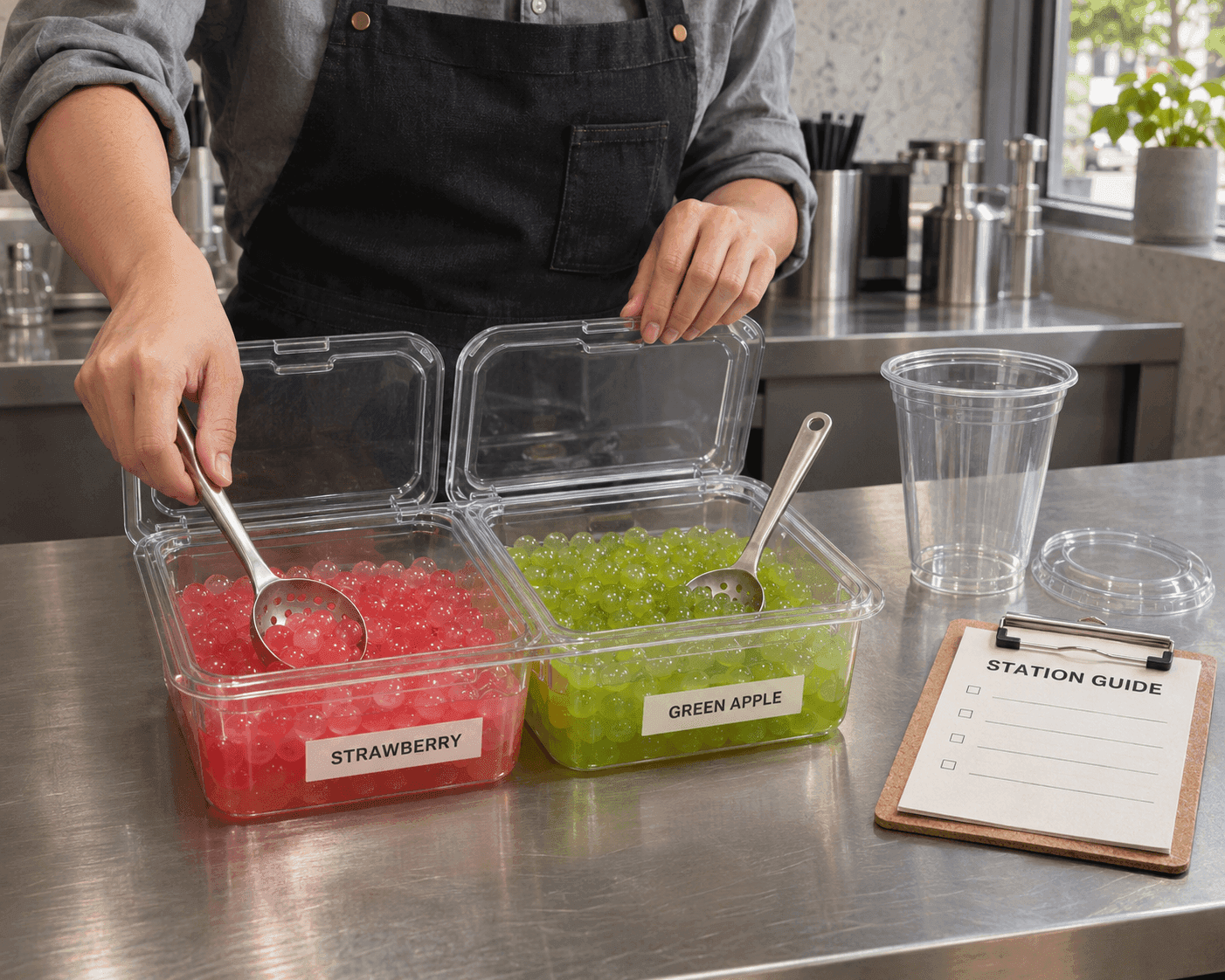
Arrange the station around the order in which staff work. A simple flow may move from identifying the correct product, to portioning, to adding it to the menu item, to closing the source or service container, to returning the tool to its approved position.
Place frequently used items where staff can reach them without crossing open cups, clean tools or customer-ready products. Separate the topping container from waste, used utensils, personal items and splash sources. The exact arrangement depends on the counter, equipment, menu and applicable food safety plan.
Test the layout with the real cup, lid, straw, scoop or weighing method and the normal service sequence. A plan that looks tidy when the store is closed may create drips, awkward reaches or repeated hand crossings during a rush. Photograph the approved layout only after the team has tested it under representative conditions.
Use Dedicated and Identifiable Tools
Choose the portioning tool through the approved popping boba portion and yield test. The tool may be a defined scoop, spoon, ladle, perforated utensil or another method that the operation has evaluated for portion repeatability, syrup carryover, pearl integrity and service speed.
Keep the approved tool identifiable and assigned to the correct product when that is part of the operating control. Similar utensils can create silent changes in portion size or syrup transfer. A label, tool code, dedicated position or other visual control can help staff select the intended tool without guessing.
Do not add extra top-ups, shake the utensil, change the drain action or substitute a different tool unless the approved instruction permits it. If the tool is missing or damaged, the station should tell staff to stop and escalate rather than improvise a new portion method.
Standardize Syrup Handling
Syrup handling affects flavor, color, portion weight, usable yield and station cleanliness. One employee may transfer the portion immediately, while another may pause or drain it. Those actions can create different menu results even when both employees use the same scoop.
Write the approved method in observable words. Identify the utensil, how staff access the product, whether mixing is permitted, how the portion is formed and how it moves to the cup or bowl. Avoid vague instructions such as use less syrup or drain well.
The goal is not to remove syrup automatically. The approved menu may rely on some syrup for flavor or visual effect. The goal is to make the treatment intentional and repeatable for the exact product and recipe. When the supplier product, recipe or utensil changes, reassess the method rather than carrying the old instruction forward.
Plan Replenishment and Batch Transitions
Replenishment can create identity and traceability problems if new product is added to an old container without a defined method. The station plan should state who may replenish, how the new source pack is checked, how lot information is retained and what happens to product already present.
Do not combine old and new product, different flavors or different lots merely to save space unless the approved food safety and traceability procedure permits it. When combination is allowed, the record should preserve the relationship required by the business and the destination market.
Observe the end of the container during the store trial. Tool angle, syrup access, pearl recovery and spill may change as the container empties. Record the operational problem instead of creating an informal practice that another location cannot reproduce.
Control Cross Contact and Information
Review the current ingredient and allergen information for the exact popping boba and the complete menu item. Do not infer allergen status from flavor, color or appearance. The store should use the approved information source and escalation route when a customer asks a question.
The Codex General Principles of Food Hygiene describe Good Hygiene Practices as the foundation for controlling food hygiene hazards. At store level, the business still needs procedures written for its own products, people, tools, premises and legal requirements.
Station controls may include dedicated tools, defined storage positions, separation from other toppings, clear labels and an approved response when a utensil is used in the wrong product. The correct controls depend on the actual ingredients, menu, customer information duties and local food safety system.
Separate Cleaning Responsibility From Recipe Instructions
A recipe card tells staff how to assemble an approved menu item. It should not become the only cleaning or food safety document. The station should point to the current procedure that defines cleaning, sanitizing, storage, employee responsibility and verification for the specific operation.
For United States operations, the FDA Food Code is a model that jurisdictions use when developing or updating retail and foodservice rules. It is not a global rulebook, and the applicable state, local, tribal or territorial requirements still need to be confirmed. Other markets require review of their own competent authorities.
Do not copy a chemical, concentration, contact time, cleaning frequency or storage limit from another operation or generic internet post. Use approved supplier directions and the business procedure for the actual tool, surface and food-contact situation.
Make the Approved Condition Visible
Staff should be able to recognize the correct station at a glance. A concise visual reference can show the approved product name, container, tool position and finished menu appearance. Use photographs of the real approved product and real workstation rather than an AI-generated image that changes color, quantity or equipment.
Version-control the visual reference. Add the station or recipe version and effective date used by the business. Replace old photographs when the topping, package, service container, tool, portion method or counter layout changes.
Visuals support the instruction but do not replace identity, traceability or written stop conditions. Staff still need to know what to do when the lot code is missing, the product looks different from the approved reference, the container is damaged or the approved tool is unavailable.
Train the Complete Service Sequence
Training should follow the full sequence from selecting the product to closing and protecting it after the portion is served. Ask trained employees to identify the product, read the station label, portion it, handle syrup, assemble the menu item, manage a replenishment scenario and respond to a staged problem.
Use more than one employee where possible. A station may work well for the person who designed it but confuse someone who did not participate in development. Observe hesitations, unnecessary movements, label confusion, drips, tool substitutions and steps that depend on verbal memory.
Correct the station, instruction or tool when the same problem appears repeatedly. More training text will not solve a container that is hard to reach or two tools that look identical. The purpose is to make the approved method practical under real service conditions.
Run a Representative Store Trial
Pilot the station in the location or representative locations where it will be used. Include the actual counter space, equipment, staff roles, service pace, menu items and customer handoff route. A development-kitchen result does not automatically prove that the station works in a smaller or busier store.
Record the product and lot, station version, location, employees involved, menu items made, portion method, observed spill, syrup behavior, replenishment events, identity issues, cross-contact concerns, cleaning handoff and any deviations. Do not invent a universal pass threshold; define acceptance for the project before the trial.
Use one of four clear outcomes: approved for the defined store and menu; approved with named actions; revision and retest required; or not suitable for the current workflow. Assign each open action to an owner and record the evidence needed for closure.
Control Changes After Approval
Review the station whenever a change can affect identity, handling, portioning, hygiene or customer experience. Examples include a new popping boba flavor or supplier version, package size, service container, utensil, portion target, syrup method, recipe, cup, lid, straw, counter layout, cleaning procedure or sales channel.
Do not let each store edit the master instruction independently. Route proposed changes through the business approval process, identify what must be retested and issue one controlled version. Remove or archive superseded station guides so old methods do not remain beside the new one.
Store feedback should include enough context to investigate. Record the location, date, product lot, station version and specific observation. A note such as station messy is less useful than syrup dripped during transfer when the approved scoop was used at the end of the container.
If your team is preparing a popping boba foodservice project, Victory Foods can review the intended menu, package and station workflow with you before samples move into a store trial.
Frequently Asked Questions
Should every popping boba station use the same layout
No. The layout should reflect the actual counter, menu, equipment, staff flow and food safety plan. The control points can be consistent even when the physical arrangement differs by location.
Can staff top up a service container with a new lot
Only when the approved replenishment and traceability procedure permits it. The operation should define how product identity and lot relationships remain controlled.
Should popping boba be served with a solid or perforated utensil
Either may be appropriate, but they can carry different amounts of syrup and affect yield and flavor. Approve the tool through the exact recipe and portion test rather than using a generic rule.
How long can product stay at the topping station
Use the approved instructions for the exact product and the operating limits established under the applicable food safety plan and local requirements. This article does not set a universal holding period.
Does a station guide replace allergen and food safety procedures
No. It can identify the approved information source and link to operating procedures, but it does not replace ingredient records, allergen controls, cleaning procedures or legal requirements.
When should the station be retested
Retest or reassess after a meaningful change to the product, pack, container, tool, portion, syrup method, recipe, service equipment, layout, cleaning procedure or sales channel, or when store evidence shows the approved method is not repeatable.