
Functional Jelly Variety Pack Planning for Retail Buyers
A variety pack can improve trial and shelf impact, but every flavor adds formulation, packaging, labeling and inventory decisions. This guide helps retail buyers define the assortment before sampling and quotation.
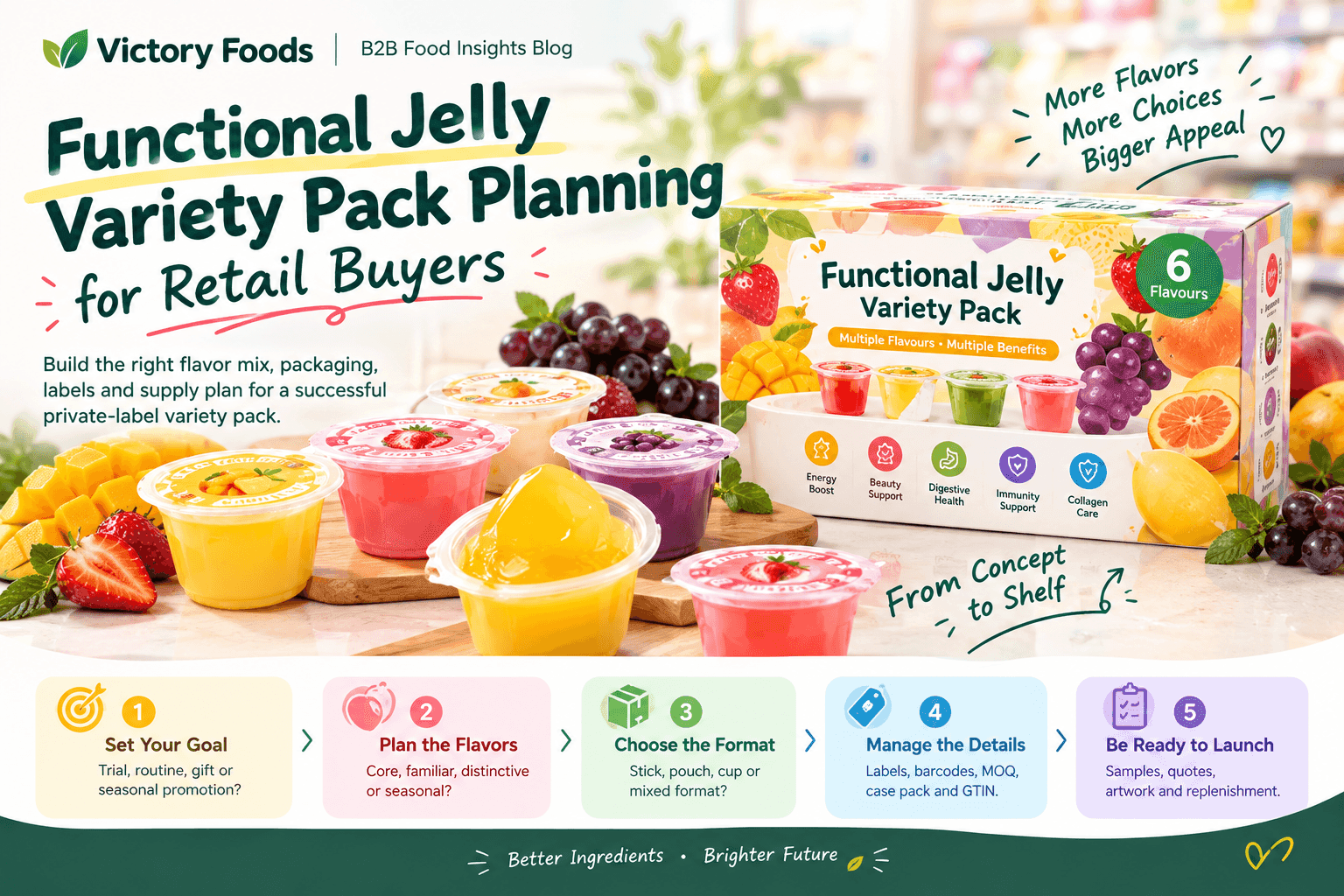
Functional Jelly Variety Pack Planning for Retail Buyers
A variety pack can make a functional jelly range easier to discover. It can offer several flavors in one purchase, create a stronger shelf story and help a buyer test assortment preference.
It can also multiply complexity.
Each flavor may have its own formula, color, ingredient list, nutrition values, claims, artwork, barcode and production minimum. The outer box must accurately describe the contents. The factory needs an exact packing ratio. The retailer needs reliable item data. Replenishment becomes difficult if one flavor is consumed faster but can only be produced as part of a fixed mix.
The right question is not simply "How many flavors should we include?" It is:
What consumer promise, SKU structure and supply plan does the variety pack need to support?
This guide gives private-label brands, importers, distributors and retail buyers a practical way to define a functional jelly assortment before requesting samples, quotations or printed packaging.
1 Define the Job of the Variety Pack
Begin with one clear purpose.
A variety pack may be designed to:
- encourage trial across several flavors
- offer different functional concepts by use occasion
- create a gift or discovery format
- provide a fixed weekly or monthly routine
- support a seasonal promotion
- reduce the number of separate shelf facings
- combine a core flavor with limited editions
These purposes lead to different assortments. A trial pack may need breadth and a low unit count. A routine pack may prioritize repeatable servings. A retailer-exclusive set may need visual impact and a stable replenishment plan.
Write the purpose before selecting flavors. Otherwise, the assortment can become a collection of available options rather than a coherent product.
2 Separate Flavor Variety From Functional Variety
A pack containing three flavors of the same base concept is simpler than a pack containing three different functional formulas.
When functions differ, the project must consider:
- distinct ingredient and active targets
- different serving instructions
- different claims and evidence
- possible allergen or dietary-positioning differences
- separate nutrition information
- consumer understanding of when to use each unit
Do not use color alone to explain materially different products. Individual units and the outer box should communicate the assortment clearly enough for the target market and channel.
If the brand wants both flavor and functional variety, map the combinations before artwork. A three-flavor, three-function concept can create more unique variants than the team expects.
3 Decide the Flavor Architecture
Classify proposed flavors by role:
- core flavor expected to drive repeat purchase
- familiar flavor that lowers trial risk
- distinctive flavor that creates differentiation
- seasonal or limited flavor
- regional preference
A balanced pack does not require equal strategic importance for every flavor. The core flavor may receive a larger share, while a distinctive flavor acts as discovery.
Use consumer and channel logic rather than choosing only the most colorful combination. Consider whether flavors remain clearly distinguishable after processing and storage, and whether each works with the same sweetness, acidity and texture direction.
4 Fix the Pack Count and Mix Ratio
The packing instruction must be exact.
Examples include:
- equal count by flavor
- weighted count toward one core flavor
- fixed sequence in a tray
- random mix within a declared range
If the mix is fixed, state the count of each flavor per saleable box and per shipping case. If variation is allowed, define the permitted range and confirm that the consumer-facing description remains accurate.
Pack count affects target price, net quantity, box size, case weight, production labor and inventory. Evaluate the full system rather than selecting a count only because it fits the artwork concept.
5 Treat Each Flavor as a Production Requirement
One variety pack does not automatically mean one production minimum.
Each flavor or formula may require a separate batch, changeover, packaging film, printed unit or quality record. The effective minimum can therefore be influenced by:
- batch size by formula
- ingredient and premix quantities
- printed packaging minimums
- flavor changeover and cleaning
- yine schedulingield and packing ratio
- safety stock for damaged or rejected units
Ask the manufacturer to separate the minimum for the finished assortment from the operating requirements behind each variant.
If a low-volume flavor makes the project inefficient, possible options may include fewer flavors, shared base formulas, common primary artwork with compliant variable identification, or a staged launch. Feasibility must be confirmed for the actual project.
6 Standardize What Should Be Common
Variety packs are easier to manage when appropriate elements are shared.
Potential common elements include:
- primary pack dimensions
- serving size
- package material and opening method
- base texture direction
- case and pallet configuration
- location of codes and mandatory information
- outer-box structure
Commonality can reduce setup complexity, but it should not hide meaningful differences. Ingredient lists, allergens, nutrition values, functional targets and claims must remain accurate for each variant.
Use a variant matrix that identifies what is common, what changes and who approves each field.
7 Build the Label Strategy Before Artwork
The outer pack and individual units must be reviewed as a system.
Confirm:
- product identity for the assortment
- flavor names and quantities
- ingredient presentation
- allergen information
- nutrition information and serving basis
- net quantity and unit count
- use and storage instructions
- responsible business information
- date and lot coding
The correct presentation depends on the destination market, product classification and packaging configuration. FDA's current allergen guidance addresses individual units in multiunit packages, while the European Union has its own mandatory-information rules. Qualified market-specific review remains essential.
Do not finalize a small primary wrapper assuming the outer box will always stay with the consumer.
8 Assign GTINs and Item Data
Clarify which objects are distinct trade items:
- each single-flavor consumer unit
- the variety-pack retail box
- a single-flavor retail box
- the shipping case
- a promotional or seasonal assortment
GS1's GTIN Management Standard provides rules for new products and product changes. The brand owner should coordinate identification with the retailer, distributor and master-data team.
Record dimensions, gross weight, contained quantities and hierarchy relationships after the commercial pack is stable. Do not copy item data from a single-flavor box if the variety pack differs.
9 Plan Packing and Verification
Mixed packs create a counting and verification task.
Define:
- packing sequence or randomization method
- flavor identification at the line
- controls to prevent the wrong unit entering the box
- checks for count and ratio
- treatment of incomplete sets
- reconciliation of unused units
- case marking for assortment identification
- traceability when several flavor lots share one box
A visual difference between flavors can help packing, but color should not be the only control. Product codes, readable names and verified work instructions reduce ambiguity.
Decide whether one finished-pack lot can contain units from several approved production lots and how that relationship will be recorded.
10 Connect Forecasting With Flavor Demand
An assortment forecast is not always enough for production planning.
Estimate demand by finished pack and by contained flavor. If a six-count box contains three units of the core flavor and one unit each of three secondary flavors, the ingredient and packaging forecast is weighted accordingly.
Consider:
- launch forecast and repeat forecast
- promotional uplift
- retailer order multiples
- lead time for each printed component
- shelf life of component inventory and finished goods
- safety stock by variant
- risk of one flavor delaying the full pack
A variety pack can be out of stock even when most components are available. The constraint is often the missing flavor or printed unit.
11 Prepare a Substitution Policy
Decide what happens if one flavor is temporarily unavailable.
Options may include no substitution, an approved alternate ratio, a revised seasonal configuration or pausing the finished pack. Each option can affect the label, barcode, retailer setup and consumer promise.
Do not substitute silently after artwork approval. The team should review whether the new contents remain consistent with the declared assortment, ingredients, allergens, nutrition information and claims.
12 Use a Staged Launch When Appropriate
A full variety pack may not be the best first production step.
Brands can consider evaluating flavors individually, running a limited discovery pack, or launching a smaller number of variants before expanding. A staged approach can produce evidence about preference, operational fit and replenishment without committing to every combination at once.
The decision should still account for minimums and packaging inventory. A temporary pack that needs unique printed materials can create its own cost and obsolescence risk.
13 Information to Include in a Variety Pack RFQ
Prepare:
- target market and retailer
- purpose of the assortment
- product format and serving size
- flavor or formula list
- count and exact mix ratio
- functional targets by variant
- common and variable packaging components
- label and barcode responsibilities
- finished-pack and per-flavor forecast
- case configuration
- substitution policy
- target launch date
Ask quotations to state assumptions. A price based on three equal-volume flavors is not directly comparable with a price based on one high-volume core flavor and two small specialty batches.
Planning Functional Jelly Variety Packs With Victory Foods
Victory Foods China develops private-label and custom hydrocolloid-based products including functional jelly, konjac jelly, squeeze jelly, freezer pops, popping boba and sports-nutrition formats.
For a variety-pack discussion, buyers should provide the target market, channel, product format, flavor list, functional targets, pack count, mix ratio, forecast and packaging concept. The project team can then evaluate formulation, packaging and production feasibility.
Final ingredients, labels, claims, item data and assortment rules should be approved for the destination market before printed packaging and commercial production.
FAQ
Does one variety pack have one MOQ
Not necessarily. Each flavor or formula may have its own batch and packaging requirements. Ask the manufacturer to explain the finished-pack minimum and the minimum drivers for each variant.
Should every flavor have the same count
No. Equal counts are simple, but a weighted mix may better support consumer demand. The ratio must be defined and reflected accurately in packing and consumer information.
Does a variety pack need a new barcode
The assortment is normally evaluated as its own trade item, but the brand owner should confirm the applicable GS1 rules and retailer requirements for the exact configuration.
Can different functional formulas be placed in one box
Potentially, but the label, serving instructions, claims, allergens, nutrition information and consumer understanding become more complex. Review the complete assortment for the target market.
What happens if one flavor is unavailable
Follow a preapproved substitution or change-control policy. Do not change the mix without reviewing the declared contents, label, barcode and retailer setup.